Season 1 · Session 08
Ripples in Spacetime
Colliding black holes shake the fabric of space, and we felt it.
Lands a threadRead along anyway. These pages stand alone.
Start with the big idea
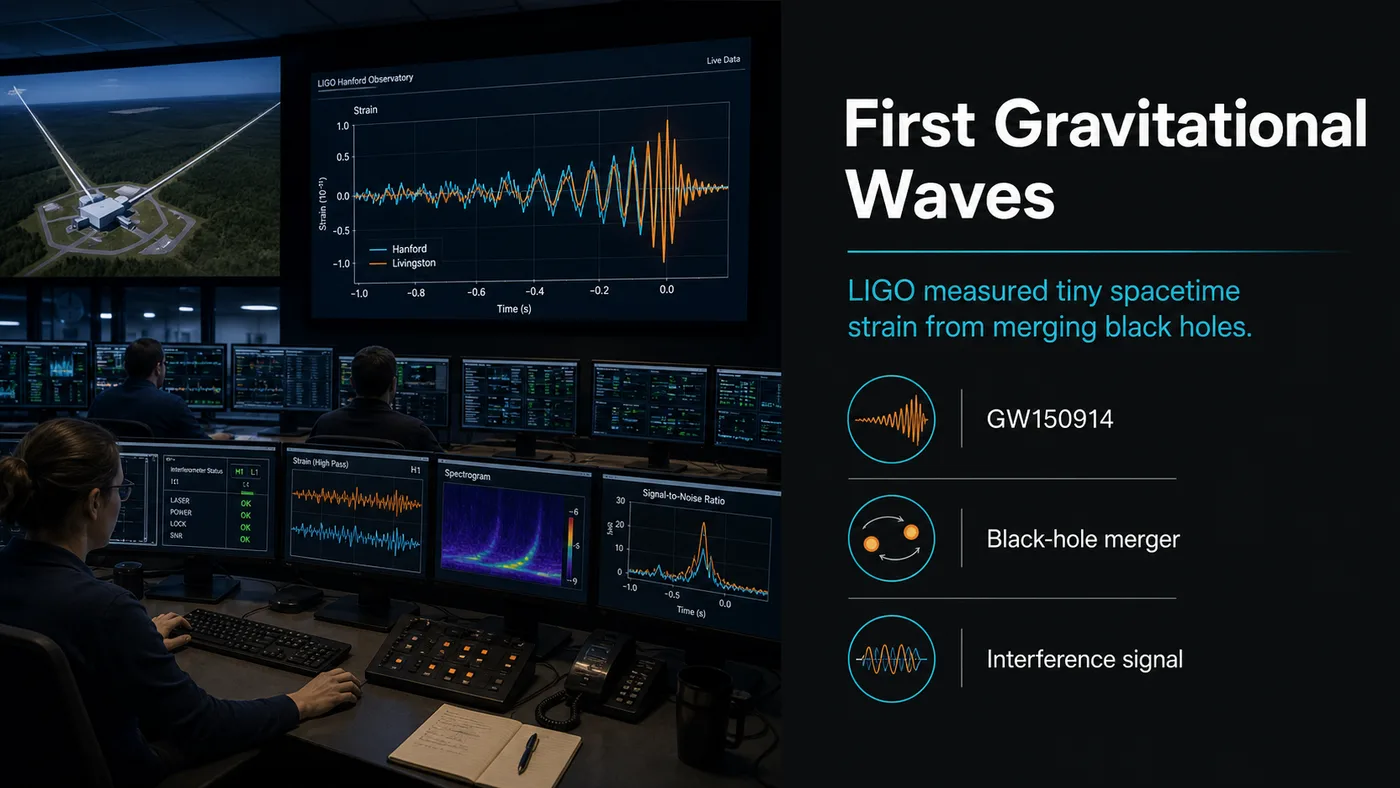
On September 14, 2015, two detectors thousands of miles apart twitched in step. The cause was a ripple thrown off by two black holes, each about thirty times the Sun's mass, spiralling together and merging 1.3 billion light-years away. For a fraction of a second that merger poured out more energy than every star in the observable universe combined, not as light but as a wave in spacetime itself. By the time it reached Earth it stretched LIGO's four-kilometre arms by less than one-thousandth the width of a proton. It is the most delicate measurement ever made. Einstein had predicted these waves in 1916 and doubted we could ever catch one. It took a century. The point that lands is that spacetime is not an inert stage the universe sits on. It is a physical fabric that stretches, squeezes, and rings like a struck bell, and now we can hear it.
See it
The precise version →
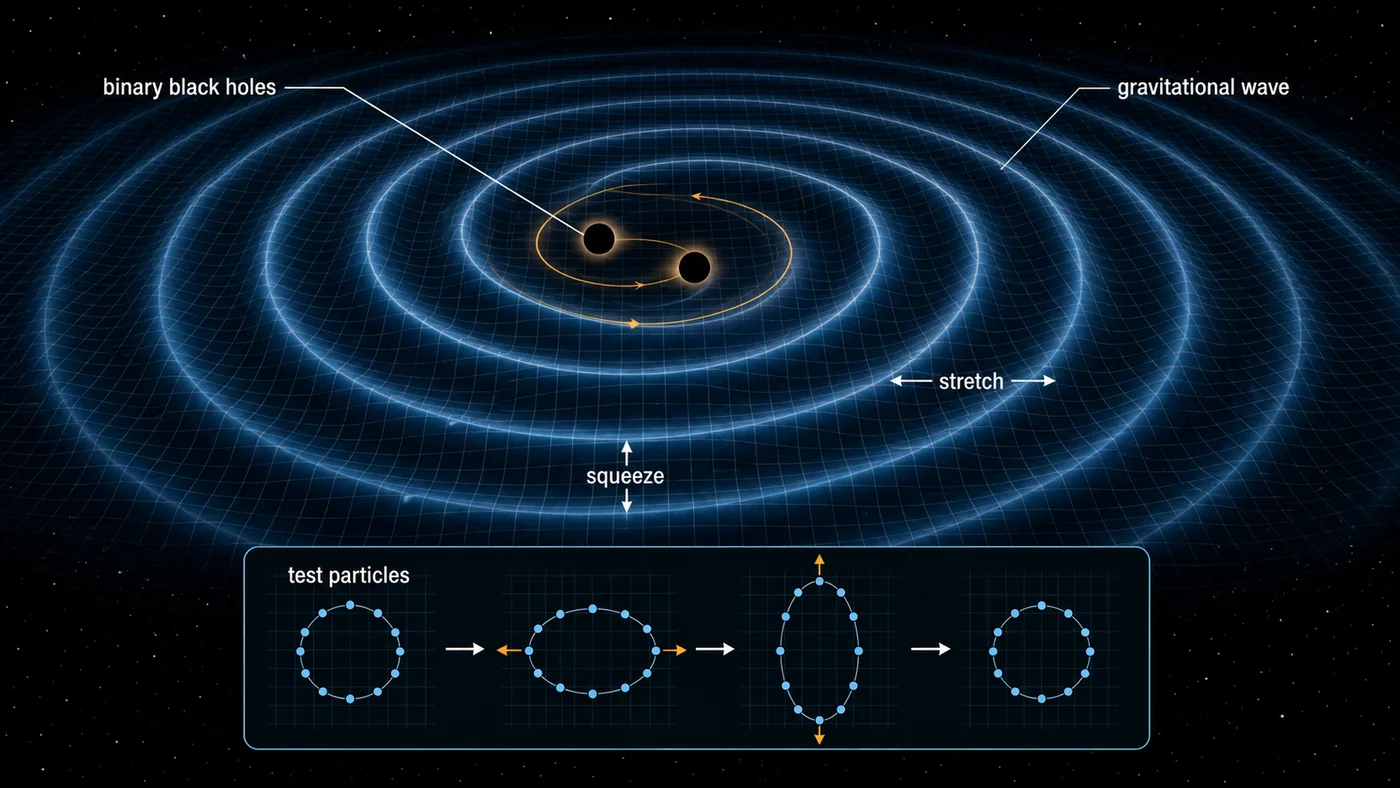
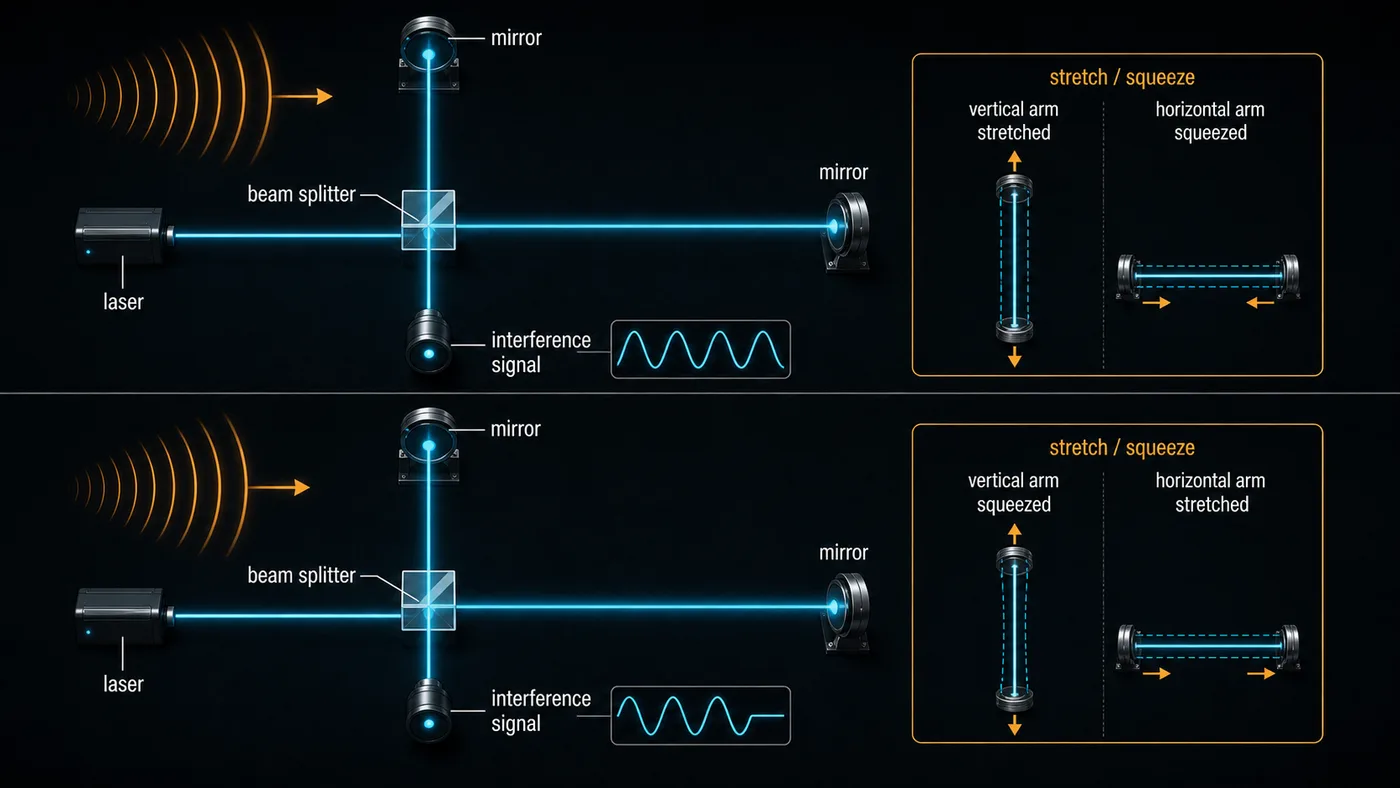
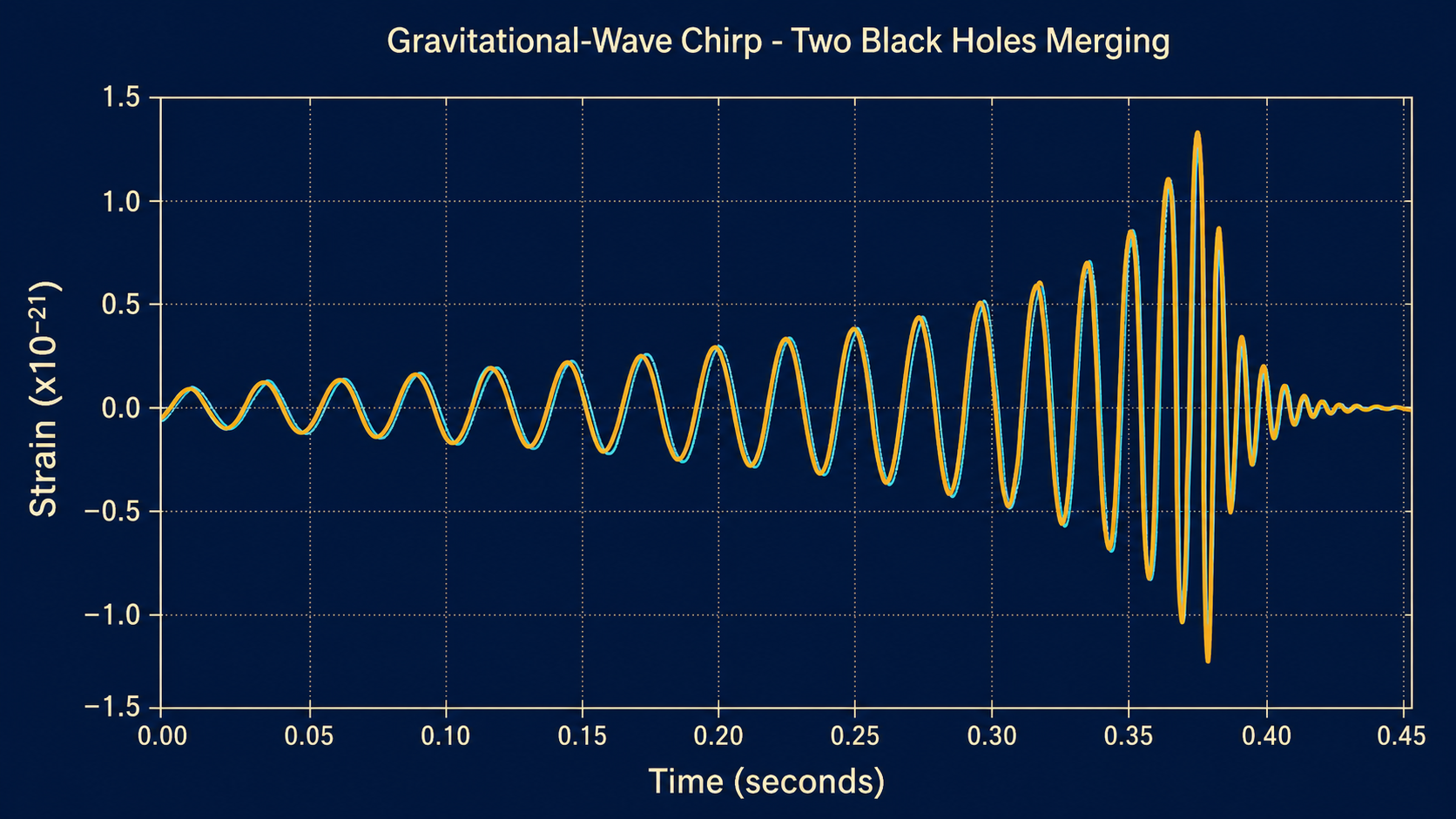
Gravitational waves are ripples in spacetime curvature, propagating outward from accelerating massive objects at the speed of light. They were predicted by Einstein in 1916 from his general field equations. The waves manifest as a strain h, a fractional change in distance, expressed as h = ΔL/L. For the first detected event (GW150914, detected September 14, 2015) LIGO measured a peak strain of approximately h ≈ 10⁻²¹. The stretching and squeezing is quadrupolar. One spatial axis stretches while the perpendicular axis squeezes, then vice versa, in the two polarization states (+ and ×). The source of GW150914 was a binary black hole merger approximately 1.3 billion light-years away.
More to see
Key ideas
- Gravitational wave
- A ripple in the curvature of spacetime, set off by massive objects accelerating, that travels outward at the speed of light. It physically stretches and squeezes space as it passes.
- Strain
- The tiny fractional change in length a wave causes. GW150914 stretched LIGO's 4-km arms by about one part in 10²¹. That's a length change near 1/1000 the diameter of a proton.
- The chirp
- As the two black holes spiralled in, the wave's pitch and volume rose together over a fifth of a second, then cut off at the merger. Played as audio, the signal sounds like a chirp.
- A new sense
- Gravitational waves pass straight through gas, dust, and galaxies that block light. They give us a way to register events light can never show. It's like gaining hearing after a life of only sight.
Sit with it
How do you feel about this science and its understanding of reality?
We sit with this together, out loud, at the session.
On your phone
Answer along during the session.
The opening question, the dig-in prompts, and the closing question, on one short form. What you write joins everyone else's on the wall, live, under your username.
Take it further
In person
Date to be announced. This page stands alone, so read along any time.