Season 1 · Session 07
The Shadow of a Black Hole
We photographed the edge of where light can't escape.
Lands a threadRead along anyway. These pages stand alone.
Start with the big idea
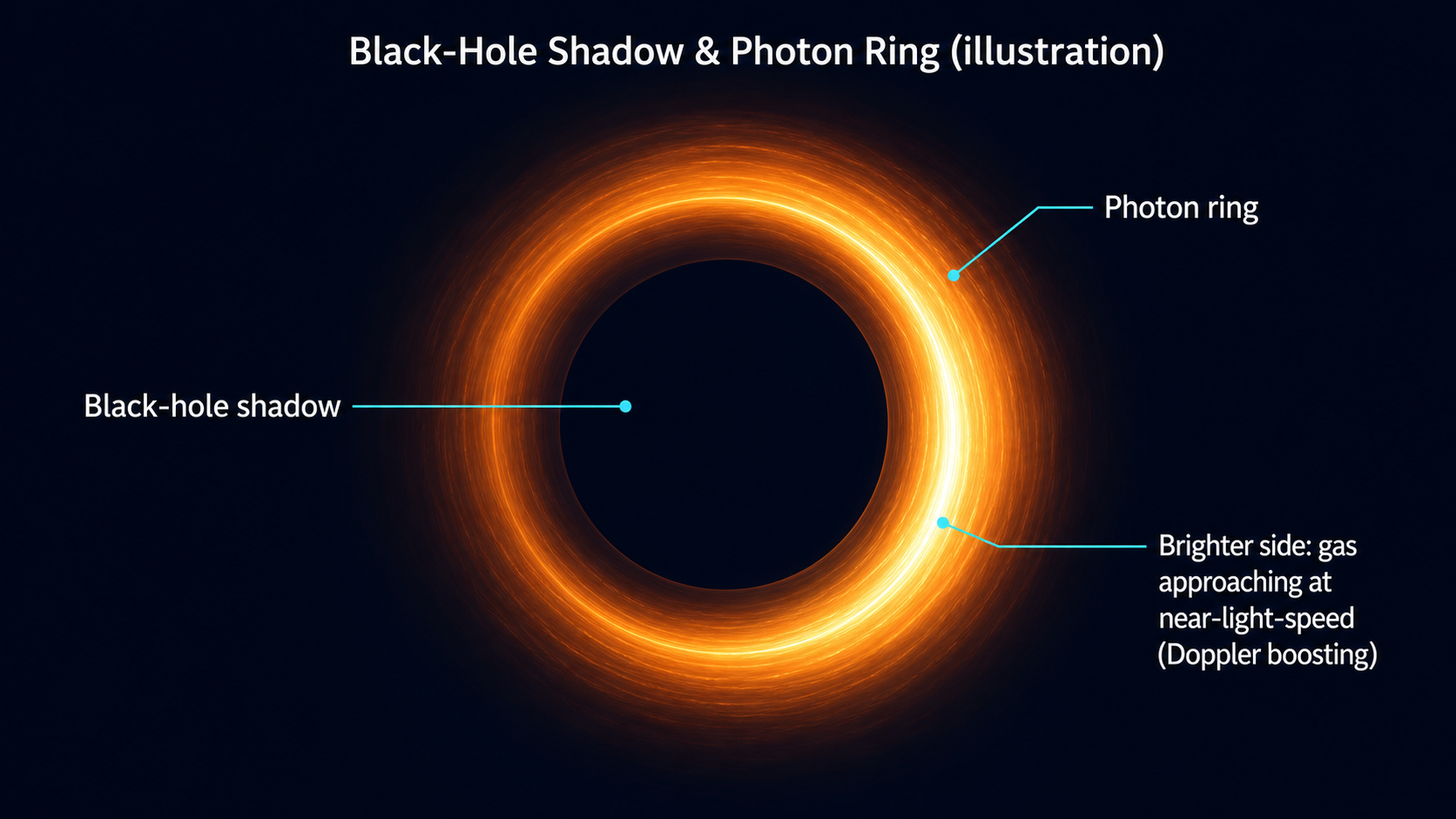
A black hole emits no light. In the most literal sense, it is invisible. So how do you photograph one? You don't aim at the hole. You aim at its shadow. In April 2019 the Event Horizon Telescope released the first image of M87's black hole, 55 million light-years away, 6.5 billion times the Sun's mass, yet appearing smaller in our sky than an orange on the Moon. In 2022 it imaged Sagittarius A* at the centre of our own galaxy. No single dish could resolve that, so a network of radio telescopes from Chile to Hawaii to Antarctica observed the same target at once, synced by atomic clocks to billionths of a second, and combined their data into one Earth-sized eye. The bright crescent is real. Gas orbiting at nearly light-speed glows brighter on the side rushing toward us, so you can read the rotation straight off a still image. What lands here is that this is not an artist's rendering. It is a photograph of a region of pure geometry, a place where space and time are warped so steeply that, past the edge, 'outward' stops being a direction at all.
See it
The precise version →
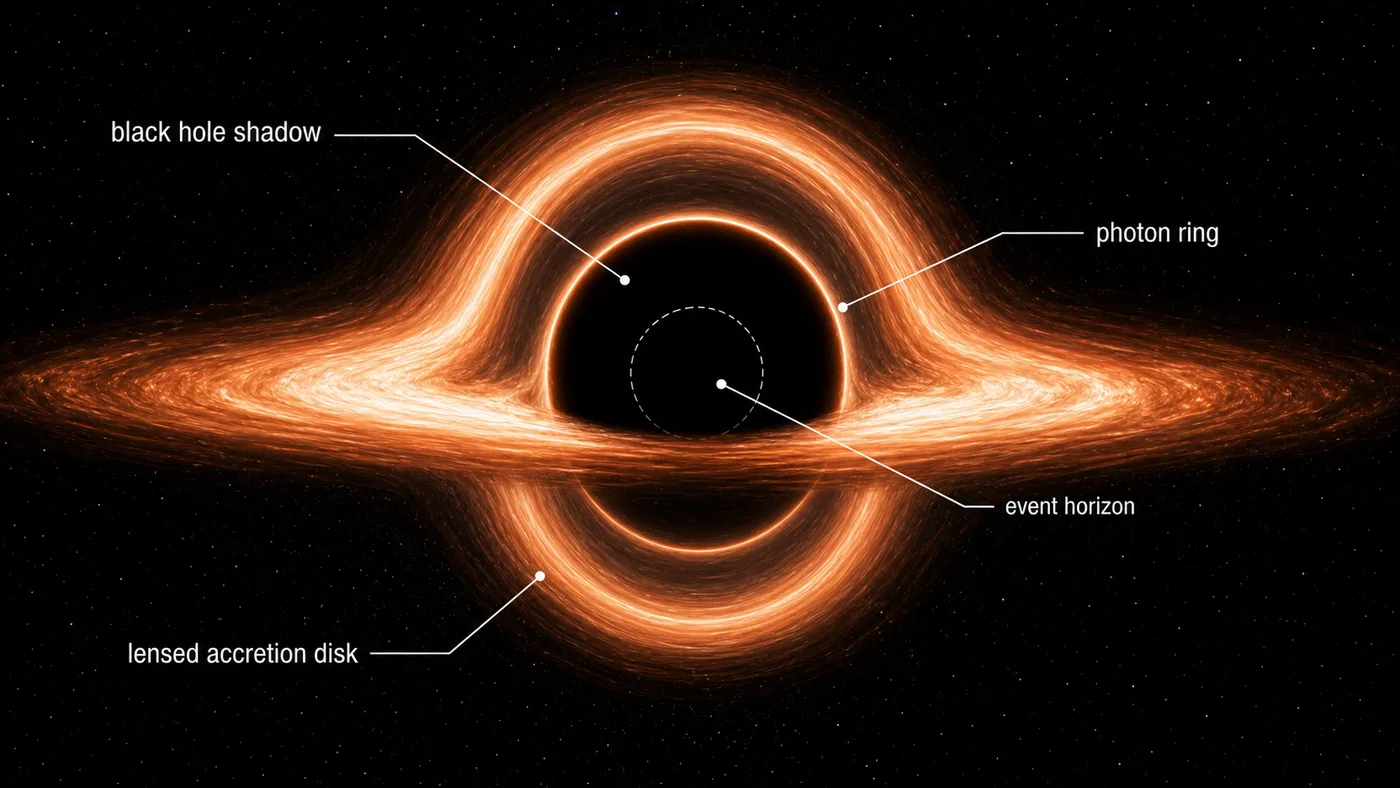
On April 10, 2019, the Event Horizon Telescope (EHT) collaboration published the first direct image of a black hole's shadow, the supermassive black hole M87*, approximately 6.5 billion solar masses at the center of galaxy M87, approximately 55 million light-years away. The bright ring in the image is produced by photons orbiting close to the photon sphere (at 1.5 times the Schwarzschild radius), with the dark center being the shadow cast by the event horizon. A second image of Sagittarius A* (the Milky Way's central black hole, approximately 4 million solar masses) was published in May 2022. Both images match general relativistic predictions.
More to see
Key ideas
- Event horizon
- The boundary around a black hole past which nothing escapes, not even light. It isn't a surface you could touch. It's a one-way edge in spacetime.
- The shadow
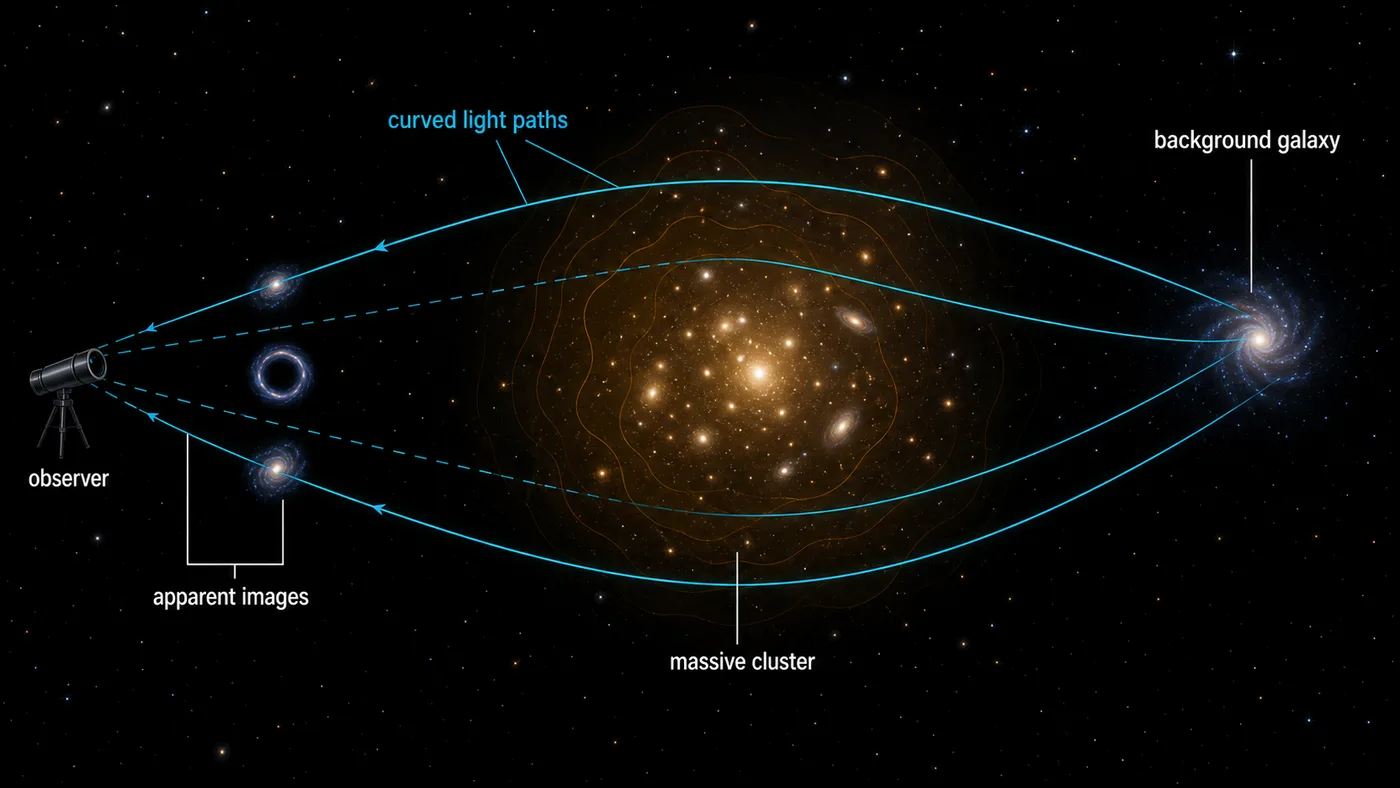
- The dark central region in the EHT images. It is larger than the horizon itself, because the black hole's gravity bends the paths of nearby light into the bright ring we see around it.
- An Earth-sized eye
- Resolution isn't set by how big a telescope you can build, but by how far apart you can spread detectors and how precisely you sync them. The EHT linked observatories across the planet into one.
- Doppler boosting
- Gas orbiting the hole at near-light speed looks brighter on the side moving toward us. That asymmetry lets us read the direction of spin from a single photograph.
Sit with it
How do you feel about this science and its understanding of reality?
We sit with this together, out loud, at the session.
On your phone
Answer along during the session.
The opening question, the dig-in prompts, and the closing question, on one short form. What you write joins everyone else's on the wall, live, under your username.
Take it further
In person
Date to be announced. This page stands alone, so read along any time.