Season 1 · Session 02
No Universal Now
There is no single moment everyone shares.
Opens a threadRead along anyway. These pages stand alone.
Start with the big idea
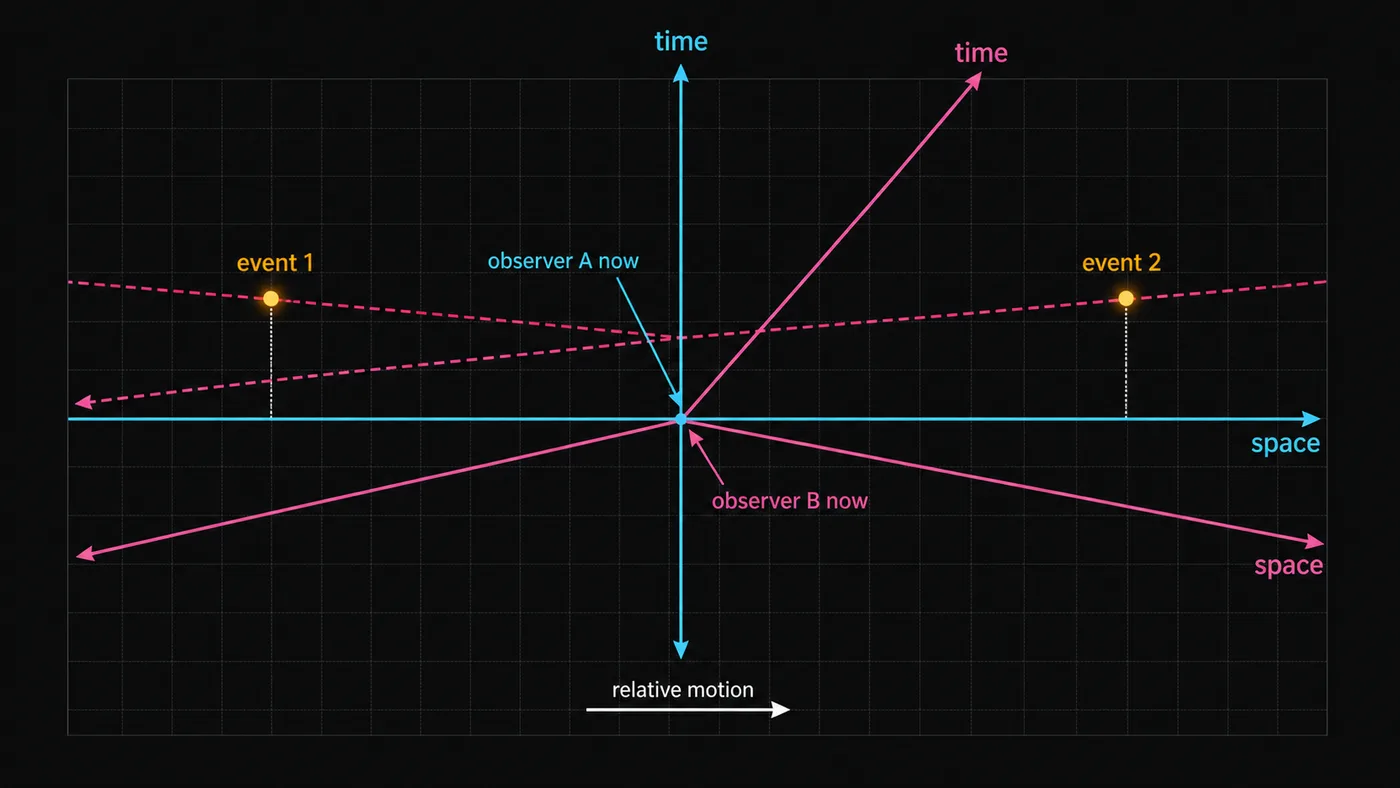
Session 1 left us with the idea that your second is your own. This one follows it somewhere stranger. There is no single 'now' stretched across the universe. We picture the present as a moving sheet, this instant, everywhere at once. But hold the speed of light fixed for everyone and that sheet comes apart. Two events that are simultaneous for you can happen in a definite order for someone moving past you, and in the opposite order for someone moving the other way. None of them is mistaken. There is simply no fact of the matter about which distant events share the same time. This isn't an illusion or a measurement error. It's built into the geometry of spacetime, and it comes with a strict limit that keeps the world sane. Cause and effect are protected. Nothing that could actually influence another event ever flips its order. The only events observers disagree about are the ones too far apart for any signal to connect, and those can't affect each other anyway. What opens here is that the present moment isn't a universal thing the cosmos shares. It's local, and it tilts with how you move.
See it
The precise version →
Einstein's special relativity (1905) showed that simultaneity is not absolute. Two events that are simultaneous in one inertial reference frame are not simultaneous in another moving frame. In a Minkowski spacetime diagram, a moving observer's surface of simultaneity ("now") is a tilted hyperplane rather than a horizontal one. The tilt angle increases with velocity, becoming 45 degrees at c. This is not an optical illusion or an error. It reflects the genuine frame-dependence of which events "happen at the same time." No preferred universal "now" exists across the cosmos.
More to see
Key ideas
- Relativity of simultaneity
- Whether two distant events happen 'at the same time' depends on how you're moving. Two observers in different motion can honestly disagree about the order, and neither one is wrong.
- No preferred 'now'
- There's no universal present sheet sweeping across the cosmos. 'Now' is a local notion that tilts with your motion, not a single moment the whole universe shares.
- The light cone
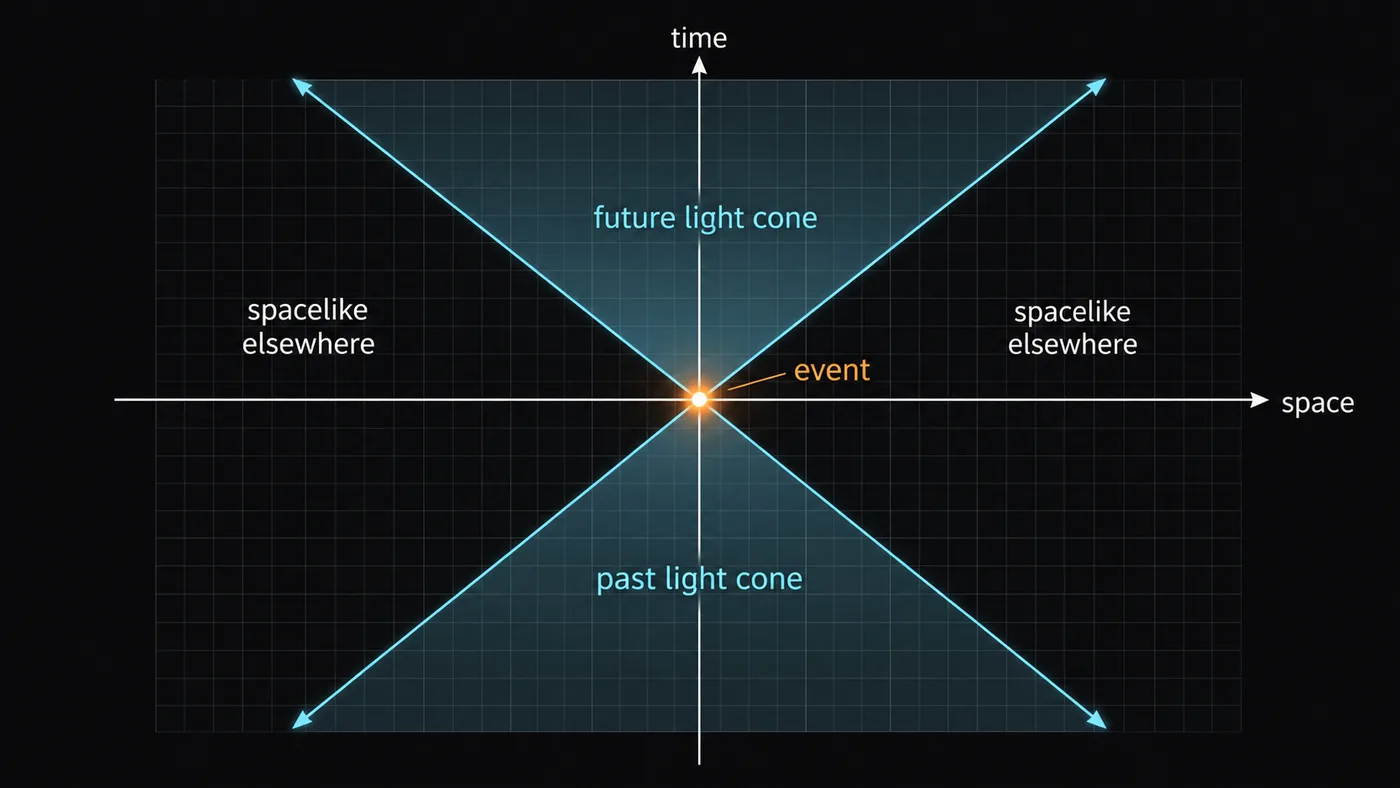
- Every event has a cone of places its light can reach. Events inside that cone can be connected by cause and effect. Events outside it, in what physicists call the elsewhere, can't influence each other at all, and that's exactly where observers disagree about order.
- Causality is safe
- The disagreement never touches cause and effect. Any two events that could actually influence one another keep their order for everyone. Only causally disconnected events flip.
Sit with it
How do you feel about this science and its understanding of reality?
We sit with this together, out loud, at the session.
On your phone
Answer along during the session.
The opening question, the dig-in prompts, and the closing question, on one short form. What you write joins everyone else's on the wall, live, under your username.
Take it further
In person
Date to be announced. This page stands alone, so read along any time.