Season 1 · Session 03
The Twins
Travel fast enough and you return younger than your twin.
Opens a threadRead along anyway. These pages stand alone.
Start with the big idea
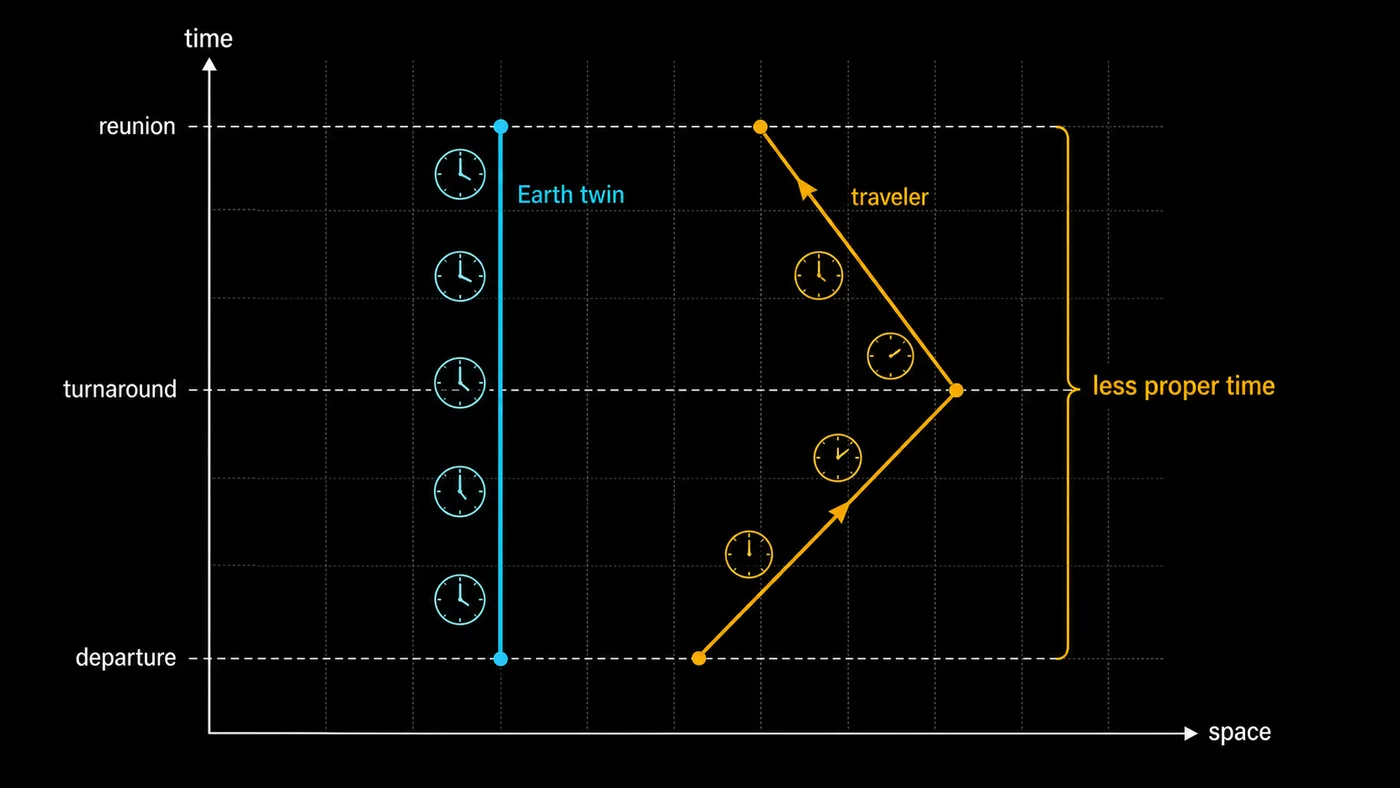
Here is the most famous consequence of Session 1, and the one that trips everyone up. One twin boards a fast ship, travels out and back, and returns to find the stay-at-home twin has aged more. Not as a trick of perception. Really. At 80% of light-speed, for every 5 years the traveller lives, about 8 years pass at home. So where's the puzzle? If motion is relative, each twin sees the other's clock running slow, so why doesn't it cancel out? Because the situation isn't symmetric. The stay-at-home twin never changes course. The traveller does, accelerating away, turning around, coming back. That turnaround breaks the symmetry, and it's the traveller who comes home younger. This isn't science fiction we can't check. The blunt version was confirmed in 1971 by flying atomic clocks around the world on ordinary airliners. The flown clocks came back measurably behind the ones that stayed put, by exactly the predicted amount. What opens here is that aging is not a universal clock the cosmos keeps for all of us. The amount of time you experience depends on the path you take through spacetime, and two people can take different amounts of time between the very same two moments.
See it
The precise version →
The twin paradox illustrates special relativistic time dilation through asymmetric aging. One twin (the traveler) departs at high velocity, reaches a distant point, decelerates, and returns. The stay-at-home twin ages more. At v = 0.8c, γ = 5/3 ≈ 1.667. For every 5 years the traveler experiences, the stay-at-home twin ages approximately 8.3 years. The paradox is resolved by the asymmetry. The traveling twin undergoes acceleration (changing inertial frames at turnaround) while the stay-at-home twin does not. In the Minkowski diagram, the traveler's worldline is shorter in spacetime length (shorter proper time arc), which corresponds to less elapsed proper time despite covering more coordinate distance.
More to see
Key ideas
- Asymmetric aging
- The travelling twin really does return younger. At 80% of light-speed, 5 years for the traveller is about 8 years at home. That's a genuine difference in elapsed time, not a viewing trick.
- Why it doesn't cancel
- Motion is relative, but the trip isn't symmetric. Only the traveller accelerates and turns around, and that break in symmetry is what decides who ends up younger.
- Proper time
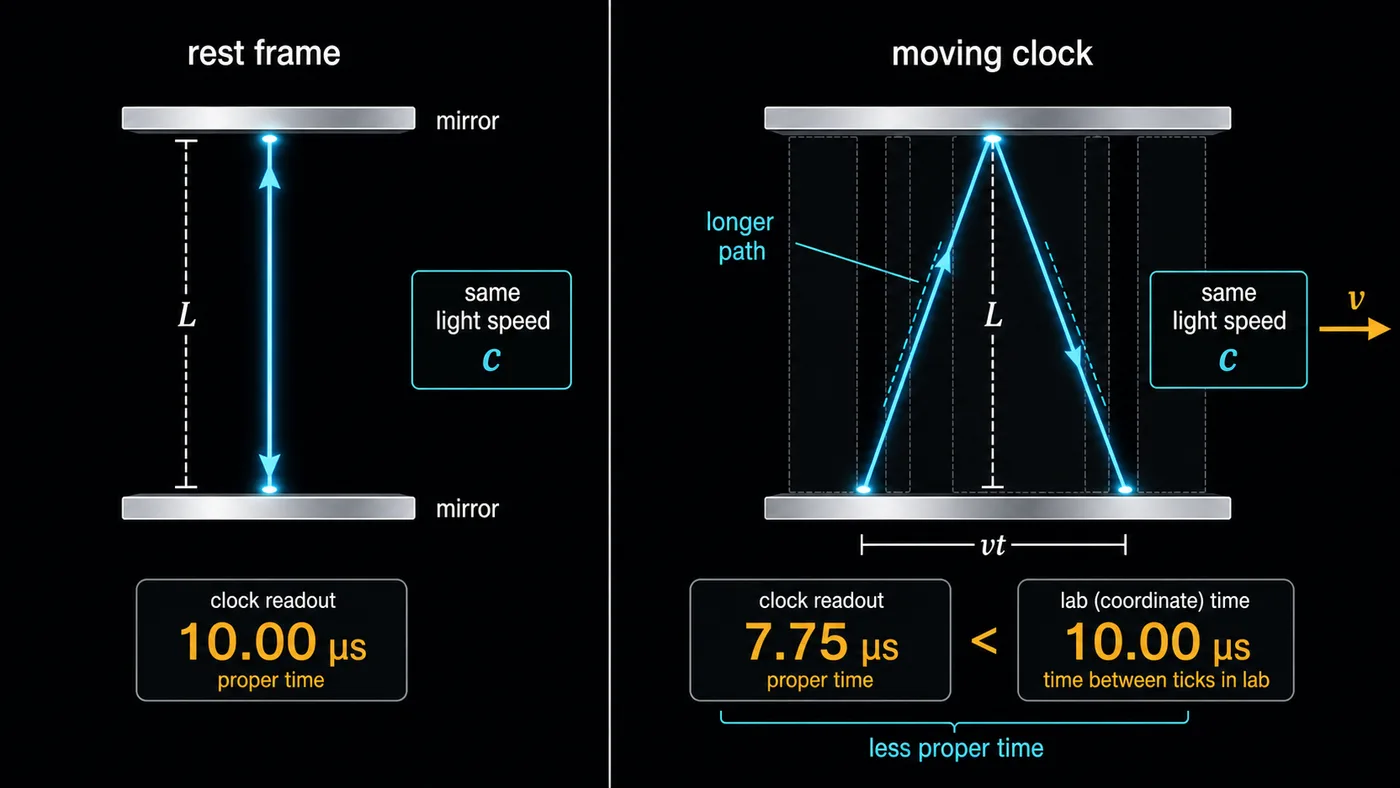
- The time a clock actually logs along its own path. Different paths between the same two events can rack up different proper times, and the traveller's path simply logs less.
- Tested with real clocks
- In 1971, atomic clocks flown around the world on airliners came back behind the clocks left on the ground, by precisely the predicted amount. The paradox is a measured fact.
Sit with it
How do you feel about this science and its understanding of reality?
We sit with this together, out loud, at the session.
On your phone
Answer along during the session.
The opening question, the dig-in prompts, and the closing question, on one short form. What you write joins everyone else's on the wall, live, under your username.
Take it further
In person
Date to be announced. This page stands alone, so read along any time.