Season 1 · Session 04
Relativity You Can Hold
Your phone's map only works because we corrected for bending time.
Lands a threadRead along anyway. These pages stand alone.
Start with the big idea
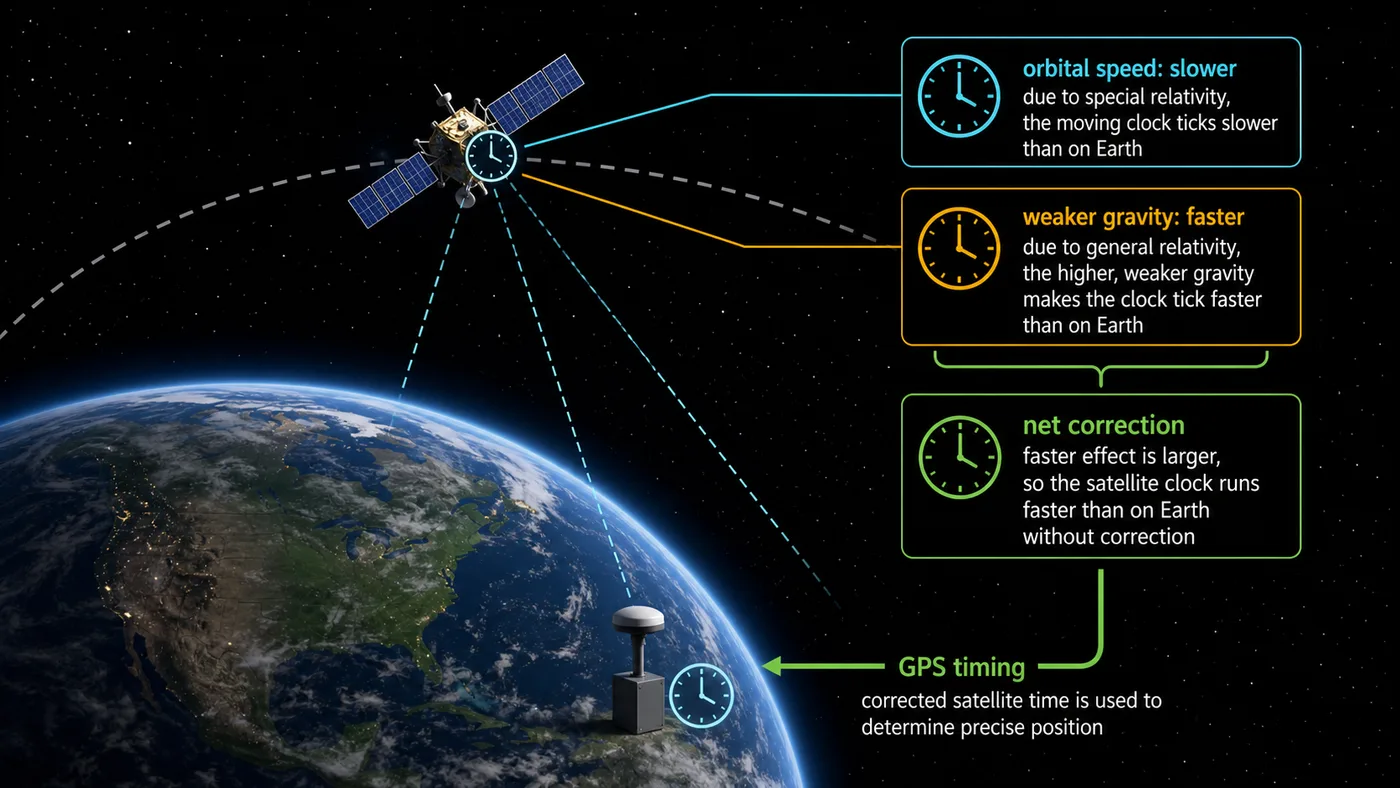
The strangeness of bending time isn't reserved for physics labs. It's in your pocket. The blue dot on your phone's map is computed from a fleet of satellites 20,000 km up, each carrying an atomic clock, each broadcasting the time. Your phone listens to several at once and triangulates from the tiny differences in when their signals arrive. But those satellite clocks do not keep the same time as the clock on the ground. Two effects pull in opposite directions. The satellites move fast, which slows their clocks, and that is special relativity. They also sit higher in Earth's gravity, which speeds them up, and that is general relativity. The speed-up wins. Each satellite clock runs about 38 microseconds per day fast. Ignore that and the error doesn't stay small. Your position would drift roughly 11 kilometres off within a single day. What lands here is that relativity is not an exotic correction for extreme cases. It is a daily engineering fact, quietly keeping your navigation honest every time you use it.
See it
The precise version →
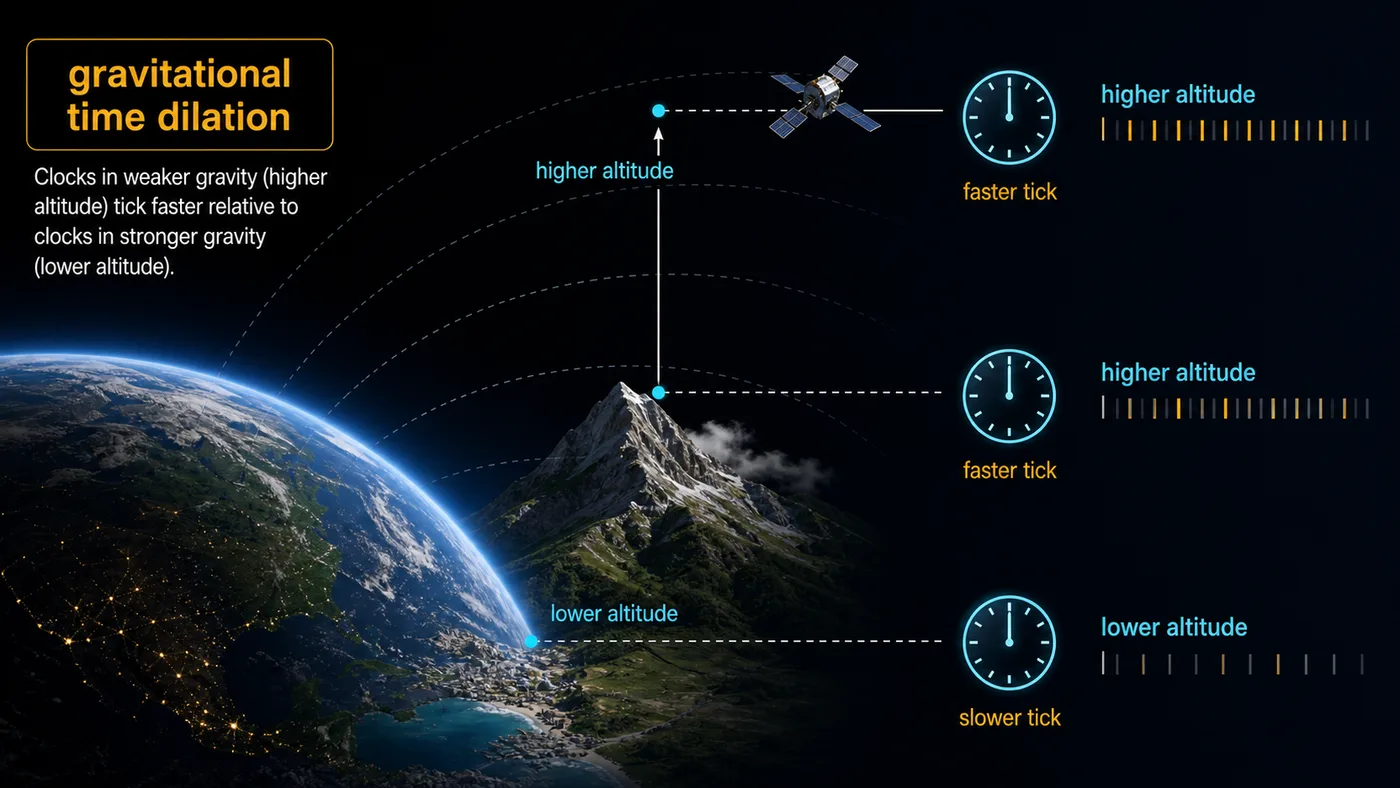
GPS satellites orbit at approximately 20,200 km altitude and move at roughly 3.87 km/s relative to Earth's surface. Two relativistic effects operate simultaneously: (1) Gravitational time dilation (general relativity) causes satellite clocks to tick approximately 45.9 microseconds per day faster than ground clocks because they are higher in Earth's gravitational potential. (2) Velocity time dilation (special relativity) causes satellite clocks to tick approximately 7.2 microseconds per day slower due to their orbital speed. The net effect is that satellite clocks gain approximately 38 microseconds per day relative to ground clocks. Without correcting for this, GPS position errors would accumulate at approximately 11 km per day.
More to see
Key ideas
- Two corrections, opposite signs
- Motion slows the satellite clocks, which is special relativity. Height in gravity speeds them up, which is general relativity. The gravity effect is bigger, so the net is a gain of about 38 microseconds a day.
- 38 microseconds → 11 kilometres
- A microsecond of clock error becomes a position error at the speed of light. Left uncorrected, GPS would drift about 11 km off within a day, which is useless for navigation.
- Why GPS is the proof you can hold
- You don't need a particle accelerator to test relativity. A working phone map is a continuous, real-time confirmation that time runs at different rates at different speeds and heights.
- The atomic clock onboard
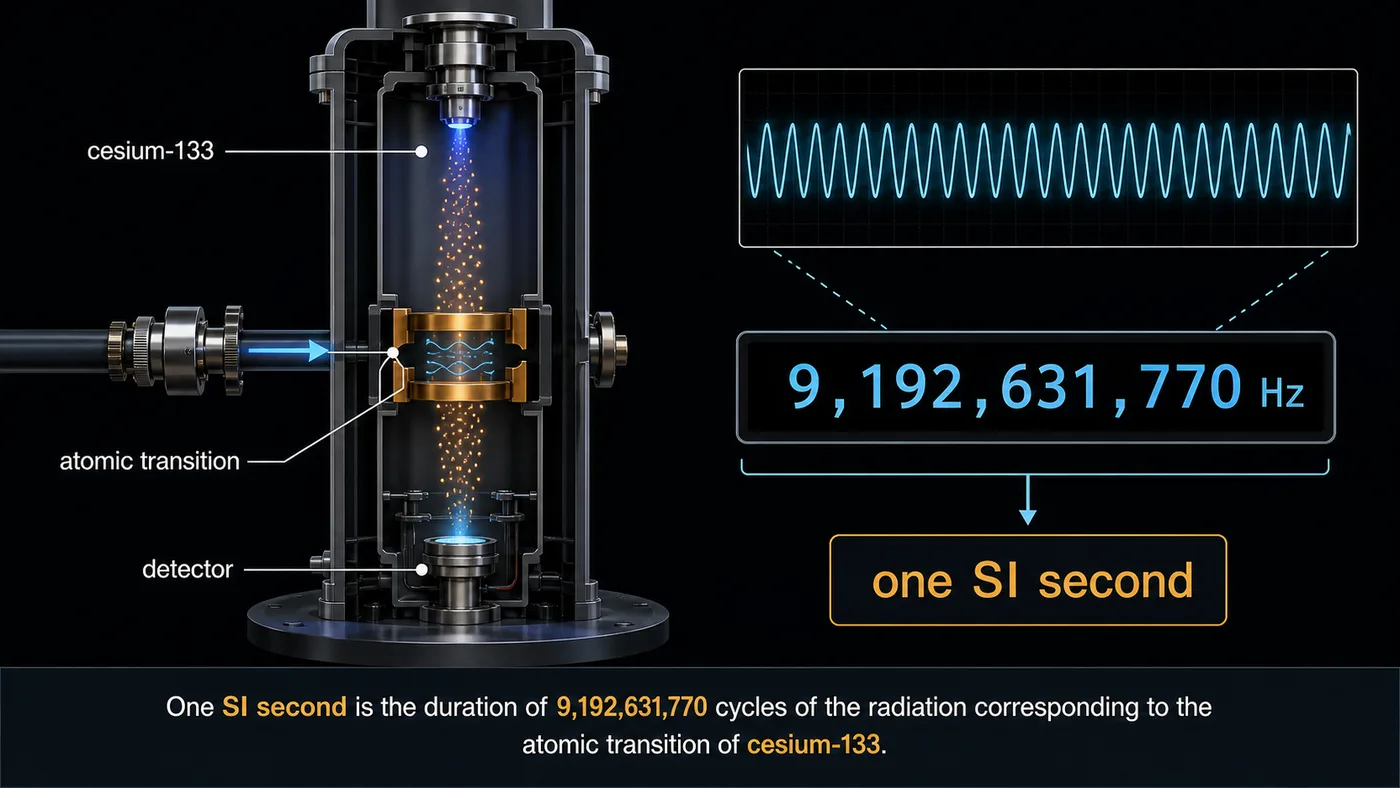
- Each satellite carries a clock as precise as the one that defines the second itself, because the whole system depends on knowing the time to billionths of a second.
Sit with it
How do you feel about this science and its understanding of reality?
We sit with this together, out loud, at the session.
On your phone
Answer along during the session.
The opening question, the dig-in prompts, and the closing question, on one short form. What you write joins everyone else's on the wall, live, under your username.
Take it further
In person
Date to be announced. This page stands alone, so read along any time.