Season 1 · Session 06
Mass Bends Light
Heavy things bend the path of light around them.
Lands a threadRead along anyway. These pages stand alone.
Start with the big idea
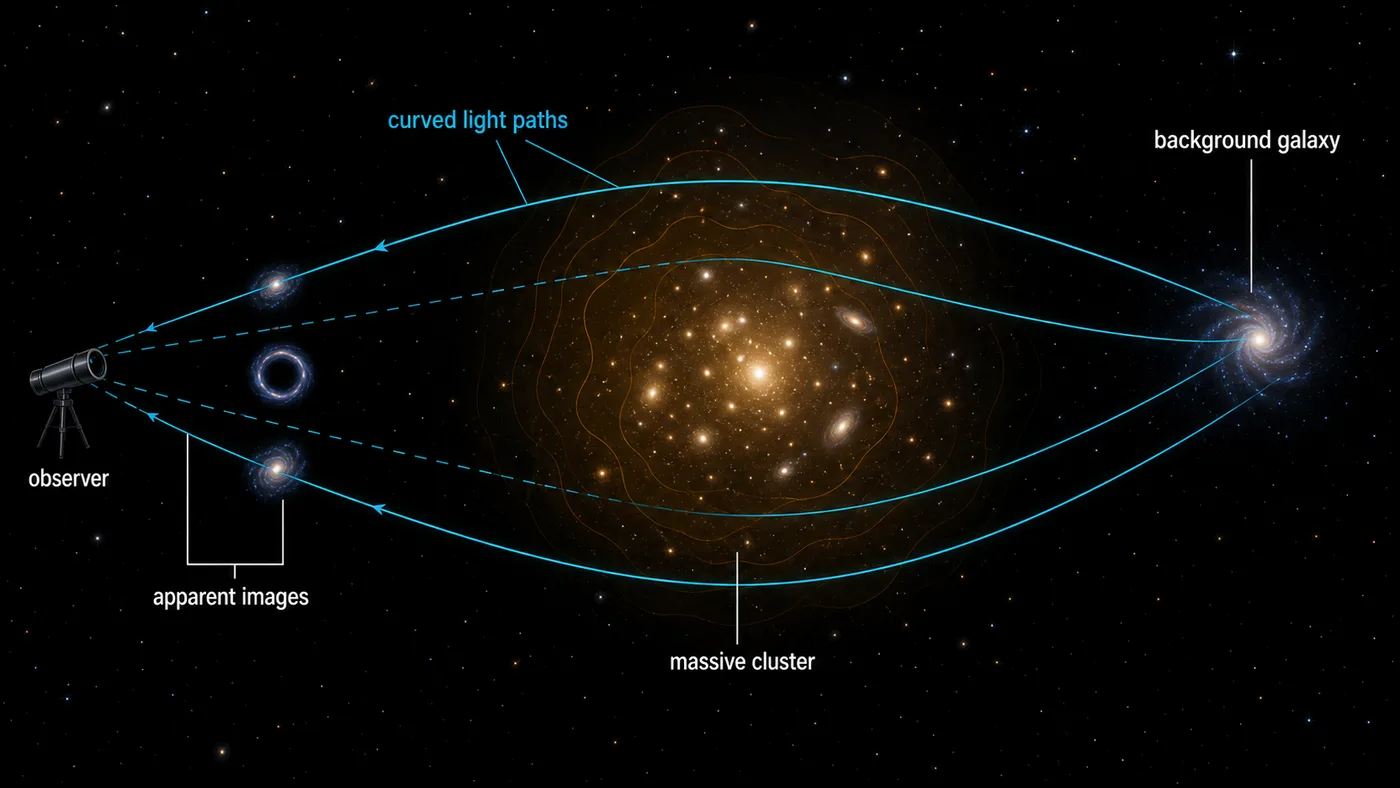
Light has no mass, so how can gravity touch it? Newton's pull between masses couldn't really answer that. Einstein's answer follows straight from the last session. Gravity isn't a pull on the light. It's a bend in the road the light travels. Mass curves spacetime, and light takes the straightest available path through that curve, so it arrives deflected. The prediction was exact. Starlight grazing the edge of the Sun should shift by 1.75 arcseconds, precisely twice what a naive Newtonian estimate gives. On May 29, 1919, Arthur Eddington's teams photographed stars near the Sun during a total eclipse. That is the only time their faint light is visible right beside it. They measured the shift, and it matched Einstein. Overnight, a patent clerk's geometry became front-page news. Today the same effect is a working tool. Galaxy clusters act as giant lenses, bending and magnifying the light of things behind them, letting us see further than any telescope alone could reach. What lands here is that gravity doesn't just hold things down. It steers light, and we can watch it happen.
See it
The precise version →
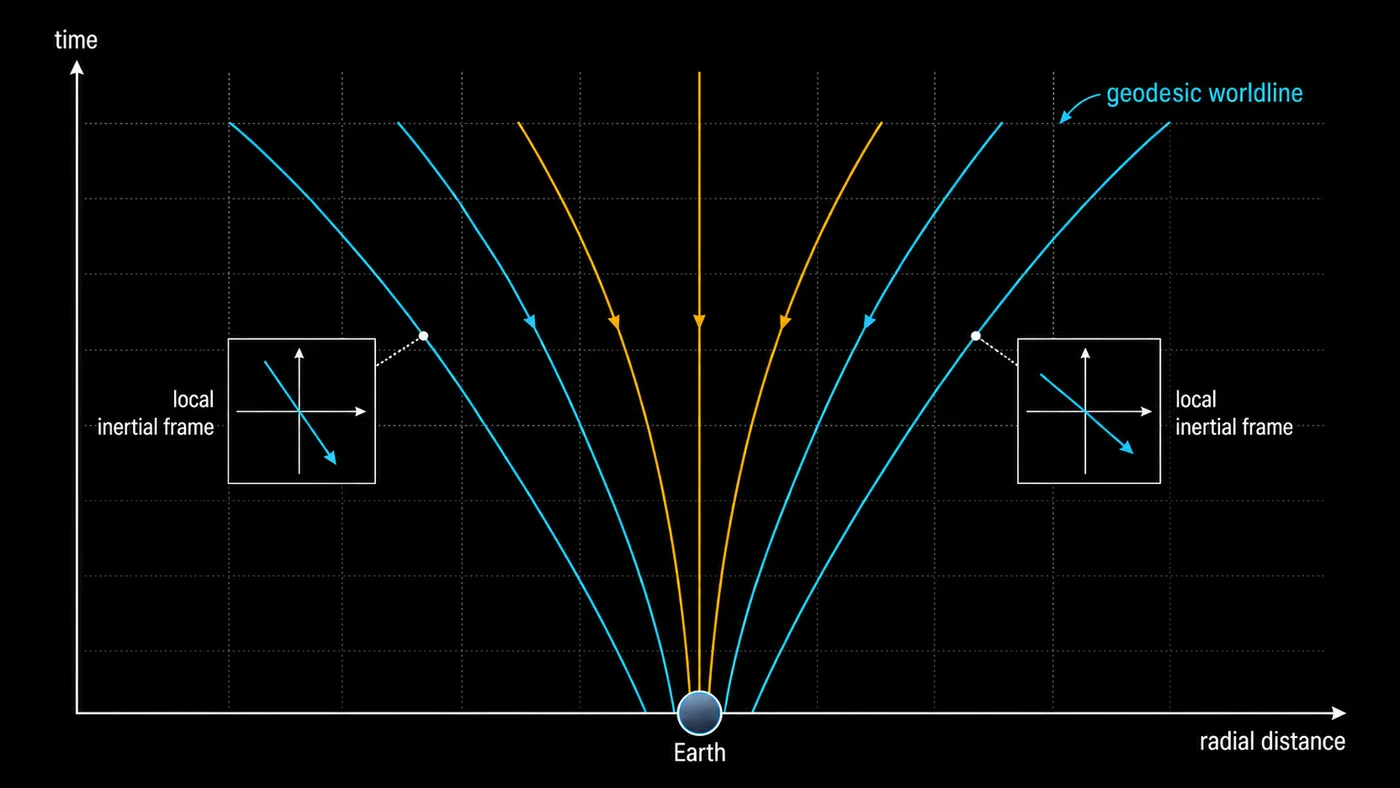
General relativity predicts that light follows geodesics in curved spacetime, meaning it is deflected by gravitational fields. The deflection angle for light grazing the Sun's limb is 1.75 arcseconds, exactly twice the Newtonian prediction. Arthur Eddington's solar eclipse expeditions of May 29, 1919 (to Príncipe and Sobral) measured this deflection and confirmed Einstein's value. Gravitational lensing by galaxy clusters can produce Einstein rings and arcs. The first confirmed gravitational lens was discovered in 1979 (Walsh, Carswell & Weymann). Strong lensing, weak lensing, and microlensing are now standard tools in cosmology and exoplanet searches.
More to see
Key ideas
- Light follows the curve
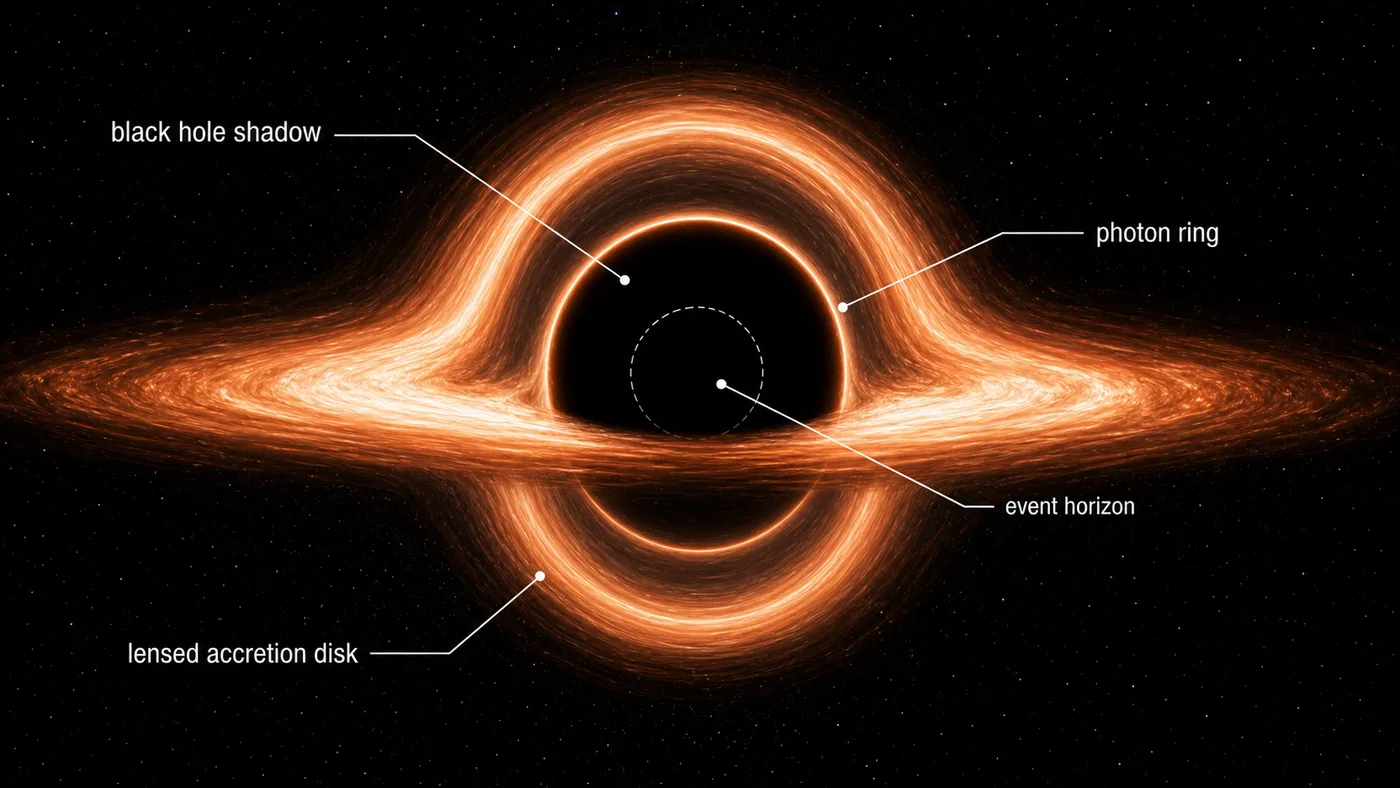
- Light has no mass, but it still follows the straightest path through curved spacetime. Near a heavy object that path bends, so the light arrives deflected. No pull required.
- Twice the Newtonian value
- Einstein predicted that starlight grazing the Sun bends by 1.75 arcseconds, exactly double a naive Newtonian guess. The factor of two is what made the 1919 measurement a real test.
- The 1919 eclipse
- Totality is the only moment starlight shows beside the Sun. Eddington photographed it, measured the predicted shift, and the match made Einstein world-famous.
- Gravitational lensing
- The same bending, scaled up. Clusters of galaxies bend and magnify the light of more distant ones, forming arcs and rings. It's a natural telescope, and we now use it to see the early universe.
Play with it
Gravity Well — Geodesic Sandbox
Dent the grid with a mass, then launch a particle and watch it fall along a curve.
A 2-D analogy, not the full 4-D math. Geometry does the work here, not a pull.
Sit with it
How do you feel about this science and its understanding of reality?
We sit with this together, out loud, at the session.
On your phone
Answer along during the session.
The opening question, the dig-in prompts, and the closing question, on one short form. What you write joins everyone else's on the wall, live, under your username.
Take it further
In person
Date to be announced. This page stands alone, so read along any time.