Season 1 · Session 09
The Oldest Light
The faint glow filling all of space is the universe's baby picture.
Opens a threadRead along anyway. These pages stand alone.
Start with the big idea
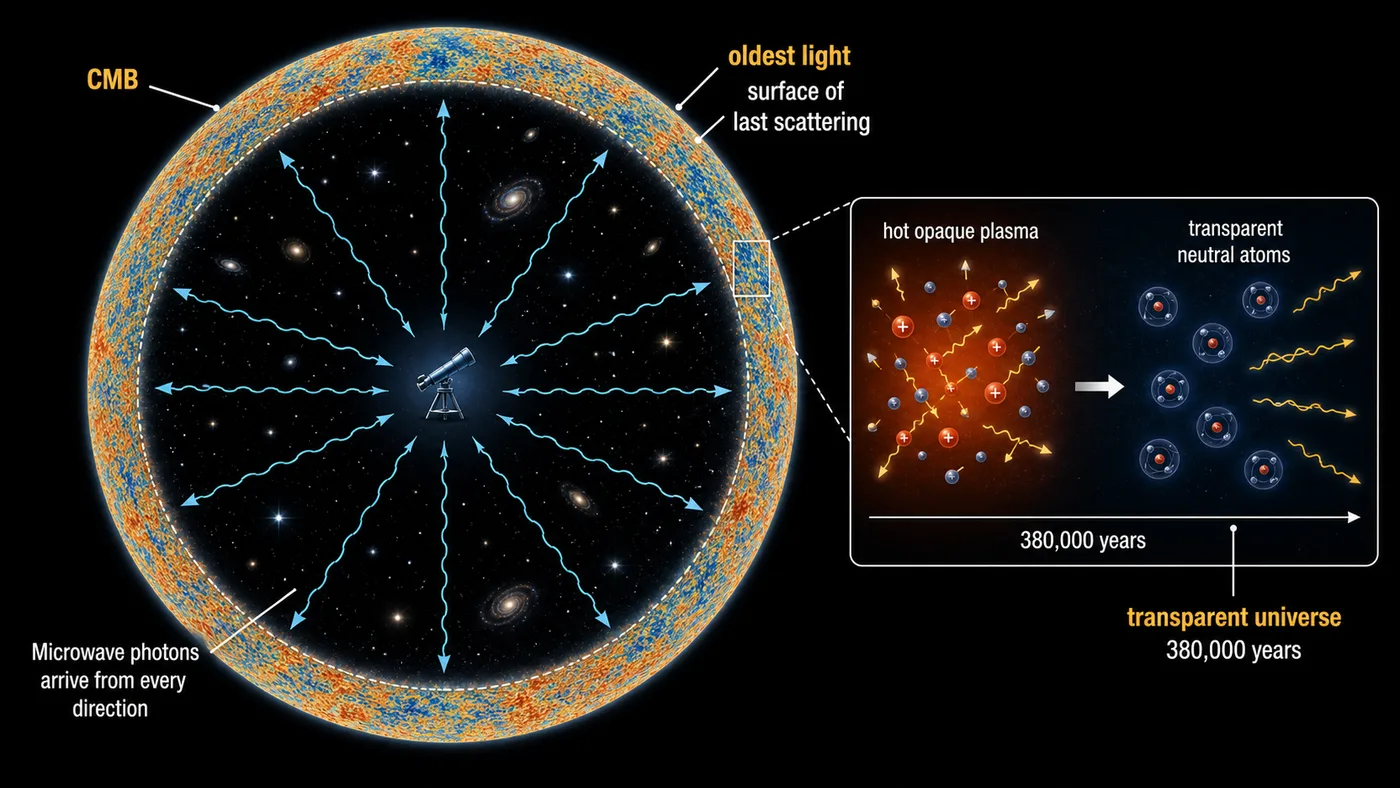
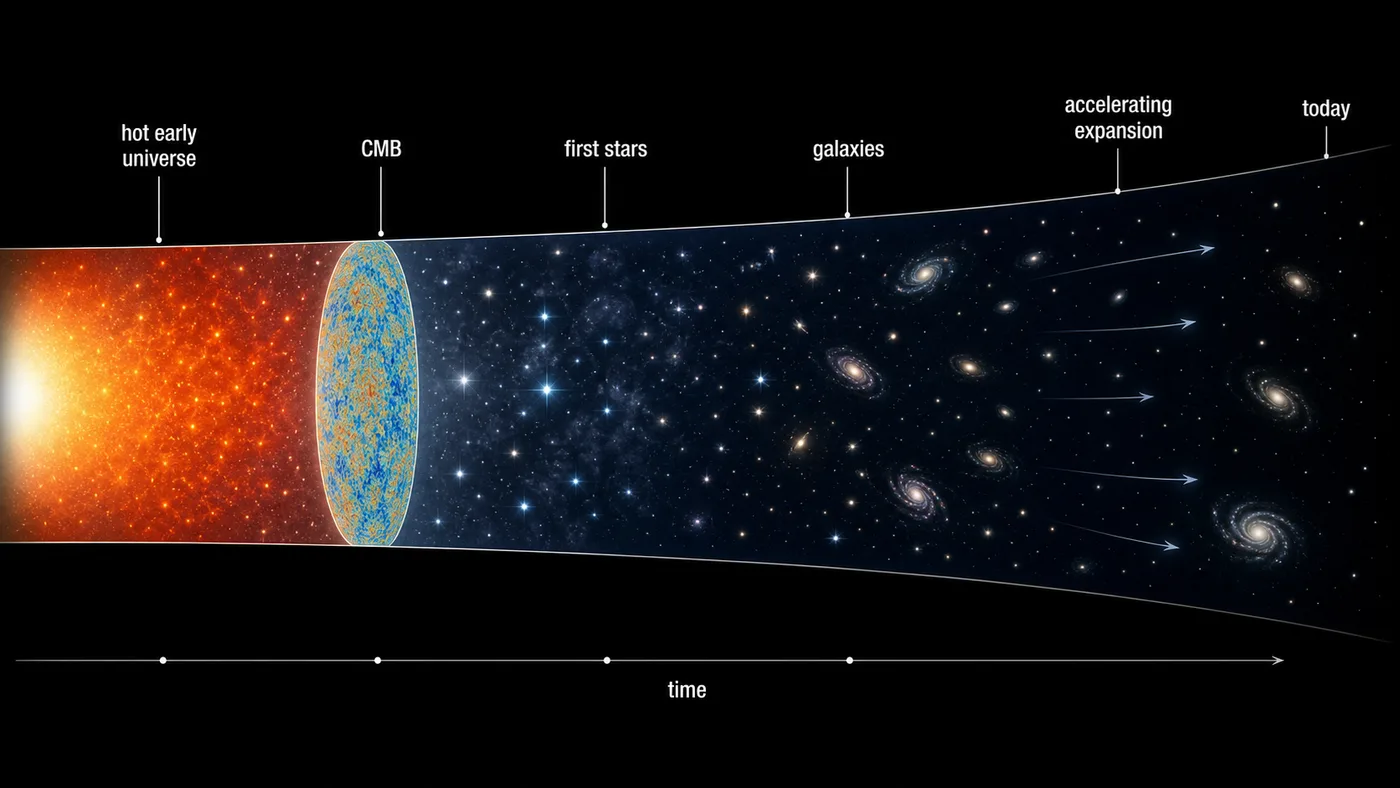
For its first 380,000 years the universe was an opaque fog, so hot and dense that light could not travel freely, scattering endlessly off a sea of charged particles. Then it cooled enough for electrons to settle onto nuclei, the fog cleared, and light streamed out for the first time. That light is still arriving. Stretched by 13.8 billion years of cosmic expansion, it has cooled from thousands of degrees to just 2.7 degrees above absolute zero, and it fills the entire sky in every direction. We call it the cosmic microwave background. It is astonishingly smooth, the same to about one part in a hundred thousand, and those faint specks of unevenness are the seeds from which every galaxy, star, and planet grew. You have even seen it without knowing. About one percent of the static on an old untuned television is this ancient light. And here is the deeper turn. Because light takes time to travel, looking far away is always looking back in time. The CMB shows the infant universe. A distant galaxy shows it as it was millions of years ago. The night sky isn't a snapshot of 'now.' It's a layered archive of different epochs, all reaching your eye at once. Distance is time.
See it
The precise version →
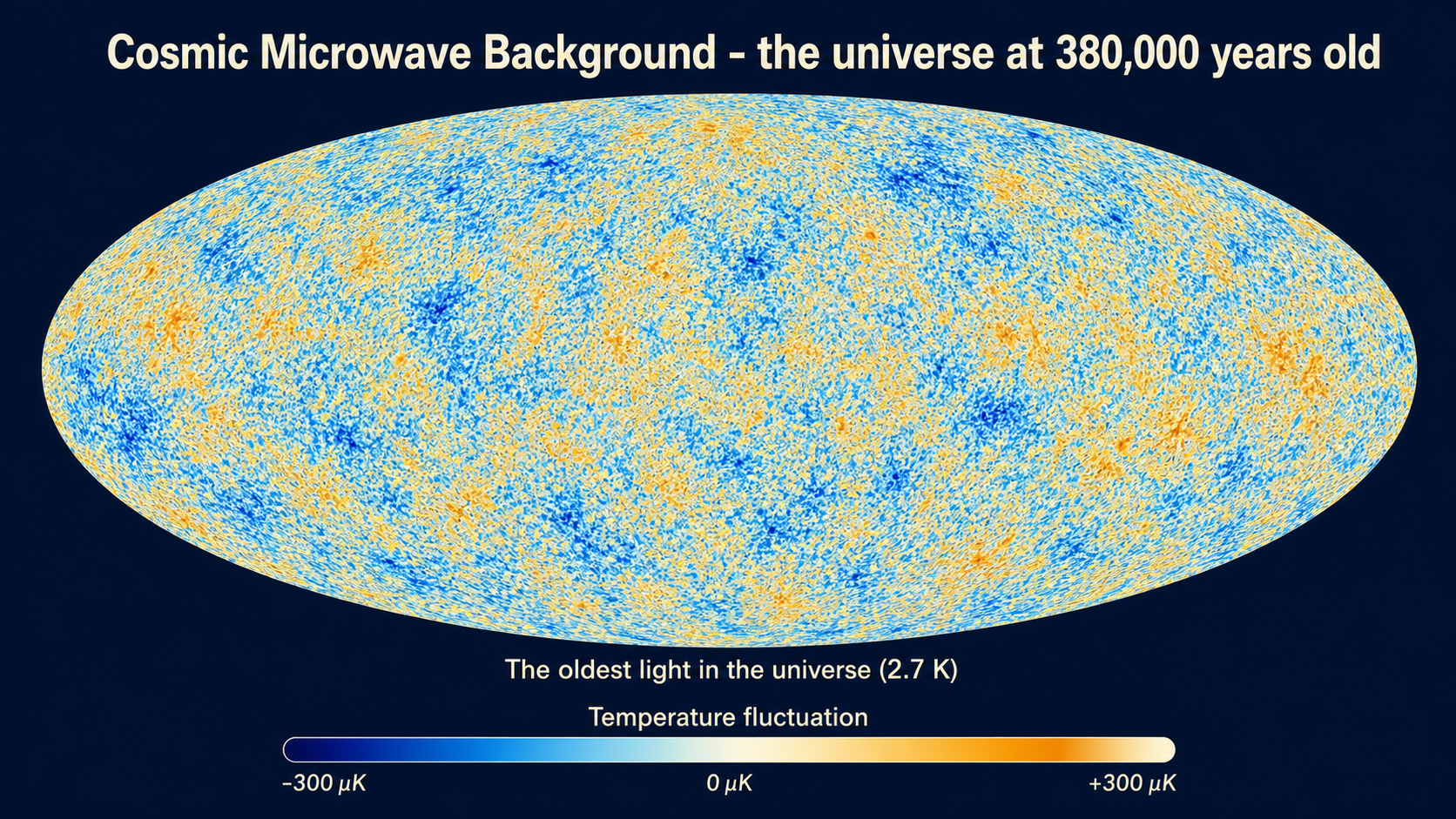
The Cosmic Microwave Background (CMB) is the oldest light we can observe, released approximately 380,000 years after the Big Bang when the universe cooled enough for neutral hydrogen to form, the epoch of recombination (redshift z ≈ 1100). Before this moment the universe was opaque. Photons could not travel freely. After recombination, photons streamed freely for the first time. Today those photons have been redshifted by the universe's expansion from their original temperature of approximately 3,000 K down to 2.725 K. The CMB is nearly uniform, but not perfectly. Temperature anisotropies at the level of approximately 1 part in 100,000 encode the seeds of all large-scale structure. The CMB was discovered accidentally by Penzias and Wilson in 1964, then mapped in detail by COBE (1989), WMAP (2001), and Planck (2009).
More to see
Key ideas
- Recombination
- About 380,000 years after the beginning, the universe cooled enough for electrons to join nuclei into neutral atoms. The fog of charged particles cleared, and light could finally travel freely.
- The cosmic microwave background
- That first free light, still arriving from every direction, stretched by expansion down to 2.7 degrees above absolute zero. It is the oldest light we can see, a baby photo of the cosmos.
- Seeds of everything
- The CMB is smooth to one part in 100,000. Those tiny denser specks were the gravitational seeds that grew, over billions of years, into galaxies, stars, planets, and us.
- Looking out is looking back
- Light takes time to cross space, so every observation is of the past. The sky is a layered archive. Nearby stars from years ago, distant galaxies from eons ago, all arriving together. Distance is time.
Play with it
Scale of the Universe — Zoom
One slider from a quark to the cosmic horizon.
Sizes are honest orders of magnitude, not a literal photo. The point is how fast the ground falls away under your intuition.
Sit with it
How do you feel about this science and its understanding of reality?
We sit with this together, out loud, at the session.
On your phone
Answer along during the session.
The opening question, the dig-in prompts, and the closing question, on one short form. What you write joins everyone else's on the wall, live, under your username.
Take it further
In person
Date to be announced. This page stands alone, so read along any time.