Season 1 · Session 10
The Universe Pulls Apart
Space itself is stretching, and the stretch is speeding up.
Opens a threadRead along anyway. These pages stand alone.
Start with the big idea
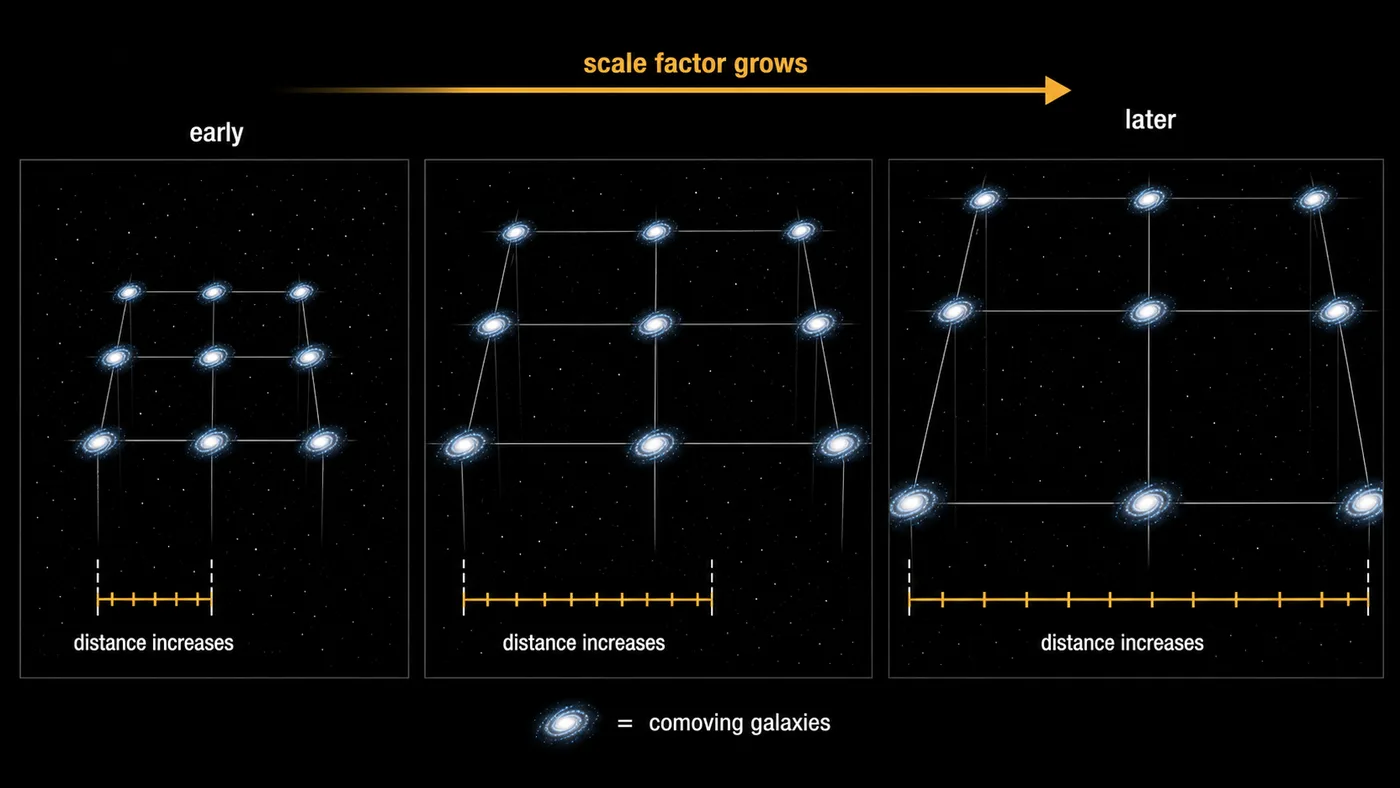
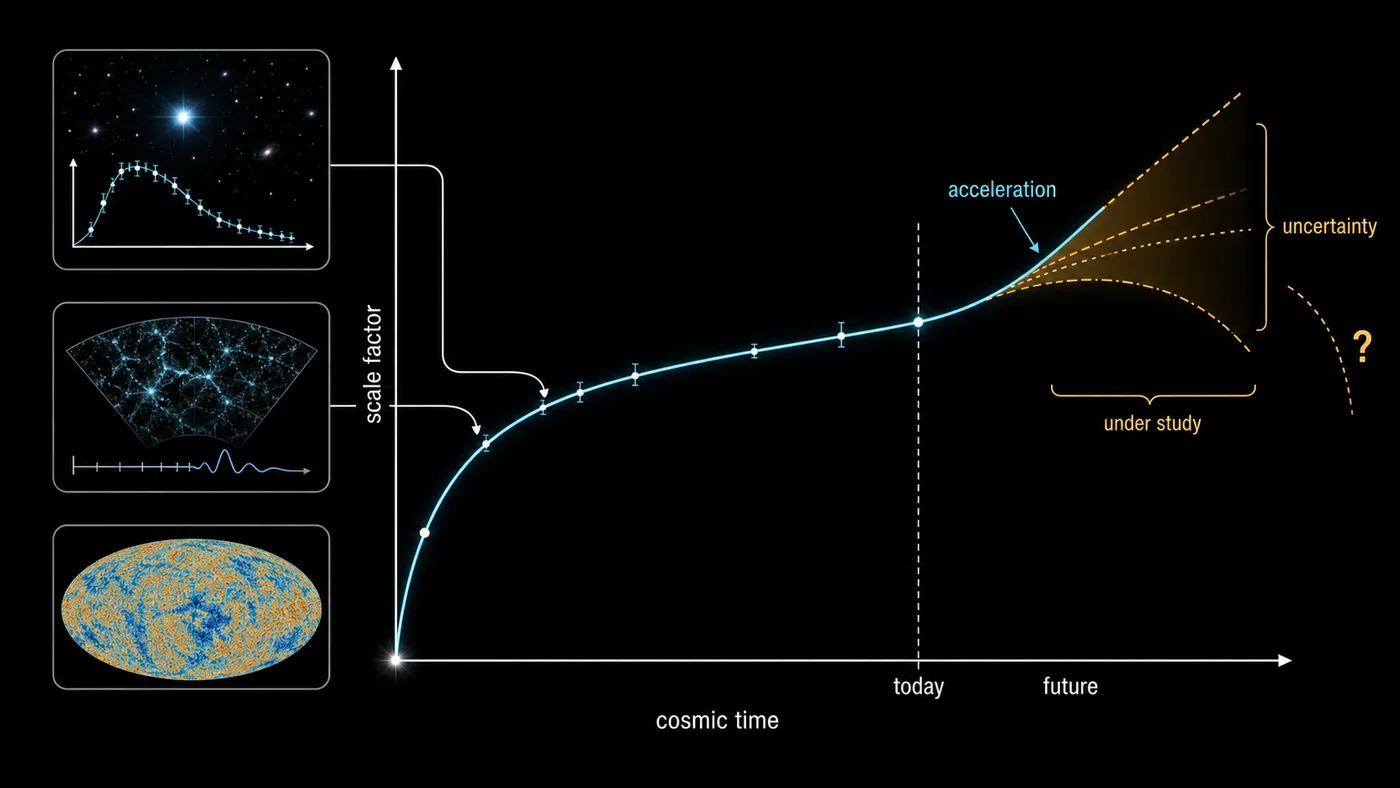
The galaxies are not flying outward through space from some central explosion. The space between them is growing, everywhere, all at once. That's the real meaning of the Big Bang. Not an explosion in space, but an expansion of space itself, with geometry and time beginning together, so that 'before' may not even have a meaning. For most of a century we assumed gravity would slowly put the brakes on that expansion. Then in 1998 two teams measured distant exploding stars and found the opposite. The expansion is speeding up. Something we can't see is pushing everything apart, and we've named it dark energy. It accounts for about 68% of the universe. Add the dark matter, about 27%, whose gravity holds galaxies together though it emits no light, and the familiar universe of stars, planets, and people turns out to be only about 5% of the whole. We can measure the other 95% precisely by how gravity behaves. We cannot yet explain what it is. The season closes here, on the honest edge of knowledge. The universe is mostly made of things we can name but not understand, and knowing that is itself a hard-won scientific result, not a gap to paper over.
See it
The precise version →
The expansion of the universe is described by the scale factor a(t), which gives the relative size of the universe at time t. The Hubble parameter H(t) = ȧ/a describes the rate of expansion. Edwin Hubble's 1929 observations showed that galaxy recession velocities increase proportionally with distance (v = H₀d), implying expansion. Today's Hubble constant H₀ is measured at approximately 67–73 km/s/Mpc (a tension between CMB-derived and distance-ladder values is an active research area). The expansion is not galaxies moving through space. It is space itself stretching. Bound systems (galaxies, solar systems, atoms) do not expand. Only the metric between unbound systems grows.
More to see
Key ideas
- Expansion of space, not in space
- Galaxies aren't moving outward from a centre. The space between them stretches everywhere at once. The Big Bang was the beginning of that stretching, and of geometry and time themselves.
- The accelerating universe
- In 1998, distant Type Ia supernovae came out dimmer than expected, showing the expansion is speeding up rather than slowing. The cause, which we call dark energy, earned the 2011 Nobel Prize and remains unexplained.
- The dark sector (95%)
- Ordinary matter, everything we can see, is about 5% of the universe. Dark matter (~27%) is known only by its gravity. Dark energy (~68%) drives the acceleration. We can measure both, and explain neither.
- Knowing what we don't know
- That the cosmos is mostly unknown is a precise result, read straight off how gravity behaves. Galaxies spin too fast. The expansion accelerates. The honest stance is to be certain about the measurements and agnostic about the cause.
Sit with it
How do you feel about this science and its understanding of reality?
We sit with this together, out loud, at the session.
On your phone
Answer along during the session.
The opening question, the dig-in prompts, and the closing question, on one short form. What you write joins everyone else's on the wall, live, under your username.
Take it further
In person
Date to be announced. This page stands alone, so read along any time.