Scale & Pattern · Coming season
Made of Stars (Cosmic Chemistry of You)
The hydrogen in your body is as old as the universe, and almost every heavier atom in you was manufactured inside a star that exploded before the Sun existed. This is bookkeeping, not metaphor.
Opens a threadRead along anyway. These pages stand alone.
See it
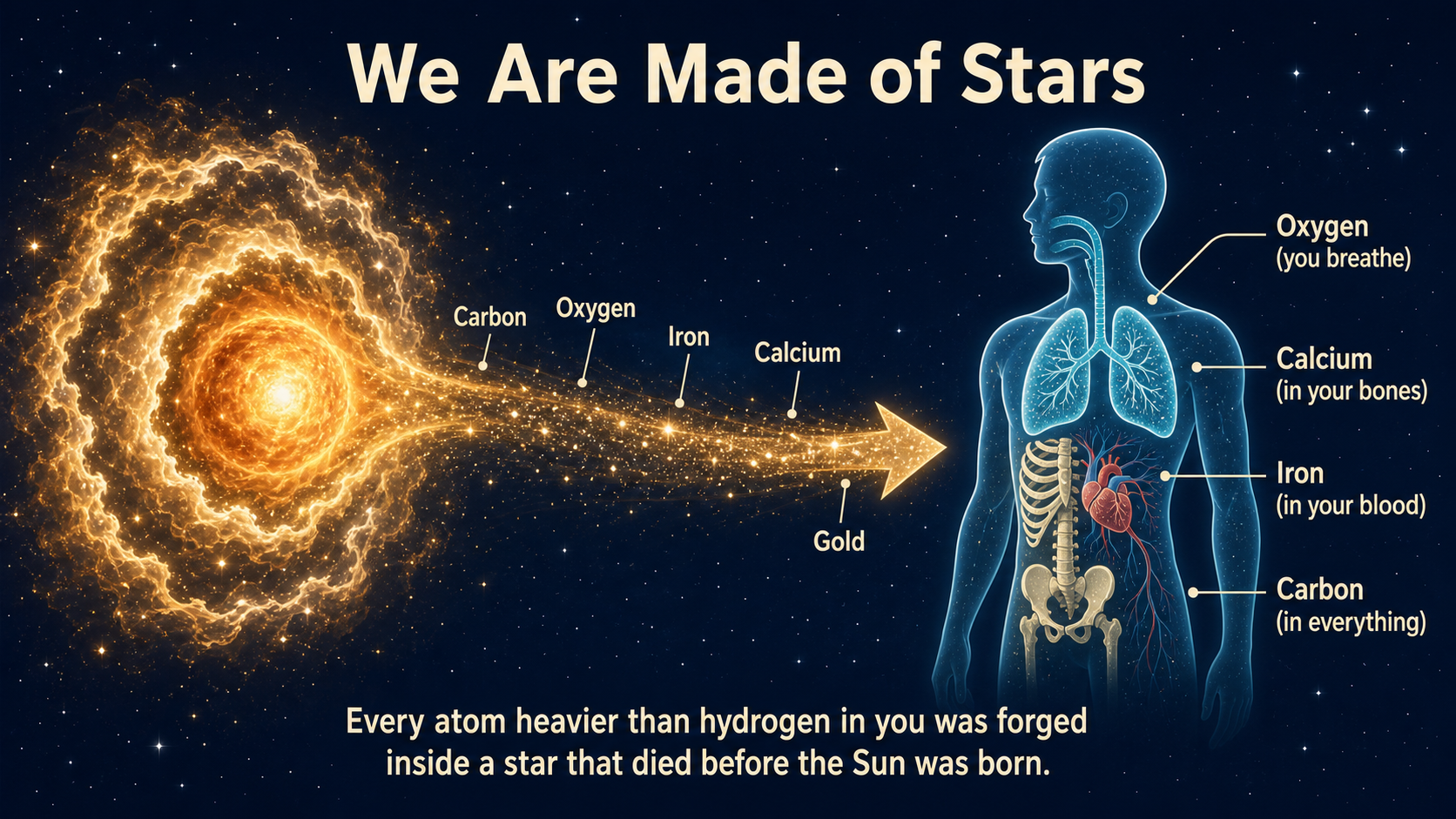
The one idea
The atoms that make you were not made on Earth and were not made together. The hydrogen, roughly two-thirds of your atoms by count, was forged in the first few minutes after the Big Bang, before there were any stars at all. Nearly everything heavier was built inside stars and flung out when they died, including the oxygen you breathe into, the carbon in every protein, the calcium in your bones, and the iron in your blood. “You are made of star-stuff” is usually said as poetry. It is actually accounting. Each element has a traceable origin, and you can sort the periodic table by where each one came from.
The science
Run the clock back. For about the first twenty minutes after the Big Bang the whole universe was a fusion reactor, hot and dense enough to fuse protons and neutrons. It made hydrogen, a lot of helium, and a trace of lithium. Then it expanded and cooled too fast to make anything heavier, and the reactor shut off. The leftover mix was roughly 75% hydrogen and 25% helium by mass, and we still measure almost exactly that ratio in the oldest, most pristine stars today. That match is one of the strongest pieces of evidence that the Big Bang happened at all. So the hydrogen in a glass of water, and the hydrogen in you, is genuinely primordial, about 13.8 billion years old.
Everything past helium and lithium had to wait for stars. Inside a star, gravity squeezes the core hot enough to fuse hydrogen into helium. In massive stars it goes further, fusing helium into carbon and oxygen and on up the chain to iron. Iron is the wall. Fusing it costs energy instead of releasing it, so when a massive star builds an iron core it can no longer hold itself up, and the core collapses in about a second into a neutron star. The rebound and the flood of neutrinos blow the outer layers apart in a supernova, scattering carbon, oxygen, and iron into space, and the violence of that explosion also cooks some of the heaviest elements. (Modern astronomy has added a twist the older “all gold comes from supernovae” story missed. A lot of the very heaviest elements, like gold and the platinum group, are now thought to come mostly from collisions of two neutron stars, a process LIGO and telescopes actually caught together in 2017.) The key move is that the explosion ejects this material. Without it, the heavy elements would stay locked in the dead star forever and never become planets or people. Our Sun is a third- or later-generation star, born 4.6 billion years ago from a gas cloud already salted with the ash of earlier stellar deaths. Every calcium atom in your skeleton was therefore manufactured in a star that lived and died before the Sun ignited.
What this changes about how you picture reality
The everyday intuition is that “you” are a local thing, born in one place, made of local material. The accounting says otherwise. Your body is an assembly of parts with wildly different ages and birthplaces. Hydrogen as old as the cosmos, oxygen and iron forged in furnaces that no longer exist, all of it gathered up by one ordinary planet and run for a few decades as you. Nothing here is mystical. It’s fusion physics and gravity. But the reach of it is hard to shrink back down. The matter in your hand has been through at least one star’s entire life and death, traveled across light-years of empty space, sat in a collapsing cloud, become a rock, become an ocean, become a person. The phrase “made of stars” usually triggers a polite nod. Earned honestly, element by element, with the iron in your blood pointing back to a specific kind of catastrophe, it’s stranger and steadier than the poetry. You are not like the universe. You are a temporary arrangement of it that became able to look back and notice where it came from.
Two ways to see it
Put two readings of the same fact in front of the room and let them sit together.
- The continuity framing (you belong to the cosmos). Lead with the periodic-table-by-origin visual and the “atoms of you → stellar furnace” tracer, every element in the body colour-coded to its source. The emotional note here is connection and belonging. You are literally continuous with the universe’s history, no part of you is foreign to it, and the same atoms have always been here, just rearranged. This lands warmly for people who find the idea consoling.
- The contingency / catastrophe framing (you are assembled from violence and luck). Lead with the supernova nucleosynthesis clip, the iron core collapsing and the star tearing itself apart. The same facts read very differently here. The calcium in your bones exists only because a star exploded, the gold you might be wearing may trace back to two neutron stars colliding, and your particular collection of atoms is a one-off accident of which cloud collapsed where. The note is contingency and even unease. You are made of debris, and there was nothing inevitable about these atoms becoming you.
Naming both out loud lets the room see that “we are children of the stars” and “we are reassembled wreckage” describe the same atoms. The comfort and the strangeness are not two facts to choose between. They’re the same fact felt from two angles. That tension is the discussion.
Discussion questions
- The hydrogen in you is 13.8 billion years old, and the iron is younger but was made in a star that no longer exists. Does it change anything to know the parts of you have such different ages and origins?
- “We are made of stars” gets said a lot. Does hearing the actual mechanism, the fusion and the iron cores and the supernovae ejecting the material, make it feel more true? Or does the precision drain some of the wonder out of it?
- The iron in your blood points back to a star that exploded before the Sun was born. Is that a comforting thought, an unsettling one, or just a neutral fact for you? And why that reaction?
- None of this needed a designer or a plan. It falls out of gravity and nuclear physics running for billions of years. Does an origin story with no author feel emptier to you, or fuller?
- Your atoms have been a star, a cloud, a rock, and an ocean before being you, and they will be something else after. What, if anything, do you think the word “you” is actually pointing at?
- Where does your own reaction land, on belonging (“I’m part of all this”) or on contingency (“I’m a lucky accident of debris”)? Can it honestly be both at once?
Closing question
How do you feel about this science and its understanding of reality?
Take it further
- The Book, Big Bang Nucleosynthesis section,
the working text (v10)lines 770–790. The first-minutes fusion reactor and shutoff (l.772–780), the ~75% hydrogen / 25% helium result and its match to the oldest stars as evidence for the Big Bang (l.782–786), “all heavier elements forged later in stars” (l.788), and the direct statement that your hydrogen is from the Big Bang while your oxygen was made in stars that died before the Sun (l.790). - The Book, the first-stars and stellar-generations passage, lines 582–590. The first stars ignite ~100–200 million years after the Big Bang, die as supernovae, and scatter carbon, oxygen, and iron (l.586). Each generation enriches the next, and the Sun is a third-generation star formed 4.6 billion years ago from already-enriched gas (l.588–590). See also l.626, “the atoms in your body were forged in stars,” for the carry-forward framing.
- The Book, the weak-force and supernova mechanism, lines 1014–1022. The neutrino burst drives the explosion, and without a successful supernova the heavy elements stay “locked inside the neutron star remnant, never seeding space.” That is exactly why ejection matters.
- Real external pointers. The 2017 neutron-star merger GW170817 (detected by LIGO/Virgo and followed up by dozens of telescopes) is the cleanest modern evidence that heavy elements like gold and platinum come substantially from neutron-star collisions rather than from supernovae alone. It makes a great “science updates itself” story for the room. Carl Sagan’s “we are made of star-stuff” (Cosmos, 1980) is the cultural origin of the phrase and a good hook to open or close on.
- Accuracy note where the book is dated. The book frames essentially all heavy elements as supernova-forged. That’s right for the carbon-to-iron range, but mainstream astronomy now attributes much of the heaviest r-process elements (gold, platinum, the lanthanides) mostly to neutron-star mergers. Correct this gently if it comes up. It doesn’t weaken the core idea, since you are still made in stellar-scale catastrophes. It sharpens it. Everything else in the book’s account here is solid mainstream science.
Visual notes
- Anchor: the periodic-table-by-origin chart, the room’s main image. Every element is colour-coded to its source (Big Bang, dying low-mass stars, exploding massive stars, neutron-star mergers, cosmic-ray fission). This is the single most powerful thing to keep on screen during the closing question, because it makes “made of stars” literal and sortable rather than poetic. The well-known Jennifer Johnson / NASA “origin of the elements” version is the reference look.
- ‘Atoms of you → stellar furnace’ tracer (science-library category: cosmic chemistry / nucleosynthesis): an animation that takes a specific atom in the body, say the iron in a red blood cell or the calcium in a bone, and traces it backward through space and time into the core of a star. Pair it directly with the continuity framing in Two Ways To See It.
- Supernova nucleosynthesis clip (science-library category: stellar death / explosions): the iron core collapsing and the star tearing apart, ideally with a beat that names “this is the moment your calcium and iron were thrown into space.” This carries the contingency and catastrophe framing.
- Sequence suggestion for a 75-min seed. Open on the periodic-table-by-origin anchor, the calm, ordered hook where every atom has an address. Use the tracer animation to walk one of your atoms back into a star, then play the supernova clip so the room feels the violence behind the tidy chart. That moves people from “nice idea” to “wait, that’s where my iron is from” right as the questions open. Bring the periodic-table anchor back up for the closing question.
Sit with it
How do you feel about this science and its understanding of reality?
We sit with this together, out loud, at the session.