Scale & Pattern · Coming season
95% Unknown (The Dark Sector)
Everything we can see, stars and planets and you, is only about 5% of the universe. The other 95% is dark matter and dark energy that we can name and measure but cannot explain.
Opens a threadRead along anyway. These pages stand alone.
See it
The one idea
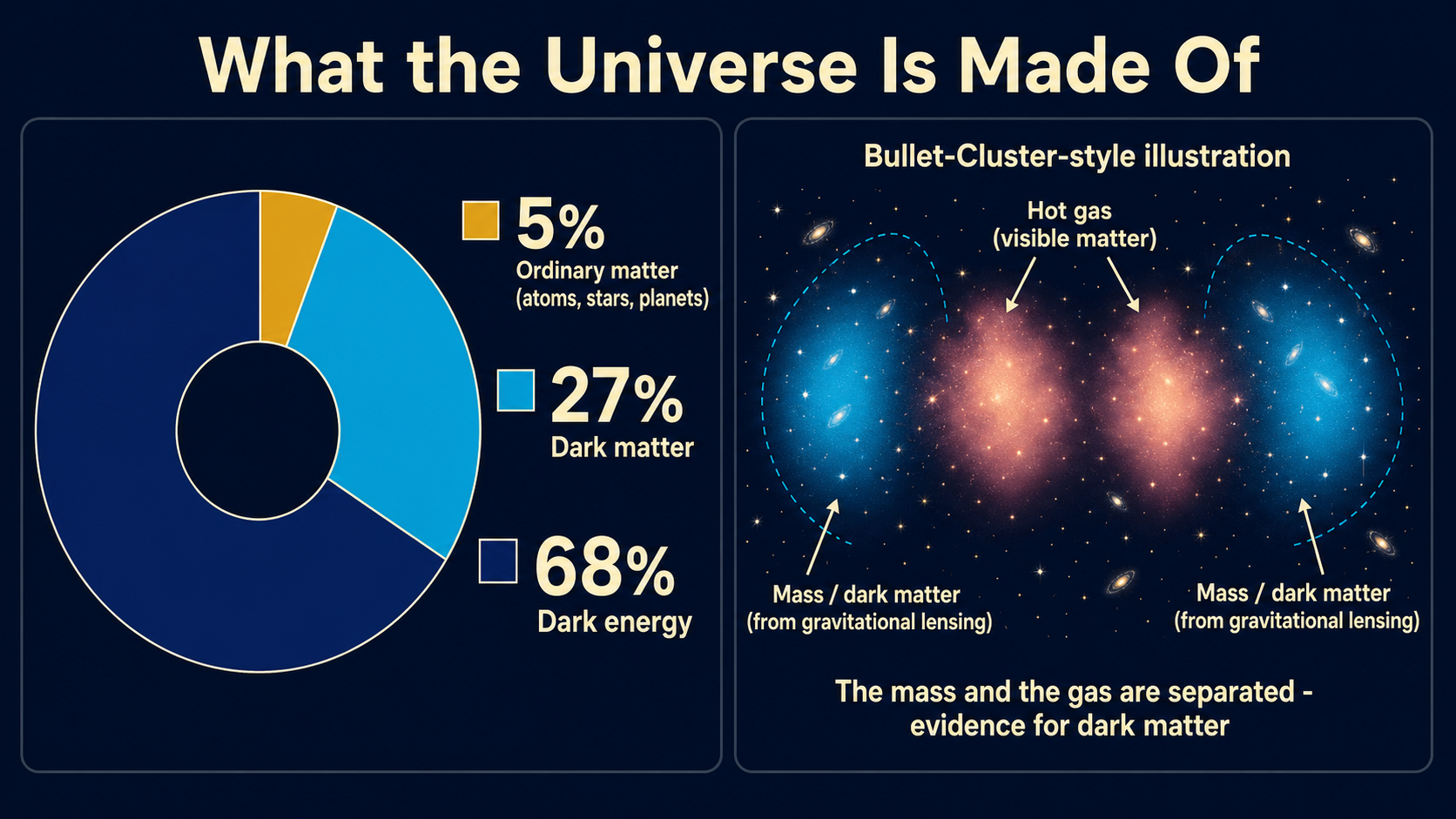
Add up every star, planet, cloud of gas, and atom we can detect, and it comes to roughly 5% of what’s out there. The remaining 95% is two things we’ve measured carefully but cannot identify. Dark matter (~27%) has mass and gravity but emits no light. Dark energy (~68%) is pushing the universe apart faster and faster. The most ordinary thing imaginable, visible stuff, turns out to be the rounding error.
The science
We didn’t guess the 95%. It forced itself on us. In the 1930s Fritz Zwicky noticed galaxy clusters moving too fast to hold together with the matter we could see. In the 1970s Vera Rubin found the same problem inside individual galaxies. Their outer stars orbit just as fast as their inner stars, when they should slow down with distance, the way outer planets do around the Sun. Those flat “rotation curves” mean each galaxy is sitting in a much larger halo of unseen mass. Add light bending around galaxy clusters (gravitational lensing) and the way structure formed after the Big Bang, and the numbers converge. About 27% of the universe is matter that pulls but doesn’t shine. The cleanest evidence is the Bullet Cluster, two clusters that collided. The visible hot gas piled up in the middle, while the gravity, mapped by how it bends background light, sailed straight through with the dark matter, physically separated from the glowing stuff. Searches for what dark matter actually is, new particles mostly, have come up empty so far.
Dark energy is the second surprise and the larger one. In the late 1990s, two teams measuring distant exploding stars expected the universe’s expansion to be slowing under gravity. Instead it’s speeding up. Something with negative pressure, roughly 68% of the total energy budget, is driving galaxies apart at an accelerating rate. We can describe it precisely. We cannot say what it is. It might be the energy of empty space itself, a new field, or a sign that our theory of gravity is incomplete on the largest scales. (The Book notes the famous figure that the predicted vacuum energy is ~10¹²⁰ times too large, physics’ worst prediction. That’s the naive estimate, and the real mismatch depends on assumptions, but by any honest accounting it’s enormous and unexplained.) Put plainly, we are made of the 5% we understand, and we’re surrounded by 95% we can only point at.
What this changes about how you picture reality
The default picture is a universe made of stars and planets with some empty space between them, and that picture is almost exactly backwards. The stars and planets are the trim. The structure is invisible. Every galaxy you’ve ever seen in a photograph is the bright froth on top of a dark mass you can’t photograph at all, and the whole thing is being stretched apart by something that has no name beyond a placeholder. What’s striking is that none of this is mysticism or hand-waving. We know the proportions to within a percent or two, from several independent lines of evidence that didn’t have to agree but do. That’s the earned awe here. Not “the universe is unknowable,” but the much sharper feeling of holding a precise, confident measurement of our own ignorance. We can weigh the dark. We just can’t say what we’ve weighed.
Two ways to see it
Put two genuinely different framings in front of the room, rather than a clip and its echo.
- “It’s stuff we haven’t caught yet” (the particle view). Most physicists expect dark matter to be a real, so-far-undetected particle, and dark energy to be the energy of the vacuum. On this reading the gaps are in our catalog, not our laws. The best visual anchor is the Bullet Cluster lensing overlay, where mass and visible matter are caught in the act of separating. This is the mainstream, we’ll-find-it stance.
- “Maybe our theory is wrong” (the modified-gravity view). A minority of serious physicists argue the dark sector might be a sign that gravity itself behaves differently at galactic and cosmic scales, and that we’re inventing invisible matter to patch an incomplete equation. The Book points to Erik Verlinde’s “emergent gravity” as one such attempt, which reproduces some galaxy observations without dark-matter particles but struggles with galaxy clusters. Here the missing pieces are in the map, not the territory.
The productive tension is that both camps look at the same rotation curves and lensing data and read them oppositely. That disagreement runs among experts, in public, without resolution, and it is itself the most honest thing about the field.
Discussion questions
- We can measure something to within a percent or two and still have no idea what it is. Does that feel like knowledge, or like a sophisticated way of admitting we don’t know?
- If 95% of reality is invisible to us, how much should that shake your confidence in the picture of the world you carry around day to day?
- Two groups of smart people look at identical data and conclude opposite things, new particle versus wrong theory of gravity. How do you, as a non-expert, decide which to lean toward, or should you?
- Naming something can make it feel explained when it isn’t, and “dark matter” and “dark energy” are labels more than answers. Where else in life do we put a label on a mystery and then stop looking?
- Does it bother you more that we can’t see most of the universe, or that the part we can see is the small, atypical exception?
- A century ago we didn’t know any of this existed. What’s your honest guess about how much of the 95% we’ll actually understand in your lifetime, and does the answer change how you feel about it?
Closing question
How do you feel about this science and its understanding of reality?
Take it further
- The Book, v10, “Dark Matter & Dark Energy,” lines 640–654 (the 5/27/68 split, Bullet Cluster, the 10¹²⁰ cosmological-constant problem). Citations [C-009] dark matter, [C-010] dark energy, [C-059] Bullet Cluster.
- The Book, v10, line 8602. Vera Rubin and Fritz Zwicky as the original observational evidence for dark matter, from rotation curves and cluster dynamics.
- The Book, v10, lines 1364–1370. Verlinde’s emergent-gravity alternative, useful for the “maybe the theory is wrong” framing. The Book is candid that it’s promising at galaxy scale but weak at cluster scale.
- The Book, v10, lines 5322 and 5332. The Vera C. Rubin Observatory (LSST) and the Nancy Grace Roman Space Telescope, the two surveys now tightening the dark-matter and dark-energy numbers.
- External pointers, real and widely available. The Bullet Cluster result (Clowe et al., 2006) is the standard go-to image and write-up for dark matter caught separating from visible matter. For the accelerating-universe discovery, the 1998–99 supernova results (Perlmutter, Riess and Schmidt) won the 2011 Nobel Prize in Physics, which makes a good verifiable anchor. Uncertainty flag. The 5/27/68 percentages come from Planck-satellite cosmology and are quoted with small error bars. Treat them as “about” these values, and expect them to be refined rather than overturned by Rubin, Roman and Euclid over the next decade.
Visual notes
Anchor the room on three images, in order.
- The 5/27/68 pie chart. Open with this. It does the whole argument in one glance, and the thin sliver labeled “everything we can see” is the hook.
- A galaxy rotation curve. The flat line where physics predicts a falling one. This is the why-we-believe-in-dark-matter-at-all slide, so pair it with Rubin’s name.
- The Bullet Cluster lensing overlay. The colored mass map (gravity) sitting beside the X-ray gas (visible matter). This is the closer. It’s the single most persuasive picture in the dark-sector case, and it’s where the particle view and the modified-gravity view sharpen against each other.
Keep dark energy mostly verbal. There’s no clean snapshot of it, which is itself worth saying out loud. We can picture dark matter’s effects, but the 68% that’s driving everything apart has no portrait at all.
Sit with it
How do you feel about this science and its understanding of reality?
We sit with this together, out loud, at the session.