Explore the ideas
The library
201 ways into the natural world, from illustrations and diagrams to the thinkers behind them. It's the same material we draw on in the room. Filter by track, or search the whole collection.
All entries
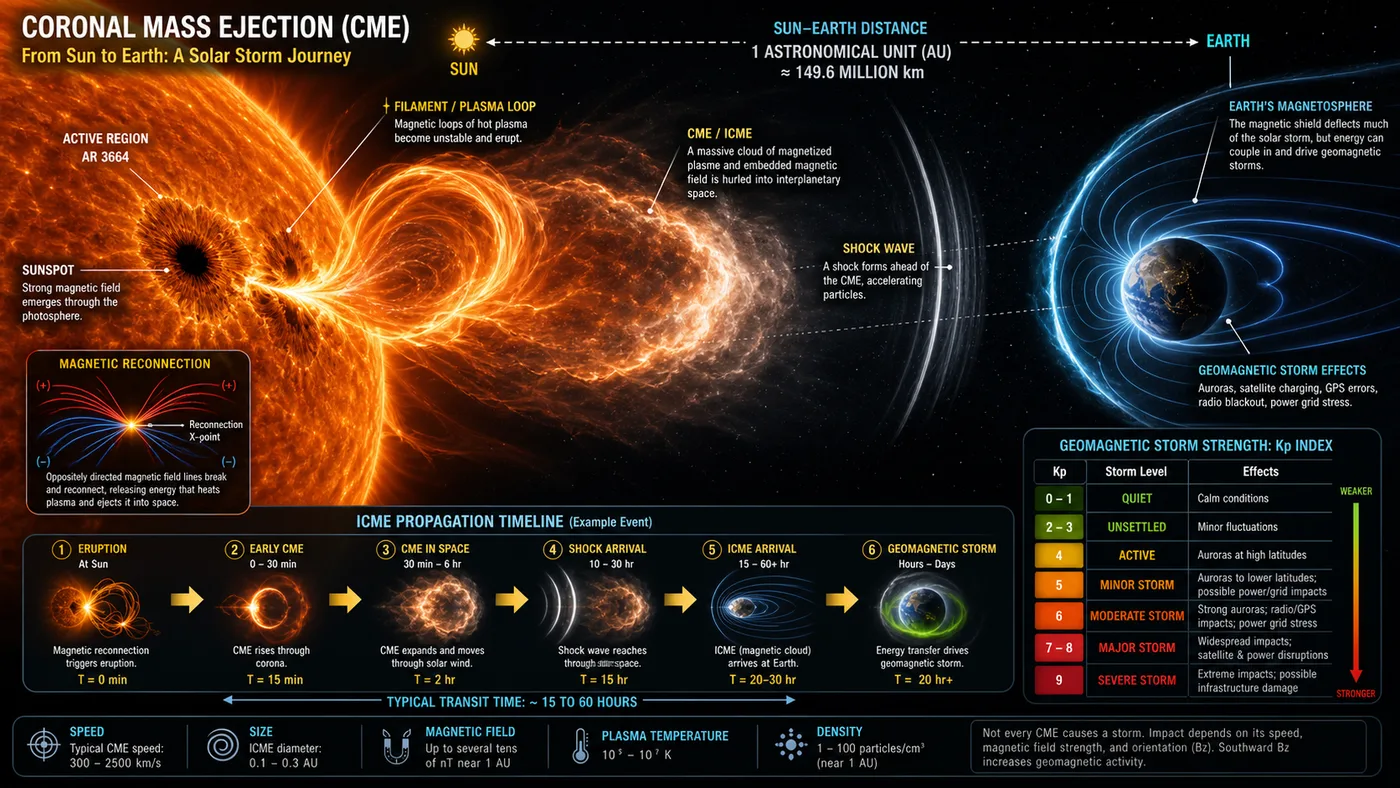
A coronal mass ejection erupting from an active sunspot
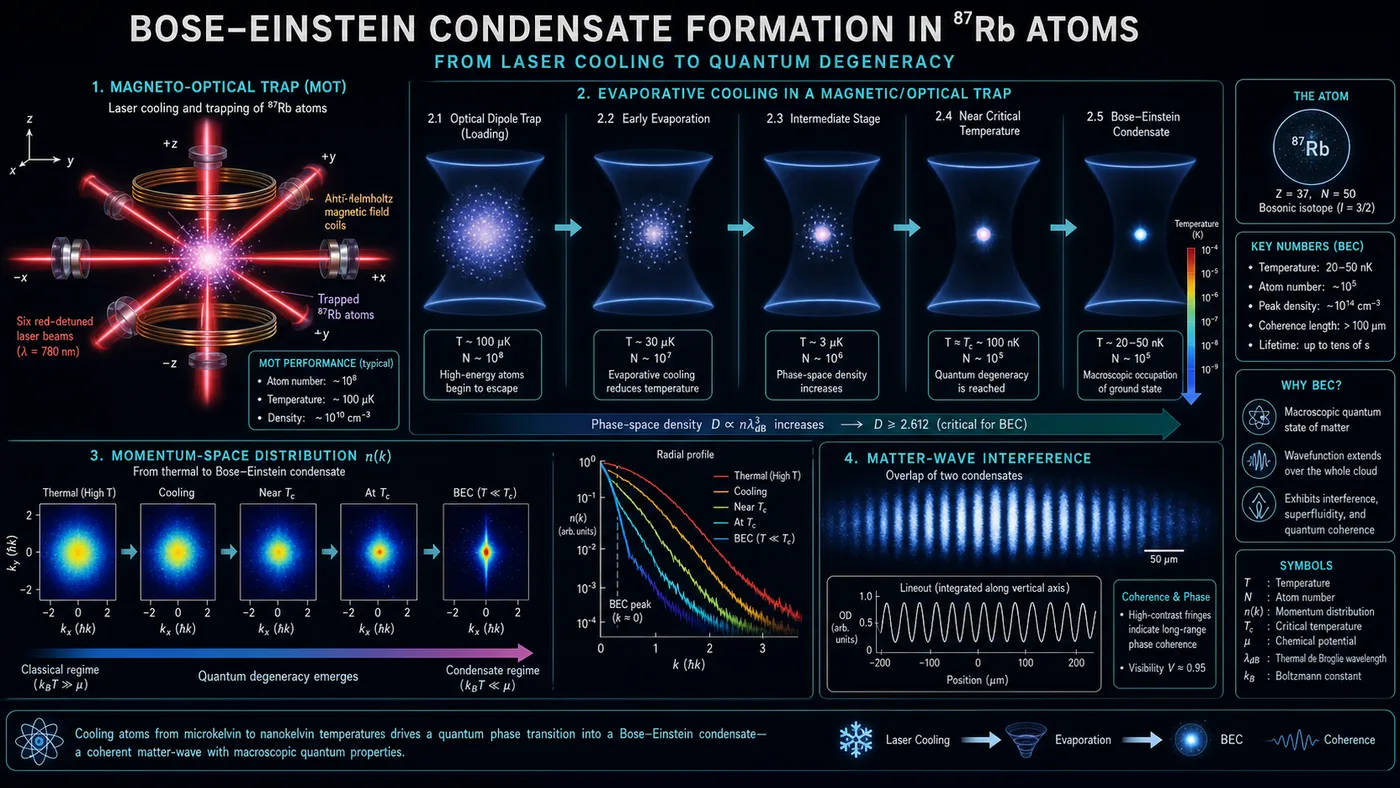
Bose-Einstein condensate formation in laser-cooled rubidium-87 atoms
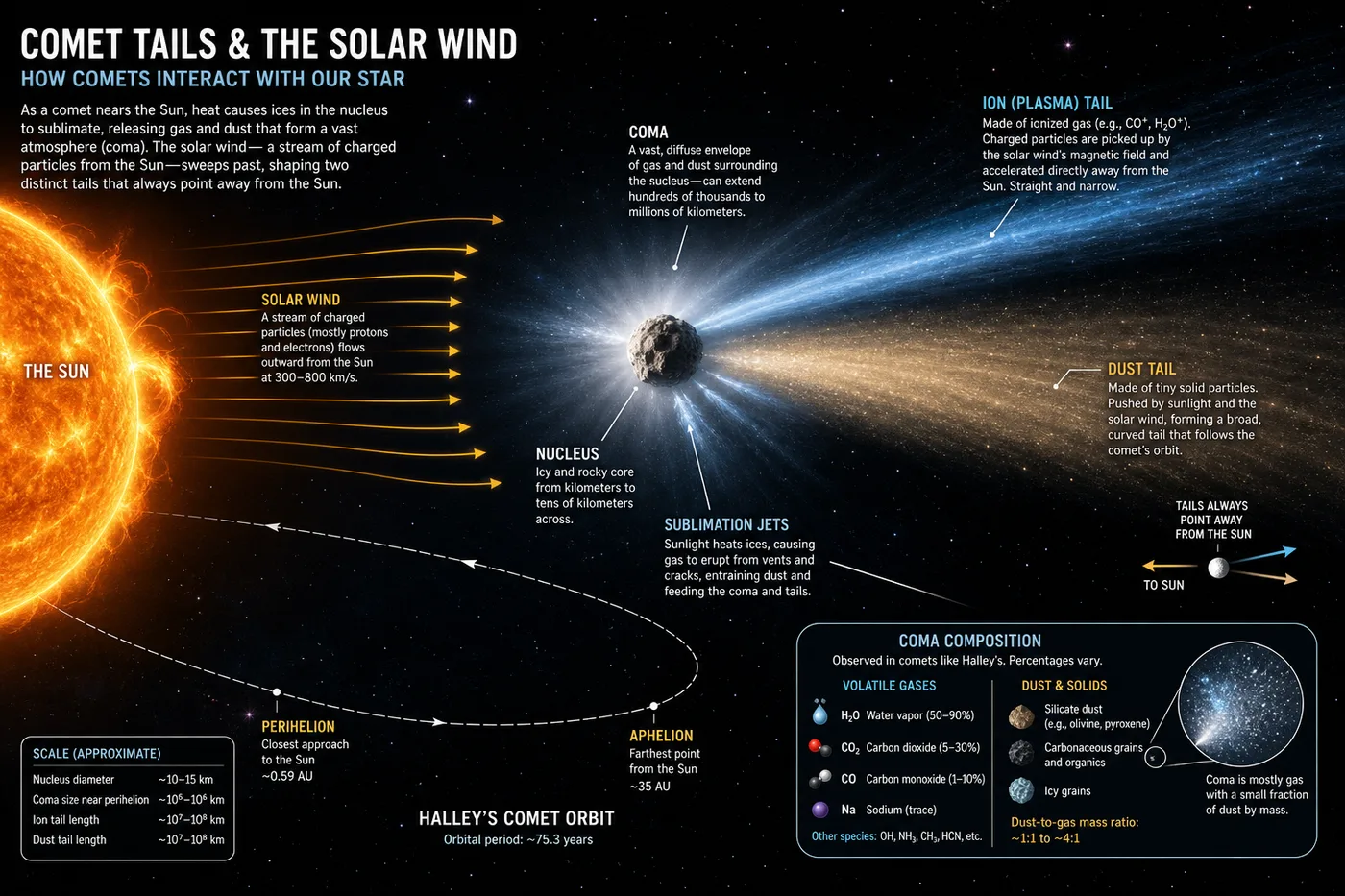
Comet tails interacting with the solar wind
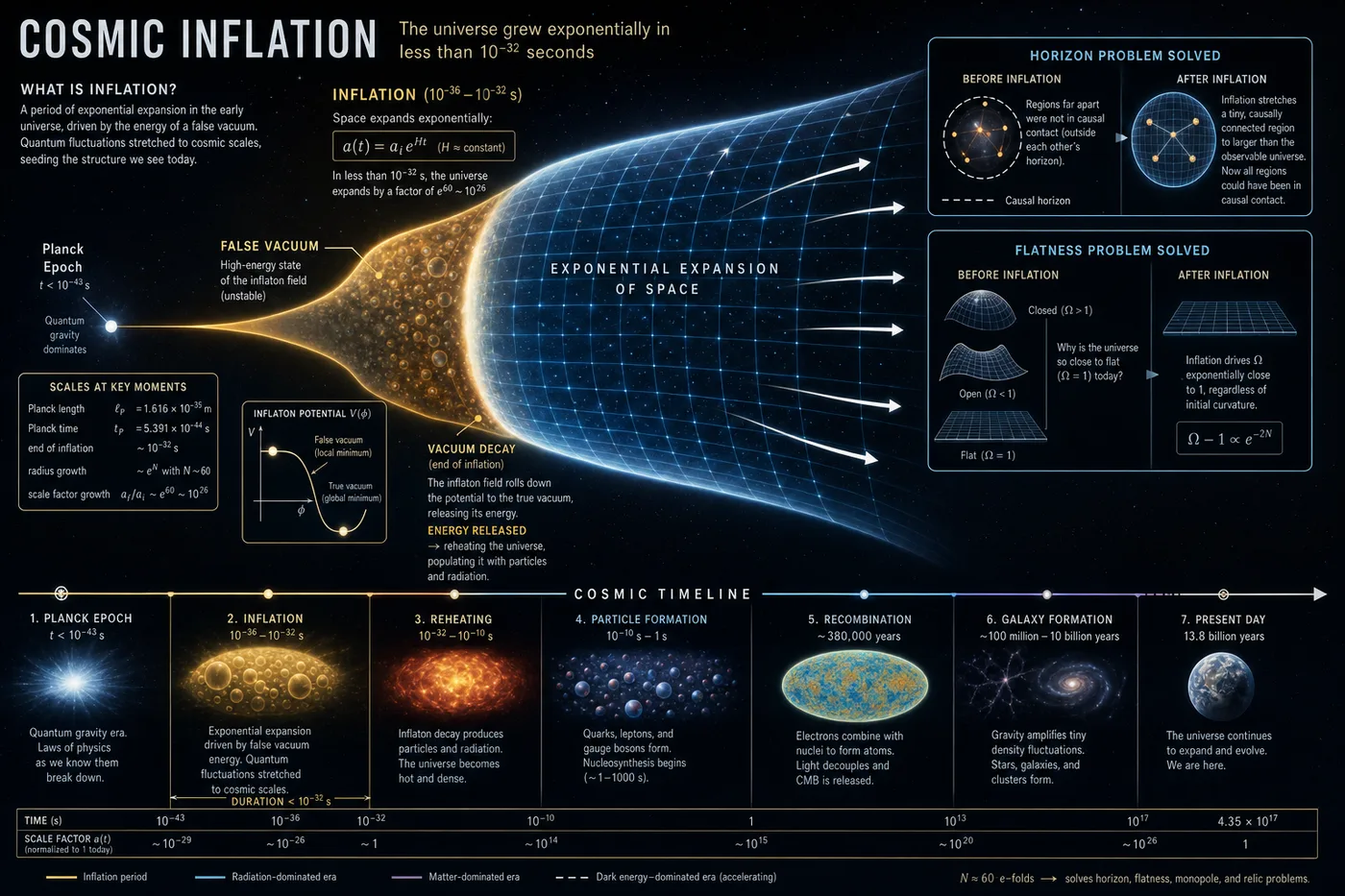
Cosmic inflation in the first 10⁻³² seconds after the Big Bang
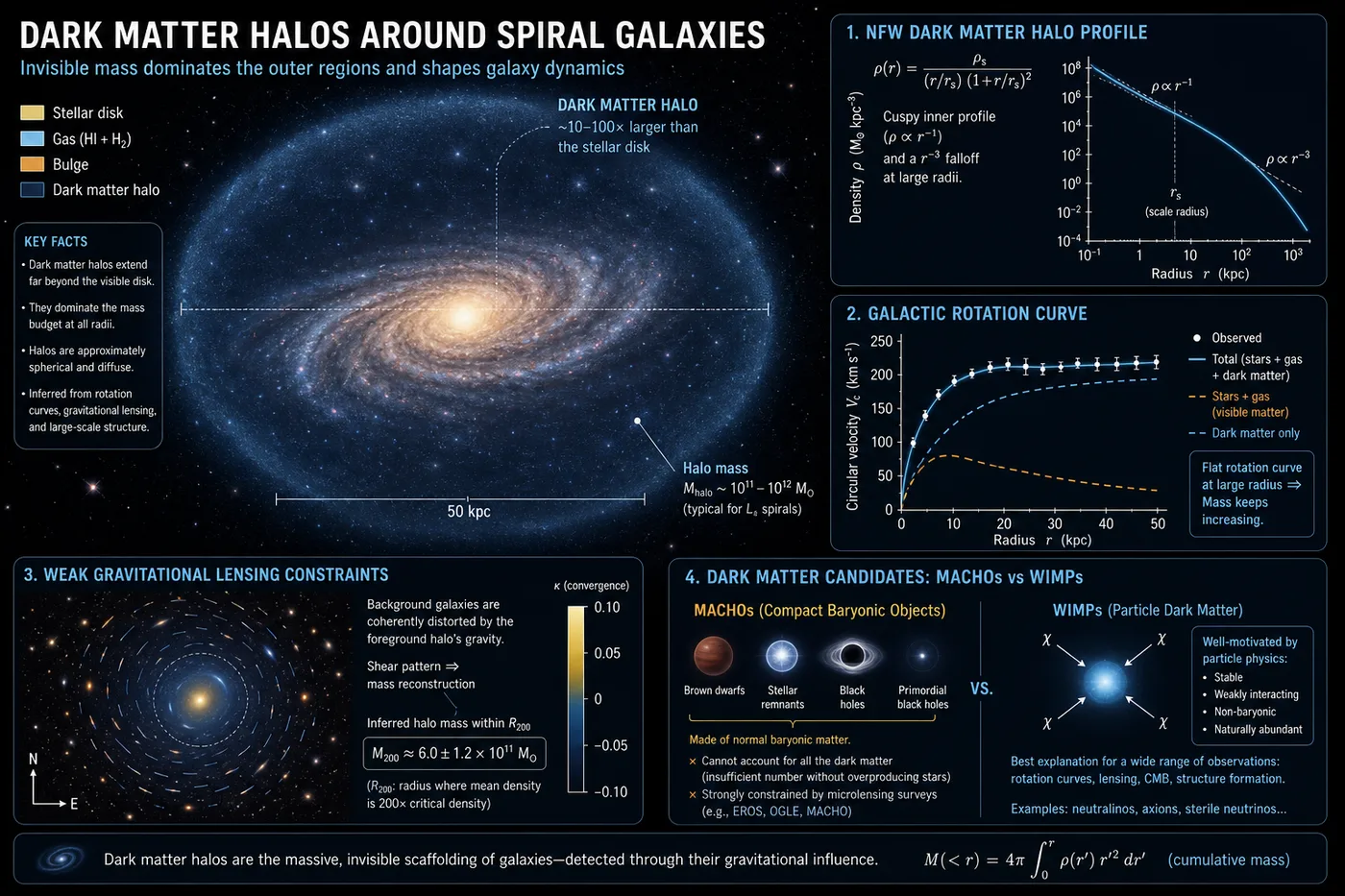
Dark matter halo distribution around spiral galaxies
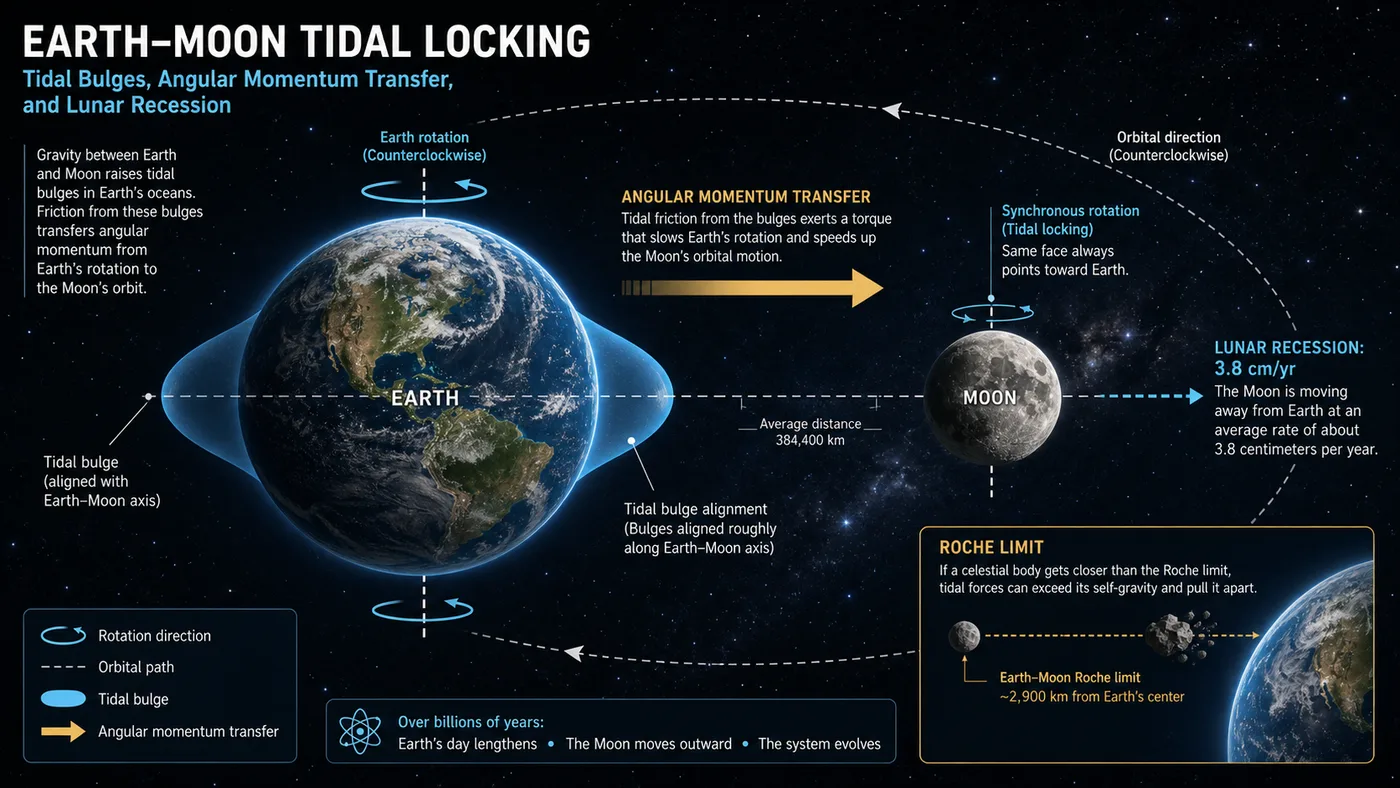
Earth-Moon tidal locking and tidal bulge mechanics
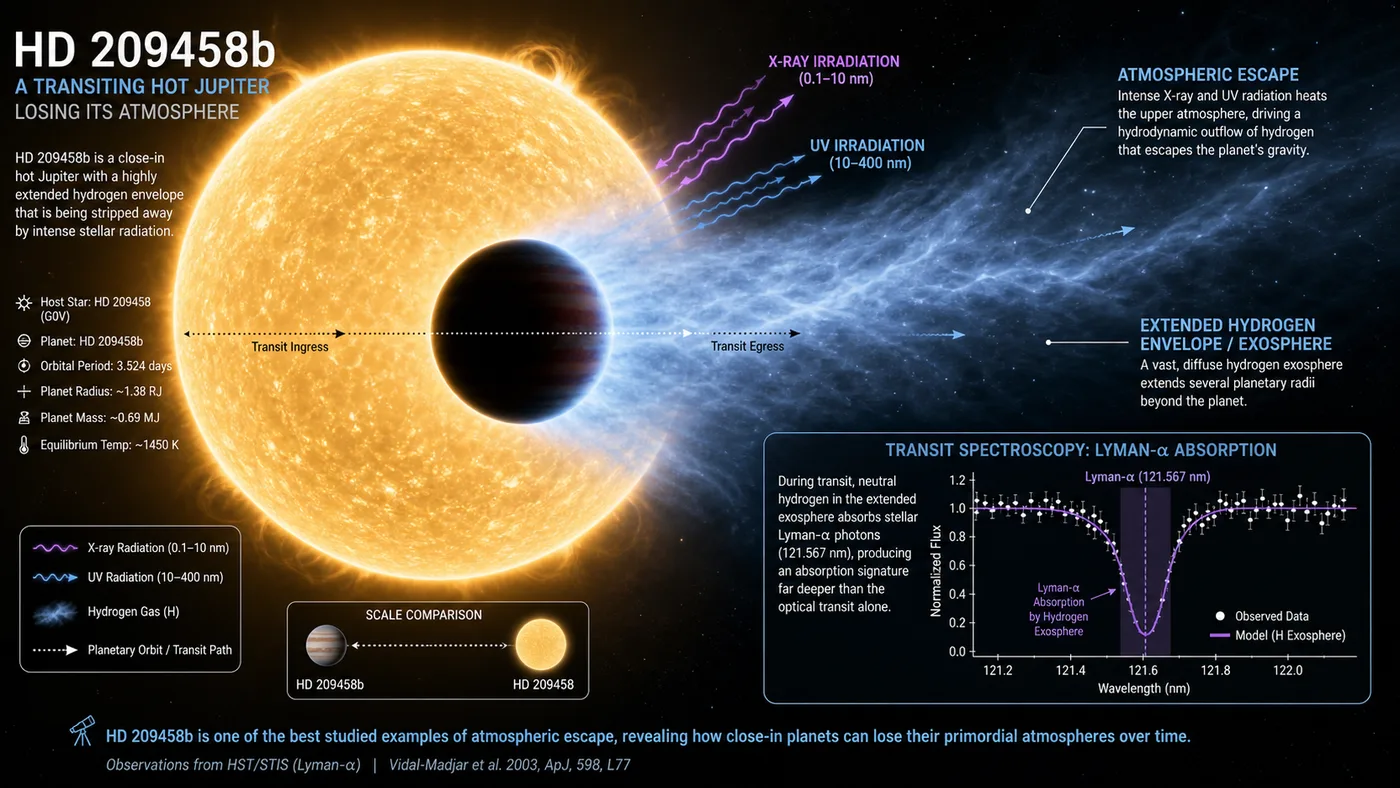
Hot Jupiter exoplanet atmospheric escape
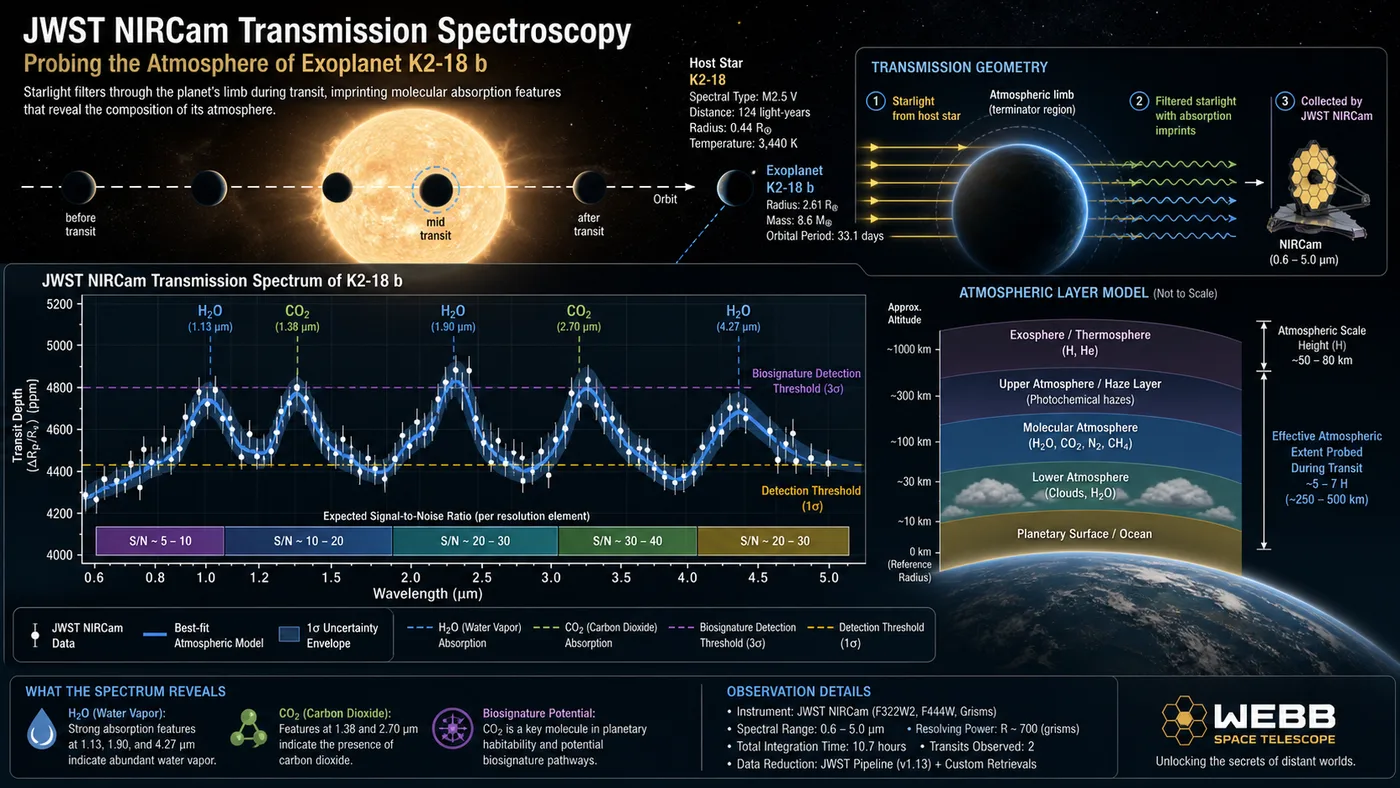
JWST NIRCam transmission spectroscopy of an exoplanet atmosphere
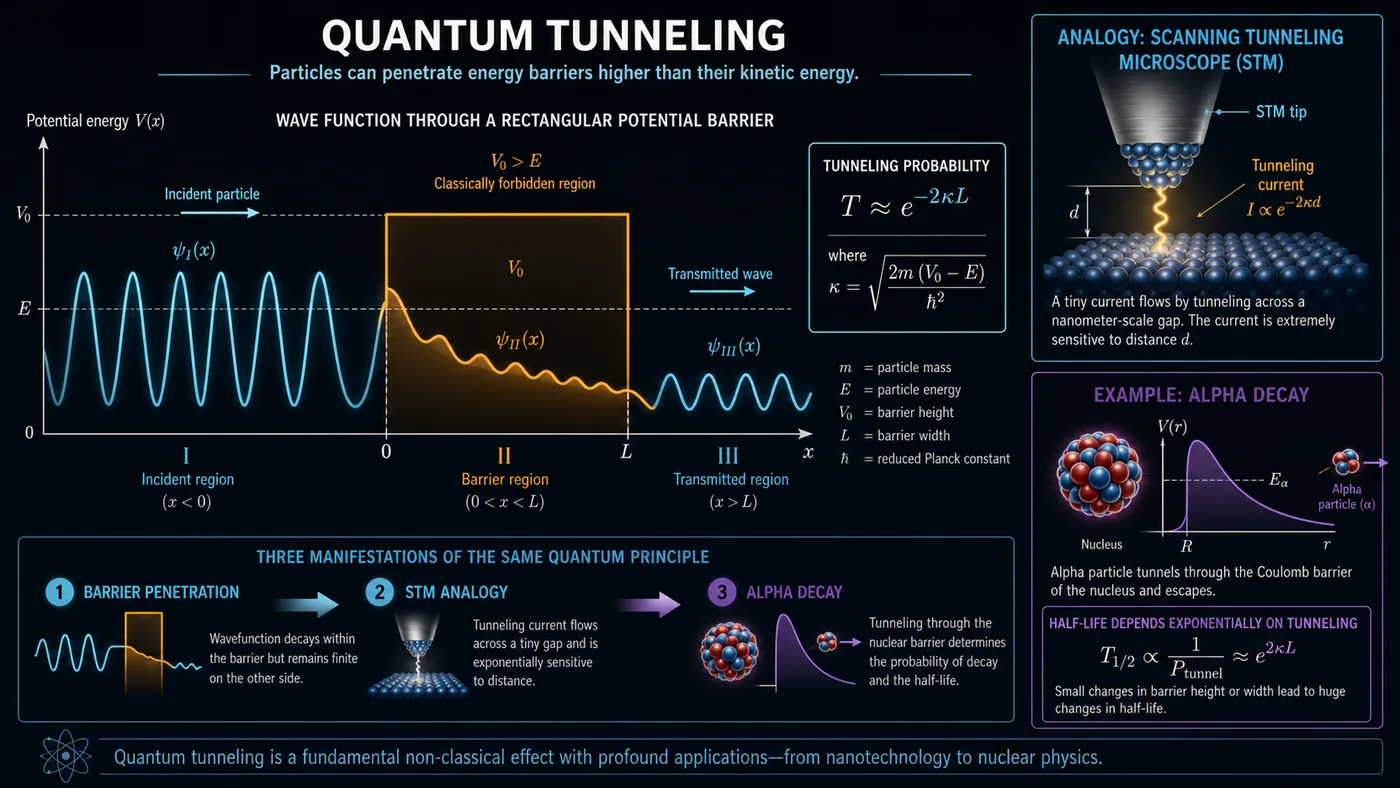
Quantum tunneling through a potential barrier
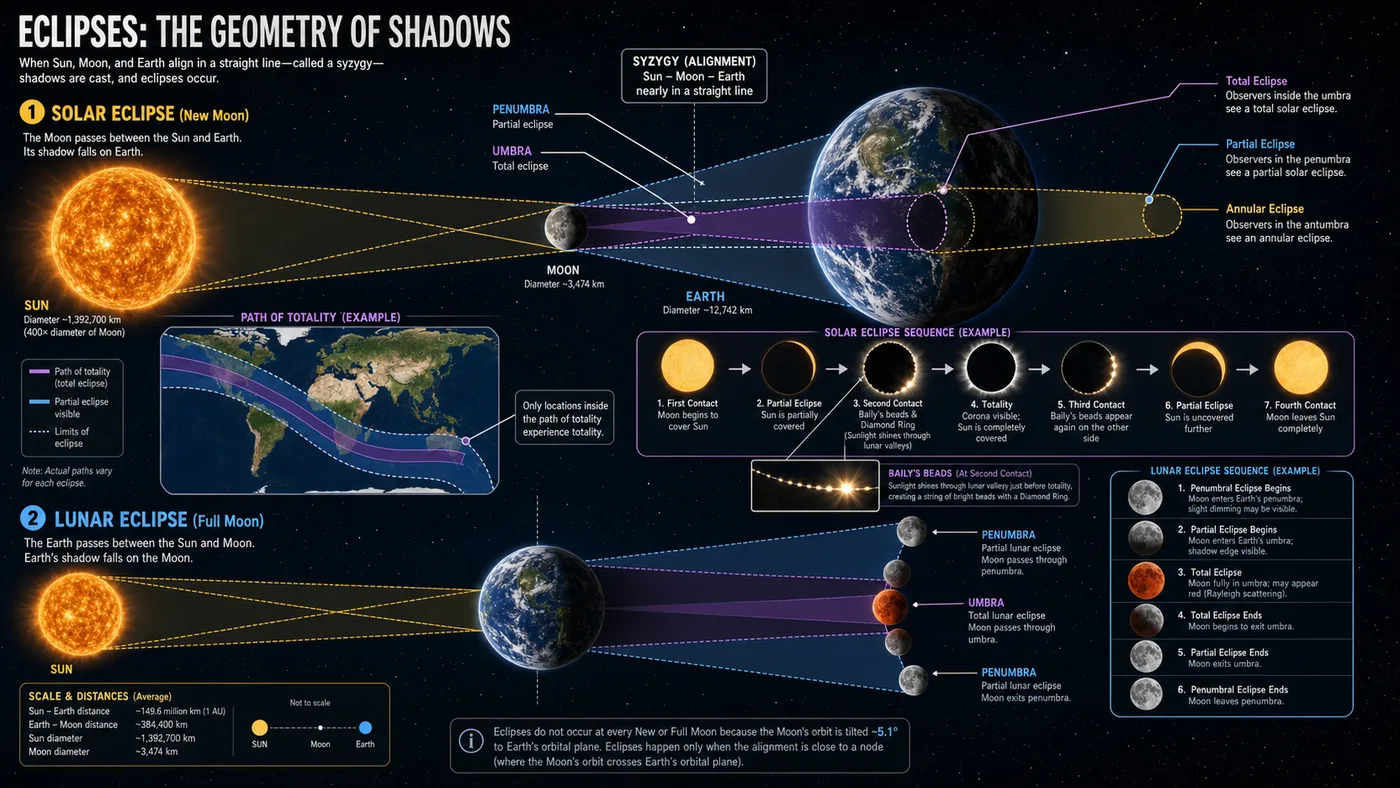
Solar and lunar eclipse geometry
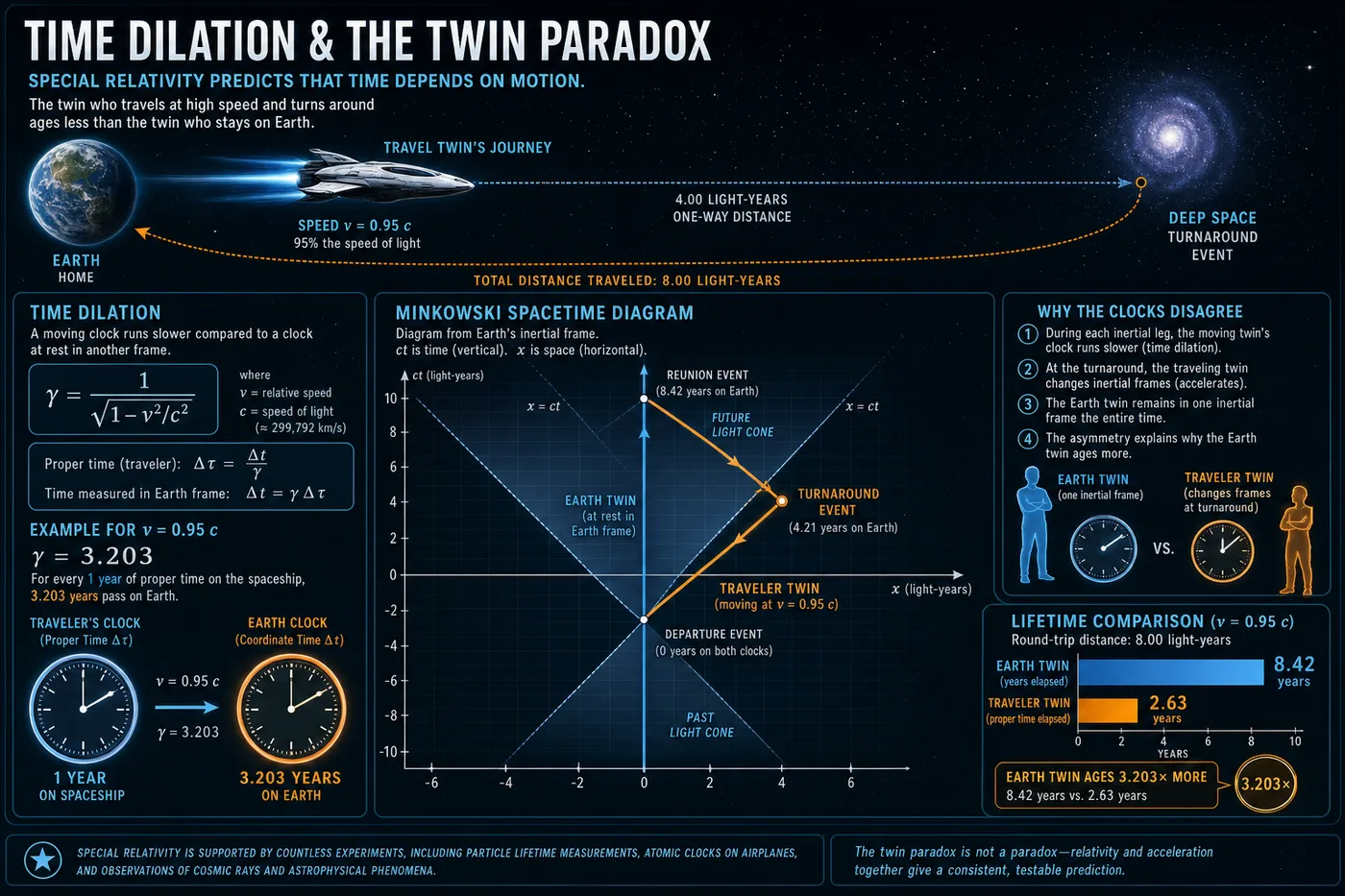
Special relativity time dilation and the twin paradox
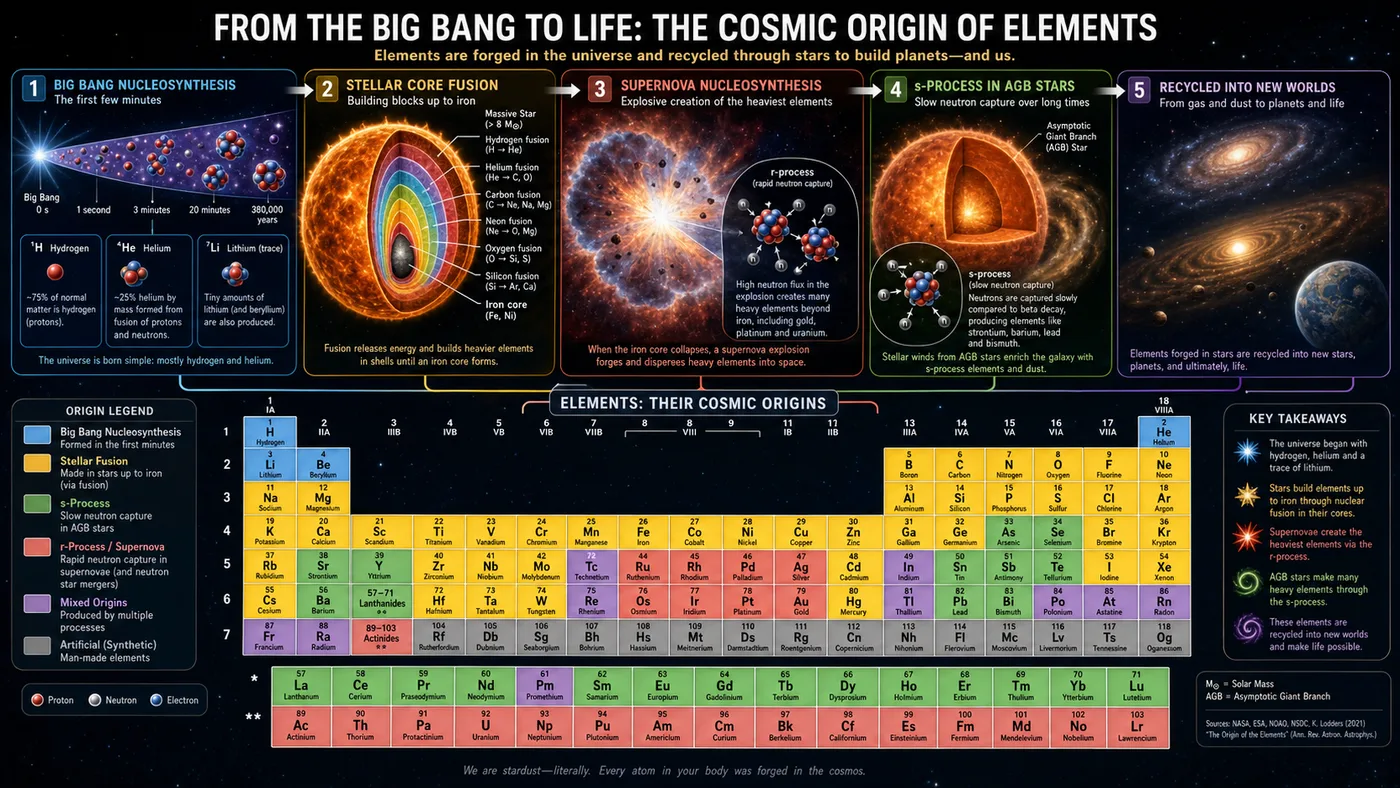
Stellar nucleosynthesis and the cosmic origin of elements
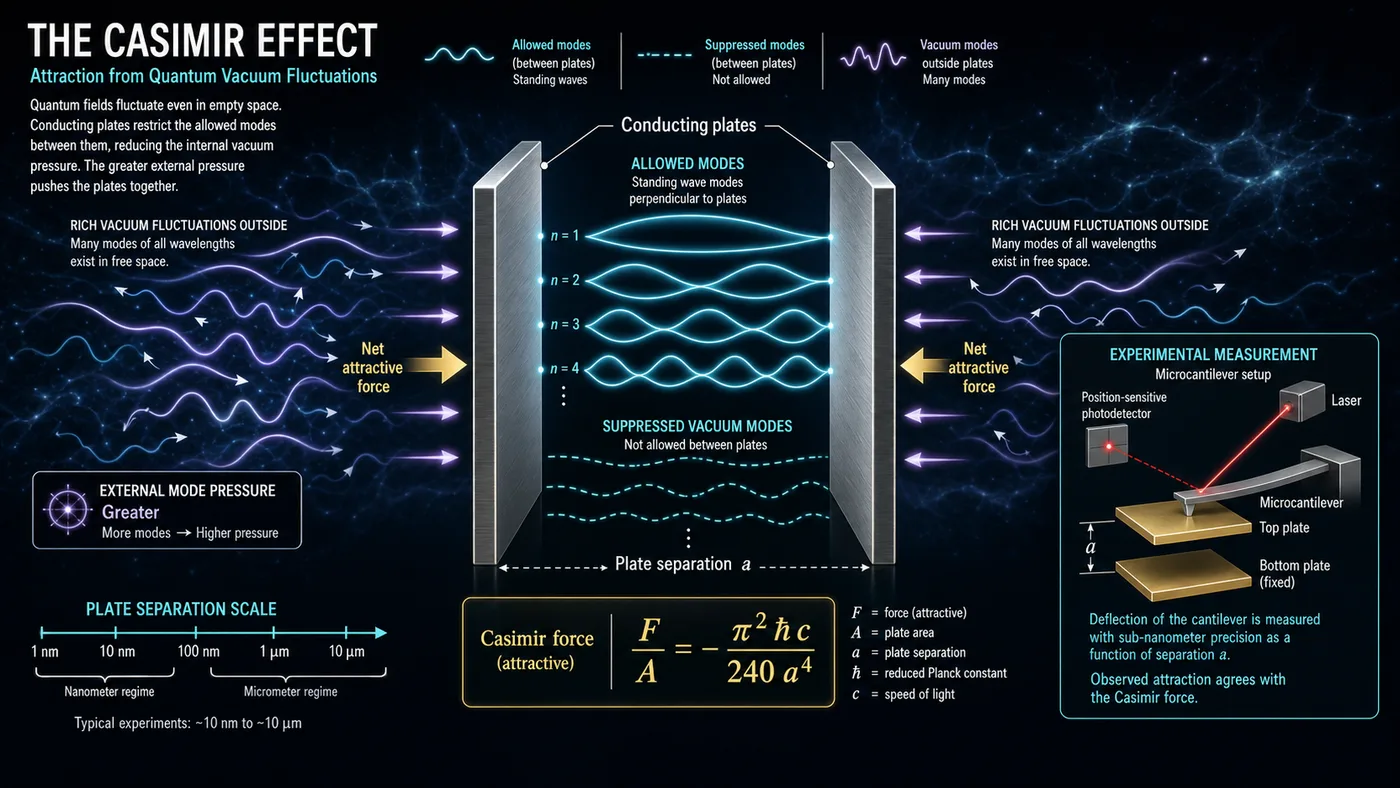
The Casimir effect from quantum vacuum fluctuations
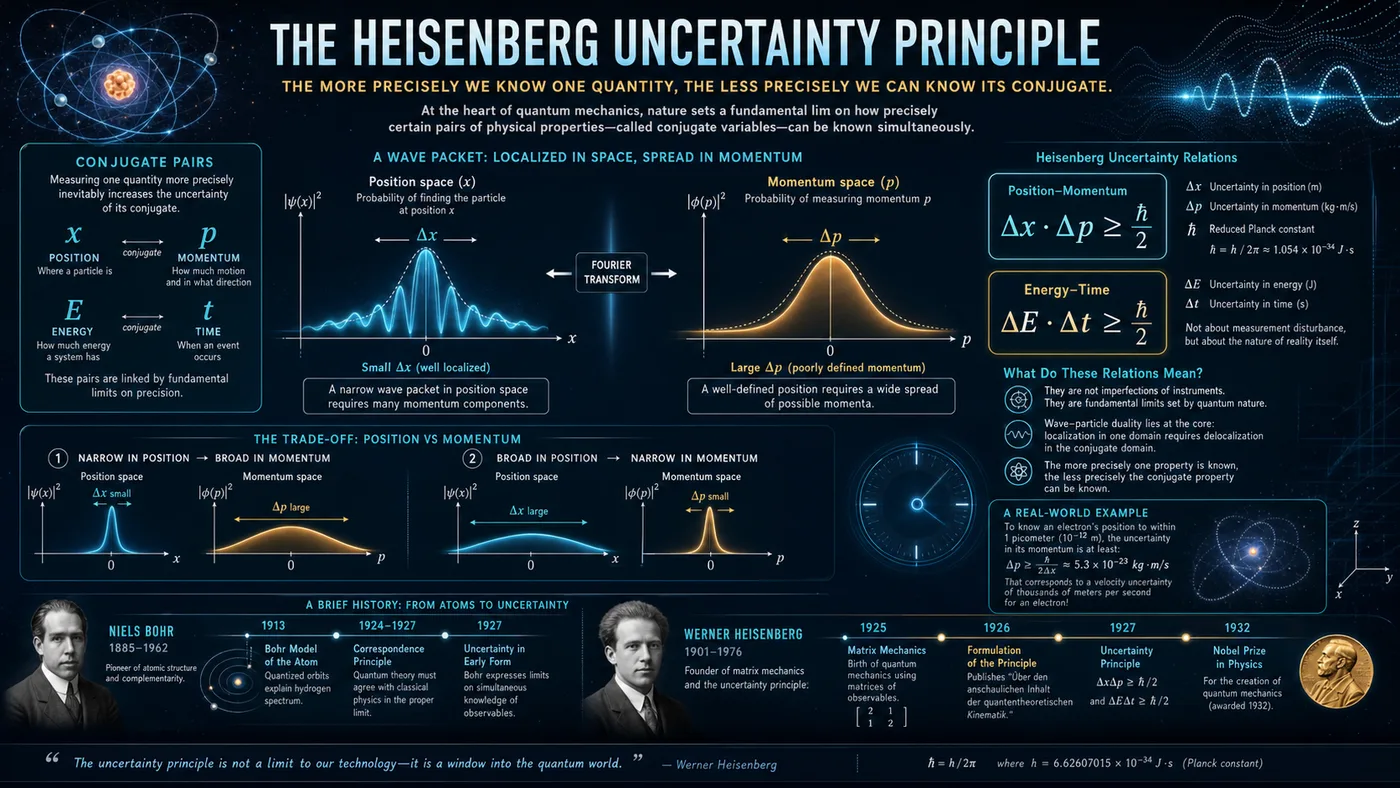
The Heisenberg uncertainty principle
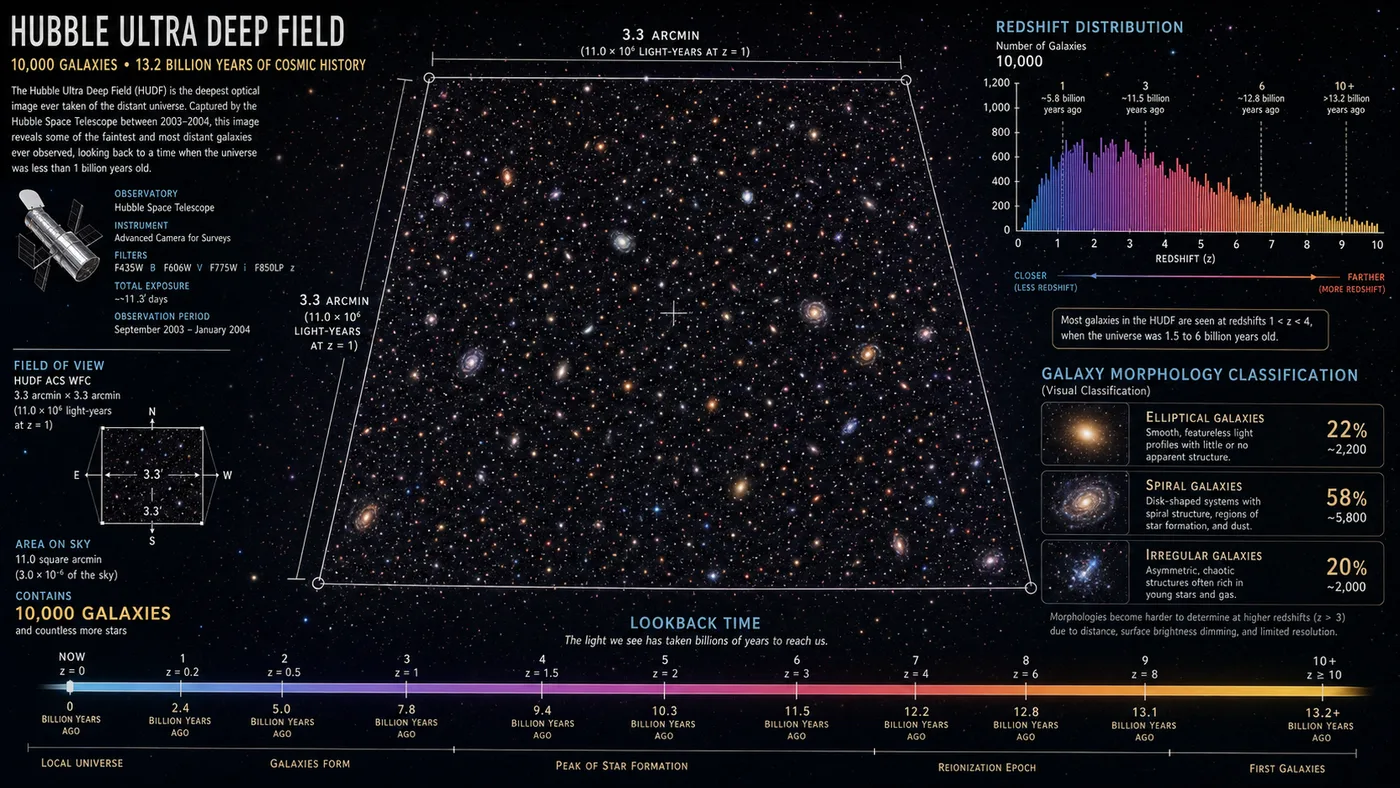
The Hubble Ultra Deep Field showing 10,000 galaxies
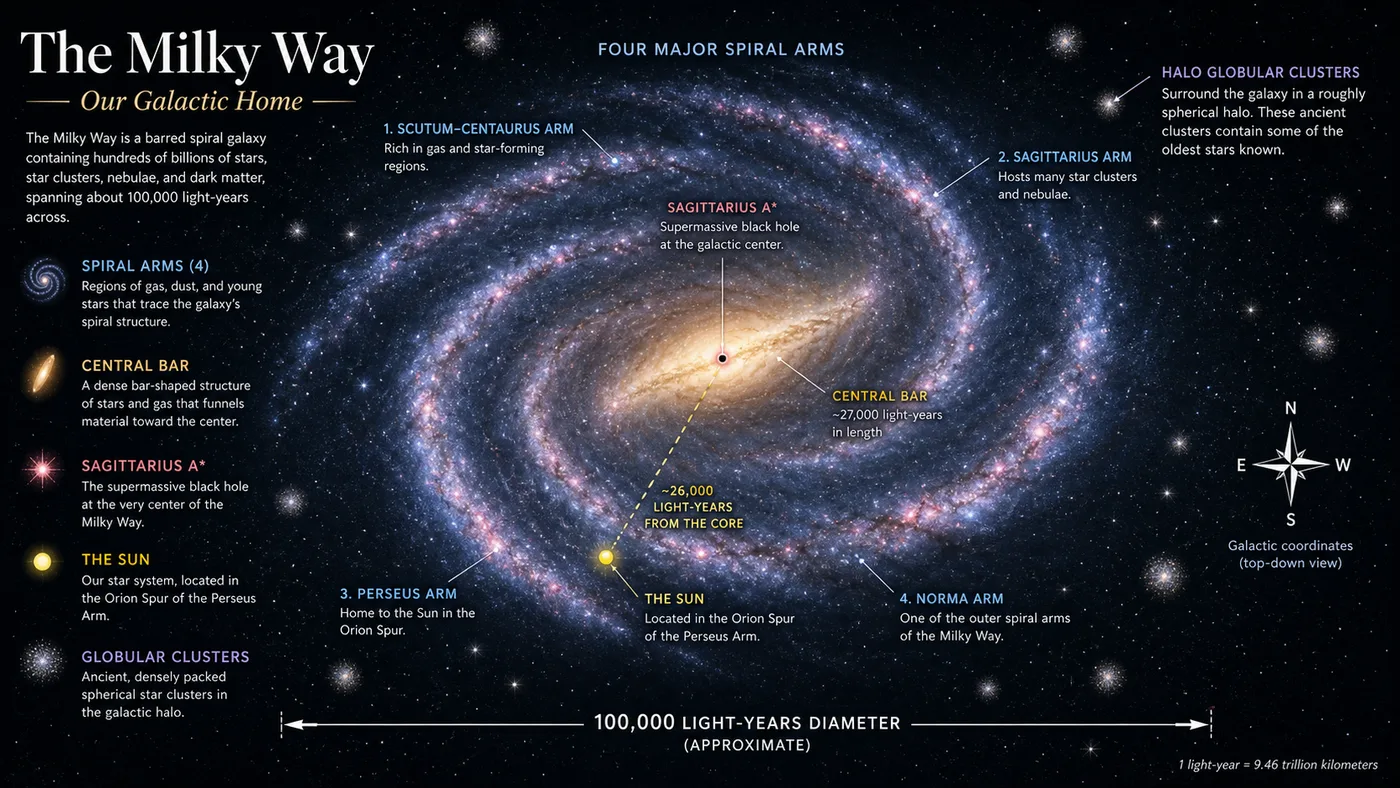
The Milky Way's galactic structure
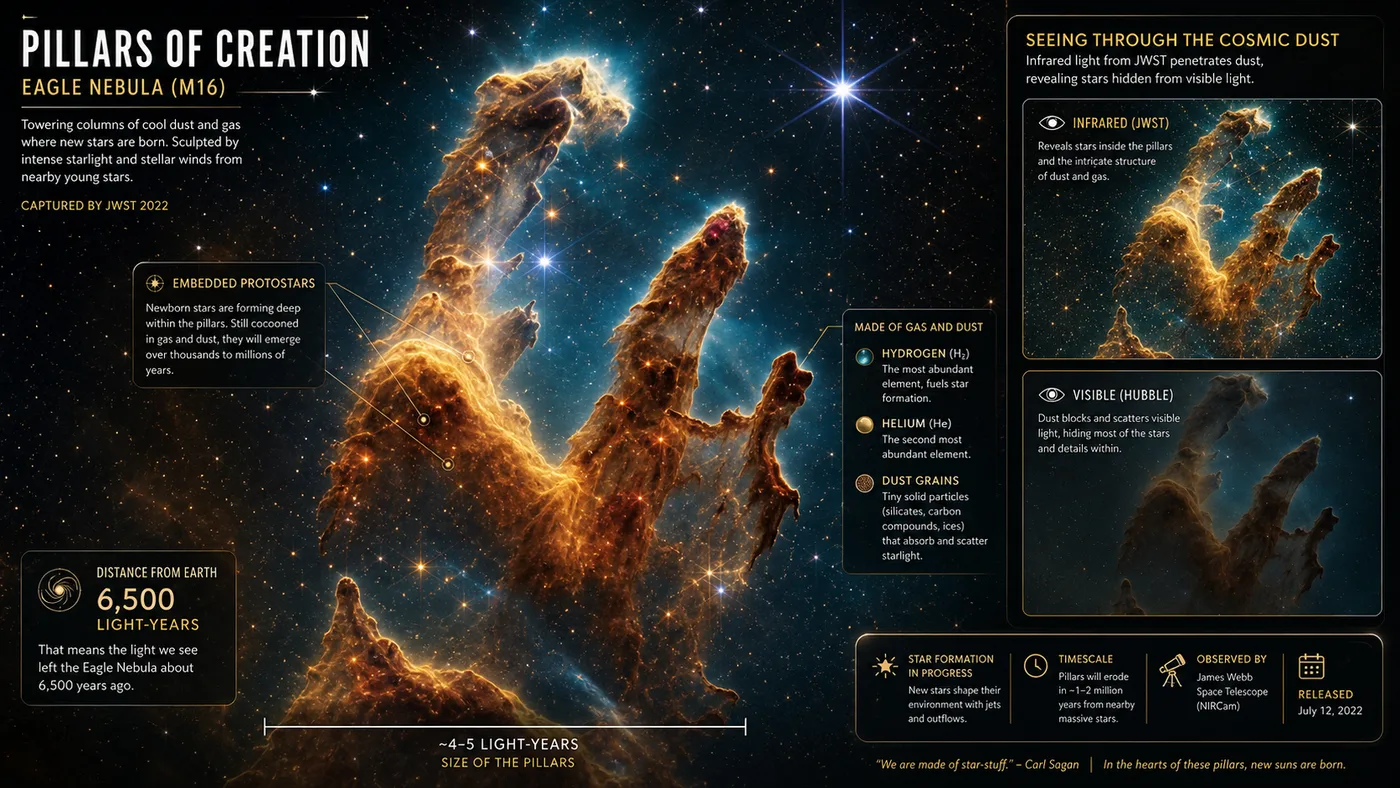
The Pillars of Creation imaged by JWST in 2022
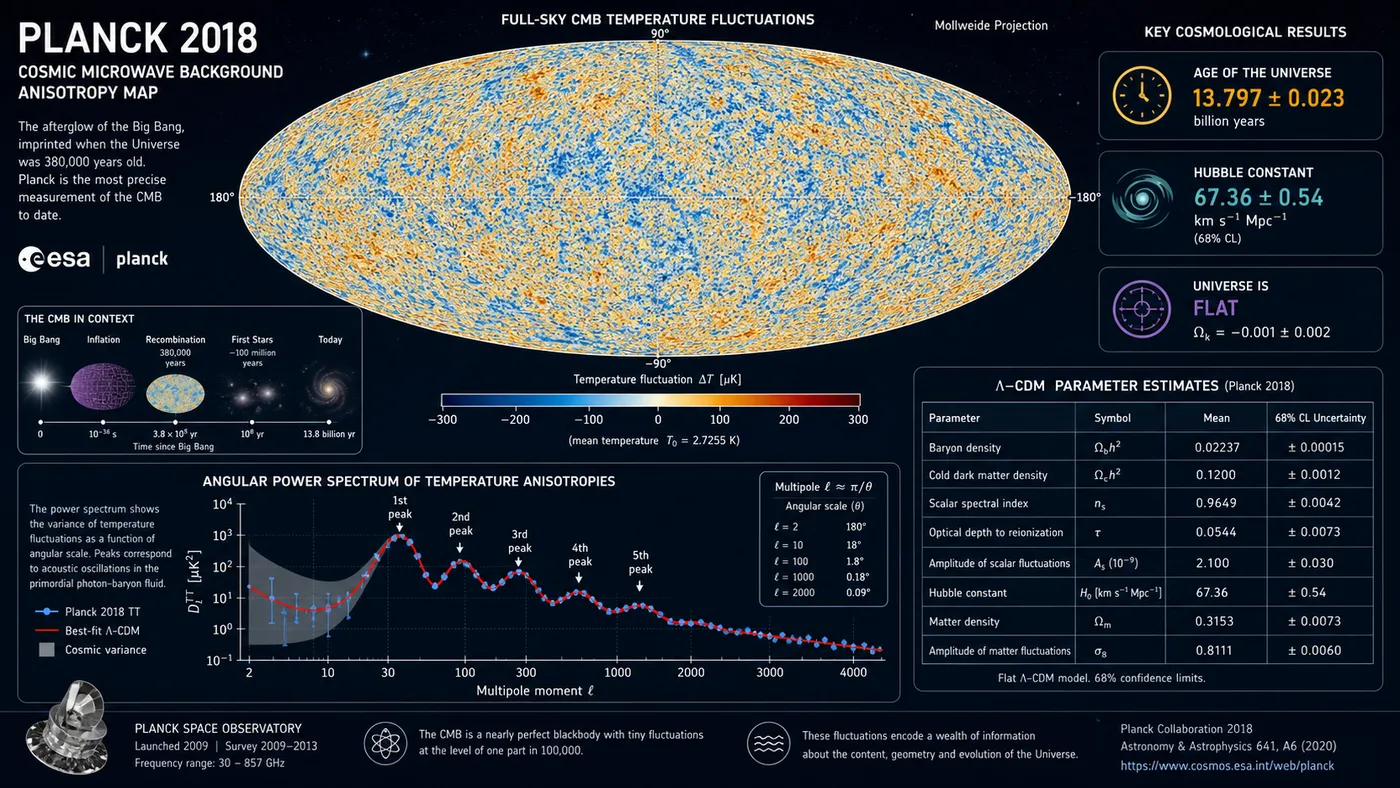
The Planck 2018 cosmic microwave background anisotropy map
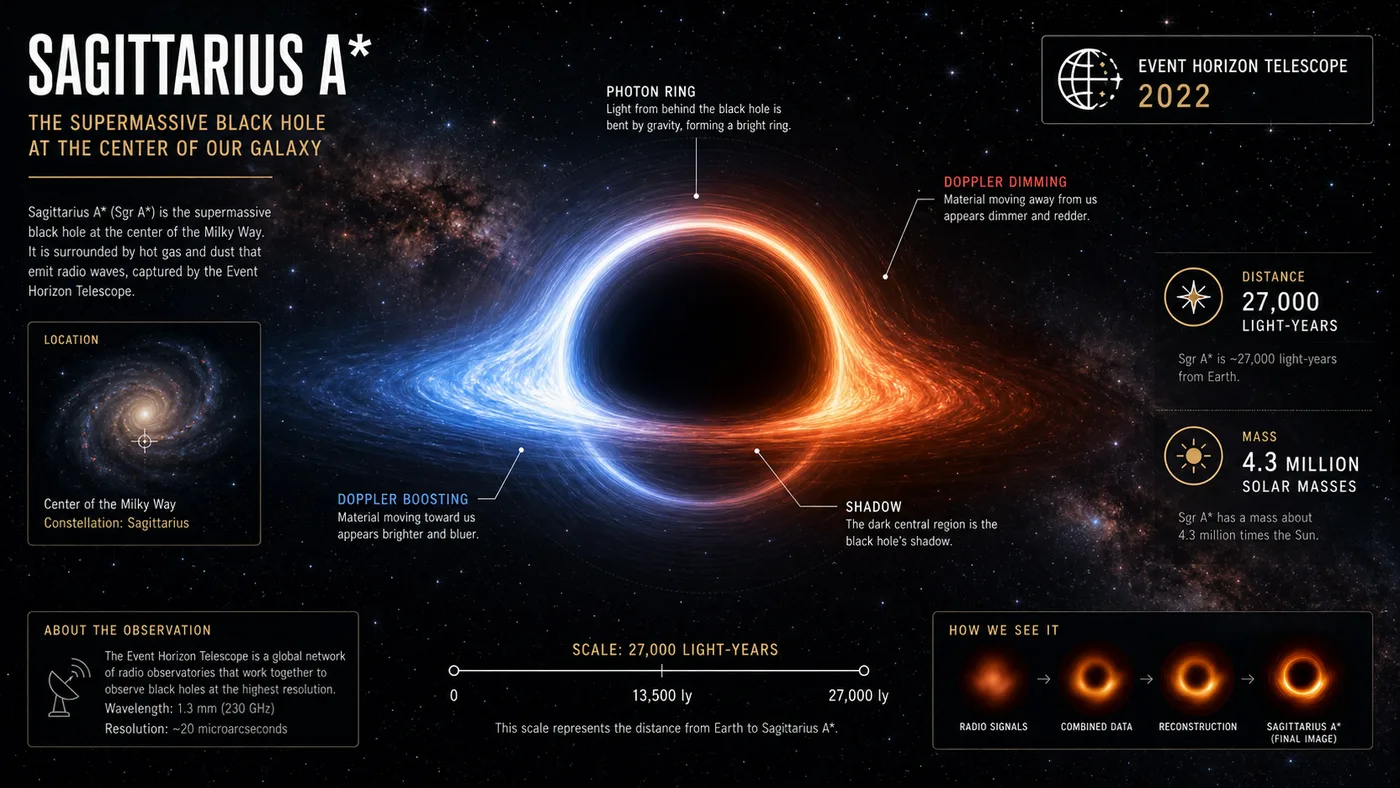
The Sagittarius A* supermassive black hole imaged by the Event Horizon Telescope
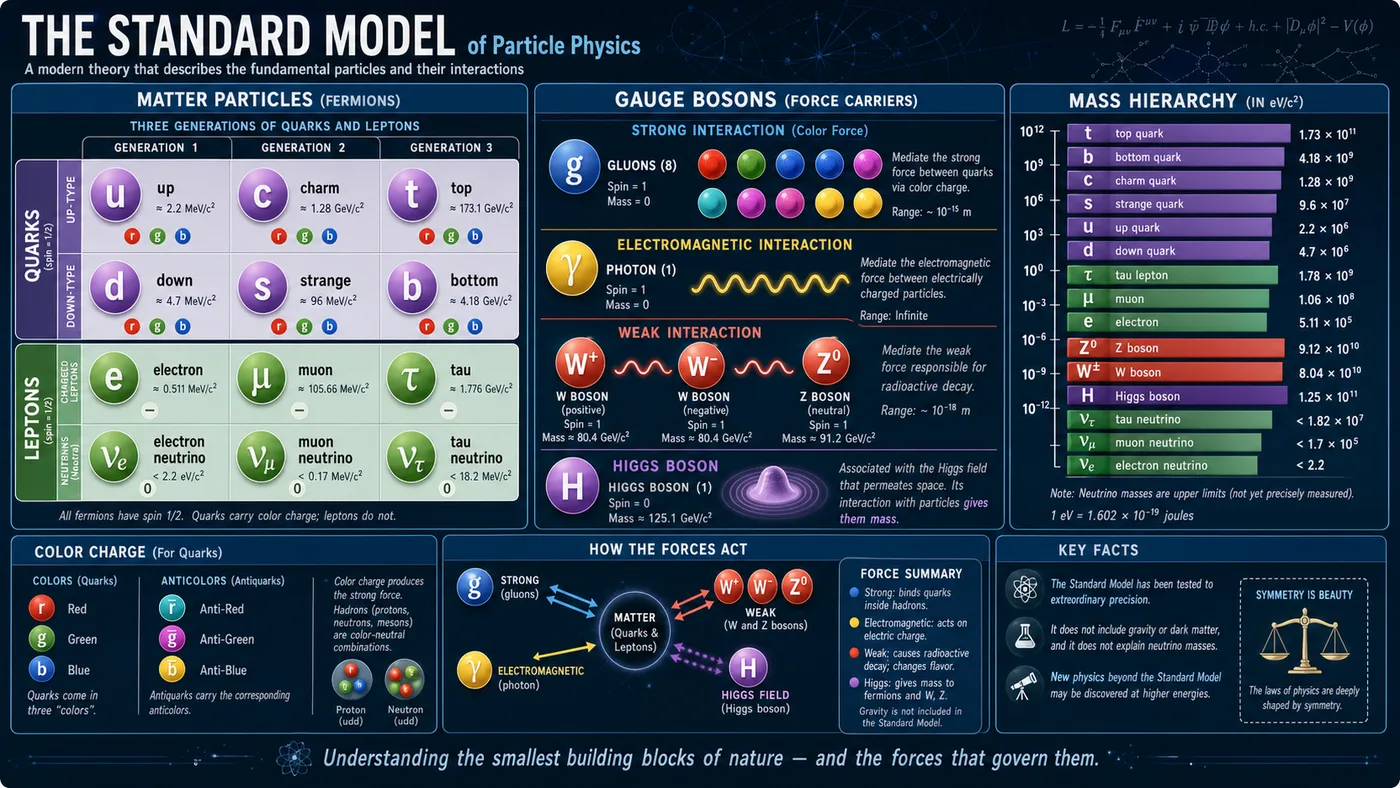
The Standard Model of particle physics
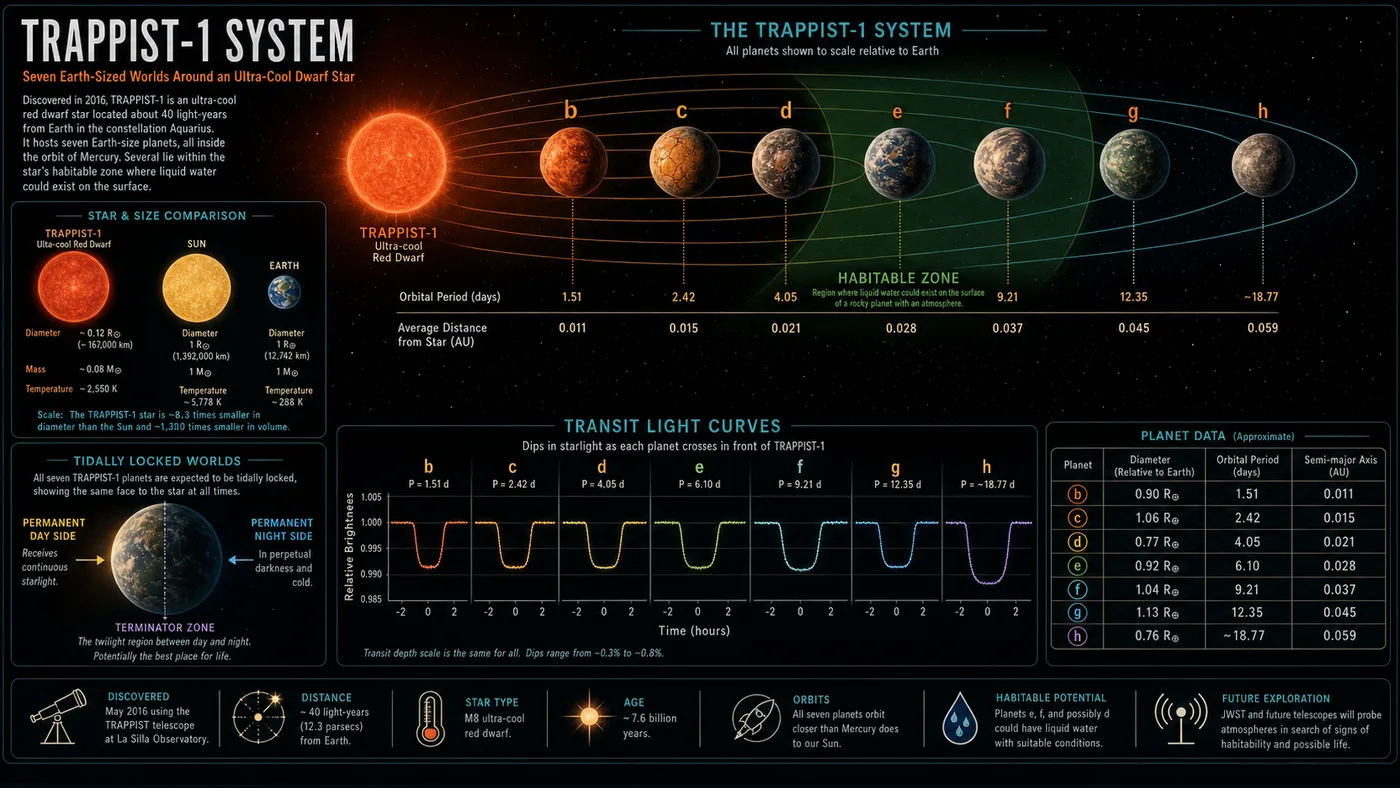
The TRAPPIST-1 seven Earth-size exoplanet system
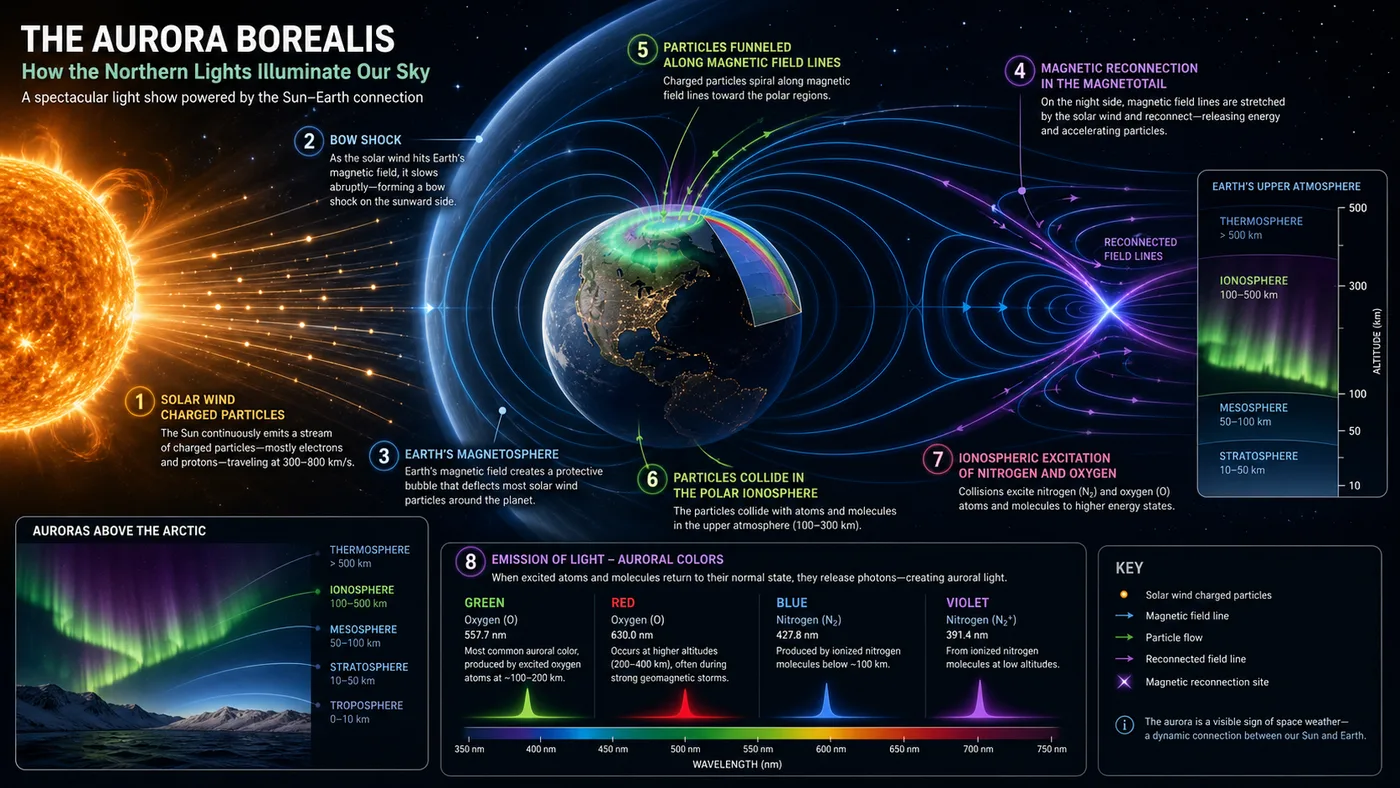
The aurora borealis mechanism
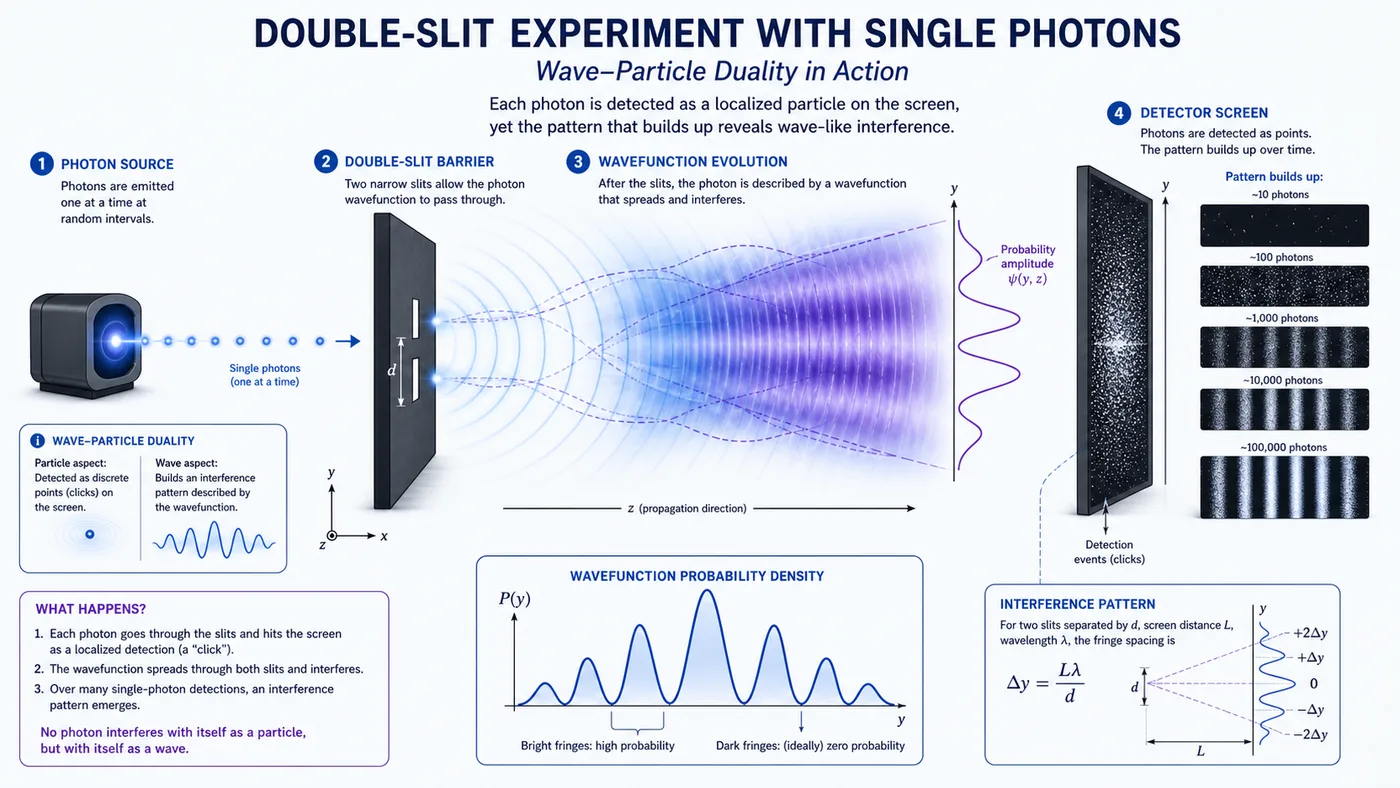
The double-slit experiment with single photons demonstrating wave-particle duali
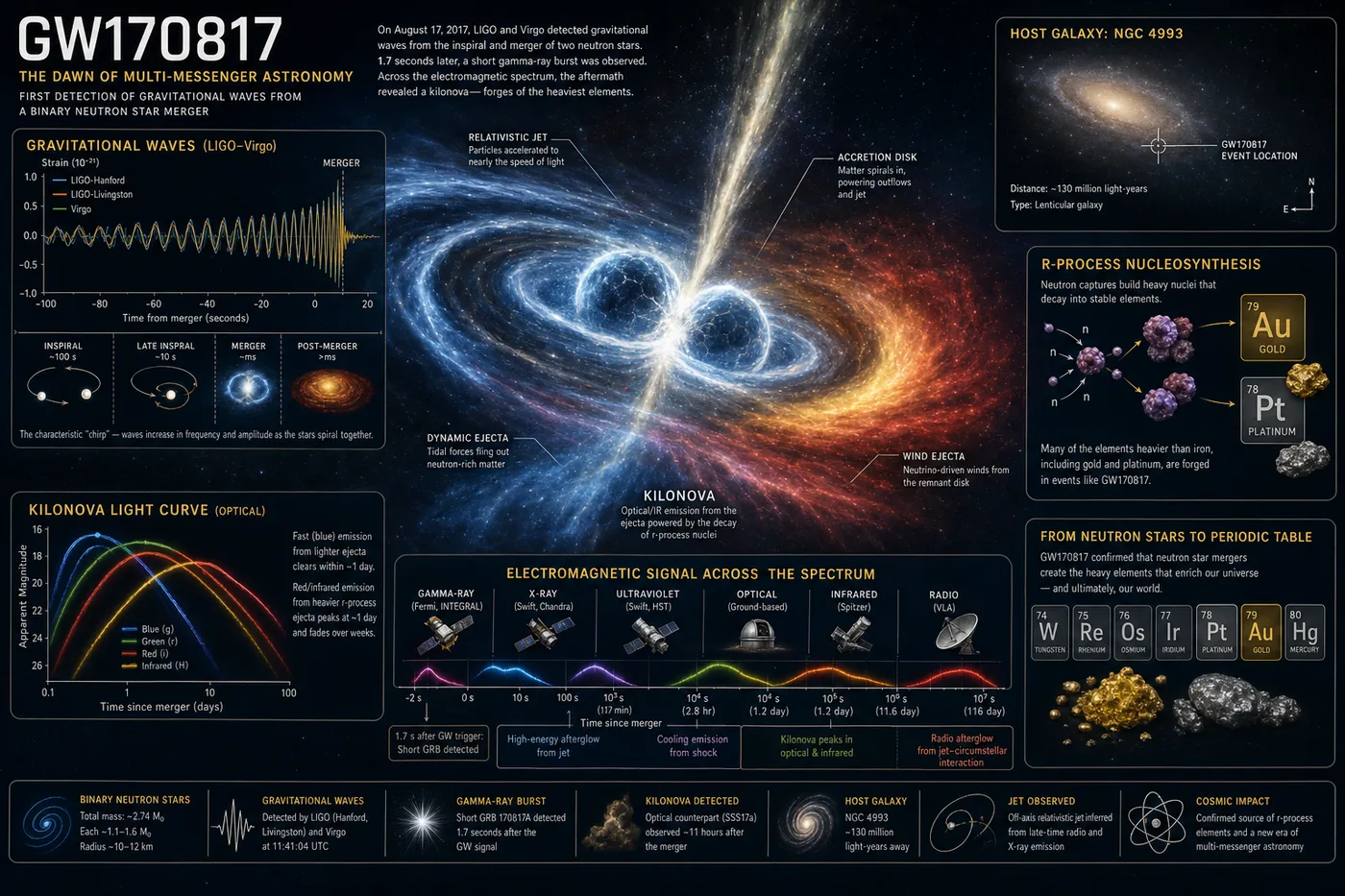
The neutron star merger GW170817 detected by LIGO and Virgo gravitational waves
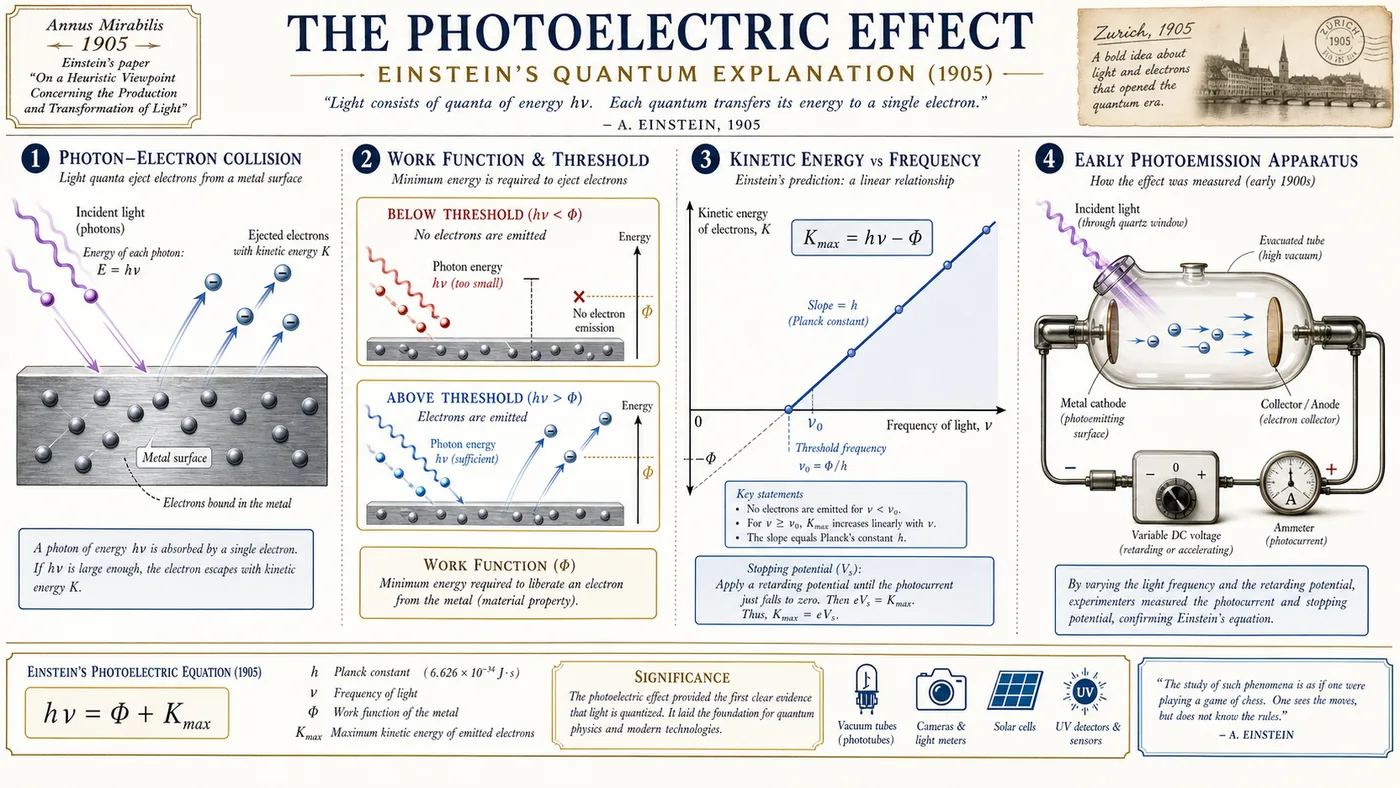
The photoelectric effect explained by Einstein in 1905
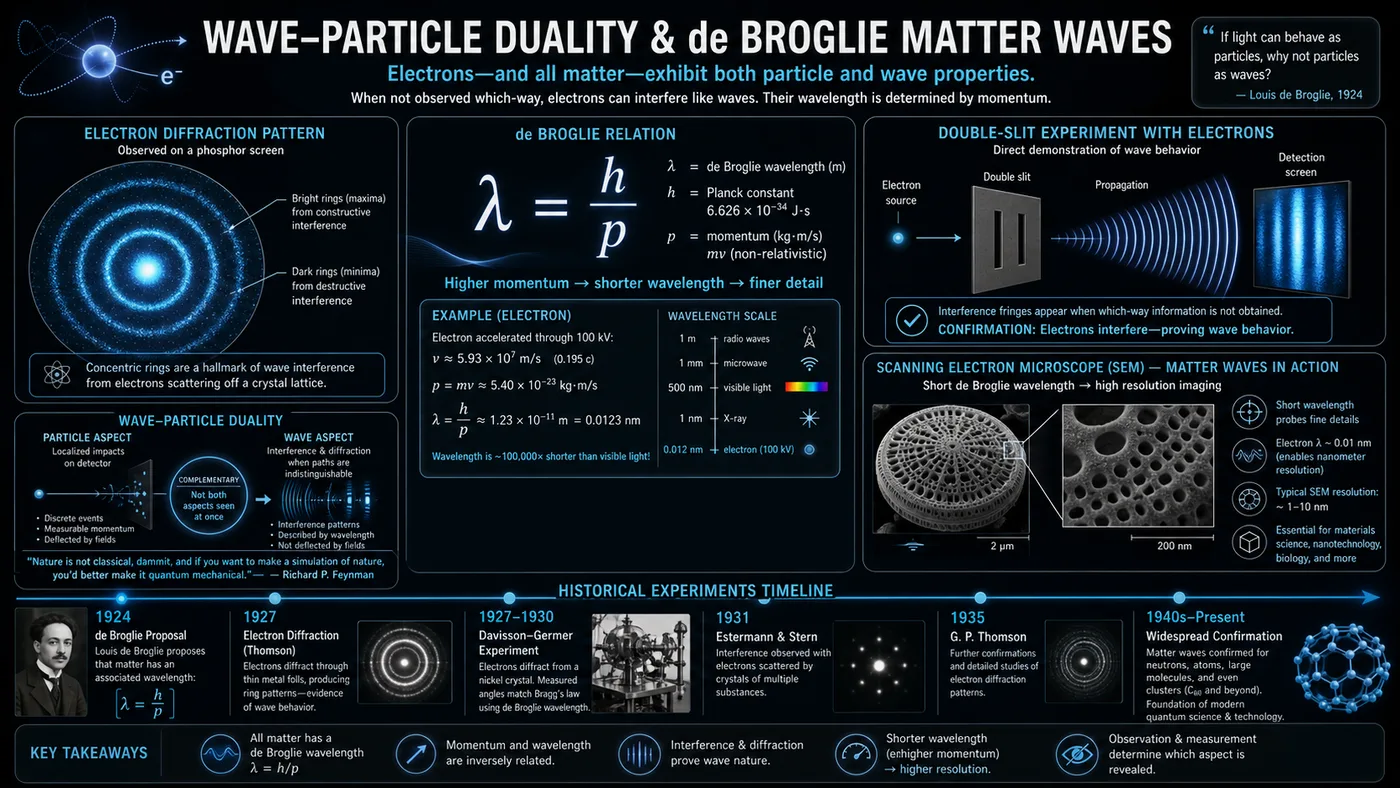
Wave-particle duality and de Broglie matter waves

Antibiotic resistance evolution in MRSA Staphylococcus aureus
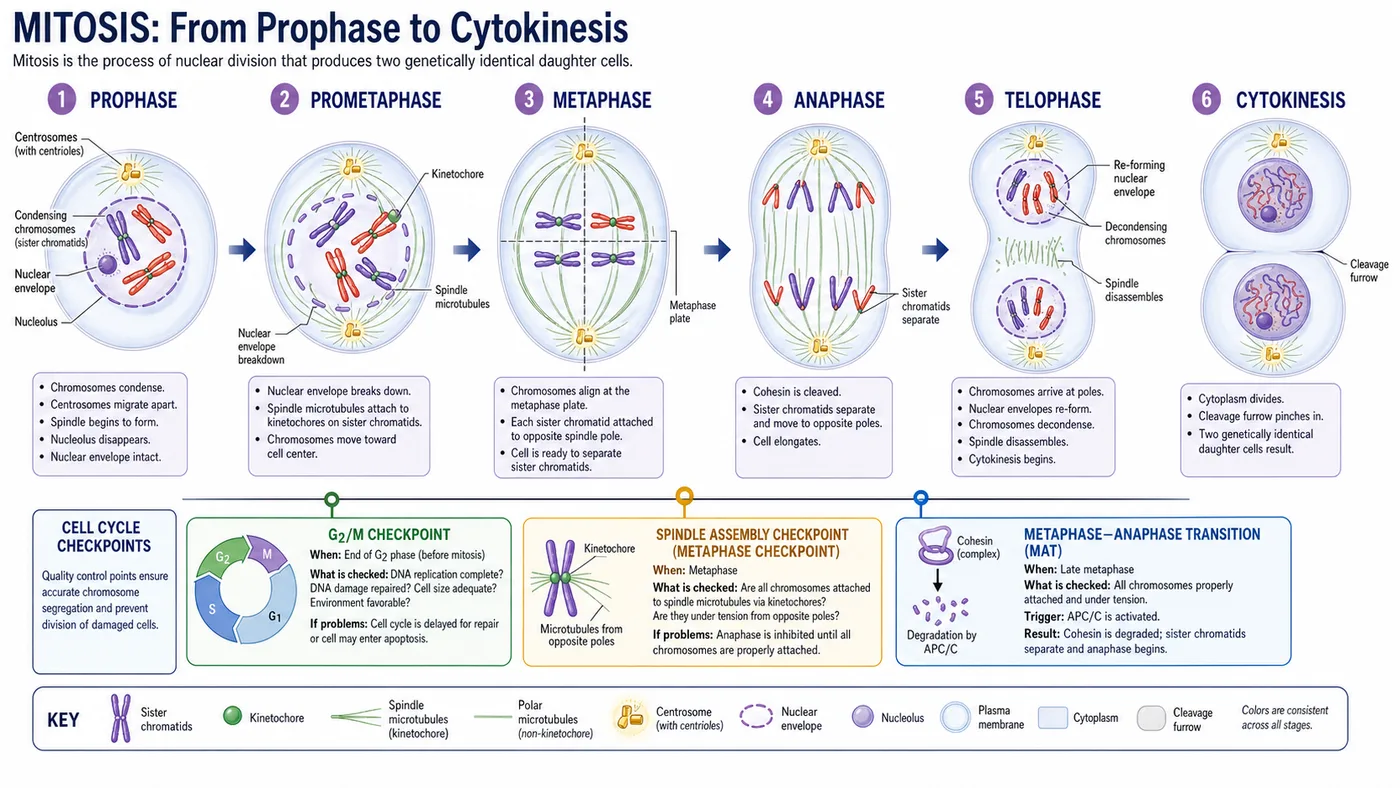
Cell mitosis from prophase through cytokinesis
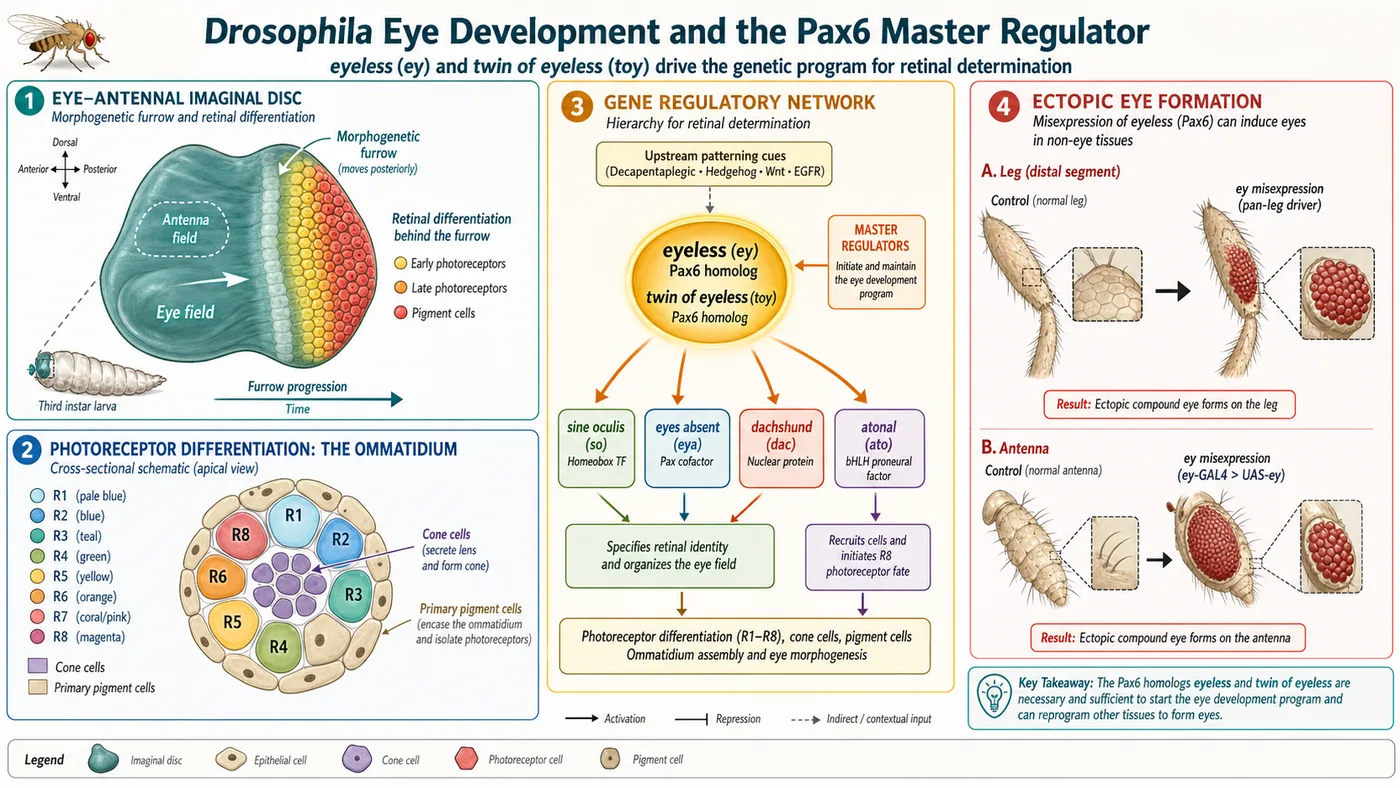
Drosophila eye development and the Pax6 master regulator
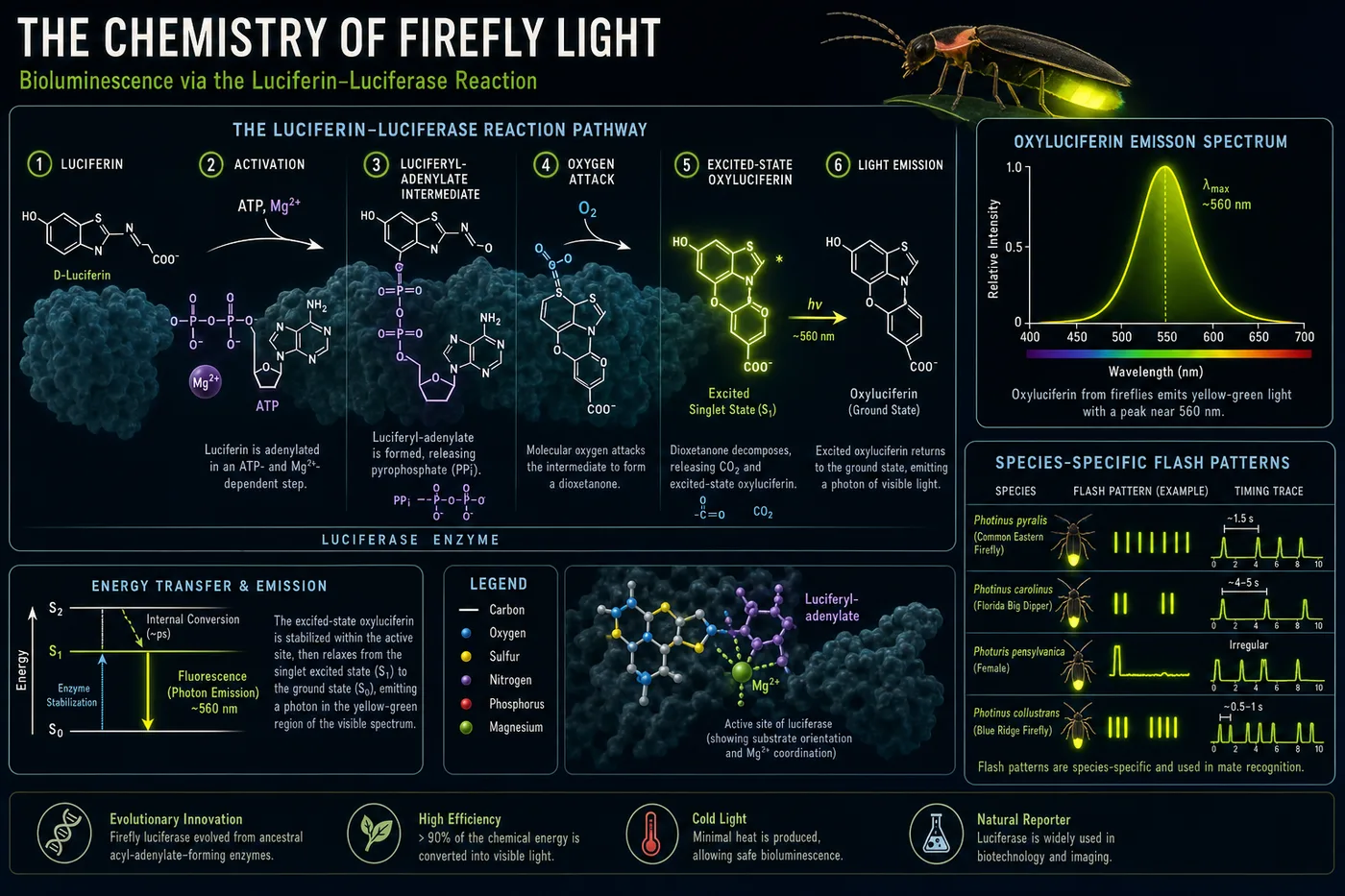
Firefly bioluminescence chemistry

Flower reproductive anatomy and pollination
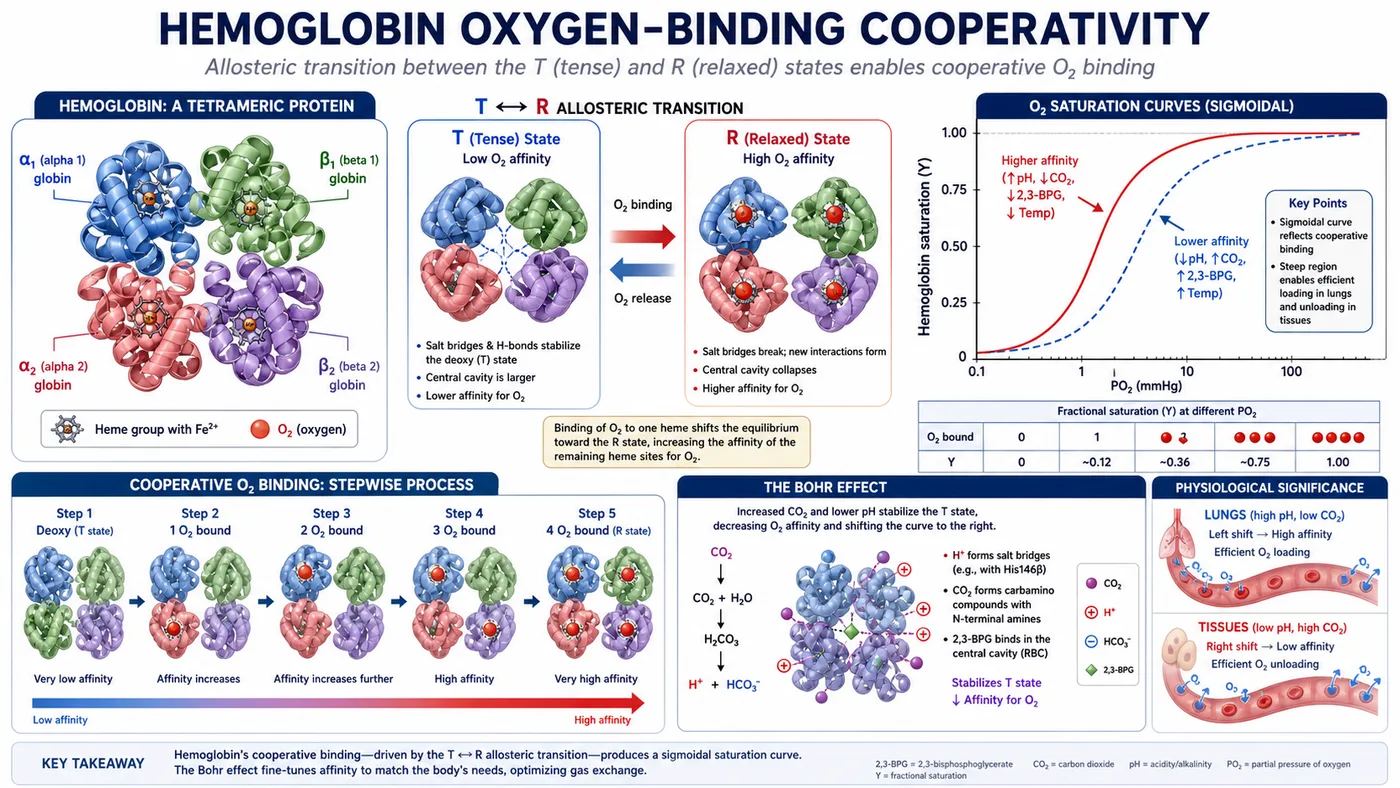
Hemoglobin oxygen-binding cooperativity
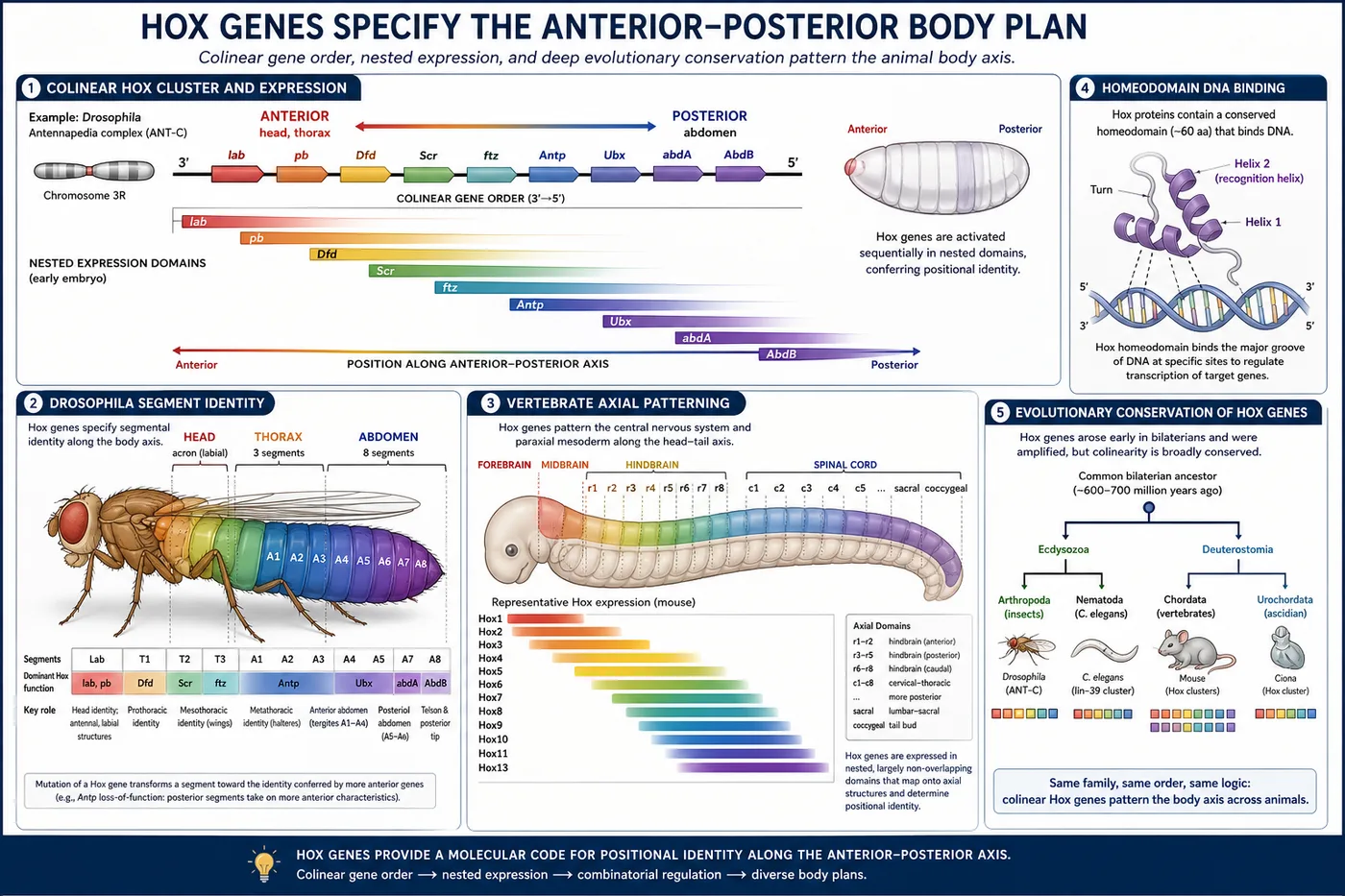
Hox genes specifying anterior-posterior body plan
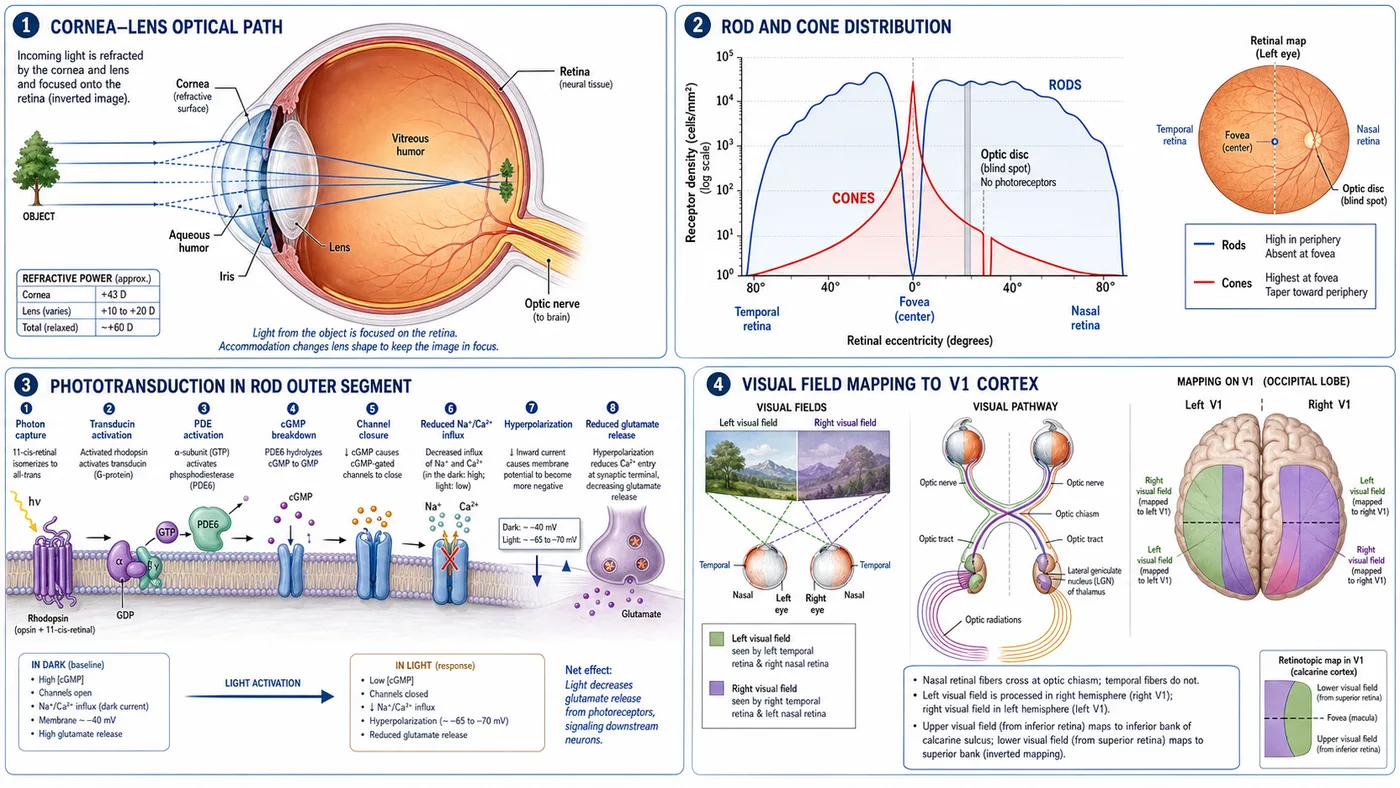
Human eye anatomy and retinal phototransduction
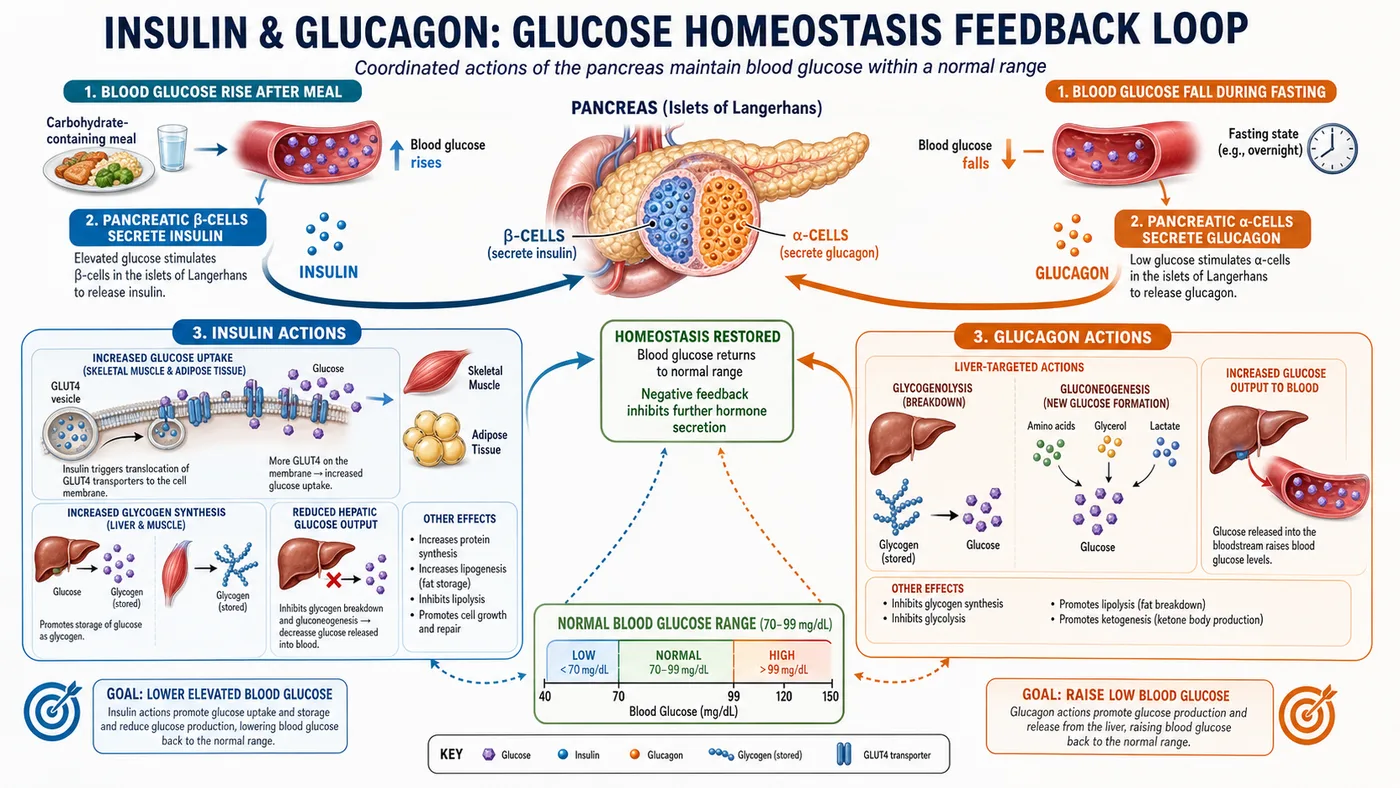
Insulin and glucagon glucose homeostasis feedback loop
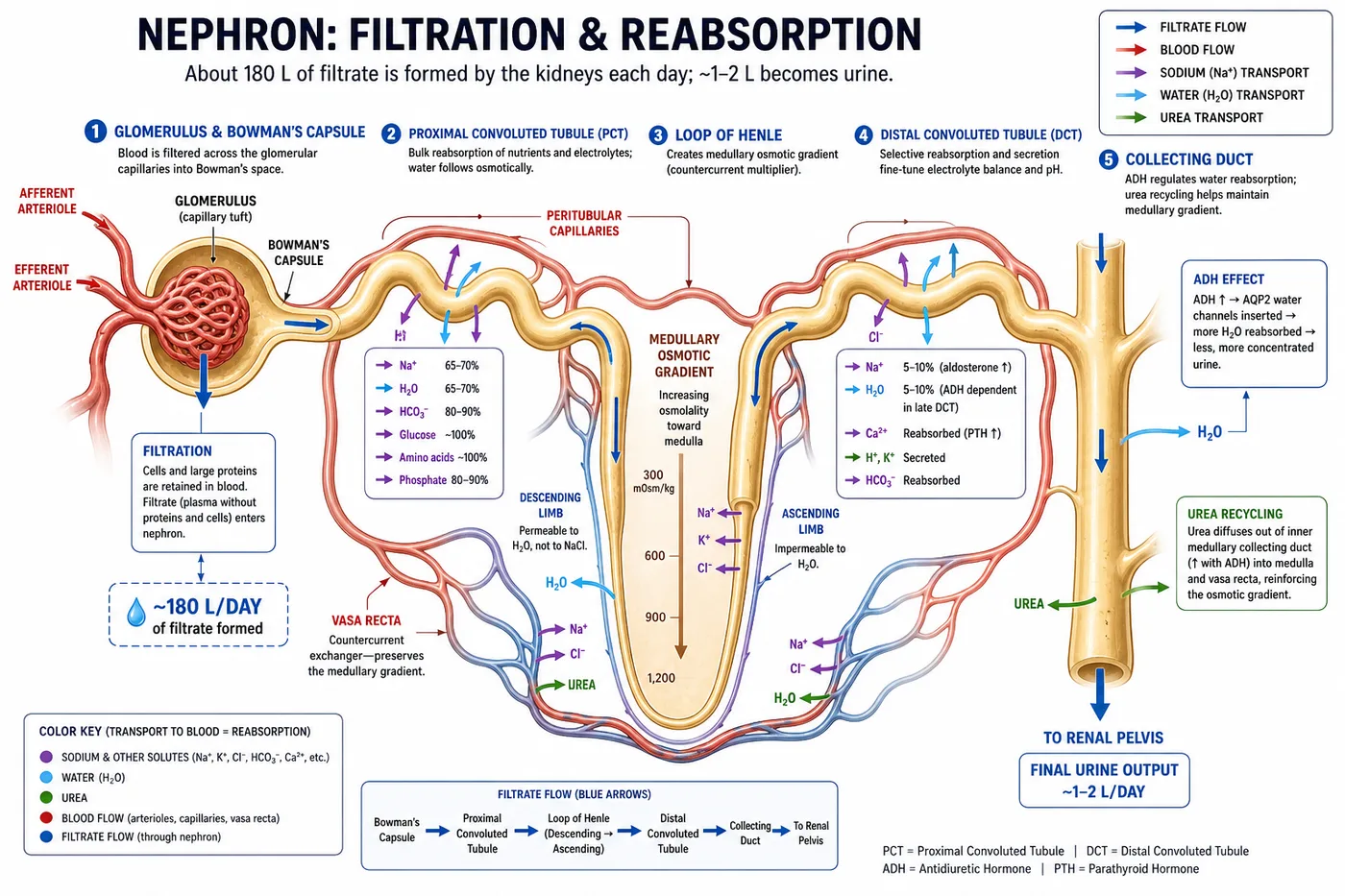
Kidney nephron filtration and reabsorption
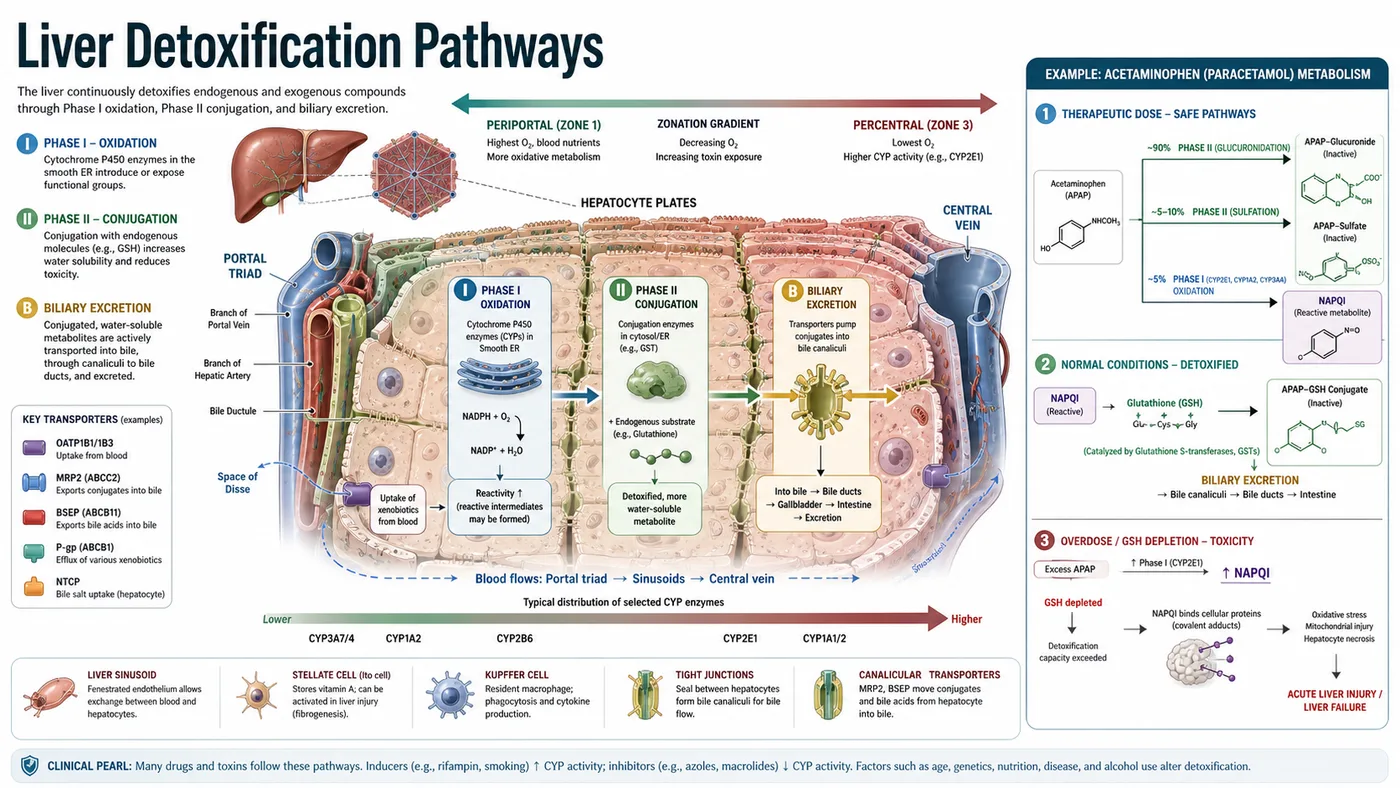
Liver detoxification pathways
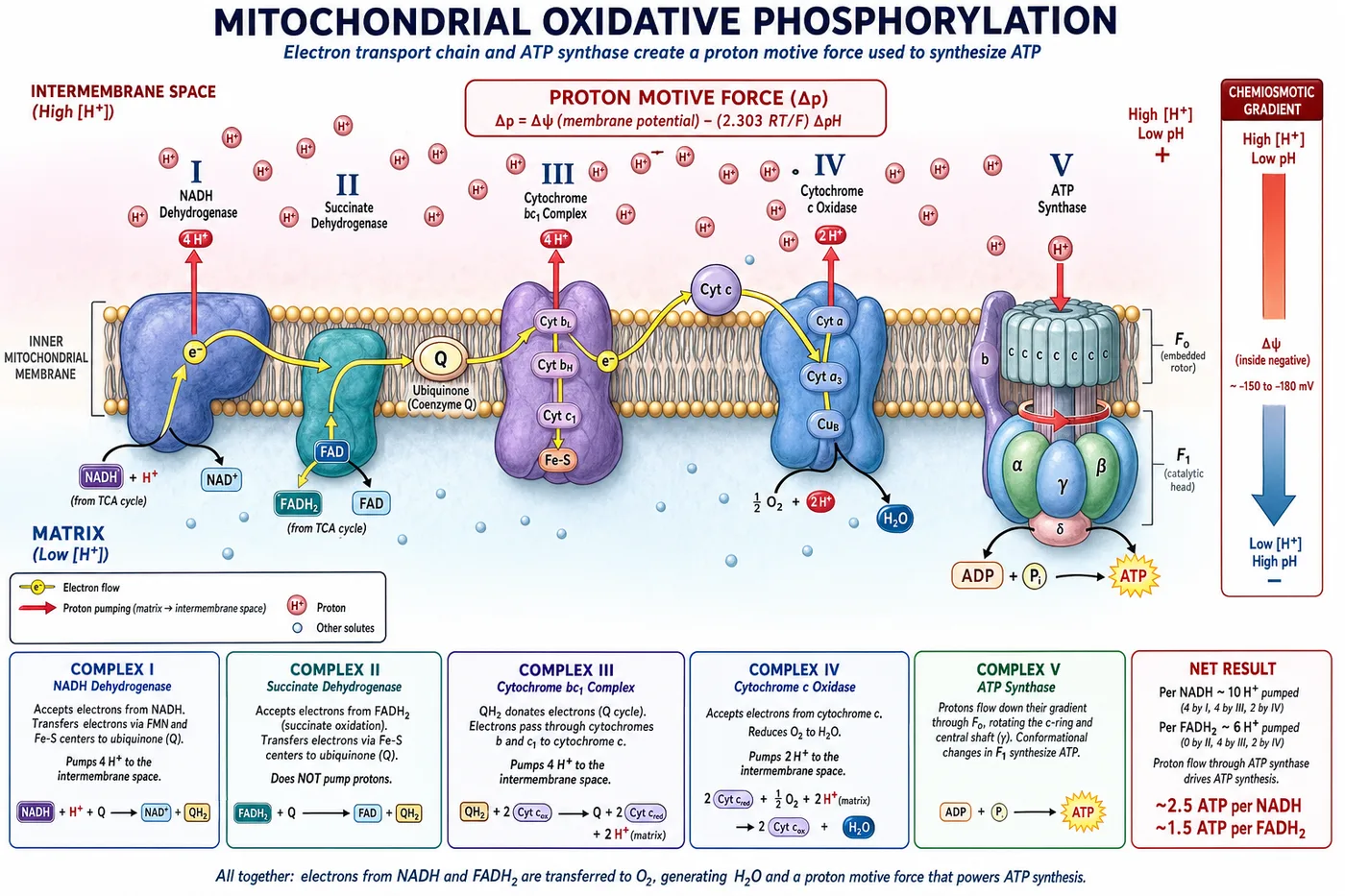
Mitochondrial oxidative phosphorylation in detail
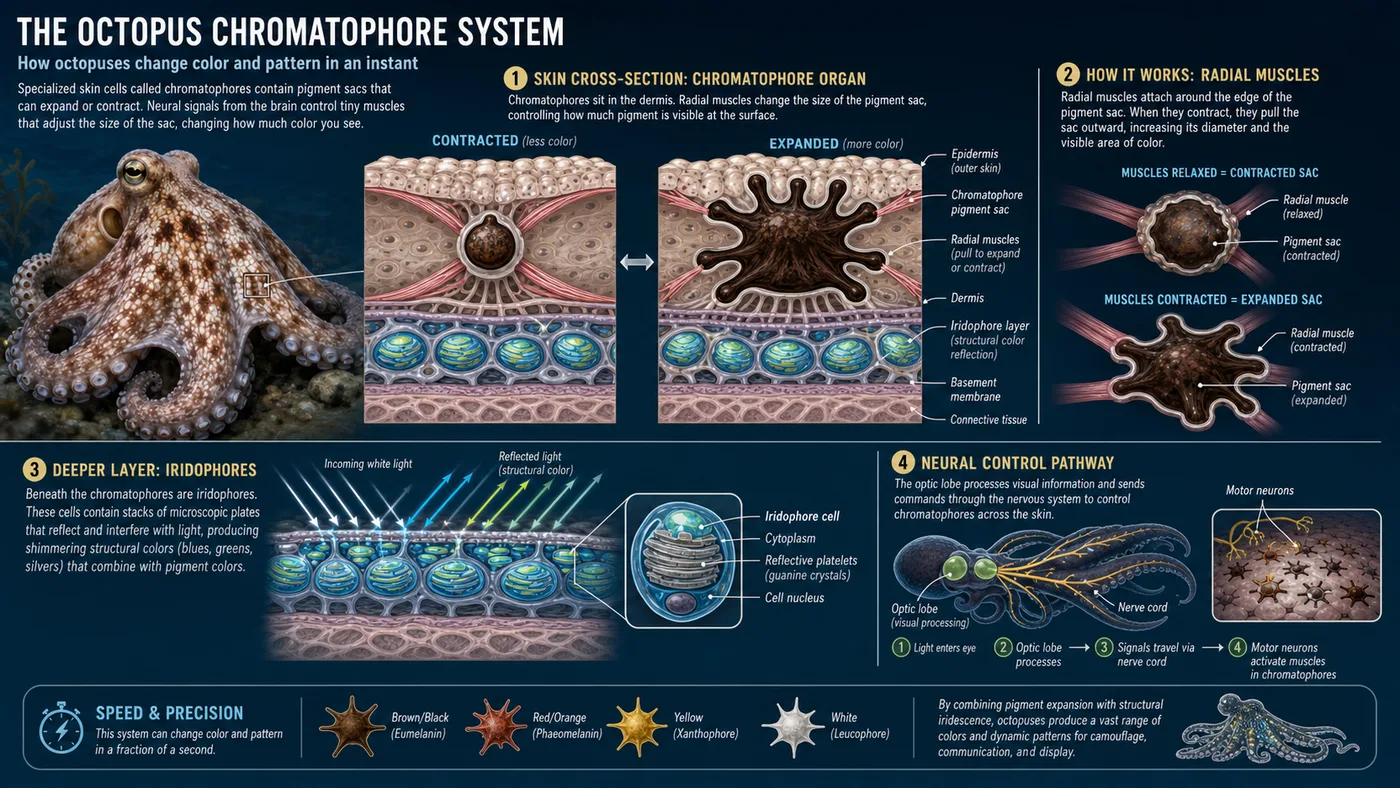
Octopus chromatophore color-changing skin mechanism

Skin layers and wound healing stages
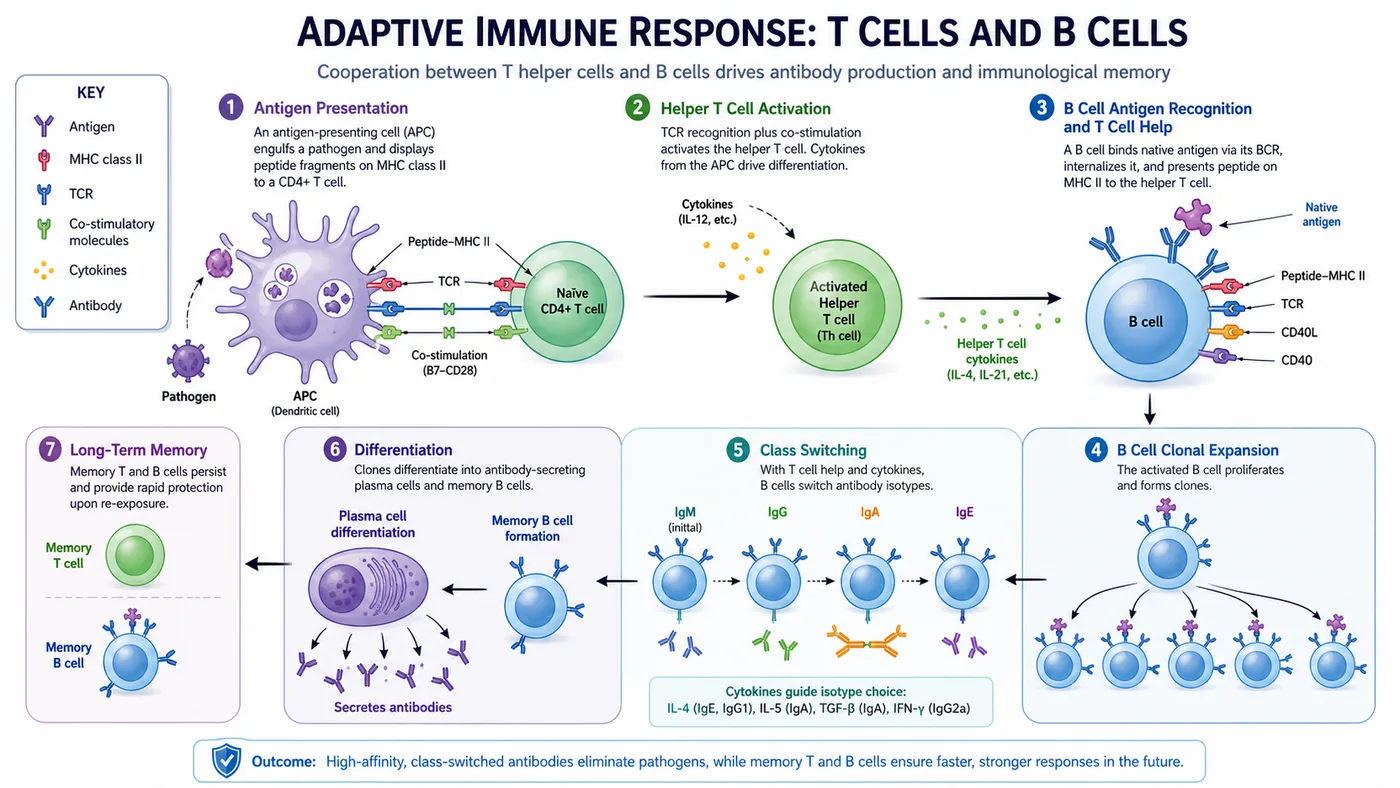
T cell and B cell adaptive immune response
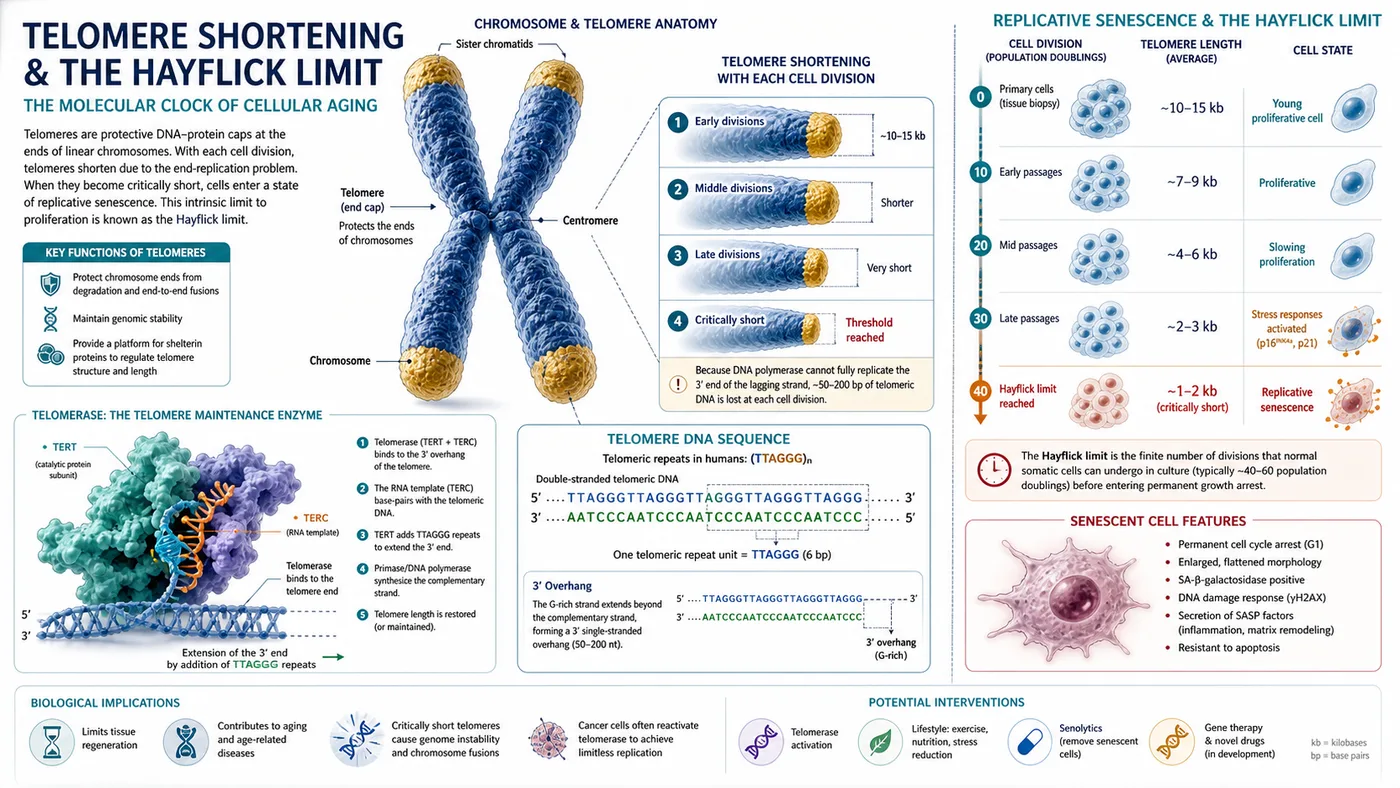
Telomere shortening and the Hayflick limit in cellular aging
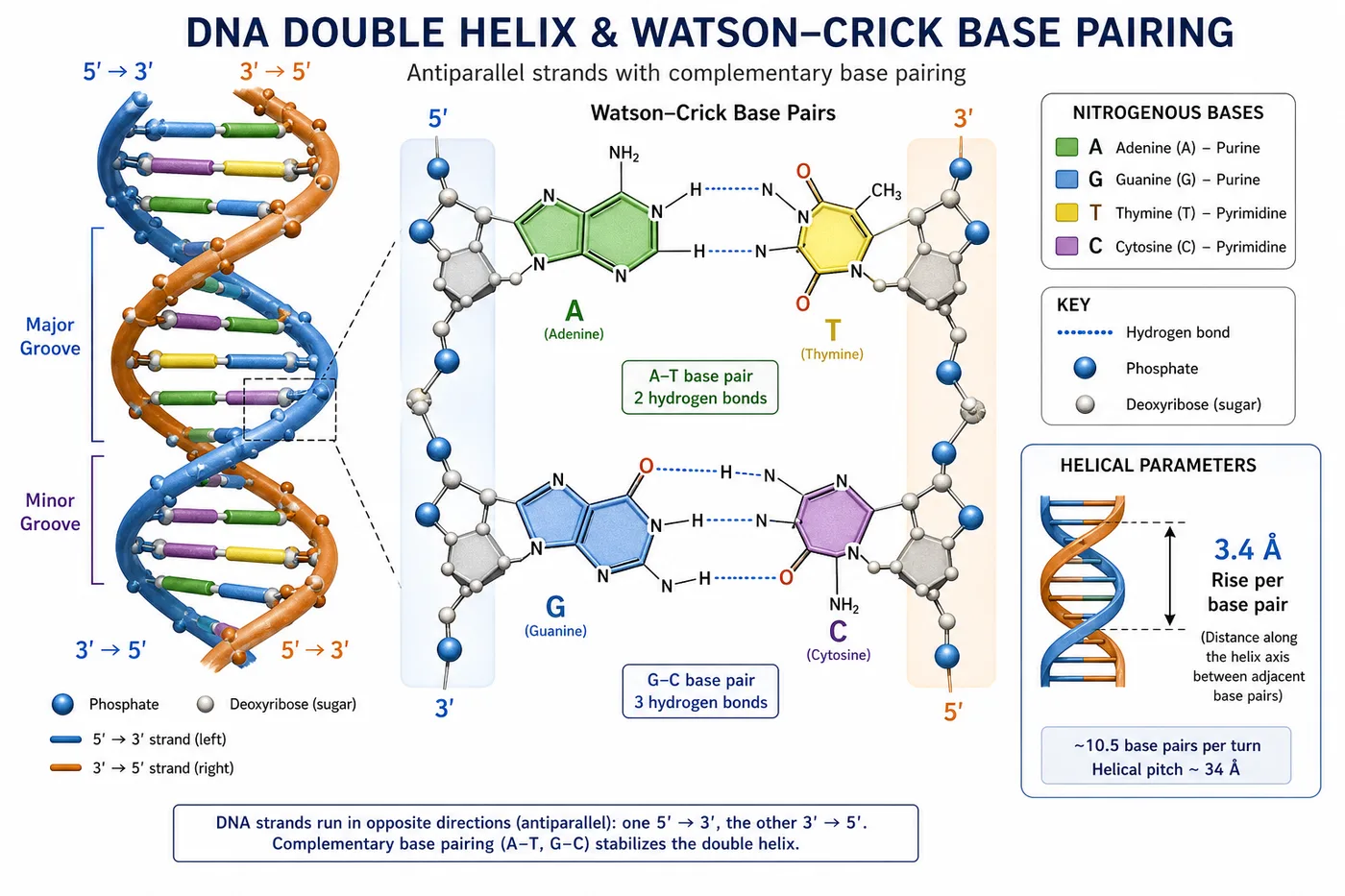
The DNA double helix with Watson-Crick base pairing
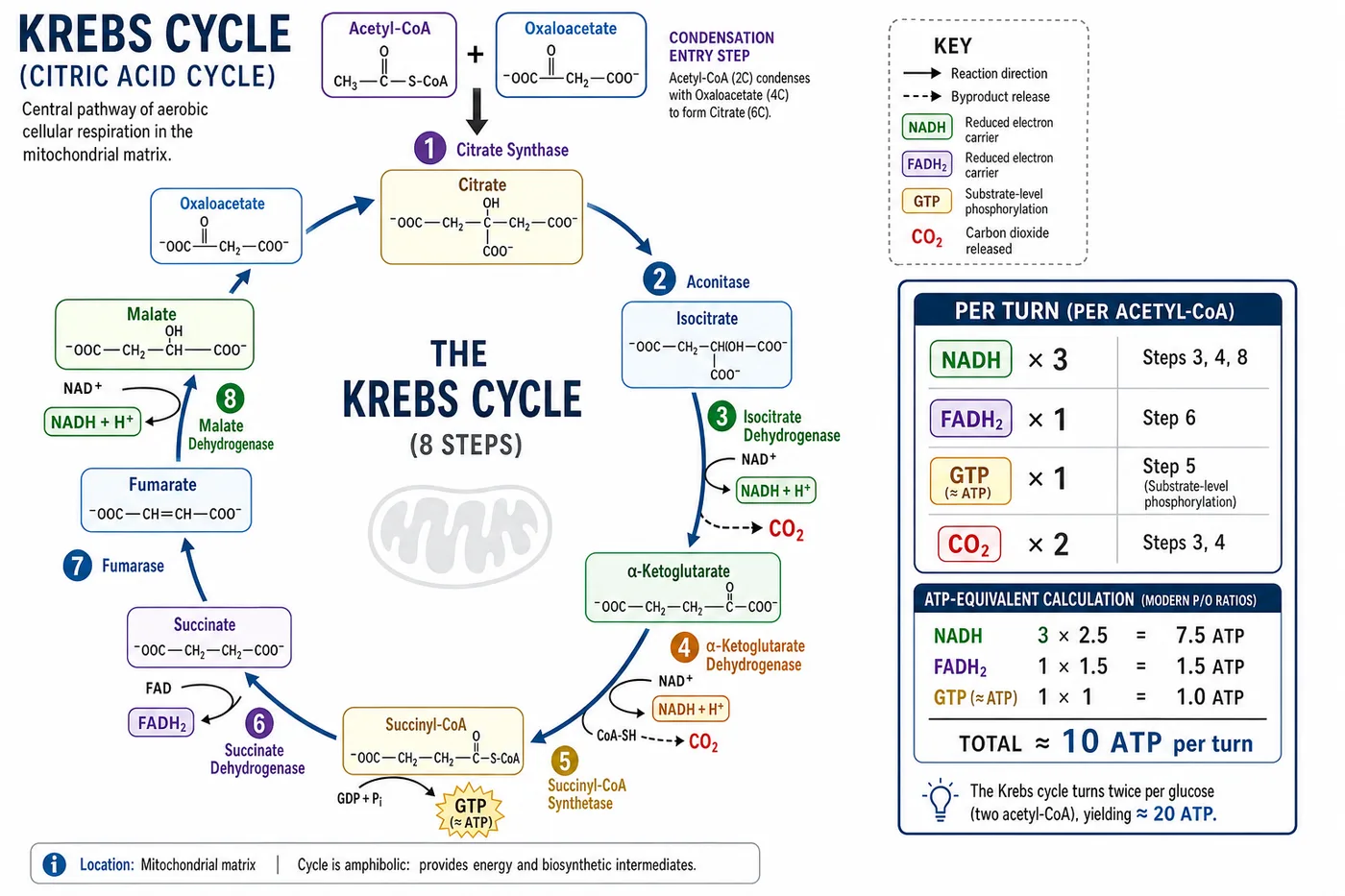
The Krebs cycle in cellular respiration
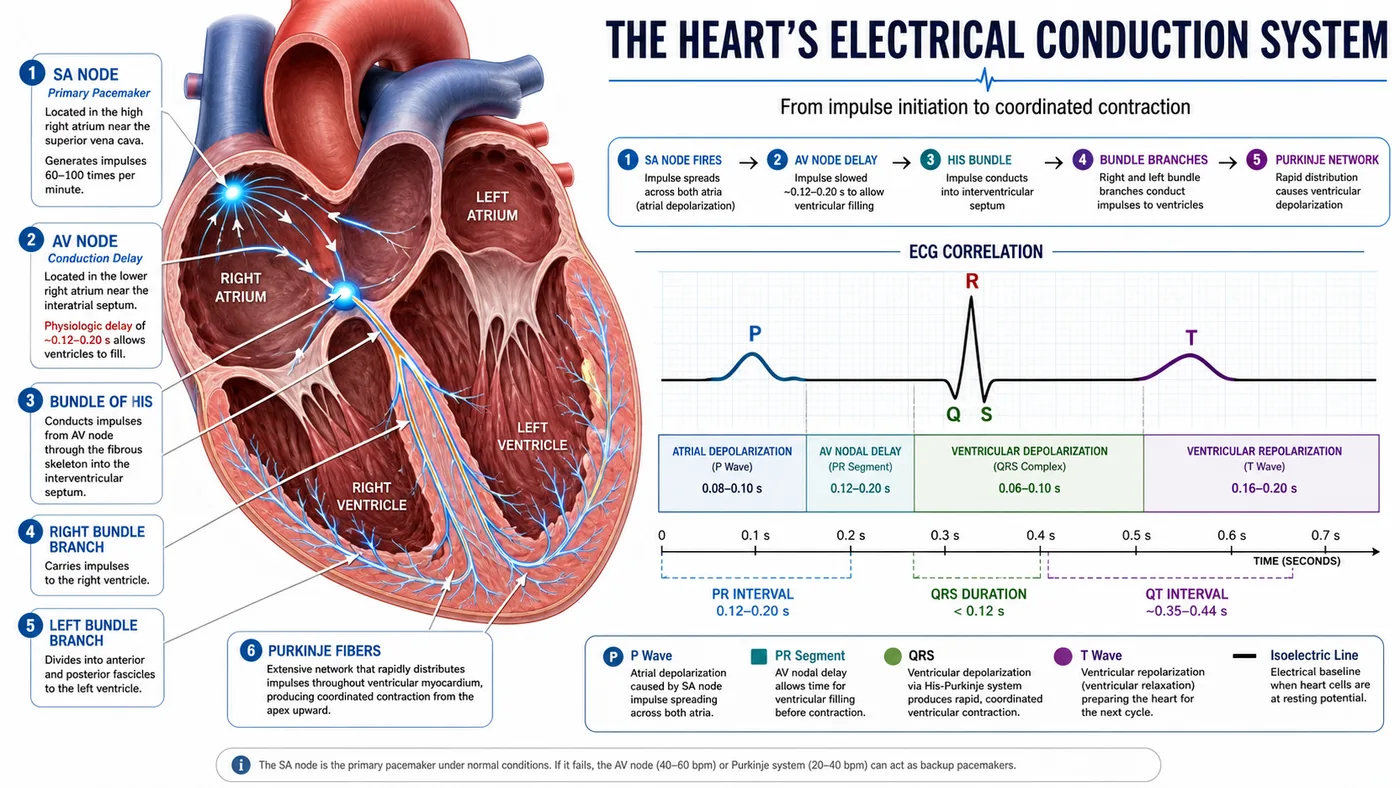
The heart's electrical conduction system
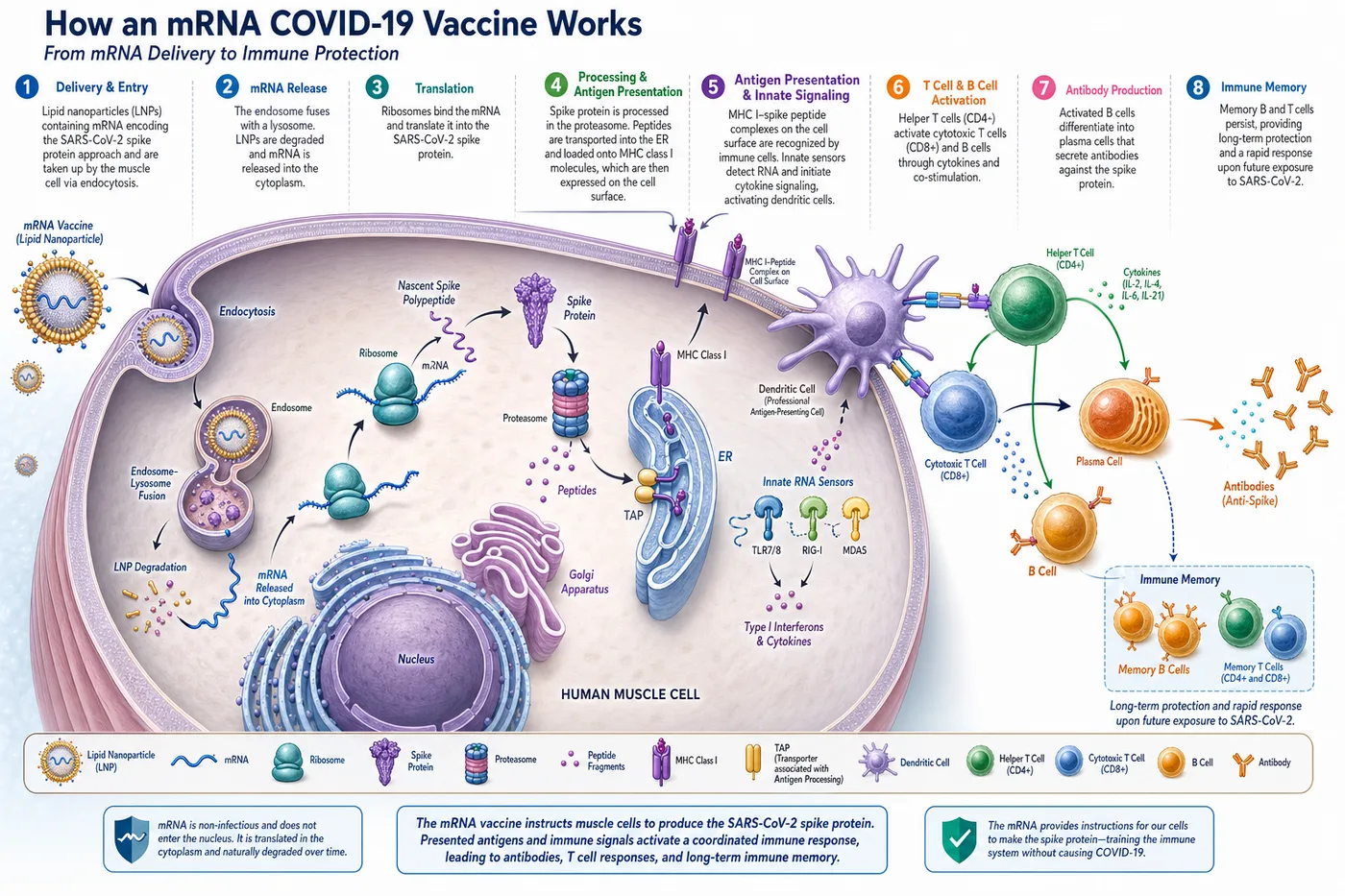
The mRNA COVID-19 vaccine mechanism inside a human muscle cell
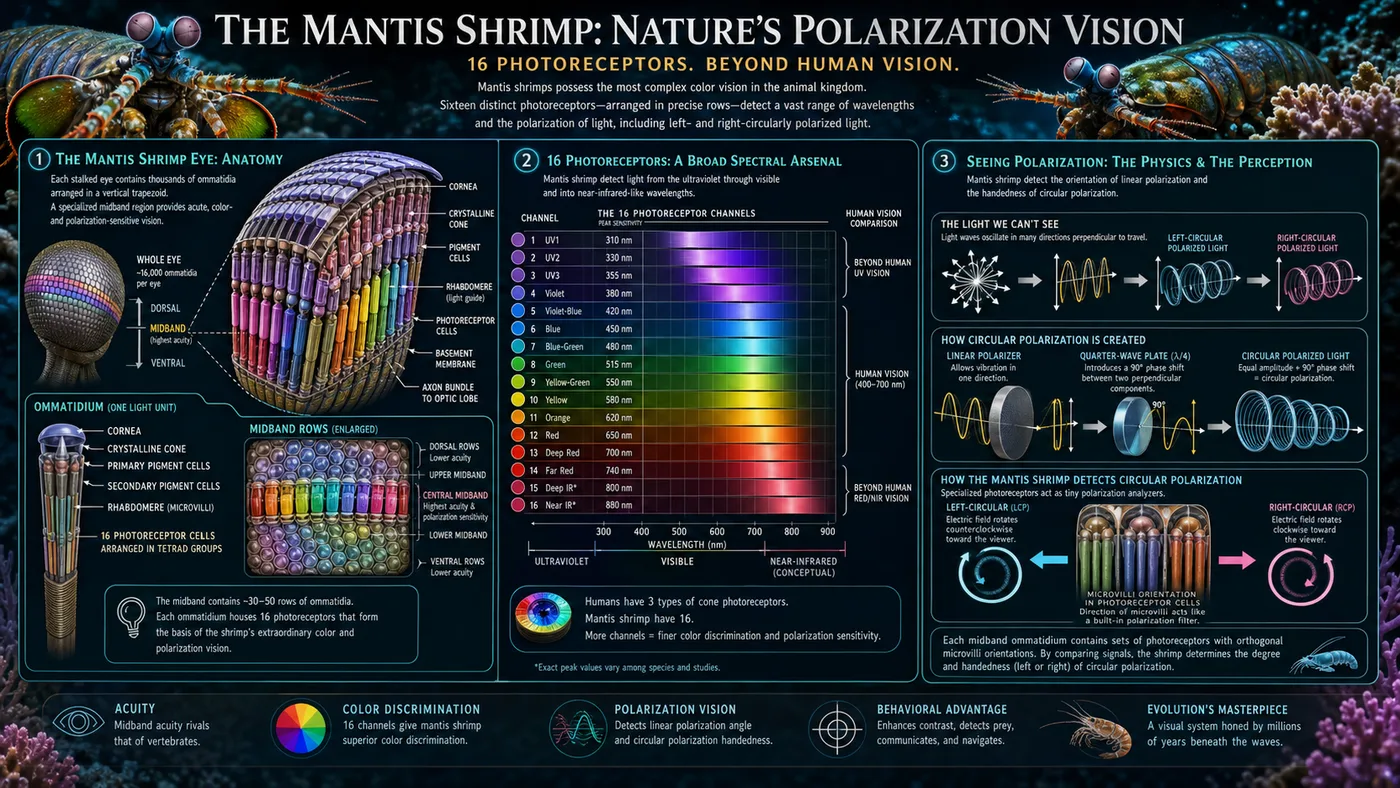
The mantis shrimp's 16-photoreceptor compound eye detecting circular polarized l

The structure of a virus showing capsid, envelope, and genome
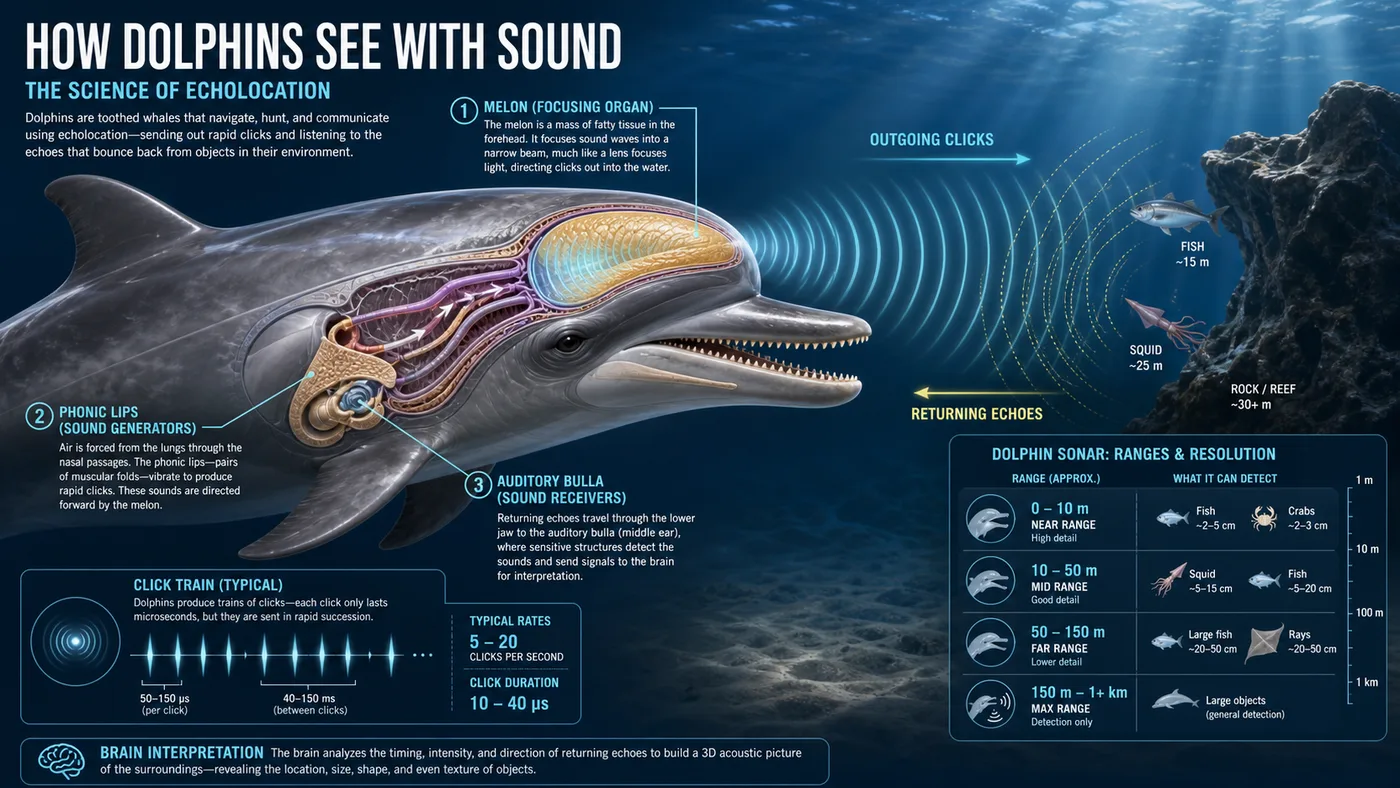
Toothed whale echolocation
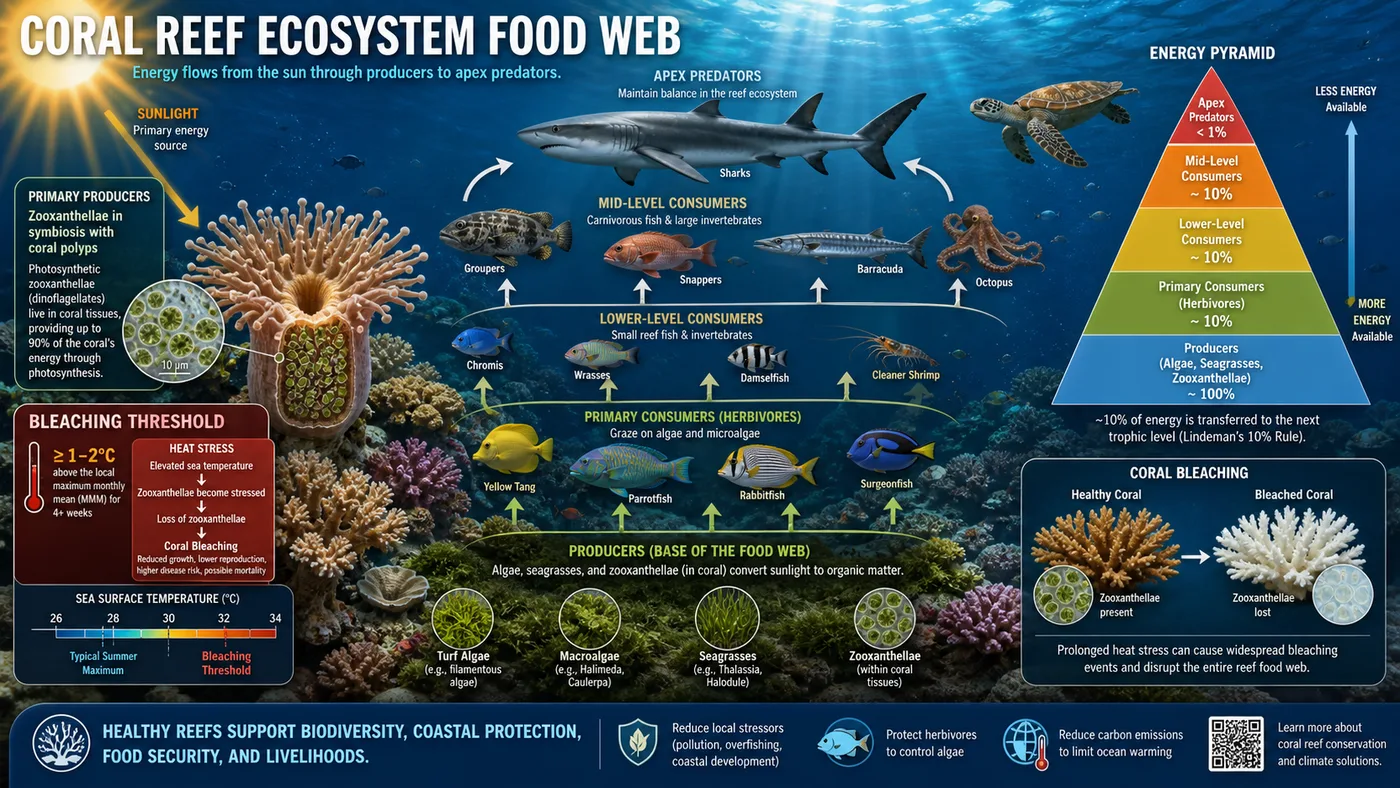
A coral reef ecosystem food web
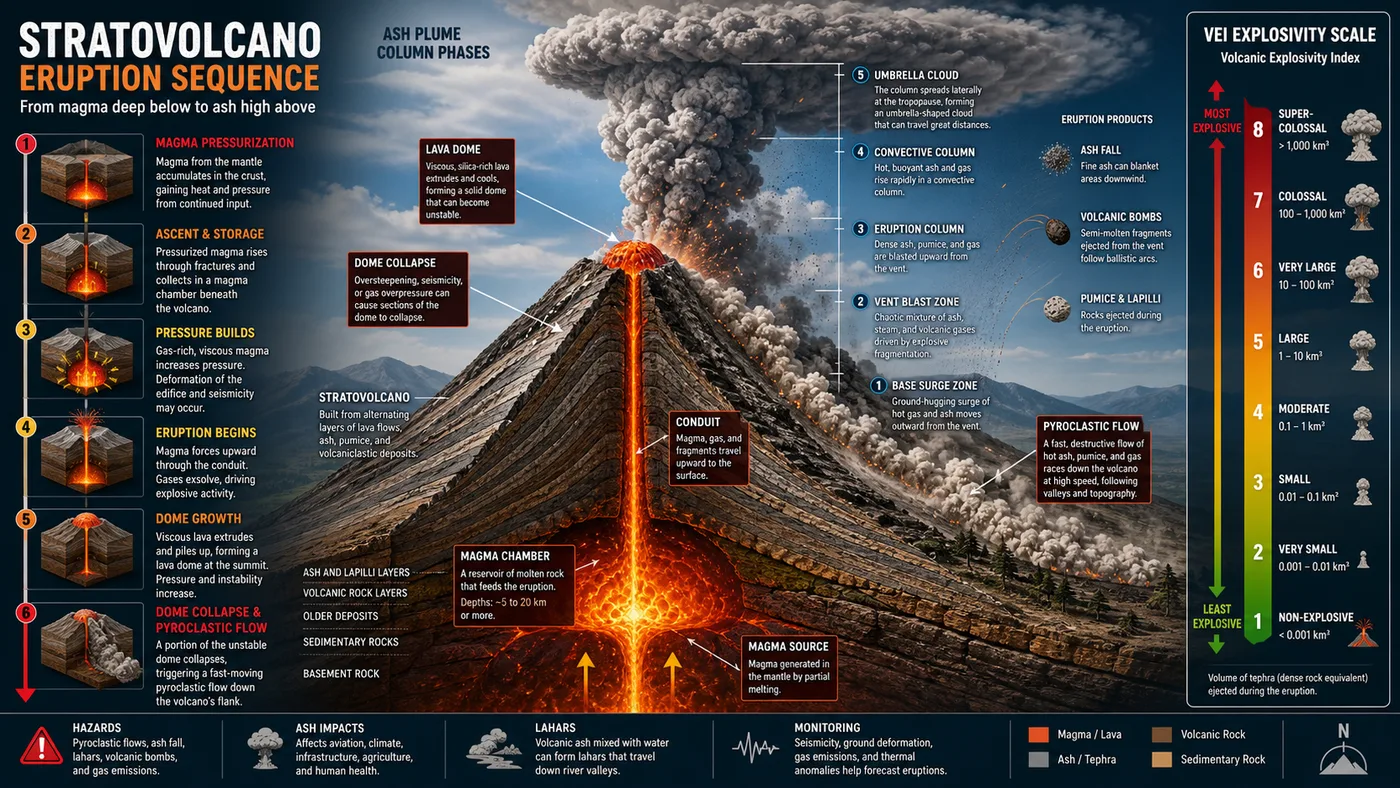
A stratovolcano eruption sequence
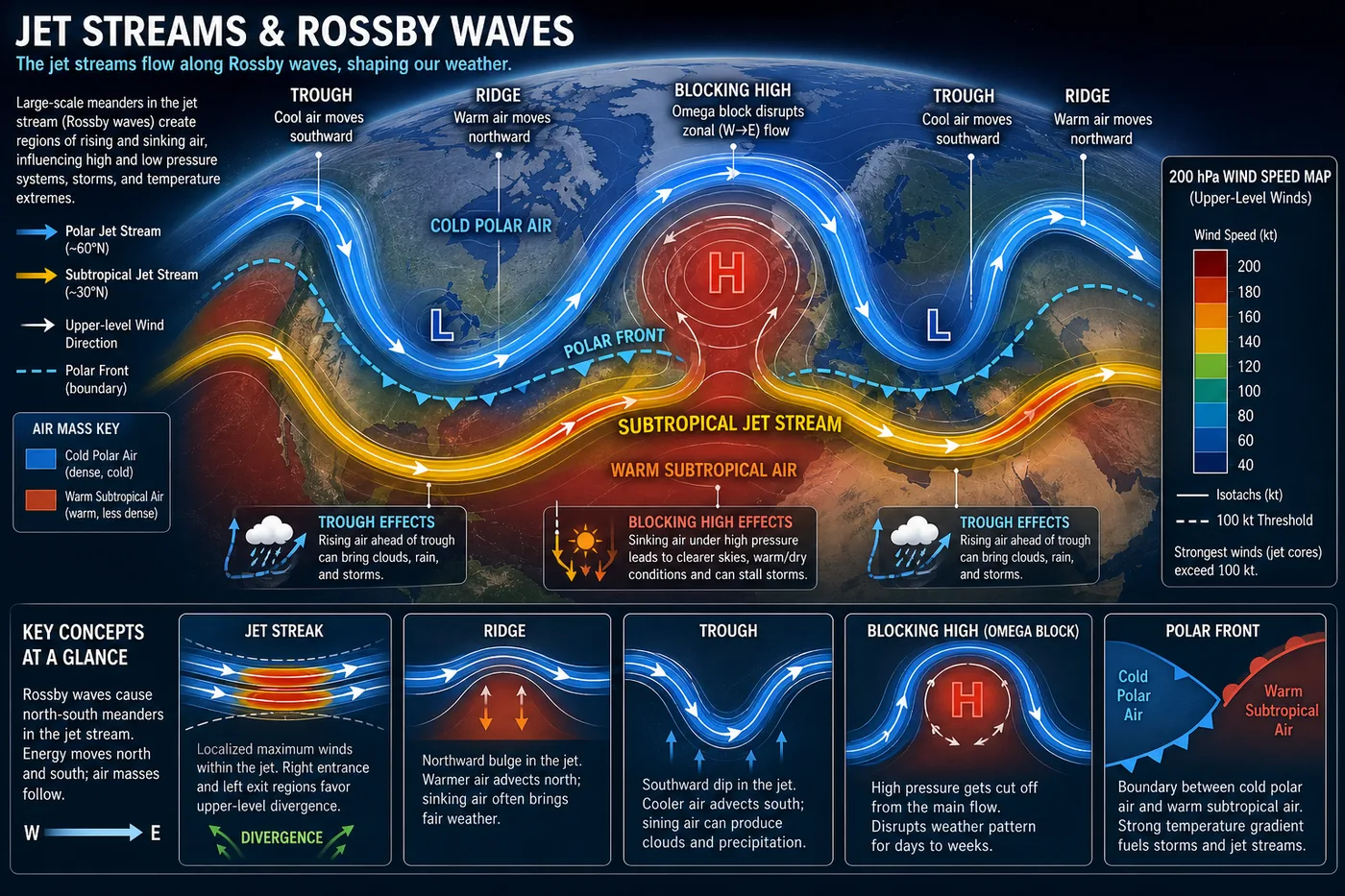
Atmospheric jet streams and Rossby waves
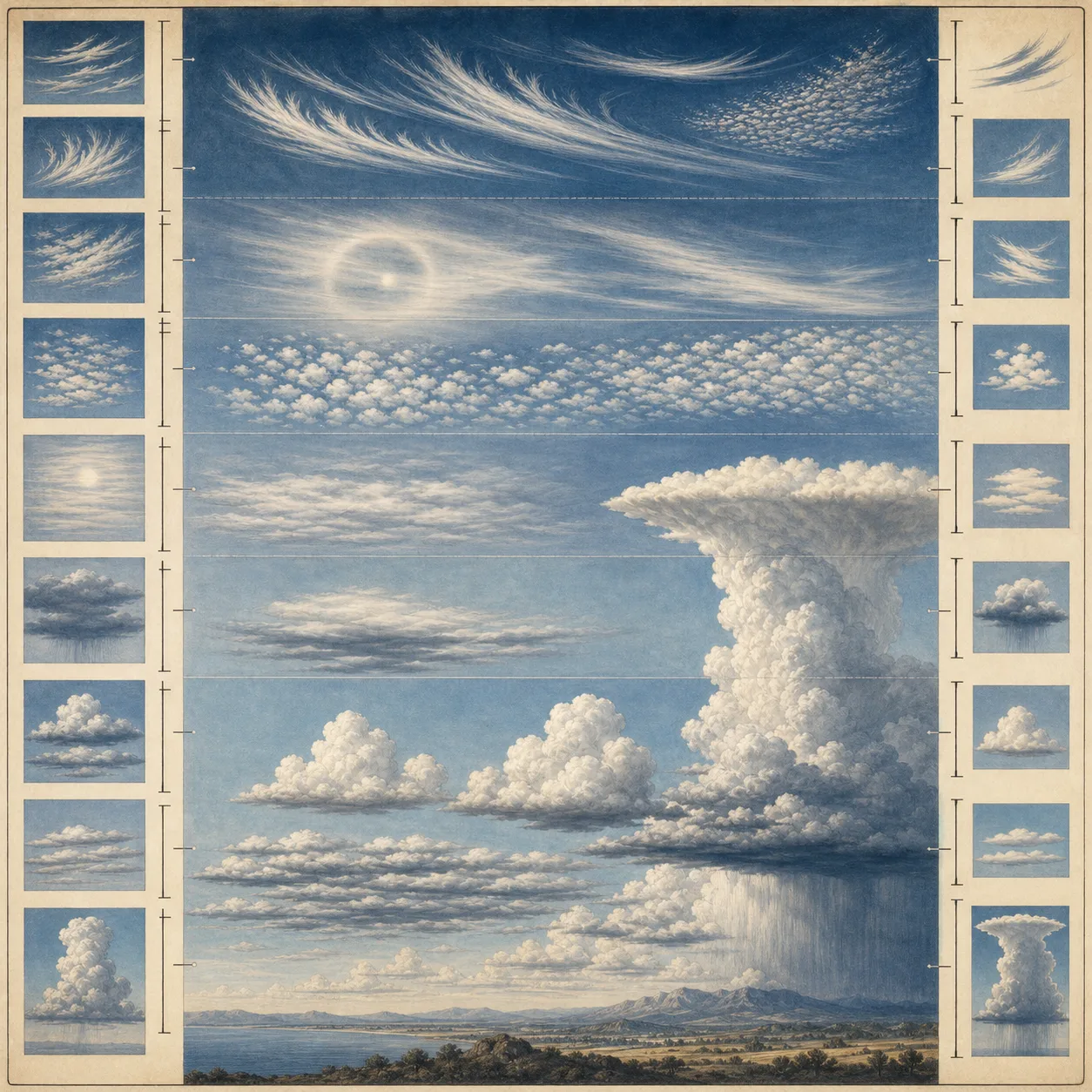
Atmospheric layers with cloud types annotated by altitude

Biome map of Earth with temperate forest, grassland, wetland, desert, tropical f
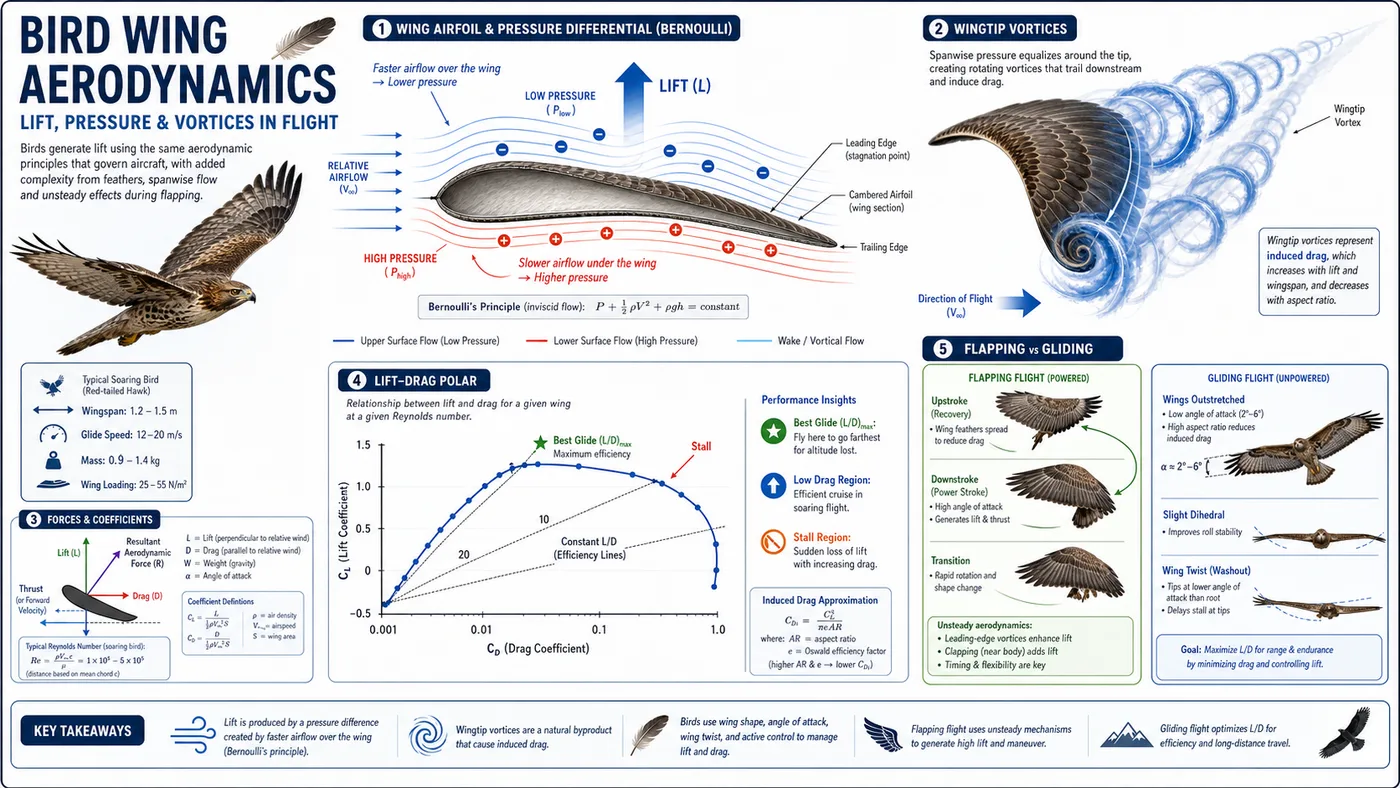
Bird wing aerodynamics with vortex generation
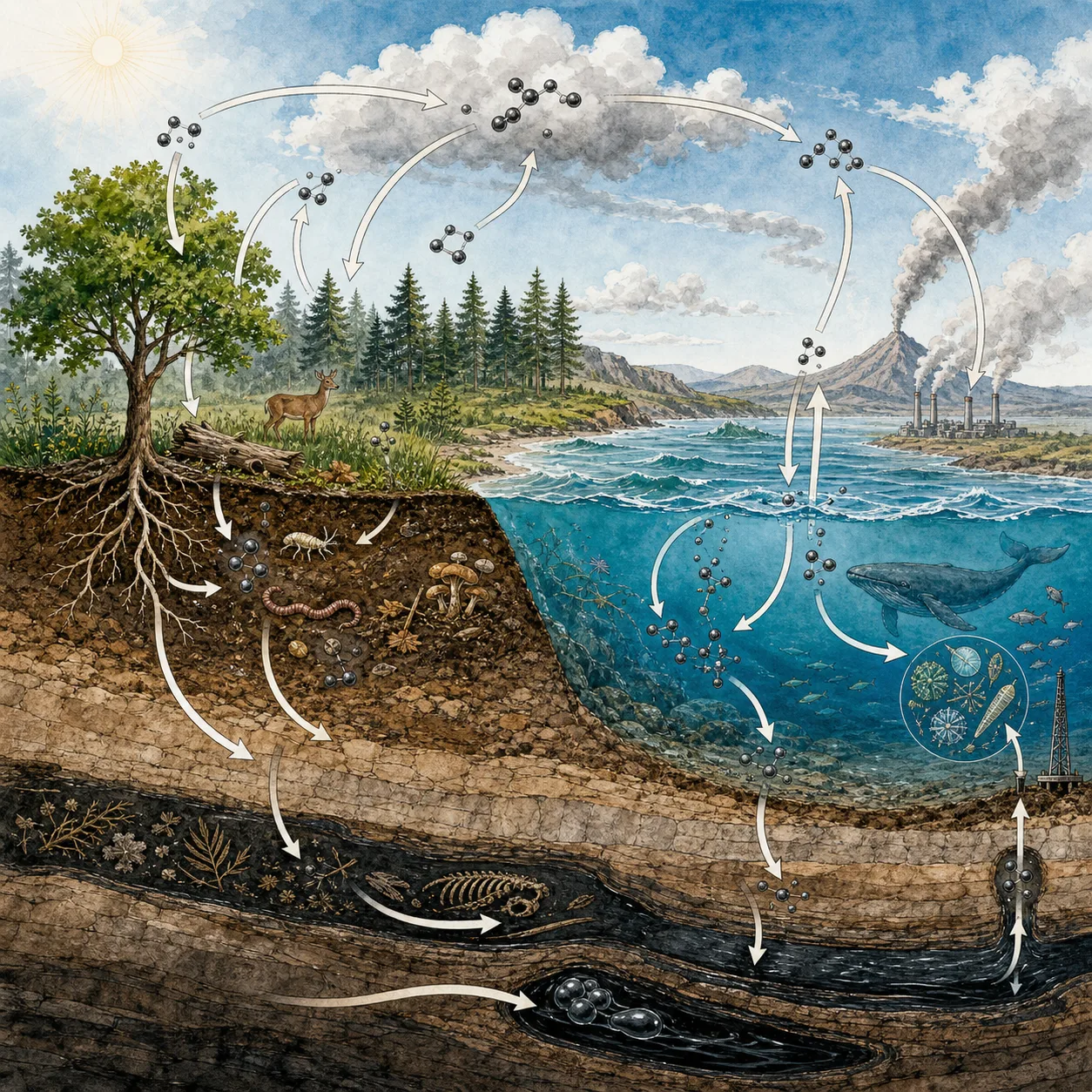
Carbon cycle diagram showing reservoirs and fluxes between atmosphere, oceans, b

Cave formation in karst limestone topography

Clouds in a clear sky
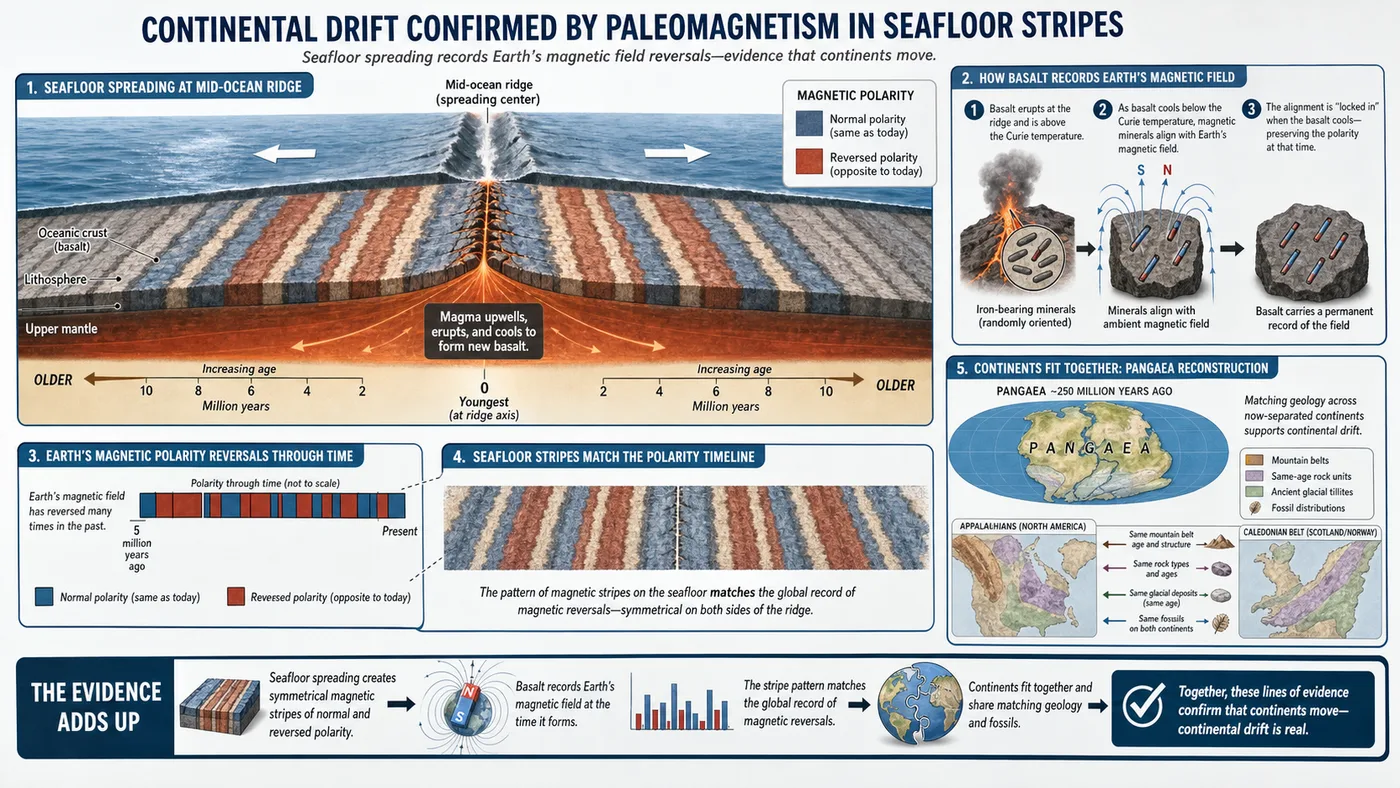
Continental drift confirmed by paleomagnetism in seafloor stripes
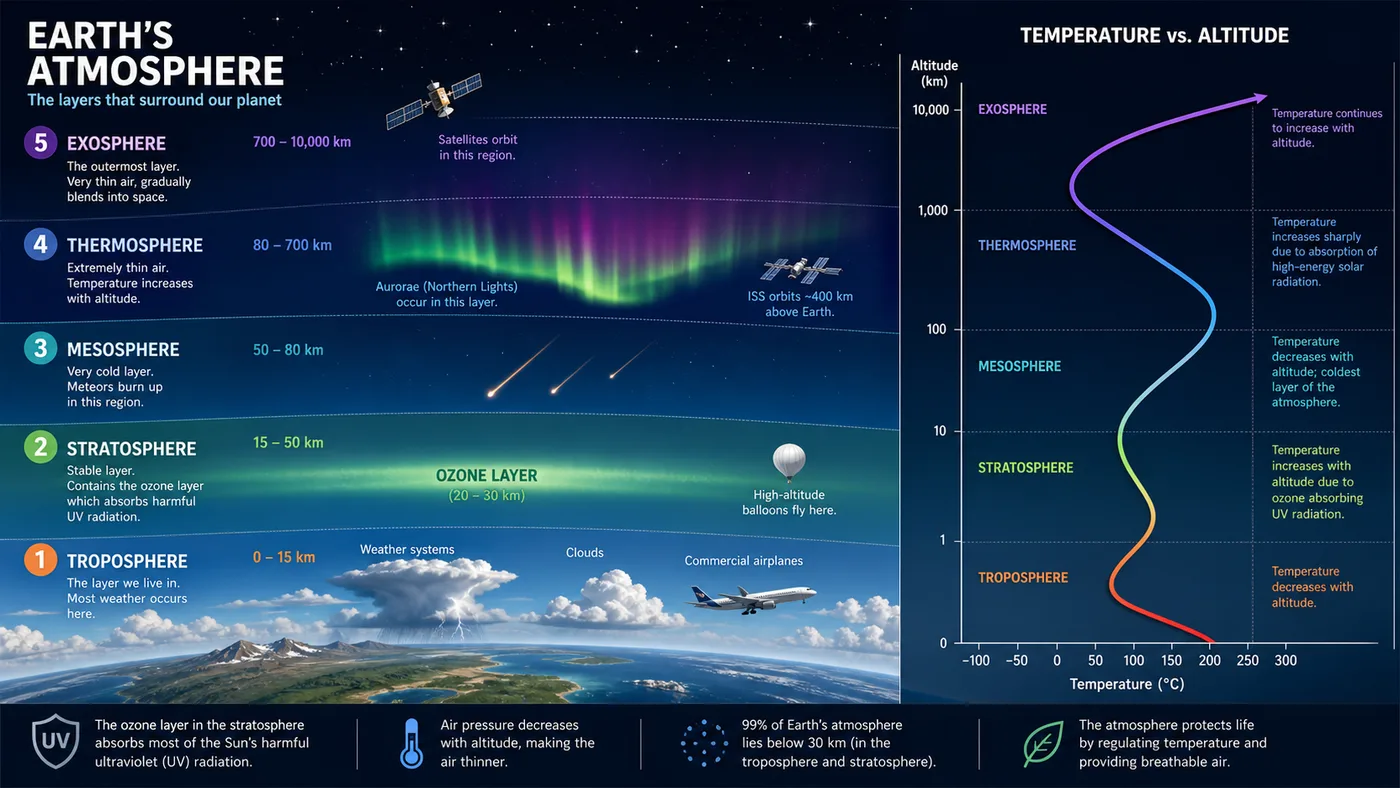
Earth's atmospheric layers
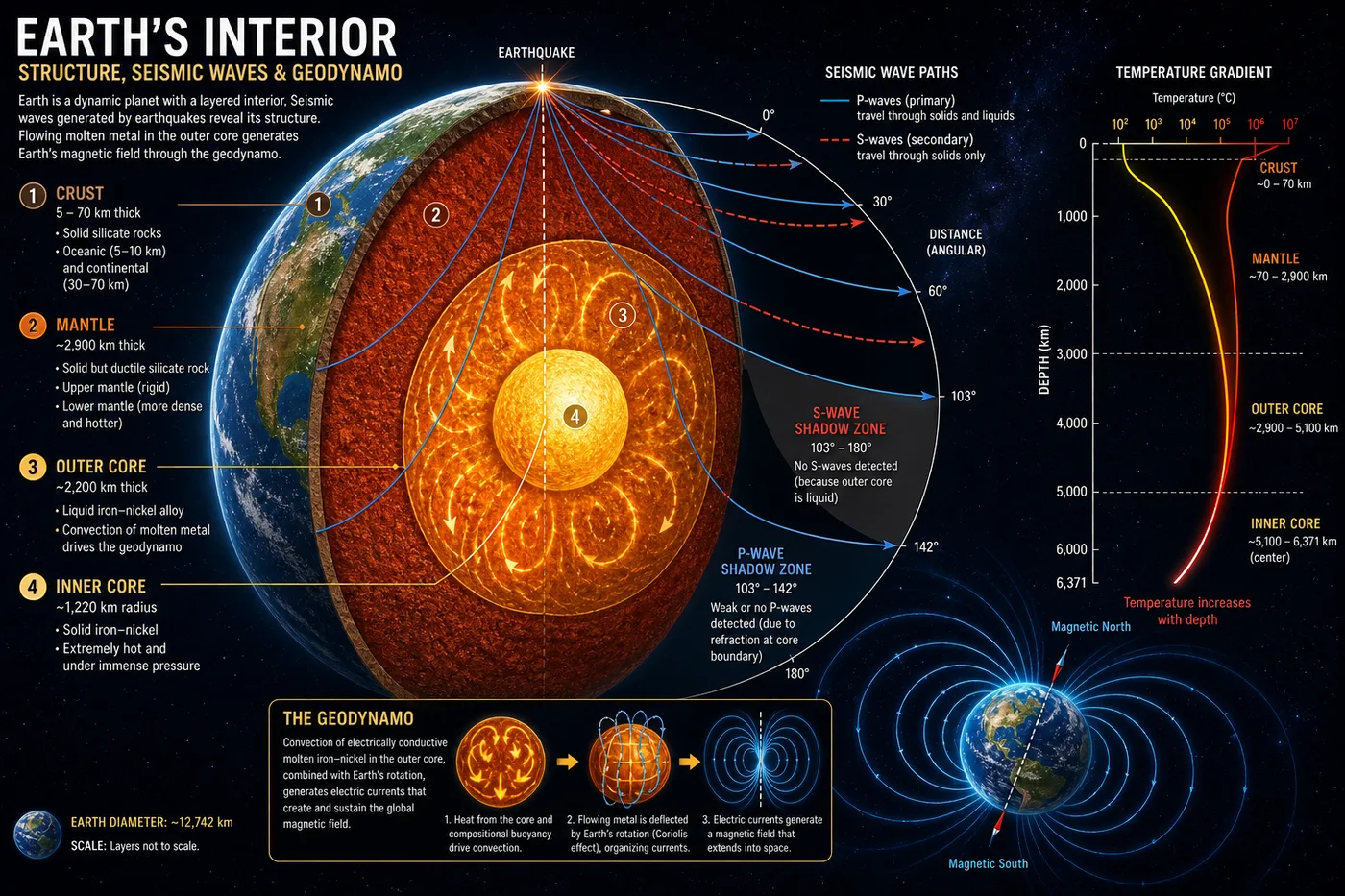
Earth's interior layered structure
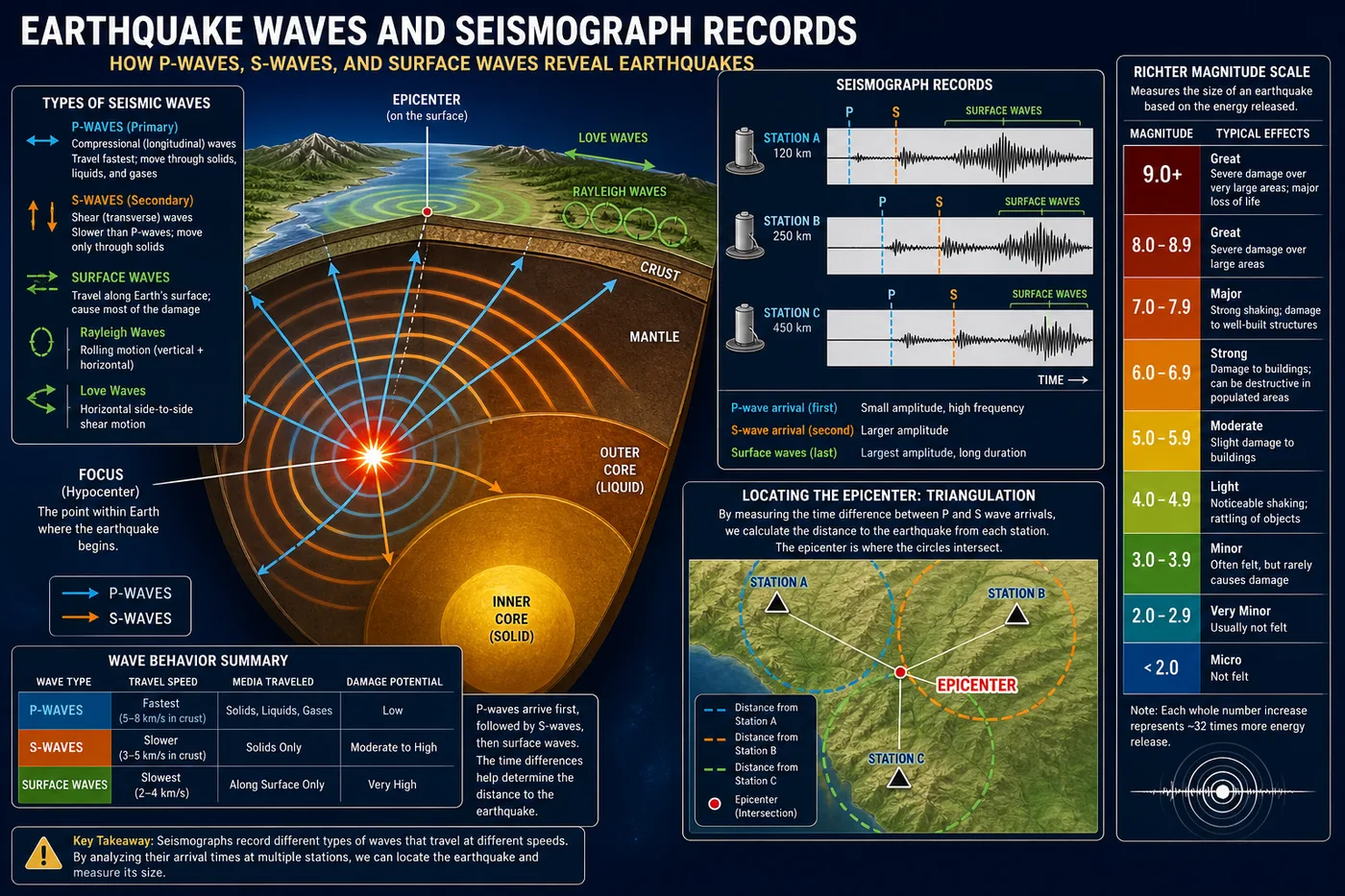
Earthquake P-wave and S-wave seismograph propagation
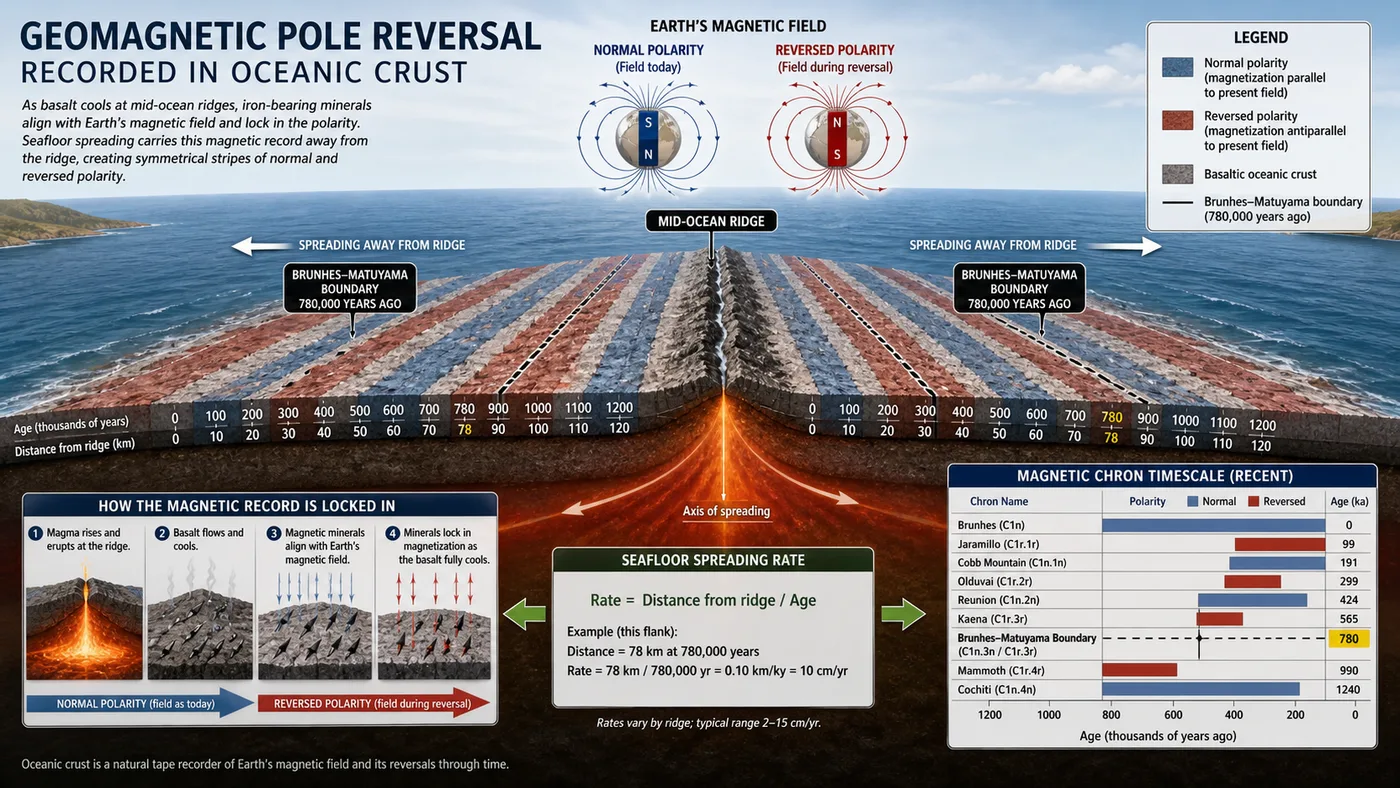
Geomagnetic pole reversal recorded in oceanic crust
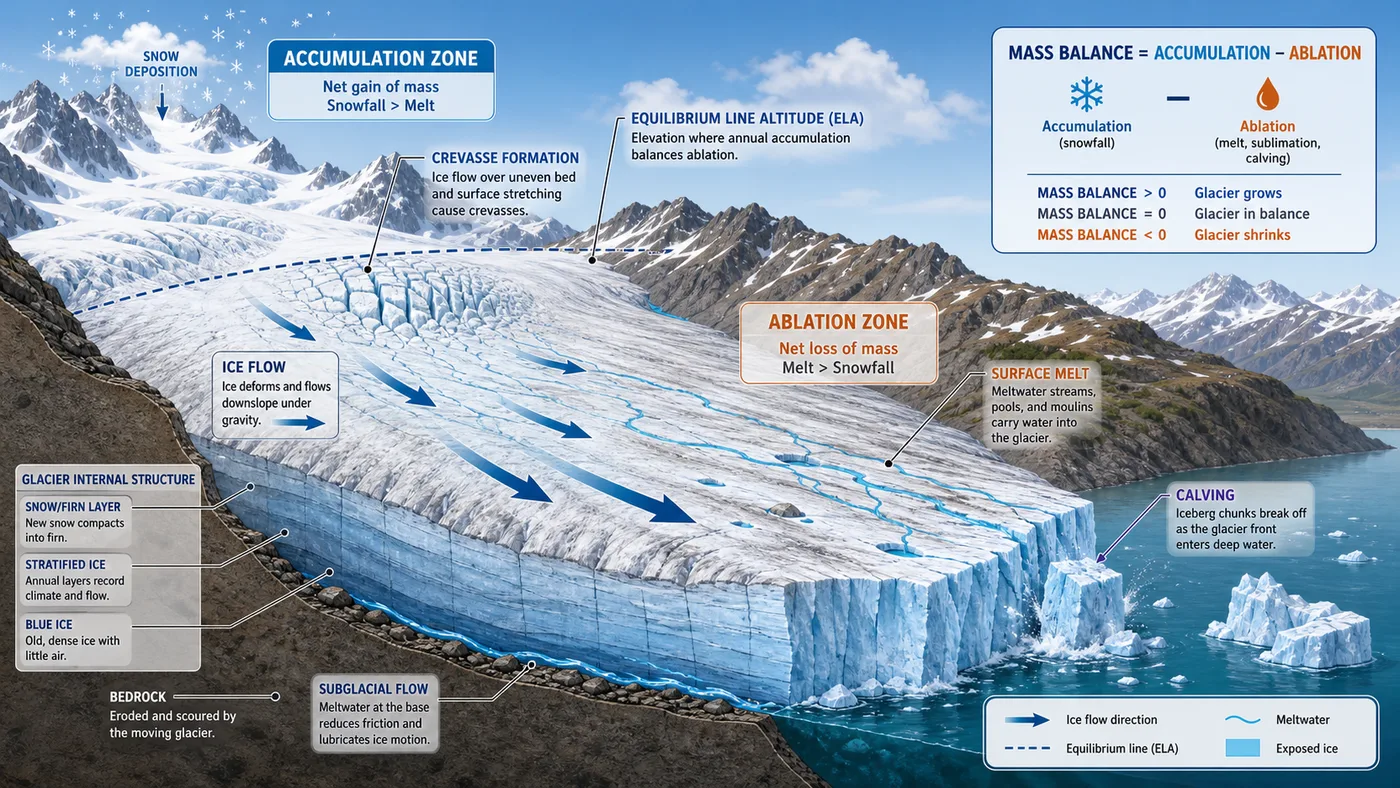
Glacier dynamics

Hand-drawn watershed map with sky, soil, water path, plants, animals, human infr
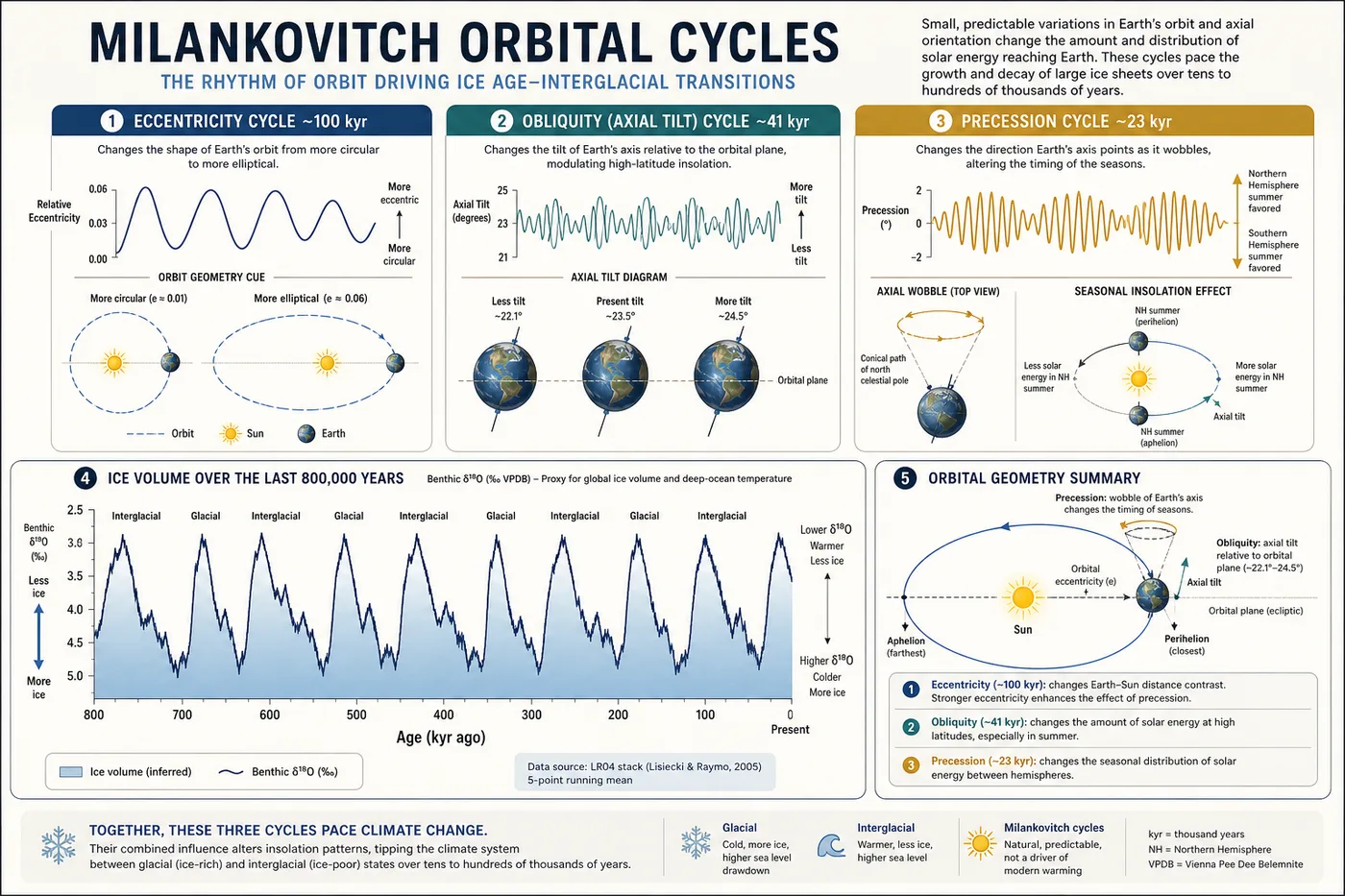
Milankovitch orbital cycles driving glacial-interglacial transitions
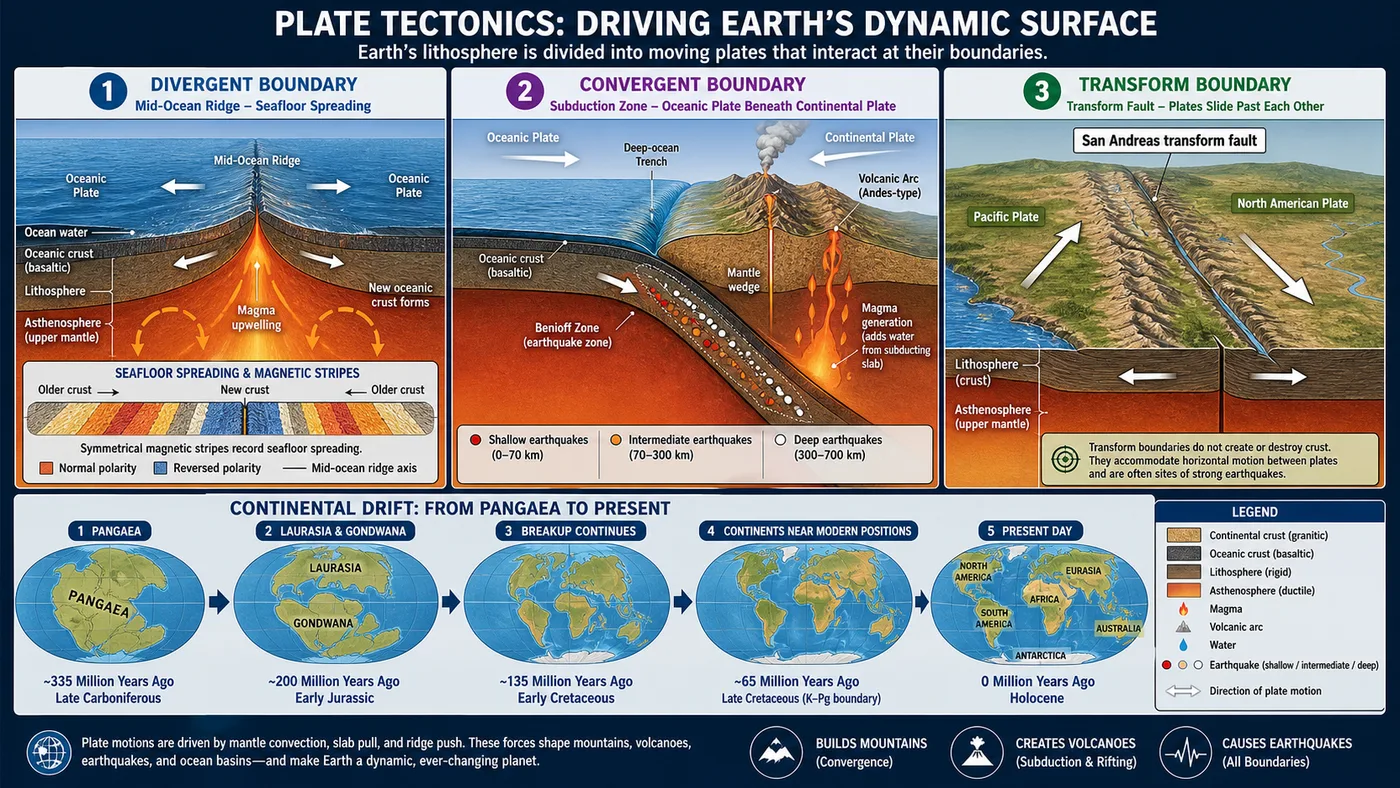
Plate tectonics with three boundary types

Root nitrogen fixation by rhizobium bacteria in legume nodules

Soil horizon cross-section
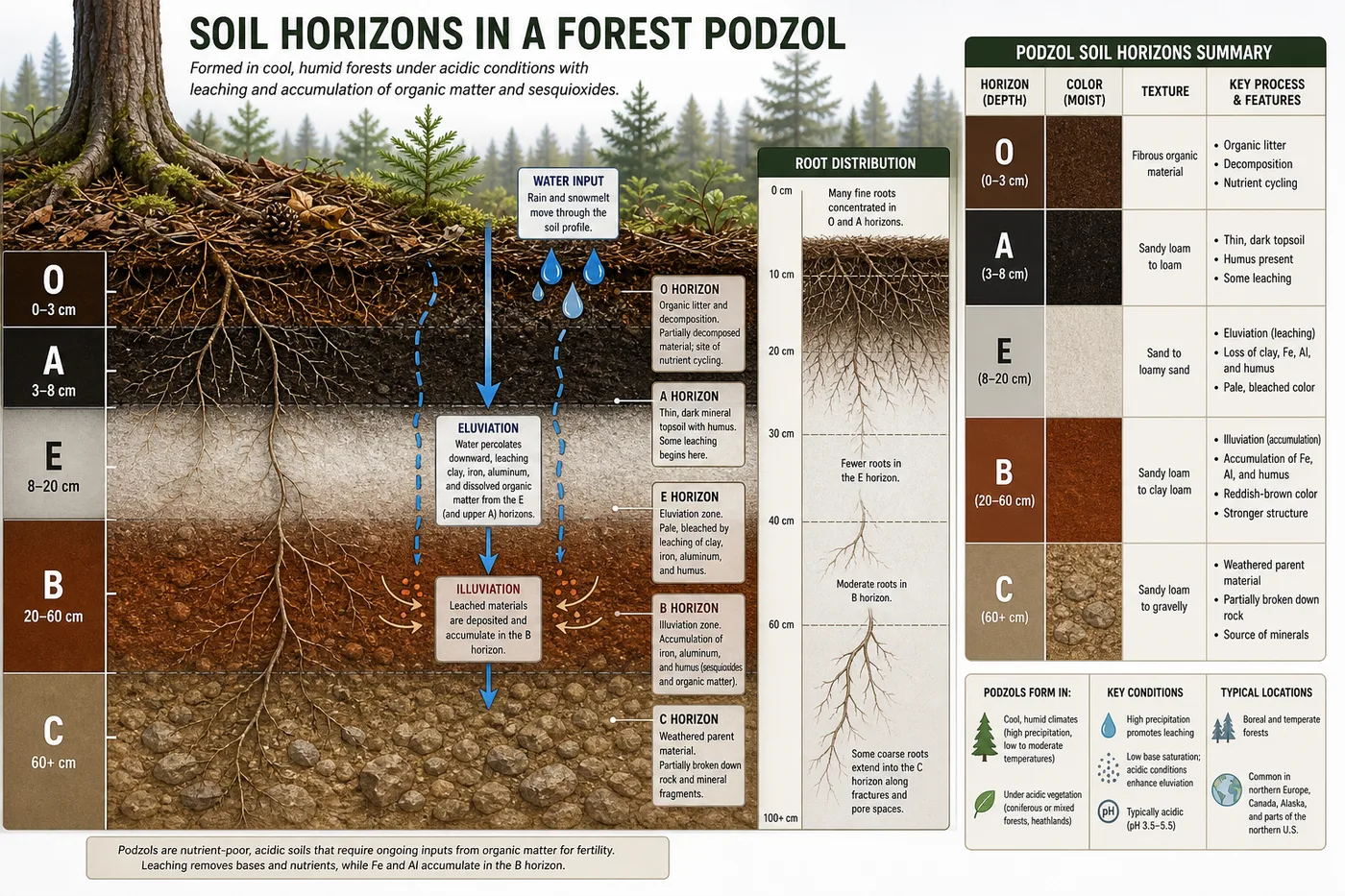
Soil horizons in a forest podzol

Soil profile diagram with annotated horizons and root structure

Spider silk biomechanics

The carbon cycle linking atmosphere, biosphere, ocean, and lithosphere
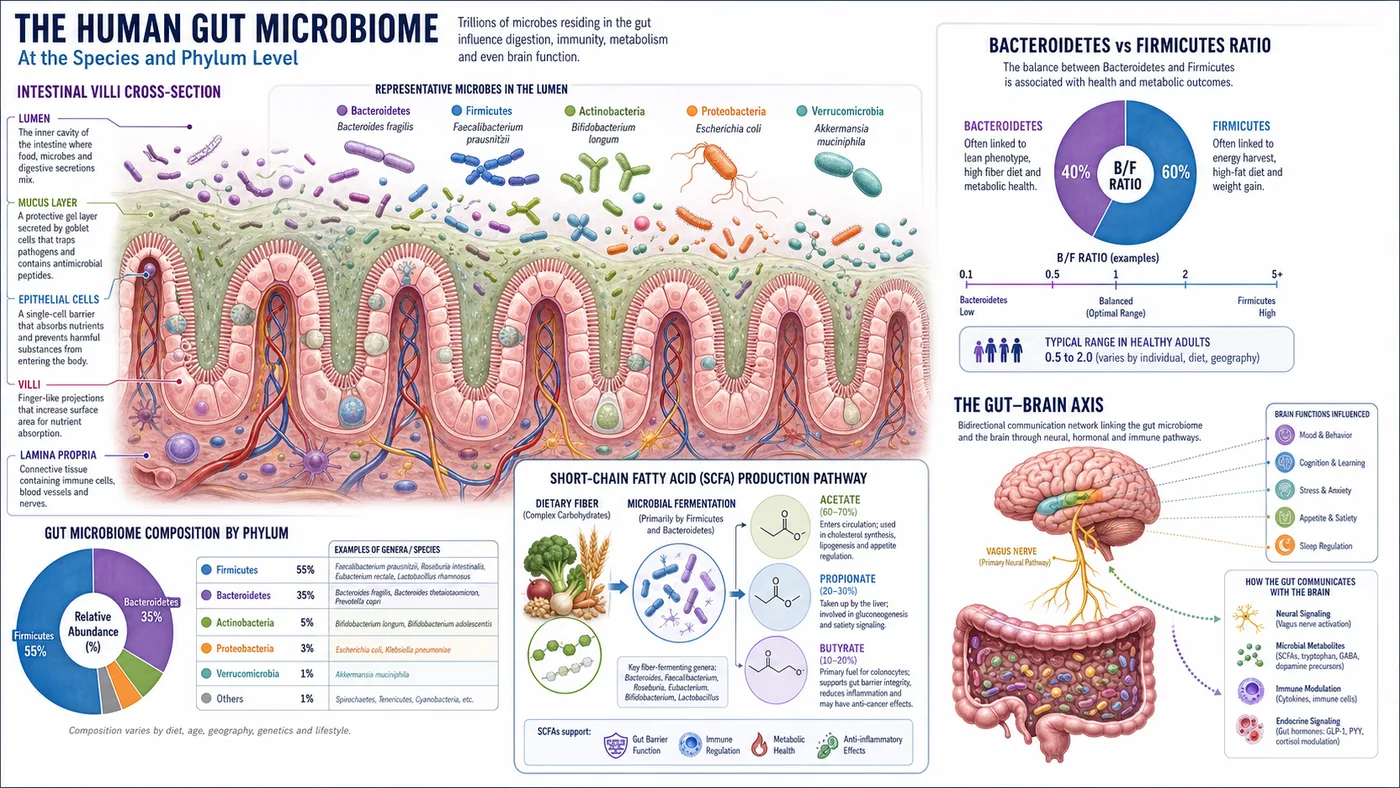
The human gut microbiome at species and phylum level
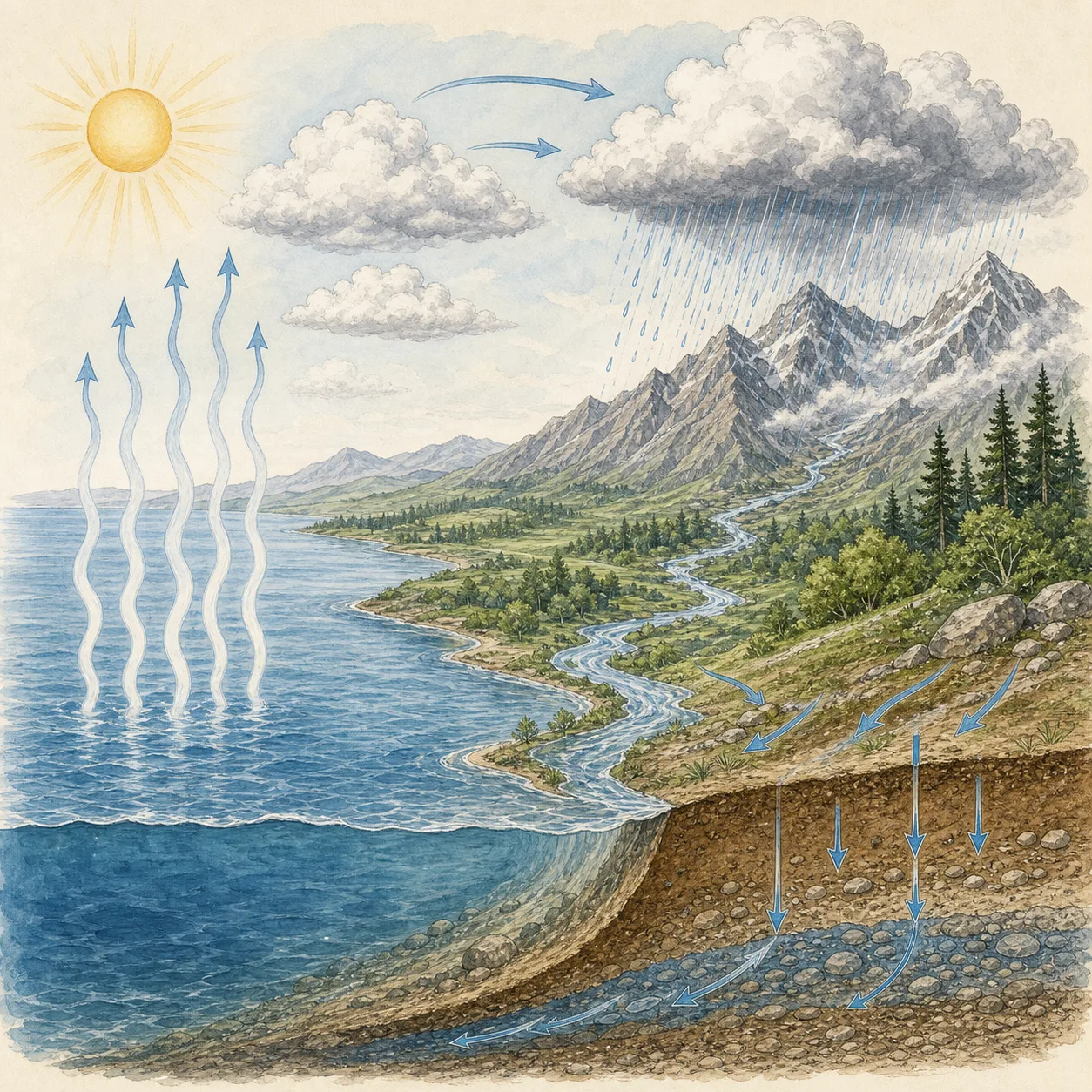
Water cycle diagram
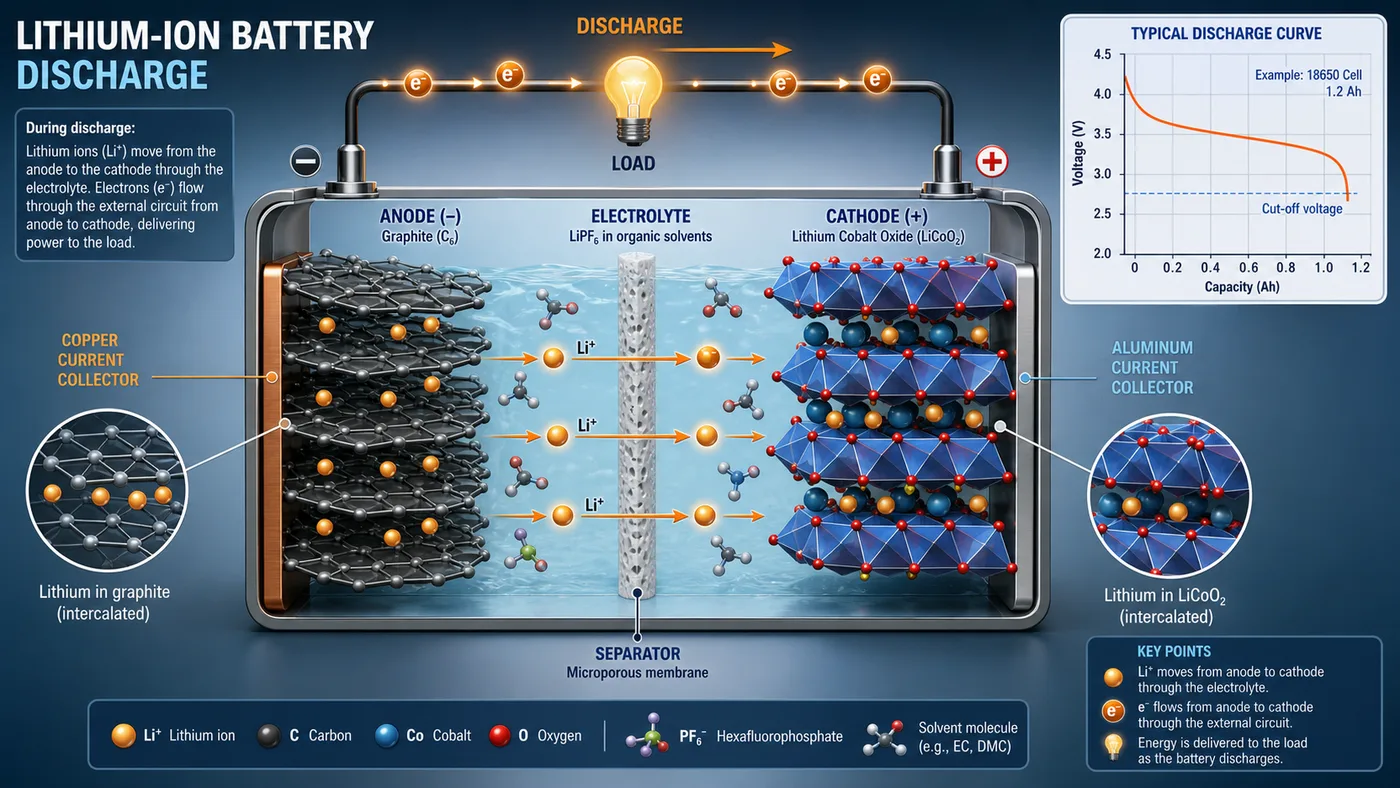
A lithium-ion battery cell during discharge
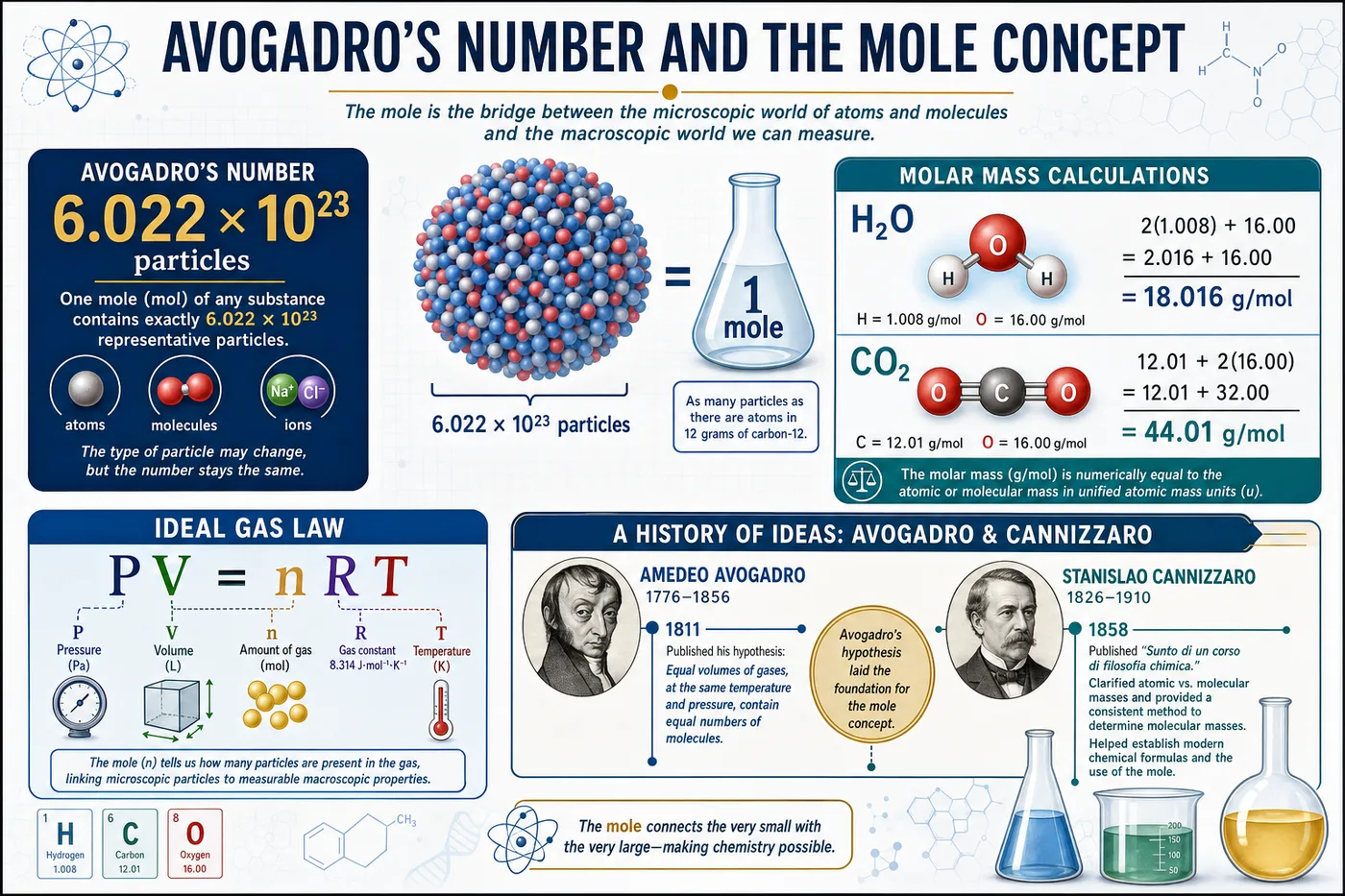
Avogadro's number and the mole concept
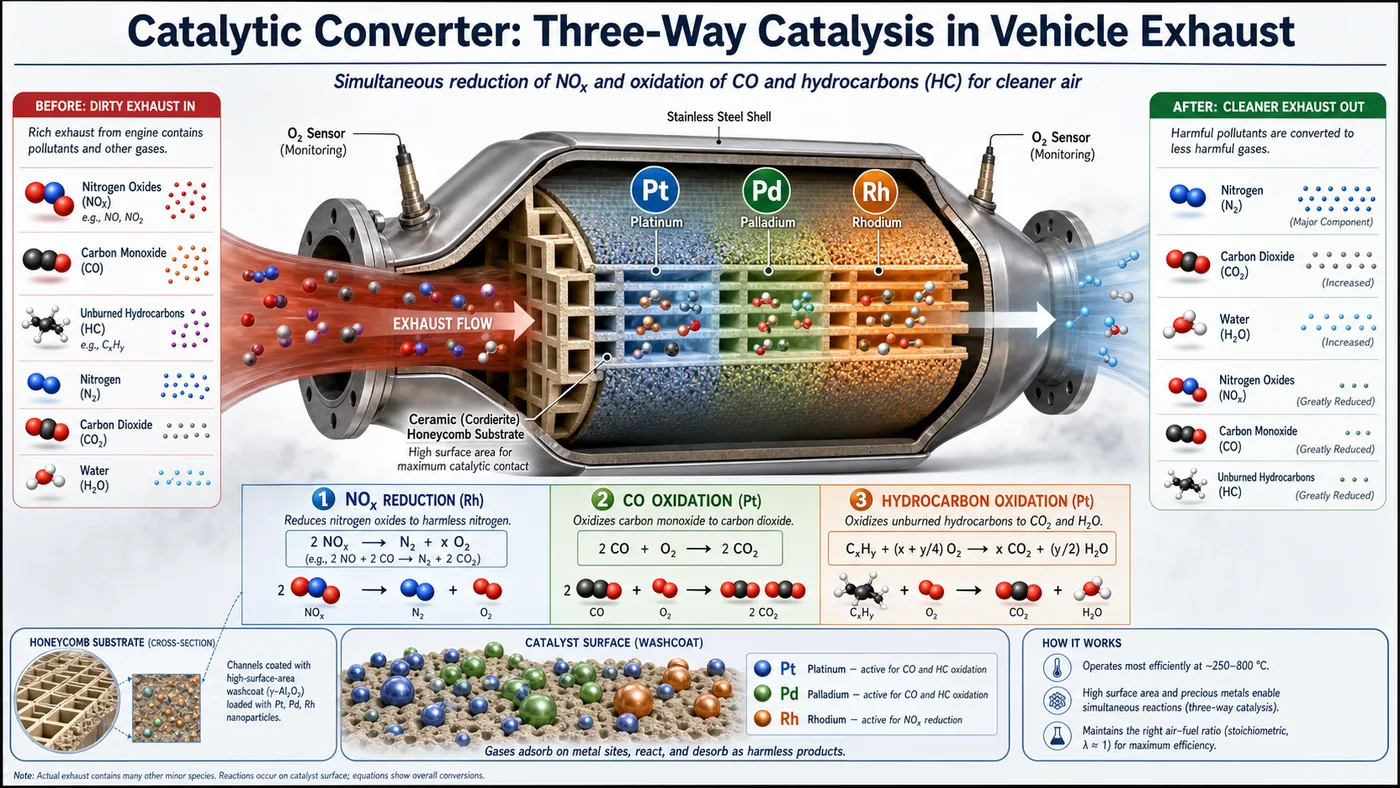
Catalytic converter three-way catalysis in vehicle exhaust
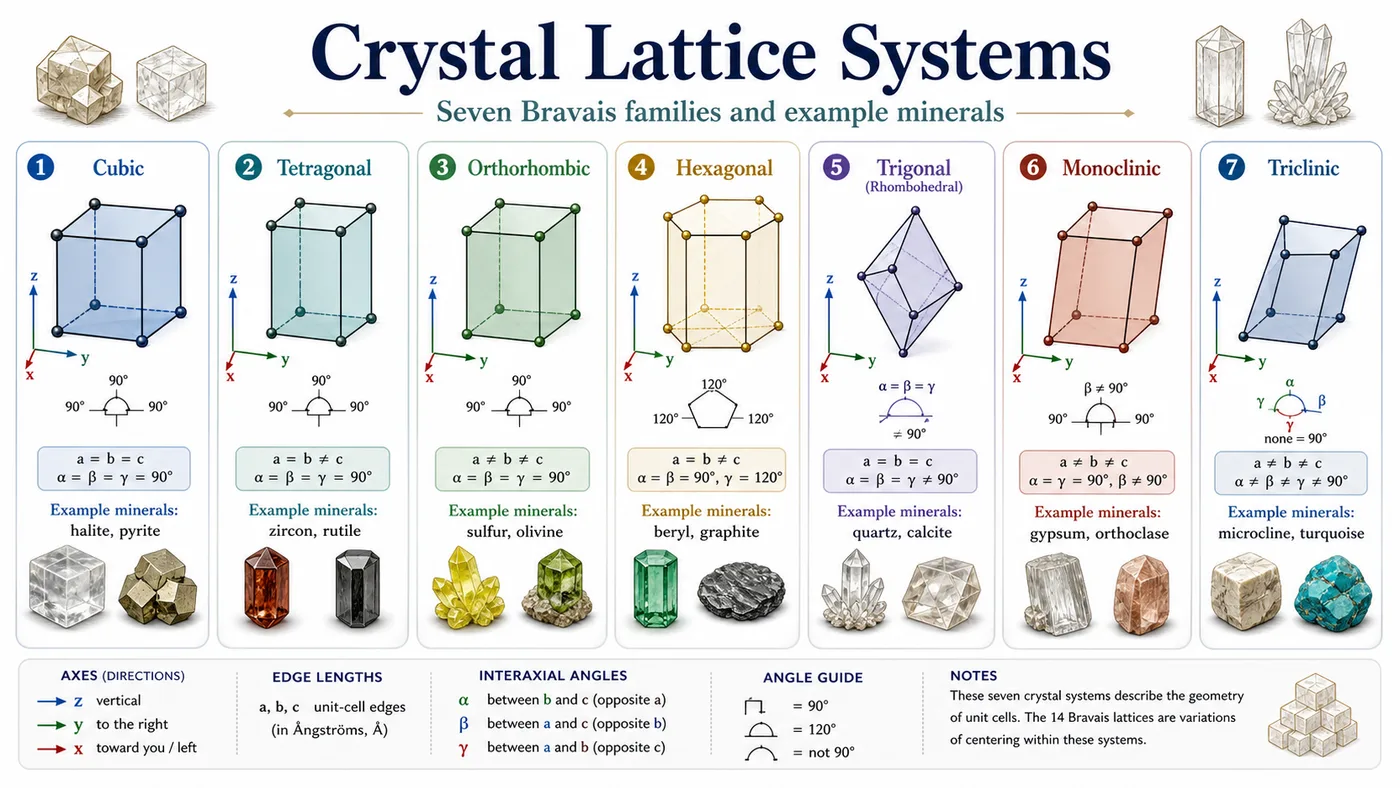
Crystal lattice systems classified into the seven Bravais families
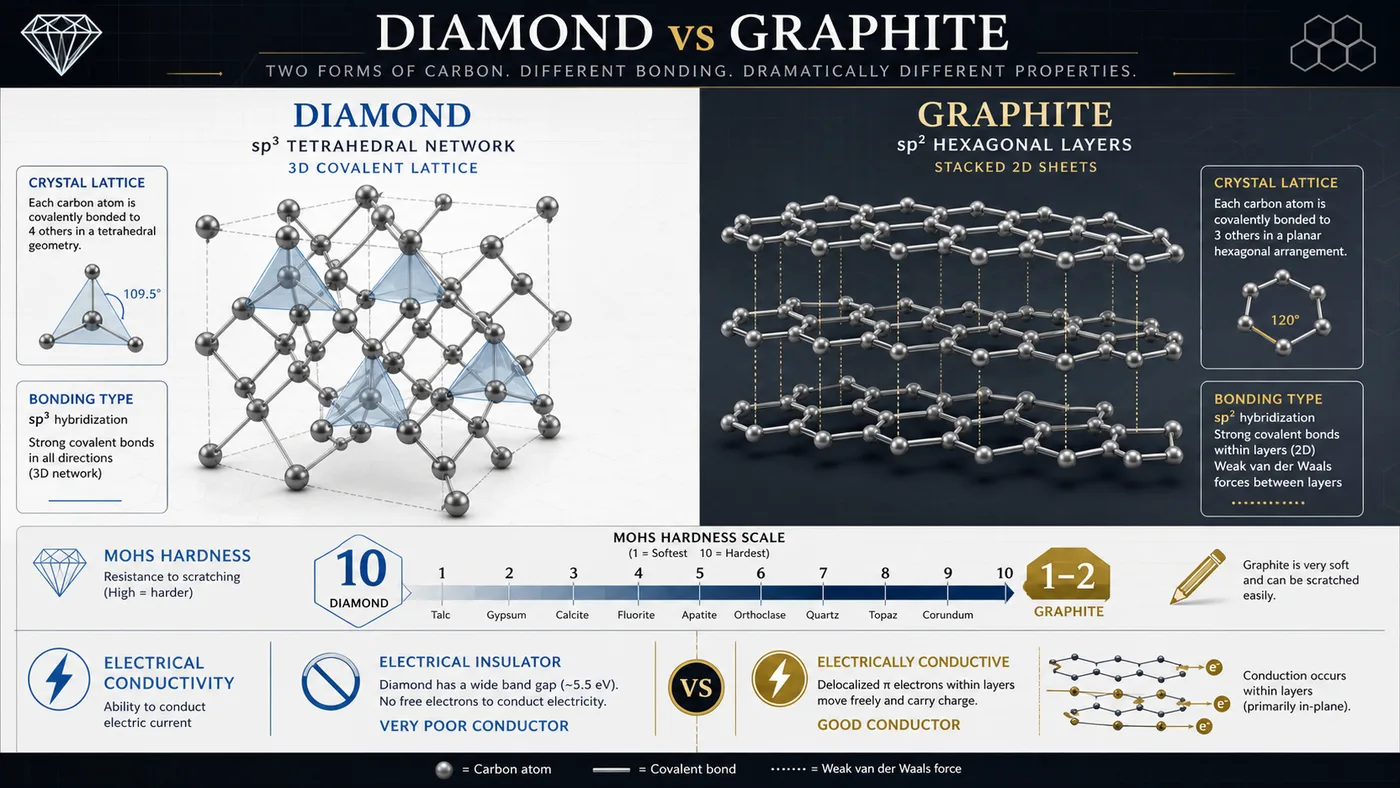
Diamond vs graphite crystal lattice comparison
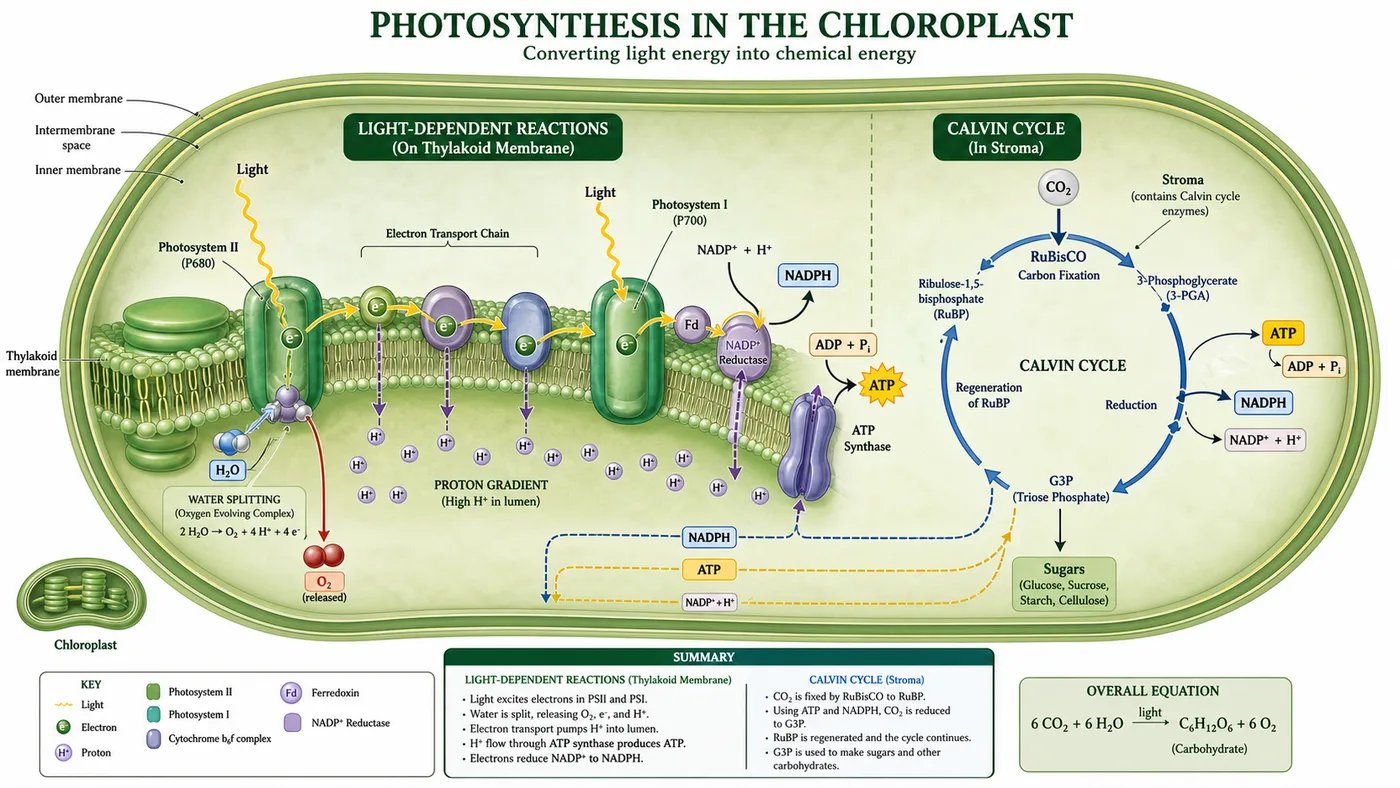
Photosynthesis with the Calvin cycle and light-dependent reactions in a plant ch
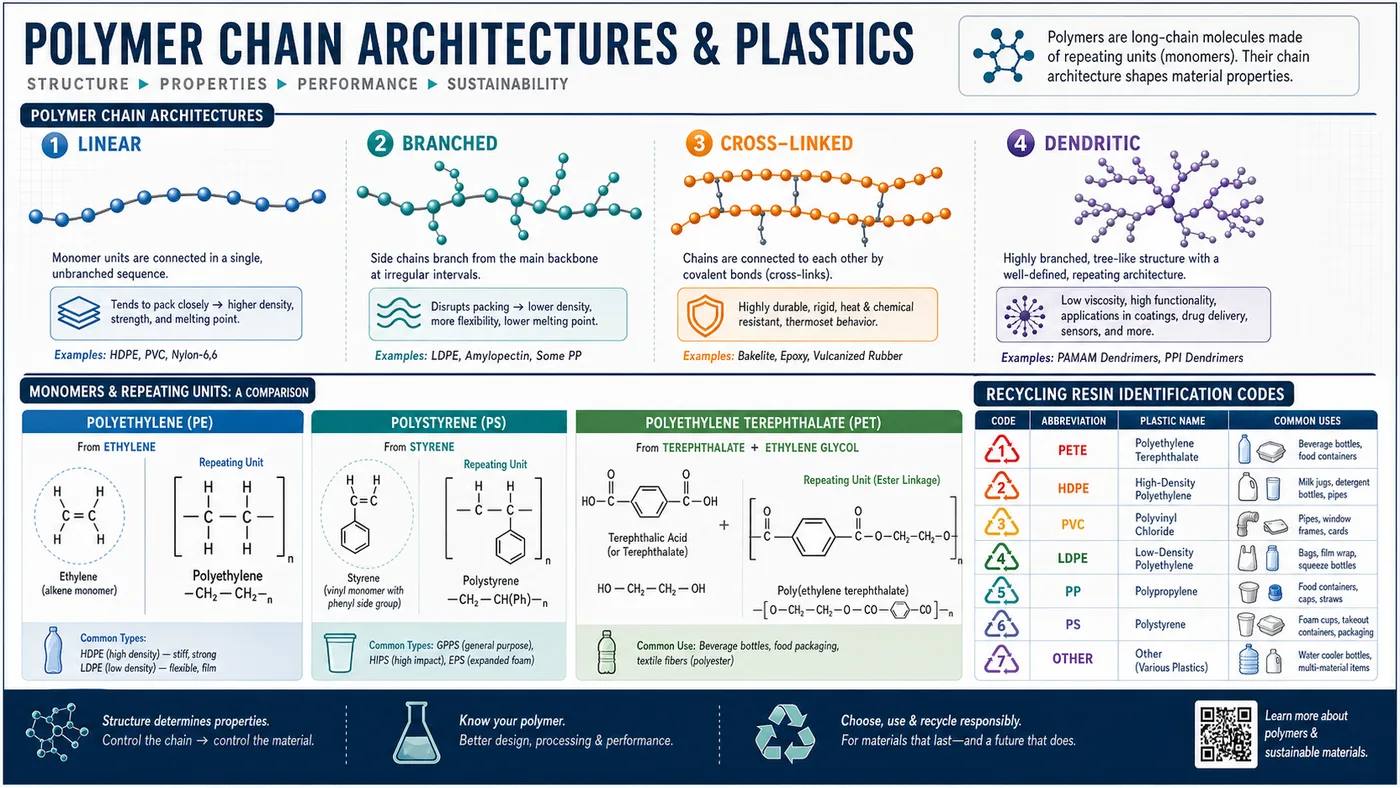
Polymer chain architectures and plastics
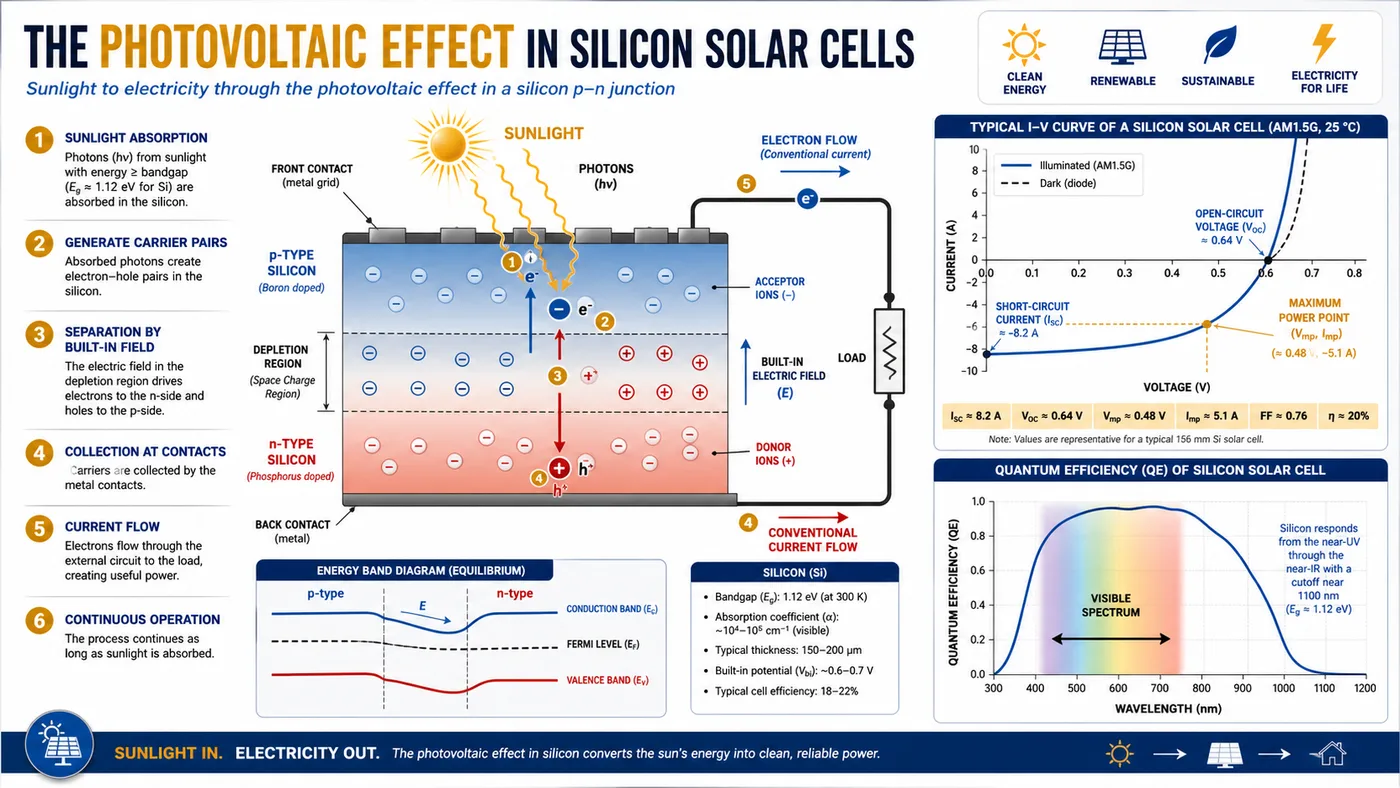
Silicon solar cell photovoltaic effect
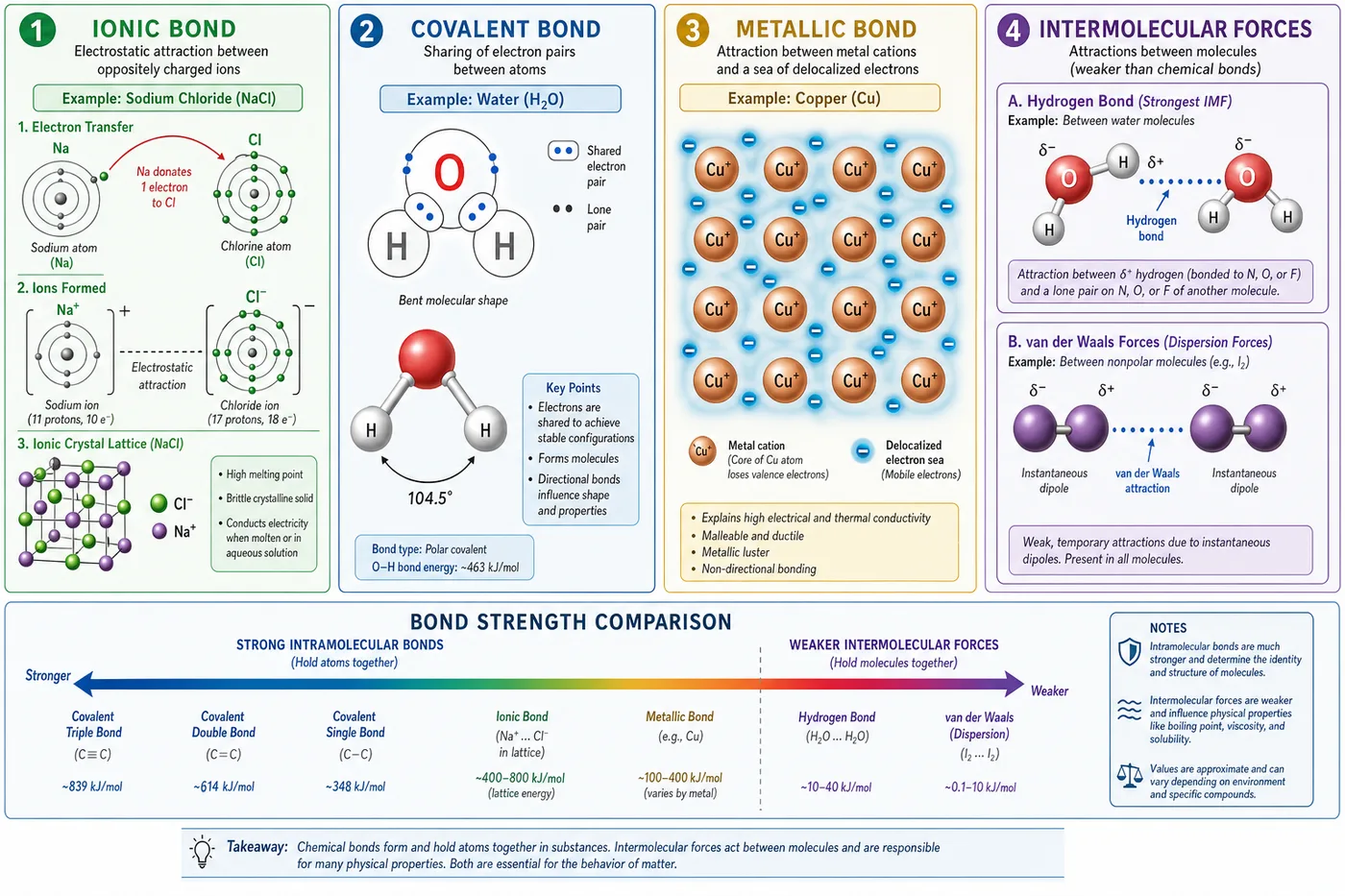
The four primary chemical bond types
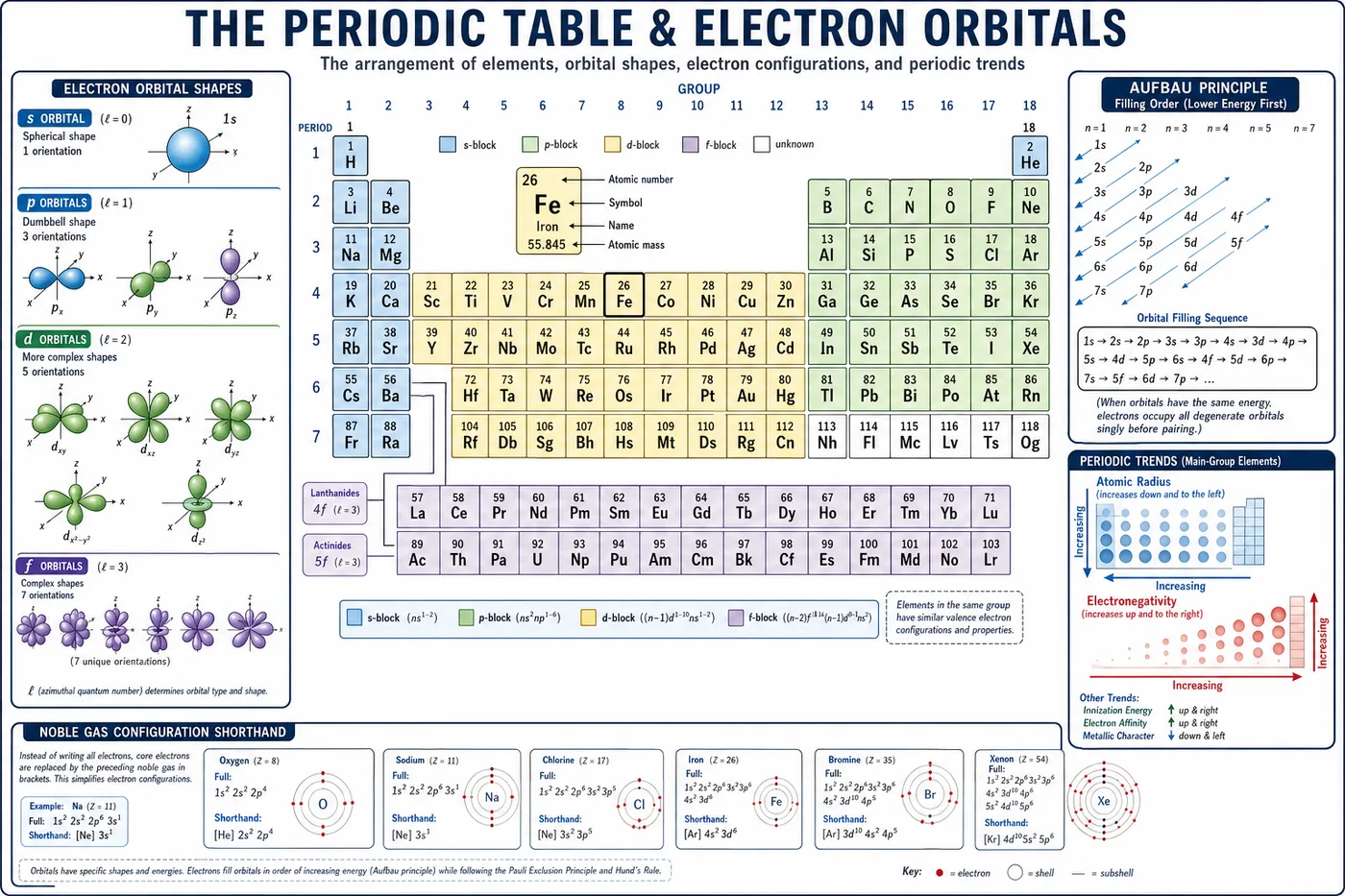
The periodic table with electron orbital shapes
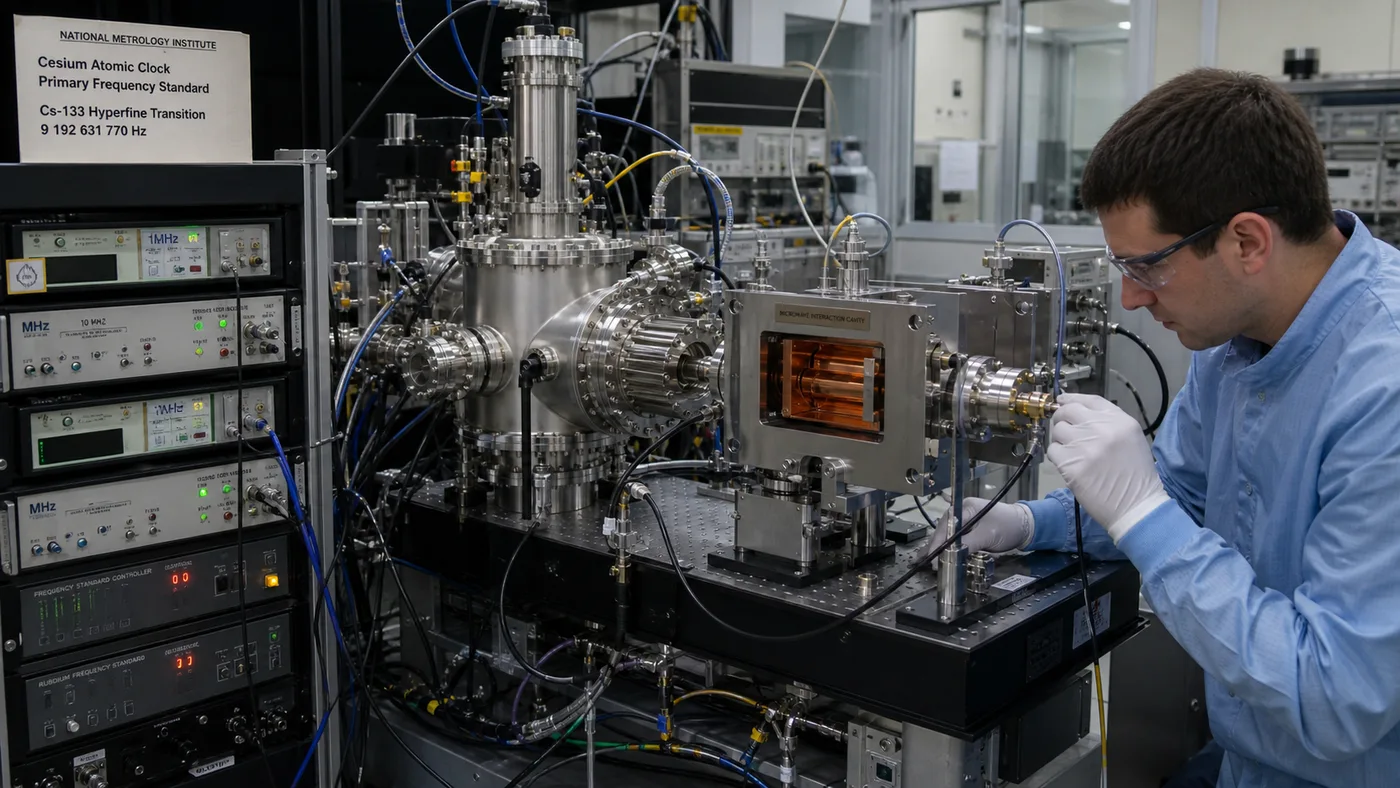
The Atomic Second
Cesium-133 hyperfine transition, the definition of the SI second since 1967.
The SI second is defined as exactly 9,192,631,770 oscillations of the cesium-133 atom's ground-state hyperfine transition. This definition was adopted by the 13th General Conference on Weights and Measures in 1967, replacing the astronomical second. Cesium beam frequency standards at national metrology institutes maintain agreement to better than 1 part in 10¹³. The NIST-F1 fountain clock, operati
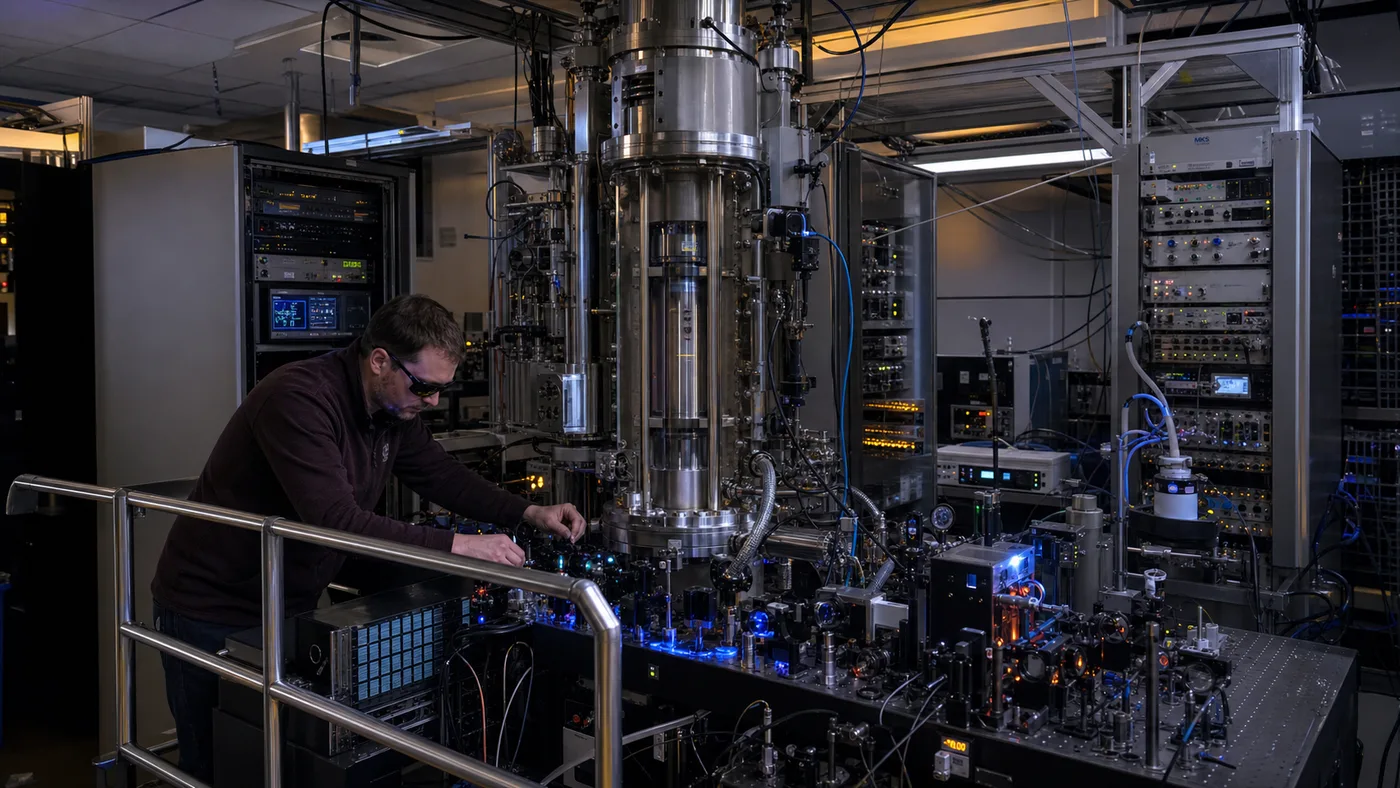
Fountain of Seconds
NIST-F1 cesium fountain, U.S. primary frequency standard, accurate to ~5×10⁻¹⁶.
NIST-F1, located in Boulder, Colorado, became the U.S. primary frequency standard in 1999. Laser-cooled cesium atoms are launched upward in a "fountain" trajectory through a microwave cavity. Gravity brings them back through the same cavity, doubling the interaction time and sharply narrowing the resonance. NIST-F1 achieves a fractional frequency uncertainty of approximately 5×10⁻¹⁶, meaning it wo
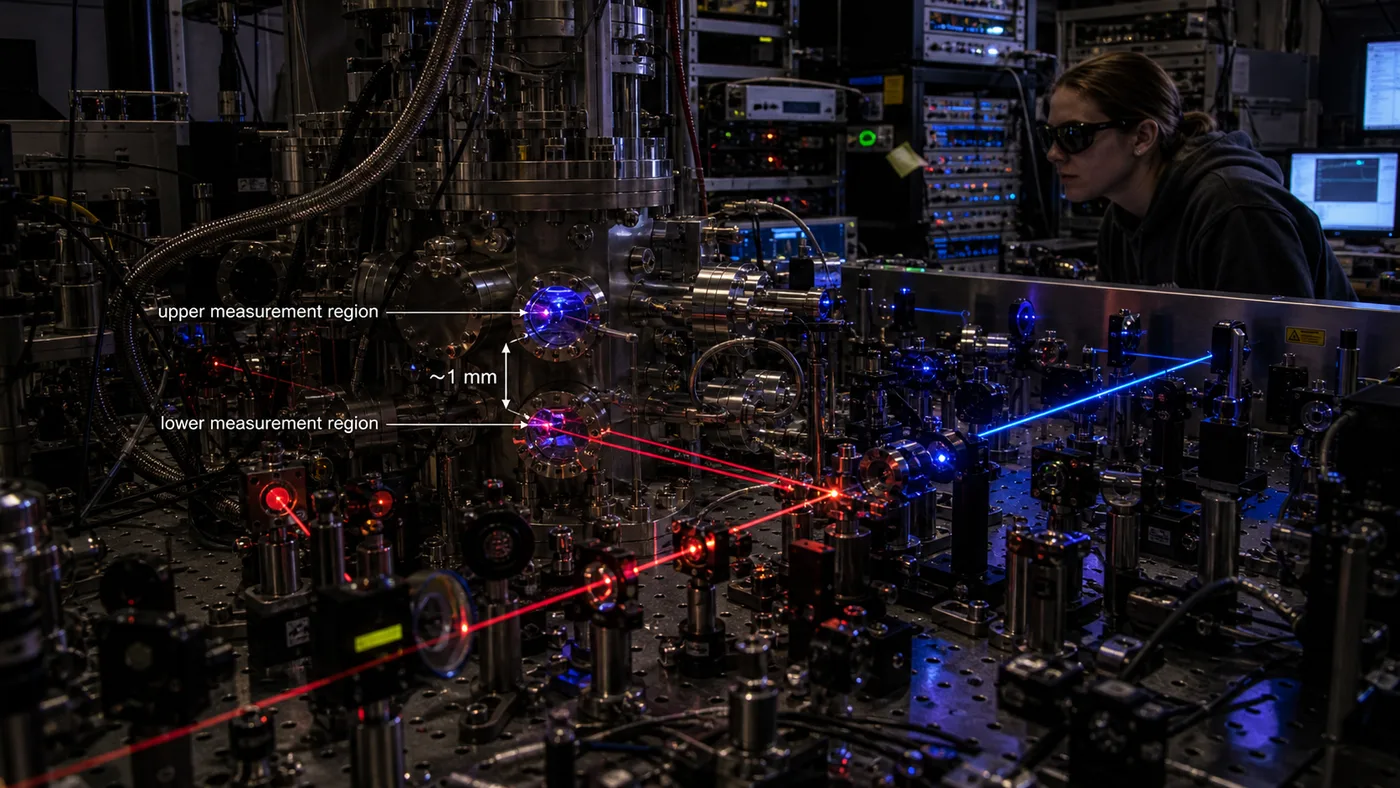
Time Bends at One Centimeter
NIST strontium optical lattice clock detects gravitational time dilation across 33 centimeters.
In 2010, NIST physicists using aluminum ion optical clocks demonstrated gravitational time dilation at differences of just 33 centimeters in height, confirming Einstein's general relativity at the tabletop scale for the first time. The NIST strontium optical lattice clock achieves a fractional frequency uncertainty of approximately 2×10⁻¹⁸, making it sensitive enough to measure the gravitational
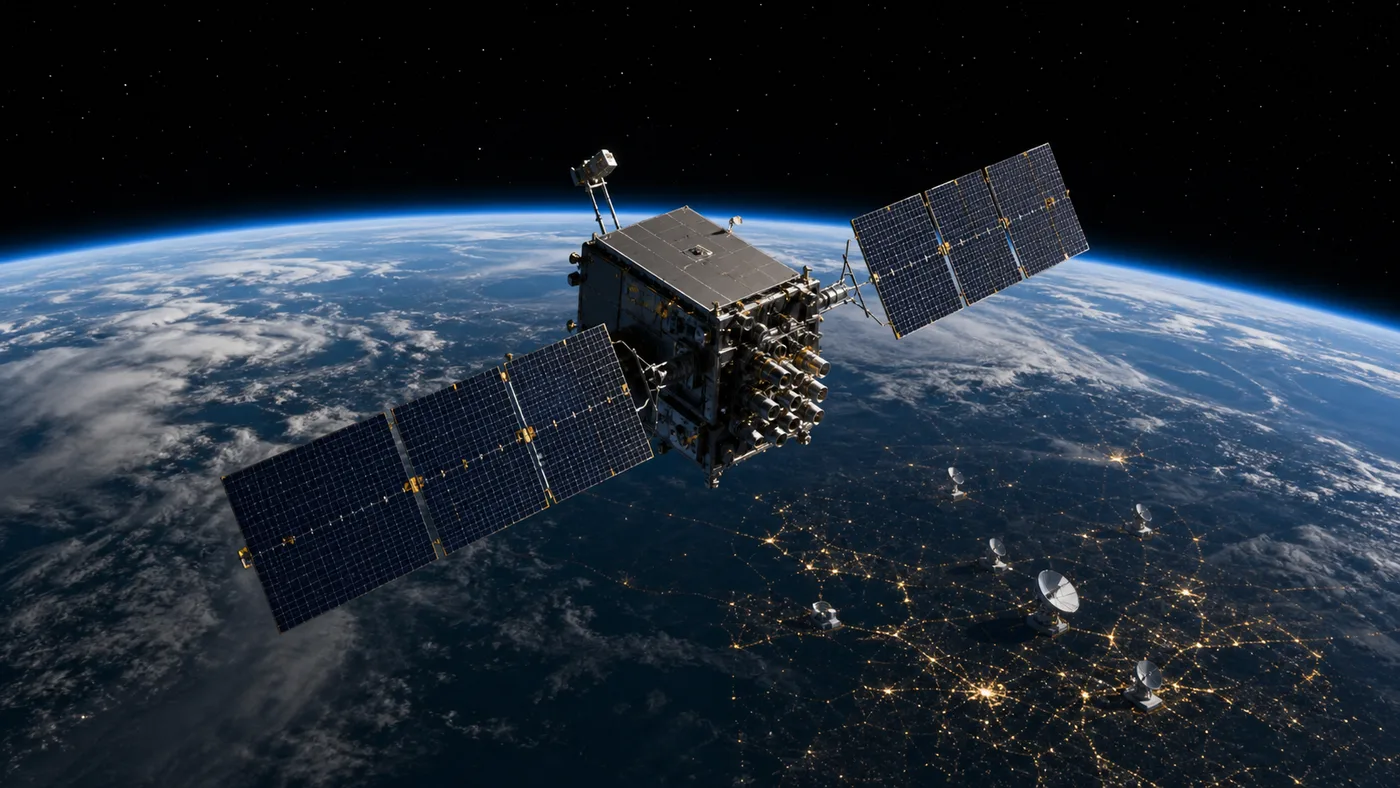
Relativity in Every GPS Fix
Relativistic corrections of 38 microseconds per day keep GPS Block II/III navigation accurate.
GPS satellites orbit at 20,200 km altitude and 3.87 km/s orbital speed. Without correction, two relativistic effects would accumulate. Special relativity (time dilation from satellite speed) causes satellite clocks to run slow by ~7 microseconds per day. General relativity (gravitational blueshift from lower gravity at altitude) causes them to run fast by ~45 microseconds per day. The net effect i
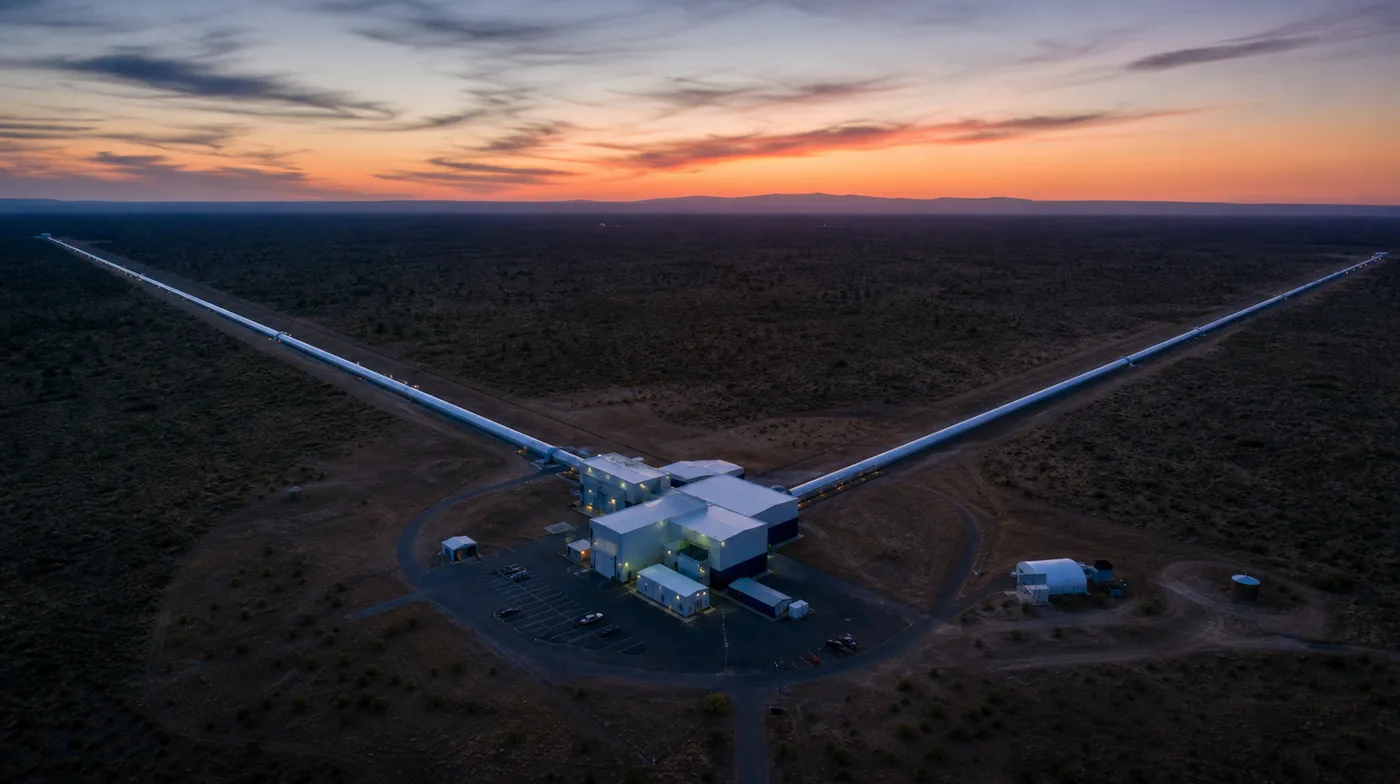
Arms Across the Prairie
At LIGO Hanford, 4-kilometer arms stretch across the Washington desert, listening for spacetime.
LIGO (Laser Interferometer Gravitational-Wave Observatory) consists of two L-shaped detectors: Hanford, Washington (4 km arm length) and Livingston, Louisiana (4 km arm length). Each arm contains a 4 km beam tube in which laser light bounces between suspended mirrors. A gravitational wave passing through compresses one arm while stretching the other, creating a phase shift detectable at the photod
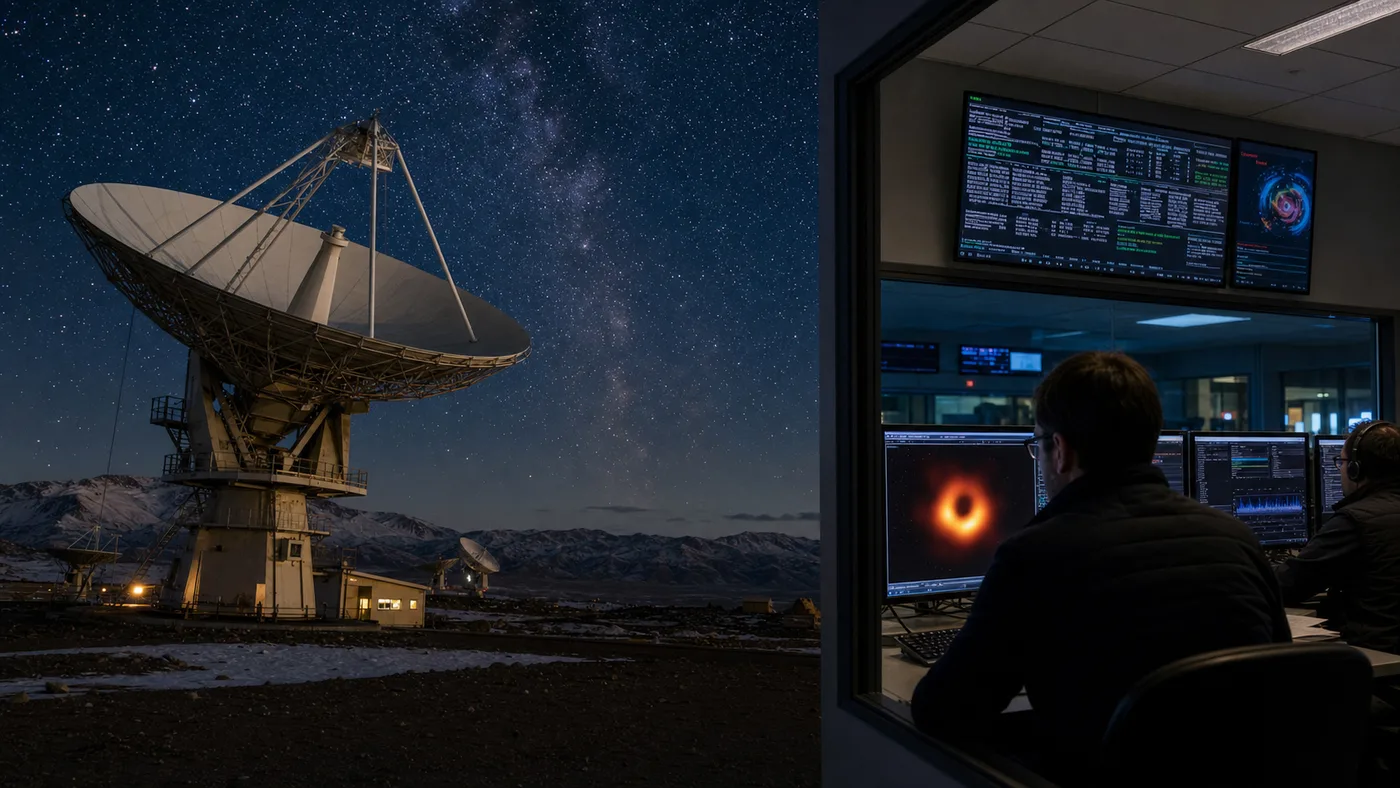
An Earth-Sized Eye
The Event Horizon Telescope links eight radio observatories by VLBI to image a black hole.
The Event Horizon Telescope (EHT) is a global Very Long Baseline Interferometry (VLBI) network that, during its 2017 observing campaign, linked eight radio telescopes across four continents, creating an effective aperture the size of Earth. The array operated at a wavelength of 1.3 mm (230 GHz). On April 10, 2019, the EHT collaboration published the first direct image of a black hole: the shadow
The Shadow of Nothing
M87*, the first black hole photographed. A ring of fire, a dark center, 55 million light-years away.
The EHT image of M87* released April 10, 2019 shows a bright asymmetric emission ring approximately 40 microarcseconds in angular diameter with a dark central shadow, the photon capture region. The brighter southern crescent arises from Doppler beaming. Plasma in the accretion disk on the approaching side (rotating toward the observer) is relativistically brightened. The black hole mass of M87* i
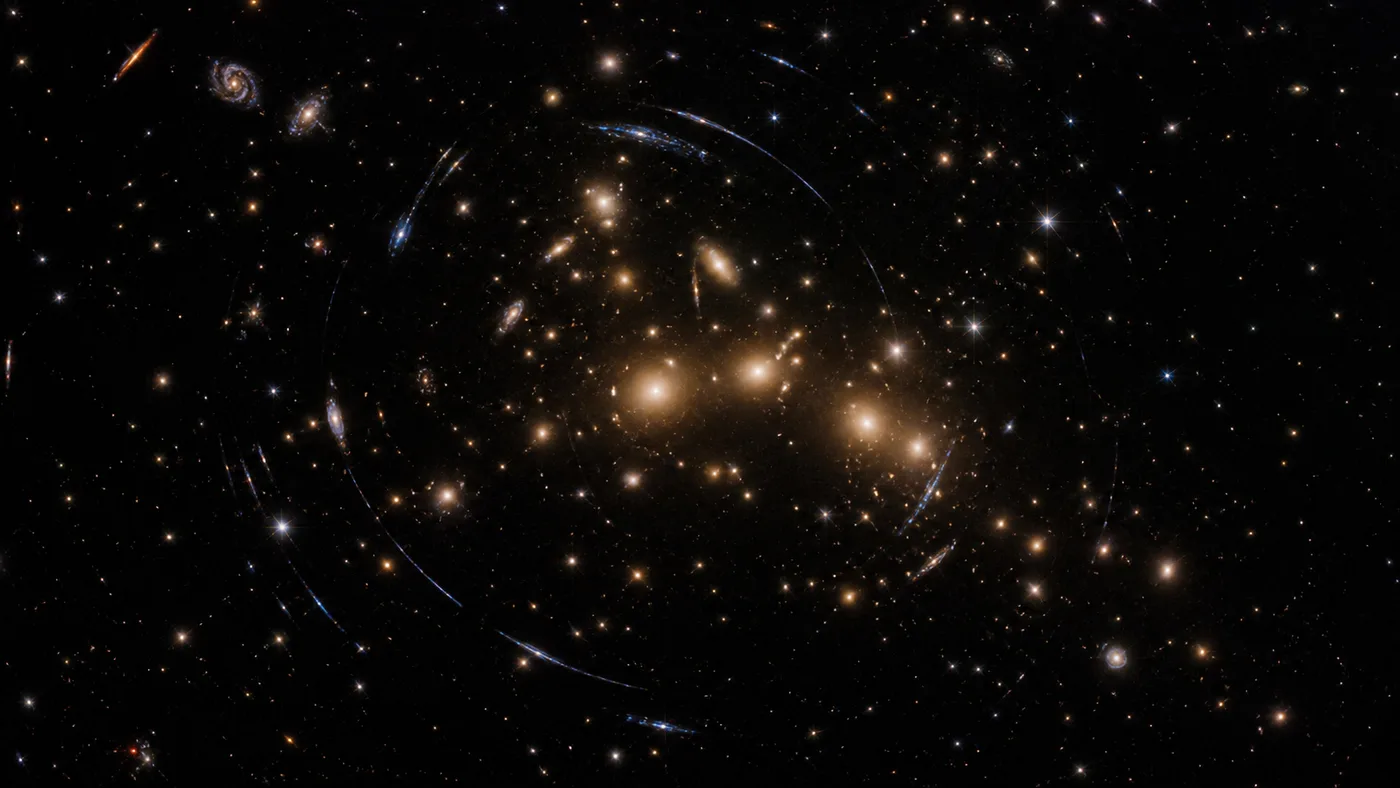
Mass Bends Light
Galaxy cluster gravitational lensing writes Einstein's spacetime curvature in arcs of distant starlight.
Massive galaxy clusters act as gravitational lenses, bending spacetime so severely that background galaxies stretch into curved arcs. The first confirmed gravitational arc was discovered in Abell 370 in 1987. Hubble Space Telescope observations of clusters like Abell 2744 and SMACS 0723 reveal dozens of lensing arcs from galaxies at redshifts z > 6, corresponding to lookback times exceeding 12 billio
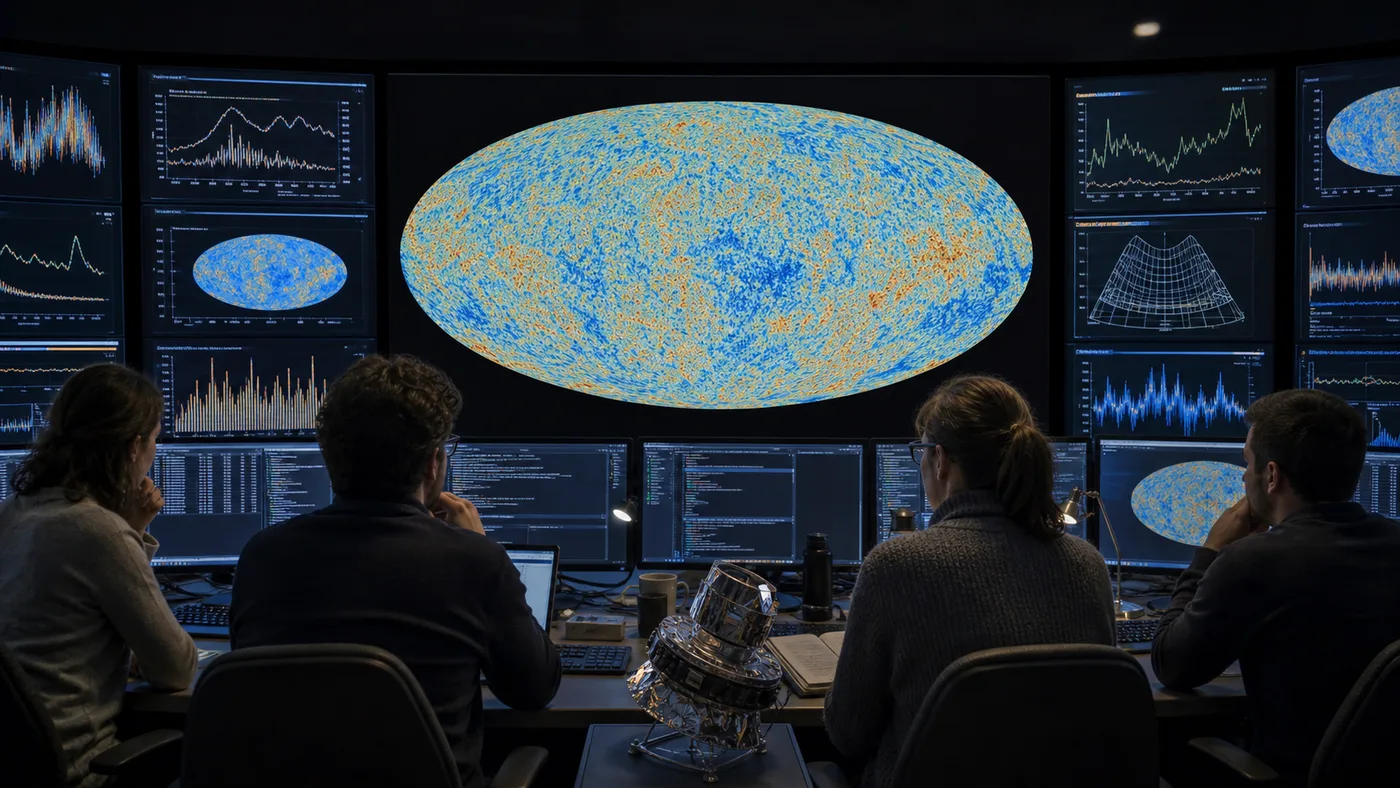
The Oldest Light
ESA Planck satellite's full-sky cosmic microwave background map, light from 380,000 years after the Big Bang.
ESA's Planck mission launched May 14, 2009 and operated until October 2013. From its halo orbit at the Sun-Earth L2 Lagrange point, Planck mapped the full sky twice in microwave frequencies, producing the most precise all-sky map of the cosmic microwave background (CMB), light from 380,000 years after the Big Bang, when the universe cooled enough for atoms to form. The 2013 and 2015 Planck data r
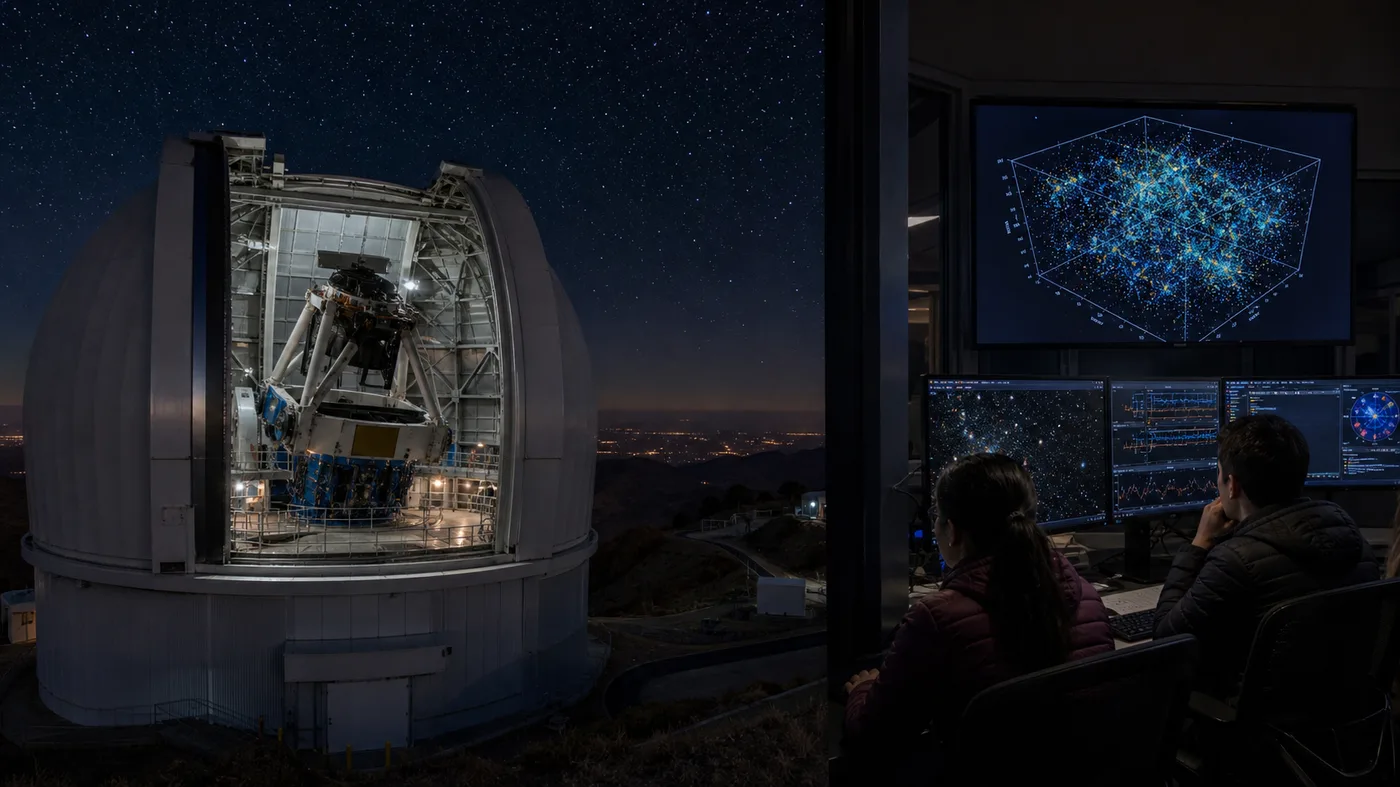
Five Thousand Eyes
At Kitt Peak, DESI's 5,000 optical fibers map the universe's expansion history to probe dark energy.
The Dark Energy Spectroscopic Instrument (DESI) began official survey operations in May 2021 at the Nicholas U. Mayall 4-meter telescope at Kitt Peak National Observatory, Arizona. DESI deploys 5,000 robotic fiber positioners in a 3.2-degree focal plane, simultaneously capturing spectra from 5,000 galaxies or quasars per 15–20 minute exposure. In its first year of science operations, DESI measured
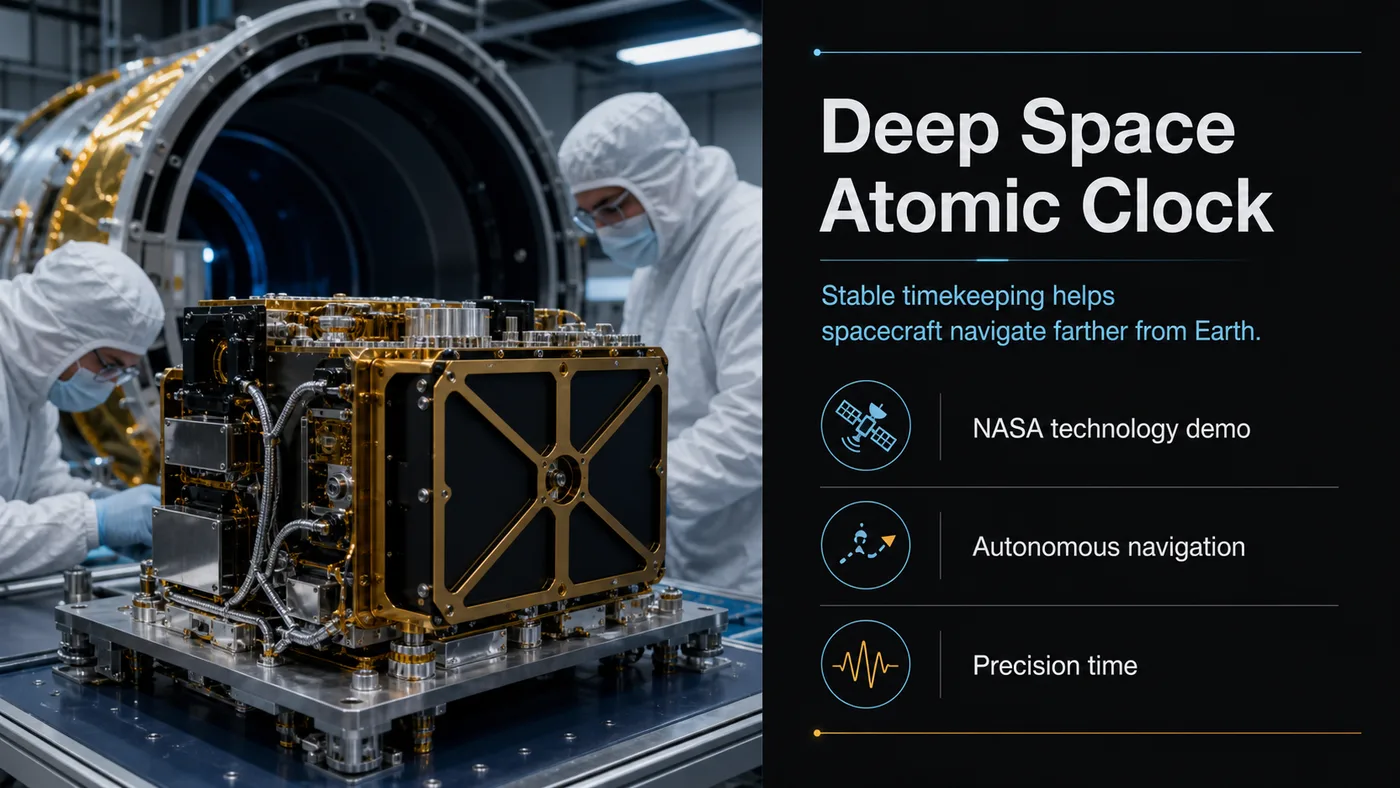
Self-Navigating in the Dark
NASA Deep Space Atomic Clock, 50x more stable than GPS clocks, enabling one-way autonomous navigation.
NASA's Deep Space Atomic Clock (DSAC) is a miniaturized mercury ion trap atomic clock developed by JPL. It launched in June 2019 aboard the General Atomics Orbital Test Bed satellite. DSAC demonstrated a clock stability of better than 3 nanoseconds of drift over 20 days, approximately 50 times more stable than the best GPS satellite atomic clocks. Conventional deep-space navigation requires two-w
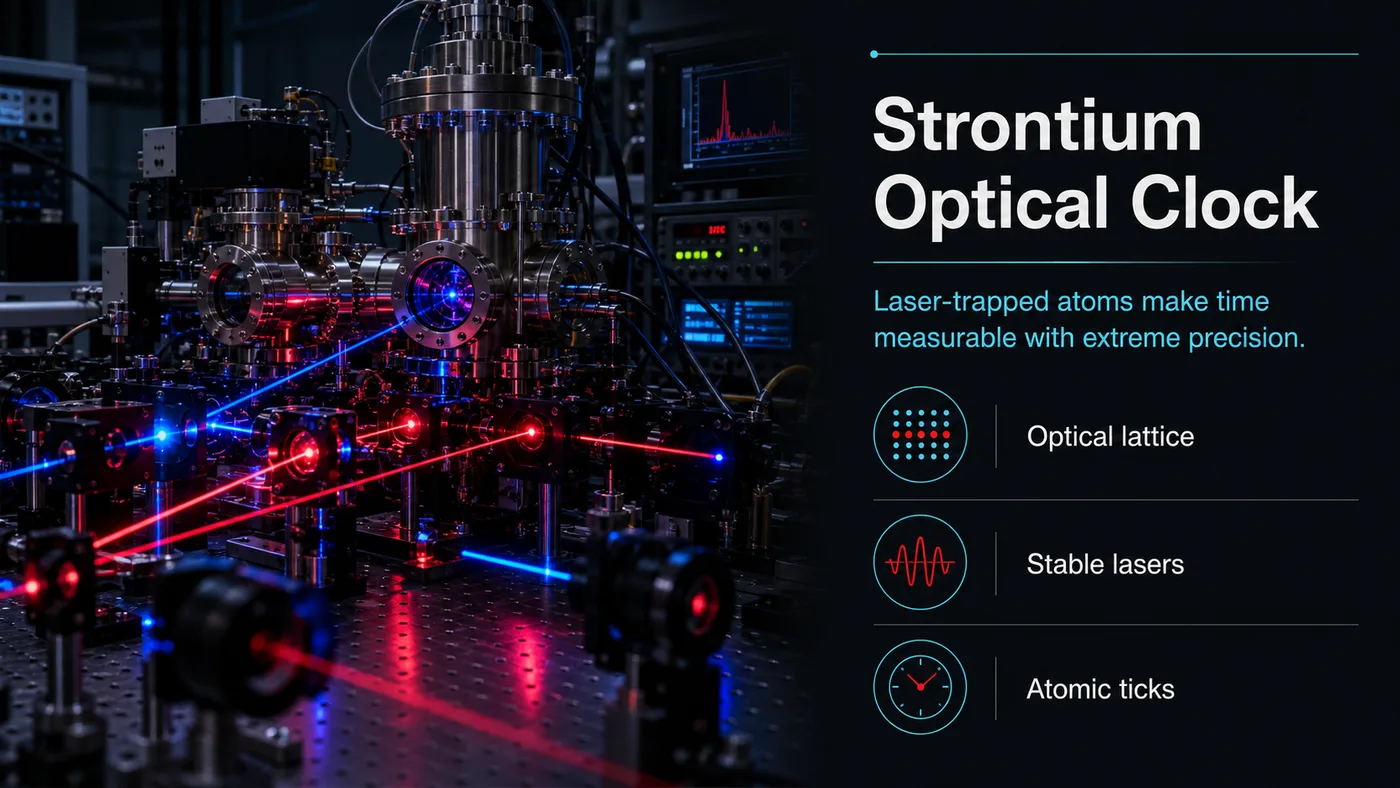
Atoms in a Crystal of Light
In the NIST strontium optical lattice clock, 10,000 atoms suspended in standing laser waves tick 430 trillion times per second.
Optical lattice clocks trap thousands of neutral atoms in a standing wave of laser light, a periodic potential formed by counterpropagating laser beams at the "magic wavelength" (813 nm for strontium-87). At this magic wavelength, the clock transition frequency is insensitive to differential light shifts from the trapping laser. The strontium clock transition at 698 nm (red) provides a reference
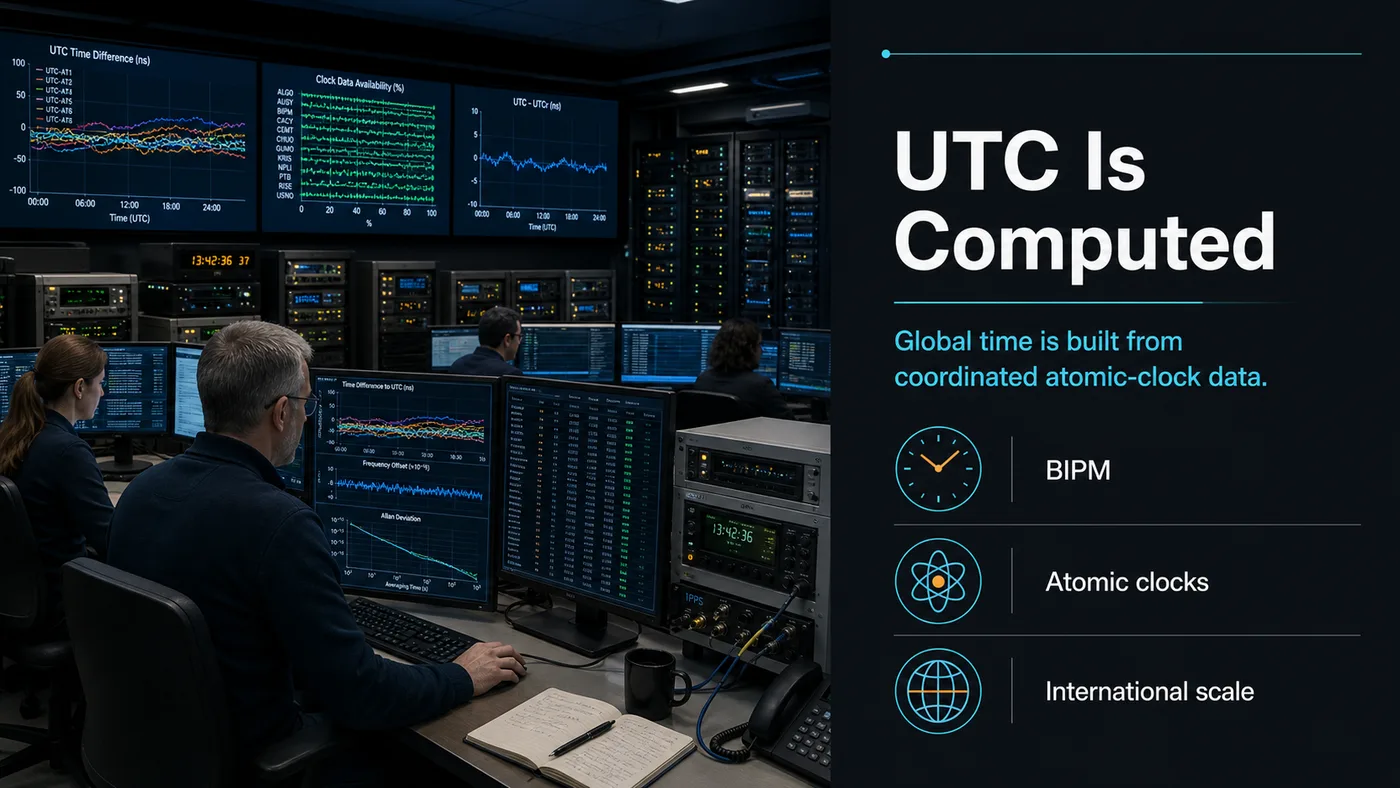
One Second, Everywhere
BIPM Coordinated Universal Time (UTC), averaged daily from 80+ national laboratories to keep the world's clocks in agreement.
Coordinated Universal Time (UTC) is computed monthly by the Bureau International des Poids et Mesures (BIPM) in Sèvres, France, by combining clock data from more than 80 national metrological institutes worldwide, including NIST (USA), SYRTE (France), PTB (Germany), NICT (Japan), and others, totaling more than 400 atomic clocks. The BIPM computes a weighted average time scale called TAI (Interna
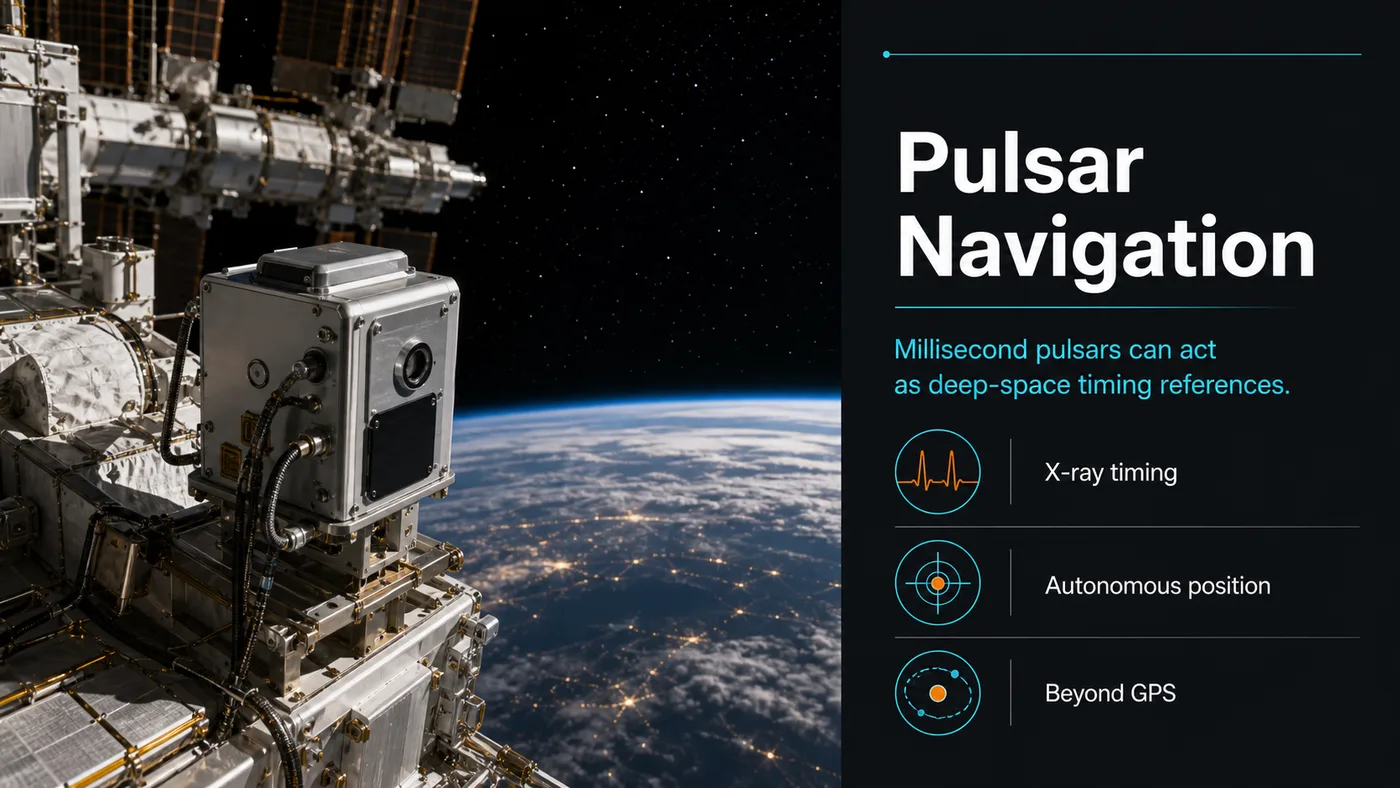
The Cosmic GPS
NICER on the ISS demonstrates X-ray pulsar-based navigation accurate to 5 km anywhere in the solar system.
NICER (Neutron Star Interior Composition Explorer) is a NASA soft X-ray telescope mounted on the International Space Station, launched June 2017. Beyond its primary science mission of studying neutron star interiors, NICER hosts the SEXTANT (Station Explorer for X-ray Timing and Navigation Technology) experiment. SEXTANT demonstrated that by timing X-ray pulses from millisecond pulsars, rotating
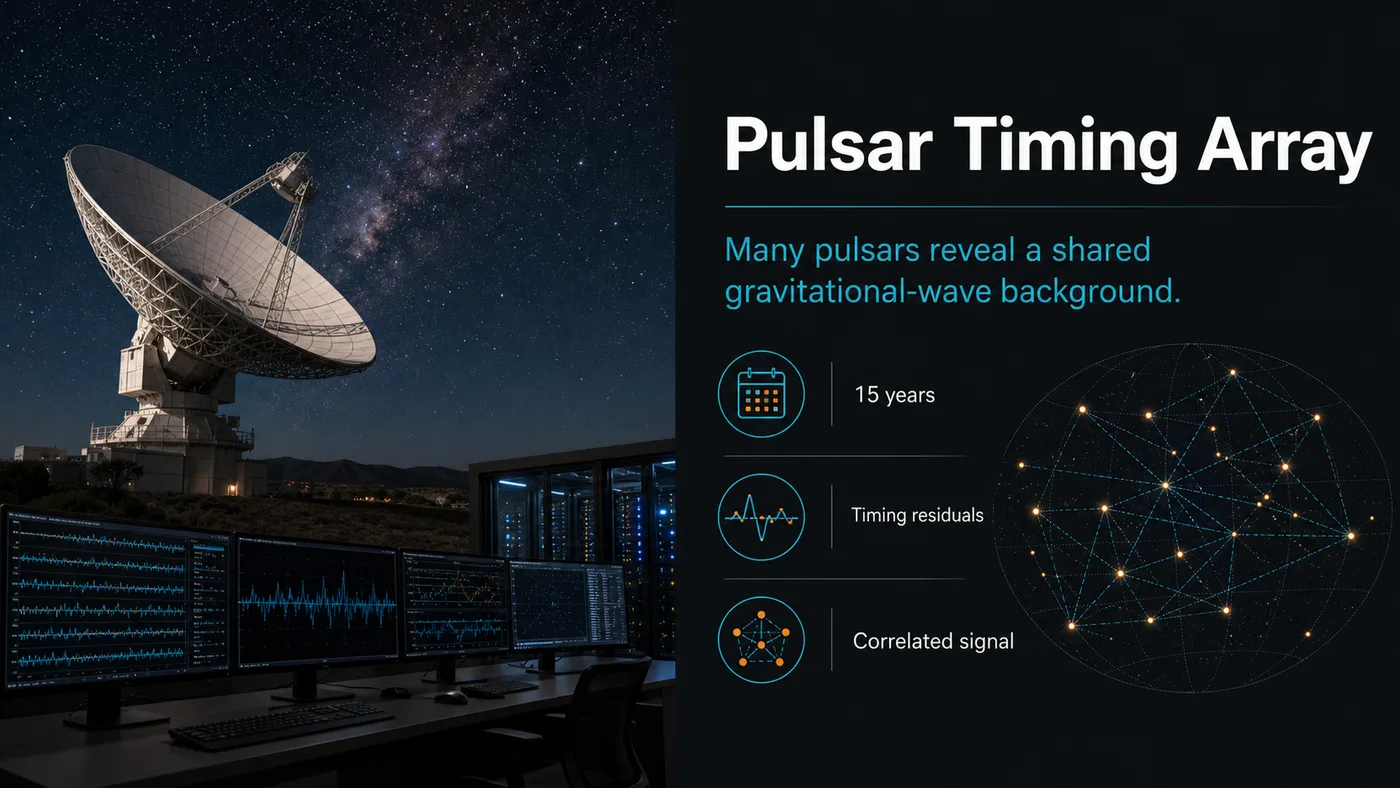
The Galaxy as a Detector
Pulsar Timing Arrays use millisecond pulsars as galactic-scale gravitational wave antennas.
Pulsar Timing Arrays (PTAs) use arrays of millisecond pulsars distributed across the Milky Way as gravitational wave detectors. Gravitational waves at nanohertz frequencies (periods of years) induce correlated timing residuals in pulsars following the Hellings-Downs angular correlation pattern. In June 2023, four PTA collaborations, NANOGrav (North America), EPTA (Europe), PPTA (Australia), and I
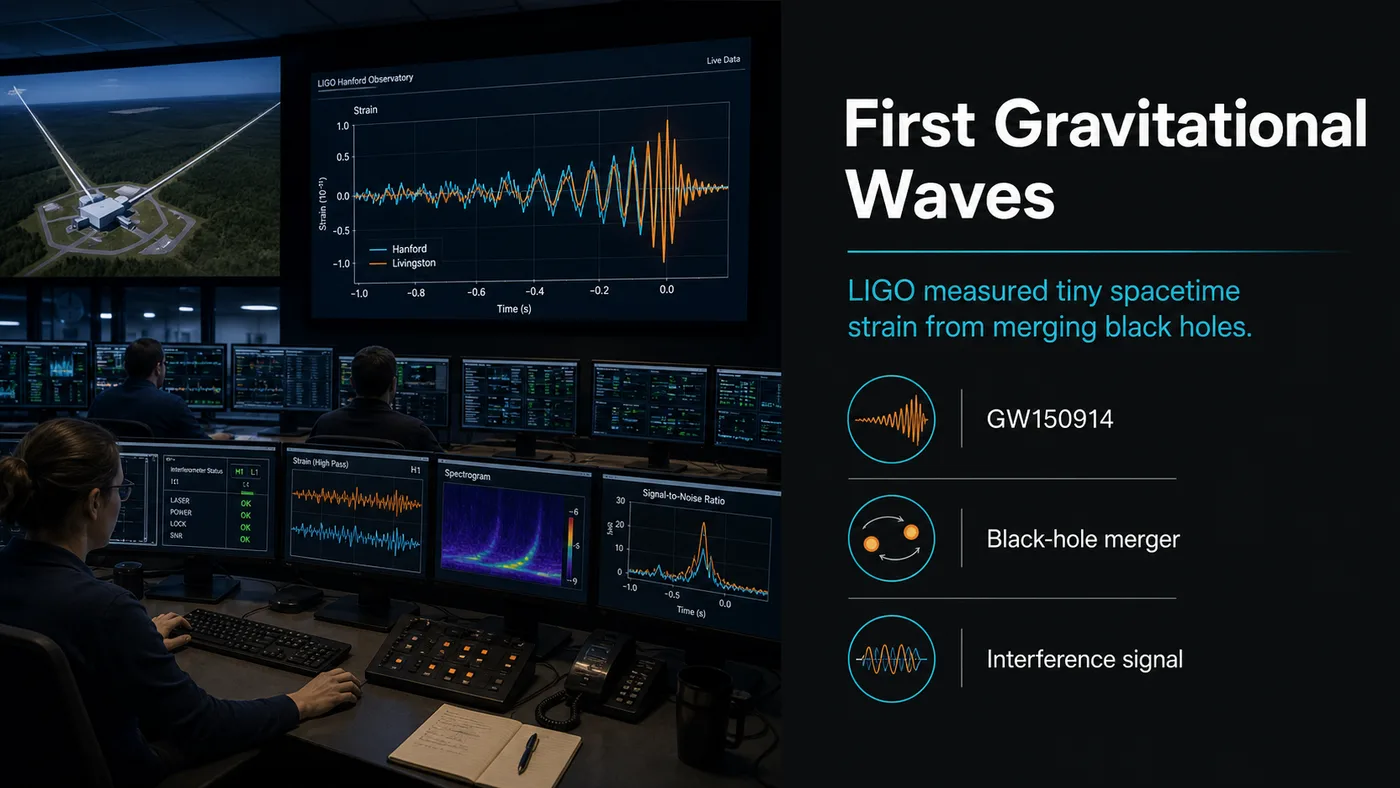
The Chirp
LIGO control room, September 14, 2015. The first gravitational wave from two merging black holes.
At 09:50:45 UTC on September 14, 2015, the LIGO Hanford detector registered a gravitational wave signal designated GW150914. Seven milliseconds later, the LIGO Livingston detector registered the same signal. The 7 ms delay corresponds to the speed-of-light travel time between the two sites. The signal lasted approximately 0.2 seconds and swept from ~35 Hz to ~150 Hz, the "chirp." The source wa
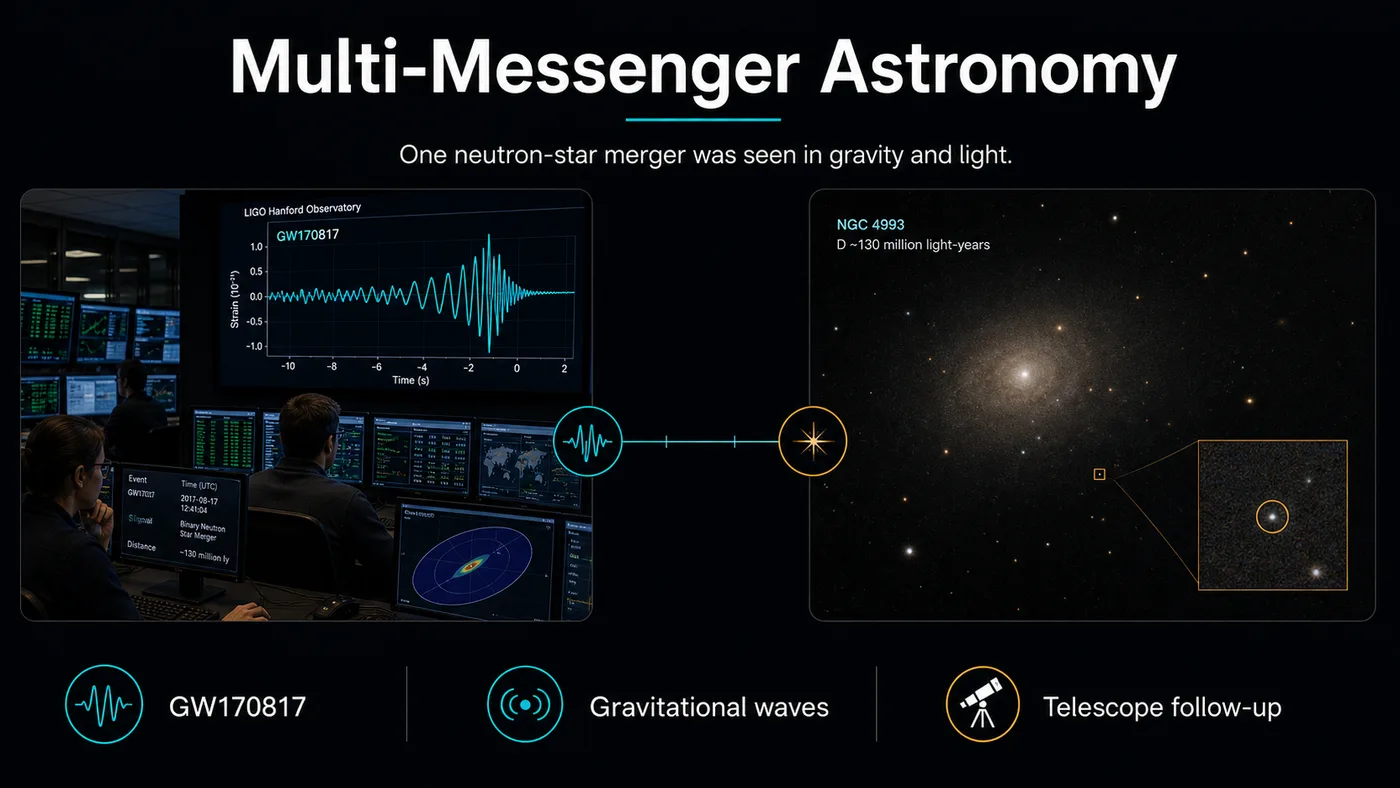
The Kilonova
GW170817, August 17, 2017. Gravitational waves, gamma rays, optical light, X-rays, and radio from one neutron star merger.
On August 17, 2017, LIGO and Virgo detected gravitational waves from a binary neutron star merger designated GW170817, in the galaxy NGC 4993 approximately 130 million light-years away. Approximately 1.7 seconds later, the Fermi and INTEGRAL gamma-ray telescopes detected a short gamma-ray burst (GRB 170817A) from the same direction. In the following days, 70+ observatories worldwide detected the e
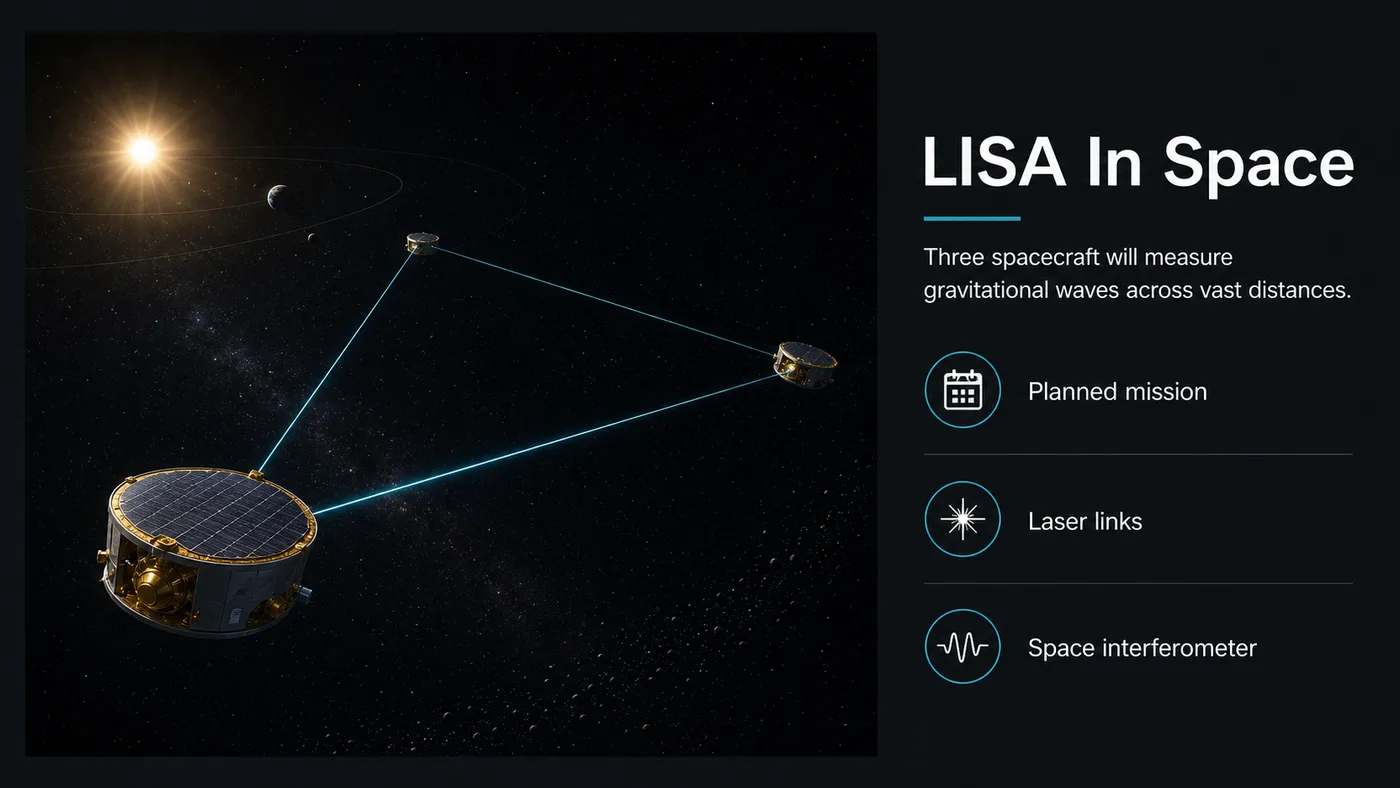
Listening in Space
Three LISA spacecraft, 2.5 million km apart, form a laser interferometer in space.
LISA (Laser Interferometer Space Antenna) is an ESA-led mission approved in January 2024 for launch around 2034. Three spacecraft will fly in a triangular formation with arm lengths of 2.5 million kilometers, trailing Earth in its orbit around the Sun at a distance of approximately 50 million km. Laser links between the spacecraft will detect gravitational waves in the millihertz frequency band (0
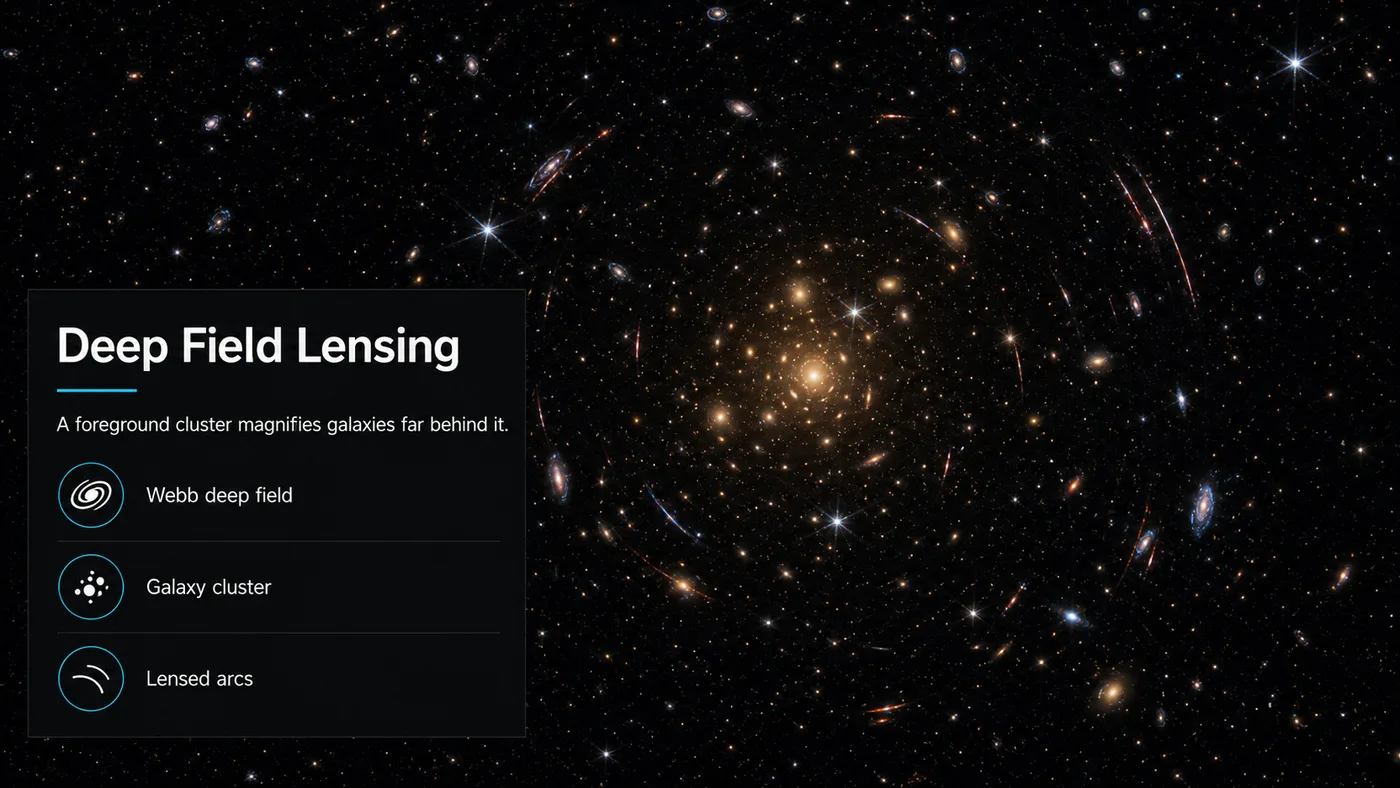
Webb's First Look
JWST SMACS 0723, the deepest infrared image of the universe, released July 11, 2022.
On July 11, 2022, NASA released JWST's first deep field image: the galaxy cluster SMACS 0723, located approximately 4.24 billion light-years away. The image was acquired using JWST's NIRCam instrument over approximately 12.5 hours of total exposure time. The gravitational lens formed by the cluster amplifies and distorts background galaxies into lensing arcs, some at redshifts corresponding to loo
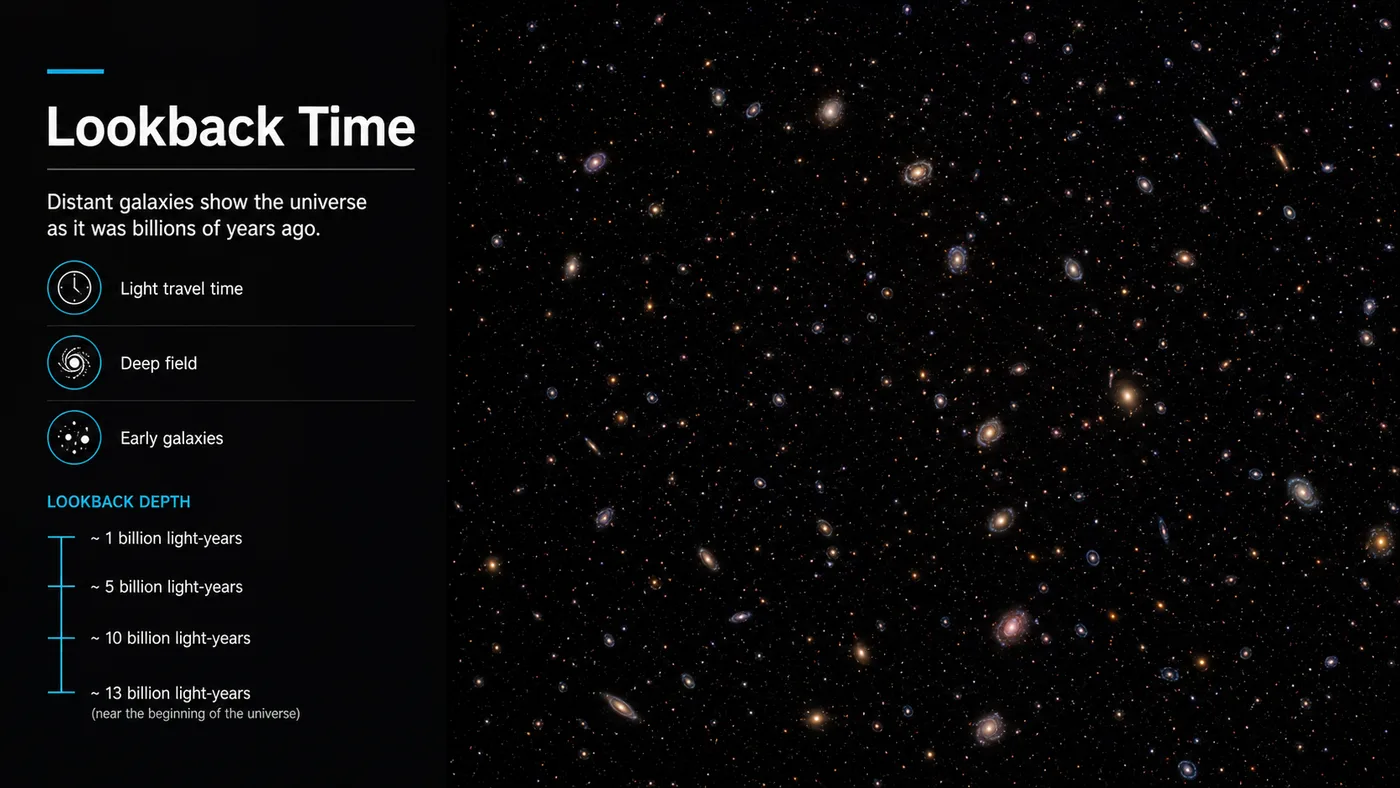
Ten Thousand Galaxies in a Speck of Sky
Hubble Ultra Deep Field, 11.3 days of exposure on a 3.1 arcminute patch of sky. 10,000 galaxies, back to 13 billion years.
The Hubble Ultra Deep Field (HUDF) was imaged by the Hubble Space Telescope's Advanced Camera for Surveys from September 24, 2003 to January 16, 2004, in 800 exposures totaling 11.3 days of exposure time. The field covers approximately 11.5 square arcminutes of sky in the constellation Fornax, directed far from the Milky Way plane to minimize foreground stars. The resulting image revealed approximat
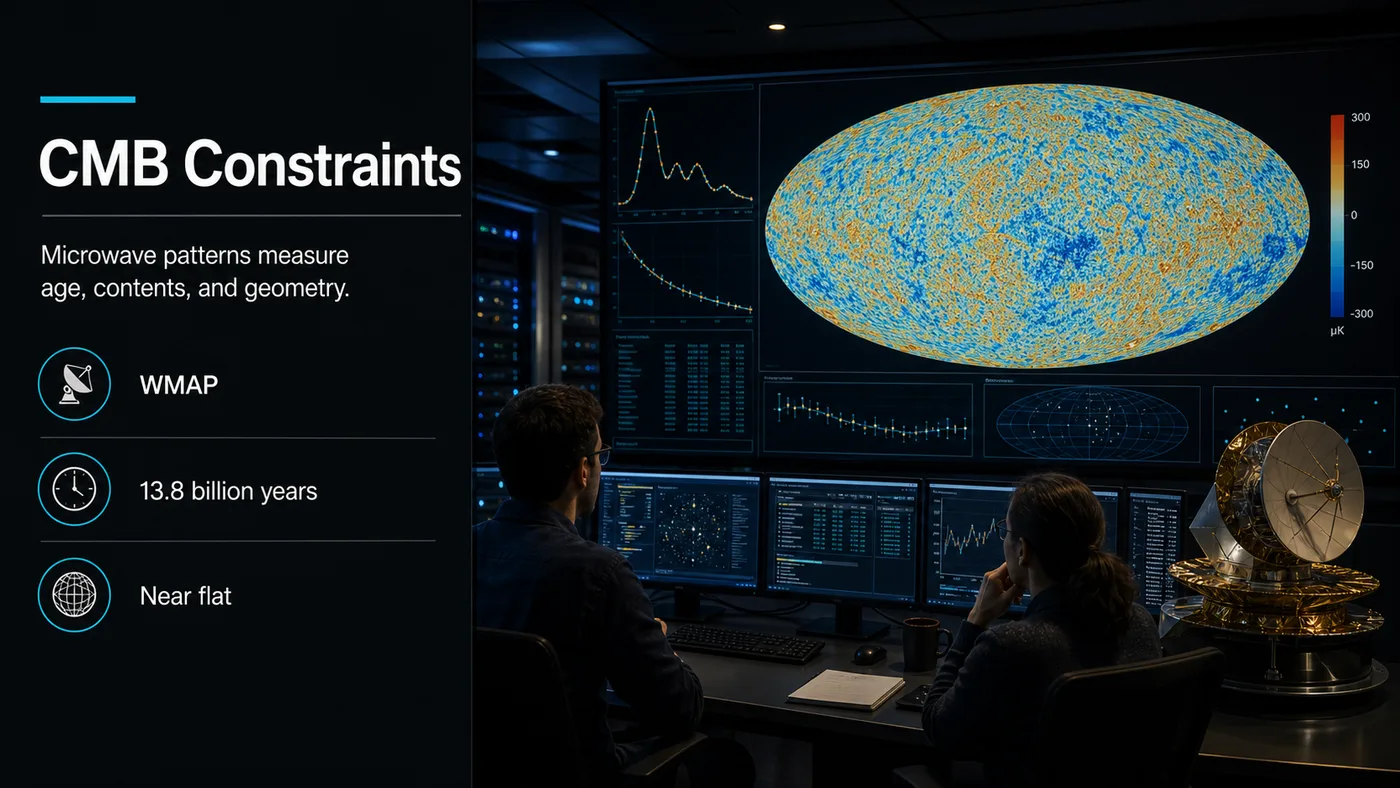
Measuring the Cosmos
Nine years of WMAP CMB measurements established the age, geometry, and composition of the universe.
NASA's Wilkinson Microwave Anisotropy Probe (WMAP) launched June 30, 2001 and observed from the Sun-Earth L2 Lagrange point for nine years, releasing its final nine-year dataset in 2012. WMAP measured the angular power spectrum of CMB temperature fluctuations to multiple acoustic peaks with high precision. The nine-year results established the age of the universe at 13.77 ± 0.059 billion years, t
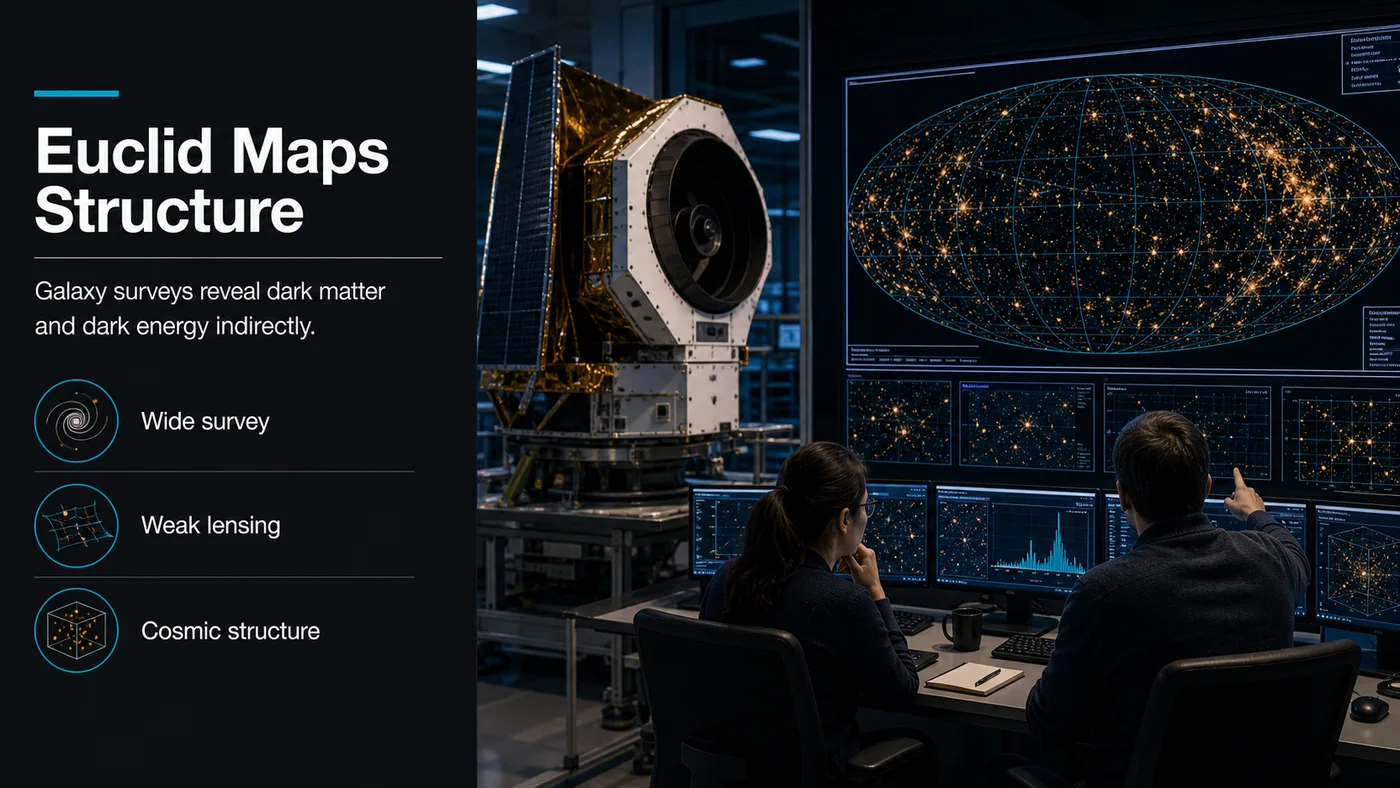
Mapping the Dark Universe
ESA Euclid, mapping 1.5 billion galaxies to trace dark matter and dark energy across 10 billion years.
ESA's Euclid mission launched July 1, 2023 and operates at the Sun-Earth L2 Lagrange point. Euclid will survey one-third of the extragalactic sky (approximately 15,000 square degrees), imaging 1.5 billion galaxies and measuring spectra for 35 million galaxies at redshifts 0.9–1.8. Two science instruments: VIS (visible imager, 0.55–0.9 µm, 609 megapixel focal plane) and NISP (near-infrared spectro
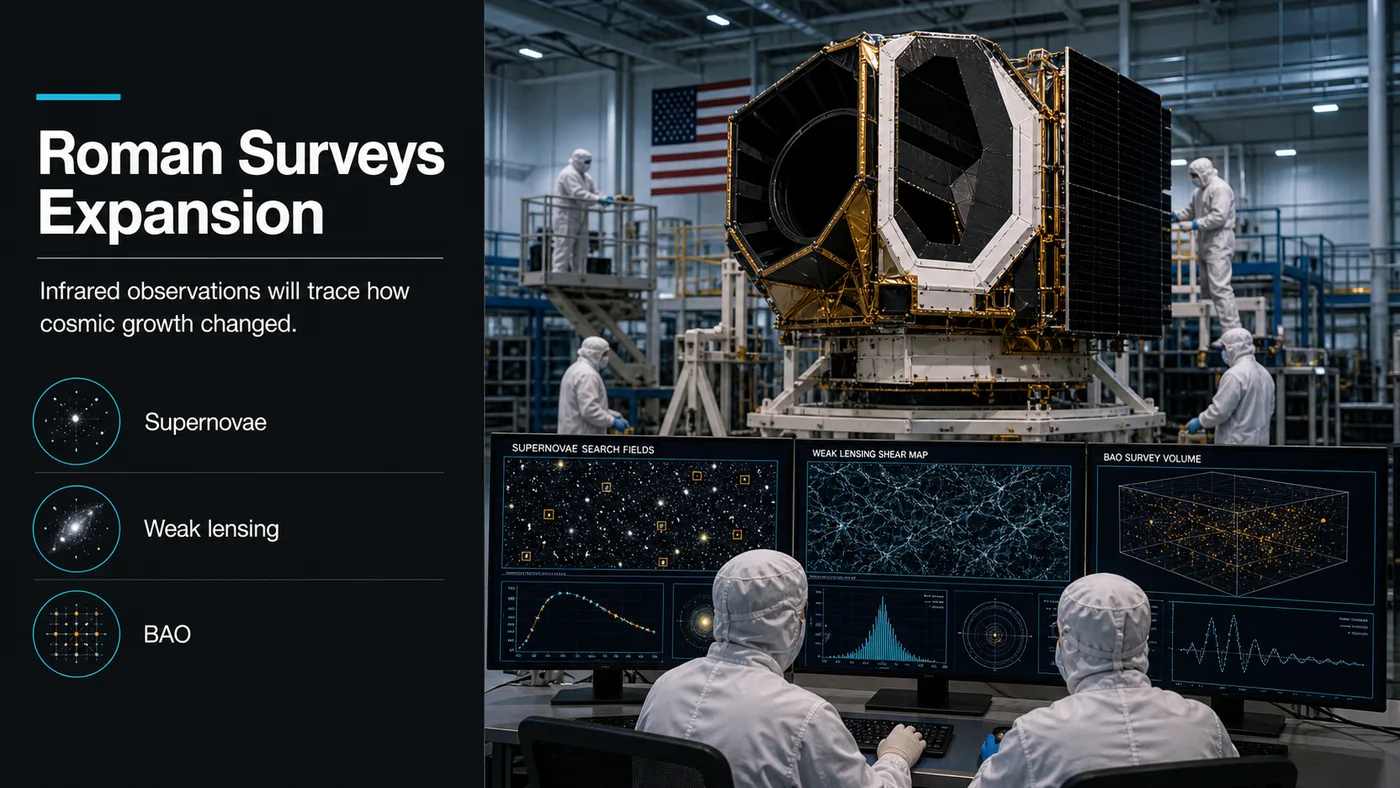
The Wide Eye
Nancy Grace Roman Space Telescope, 288-megapixel infrared camera, Hubble's resolution, 100x the field of view.
The Nancy Grace Roman Space Telescope (formerly WFIRST) is a NASA infrared observatory scheduled for launch no earlier than May 2027. Its wide field instrument (WFI) features a 288-megapixel focal plane array with 18 H4RG infrared detectors, covering a 0.28 square degree field of view at Hubble resolution (0.11 arcseconds per pixel), 100 times Hubble's field of view at the same angular resolution
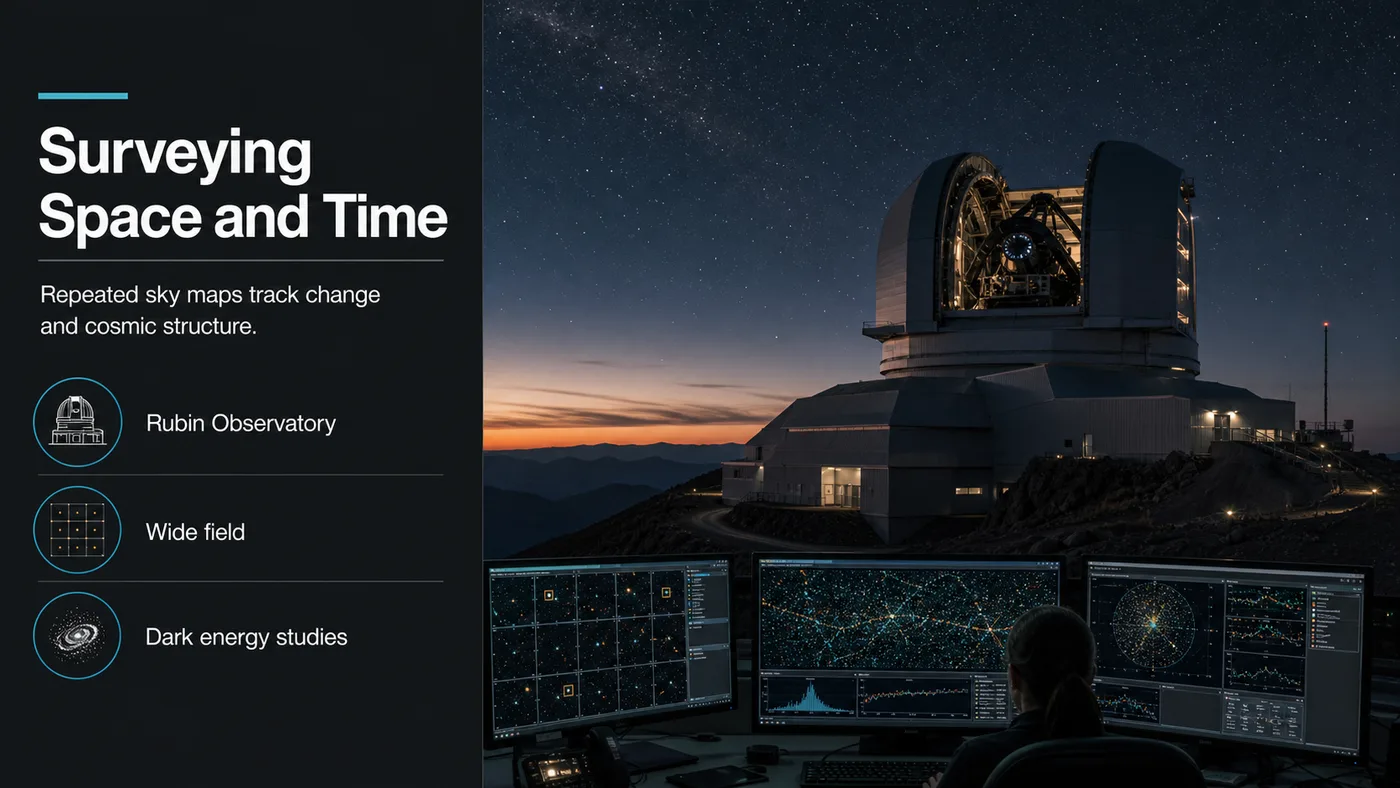
Ten Years of the Southern Sky
Vera C. Rubin Observatory, a 3,200-megapixel camera surveying the entire southern sky every three nights for ten years.
The Vera C. Rubin Observatory on Cerro Pachón, Chile, houses the Simonyi Survey Telescope with a primary mirror of 8.4-meter effective aperture and the world's largest digital camera: 3,200 megapixels covering a 3.5-degree field of view. The 10-year Legacy Survey of Space and Time (LSST) began commissioning in 2025 and will photograph the entire southern sky in six photometric bands every three ni
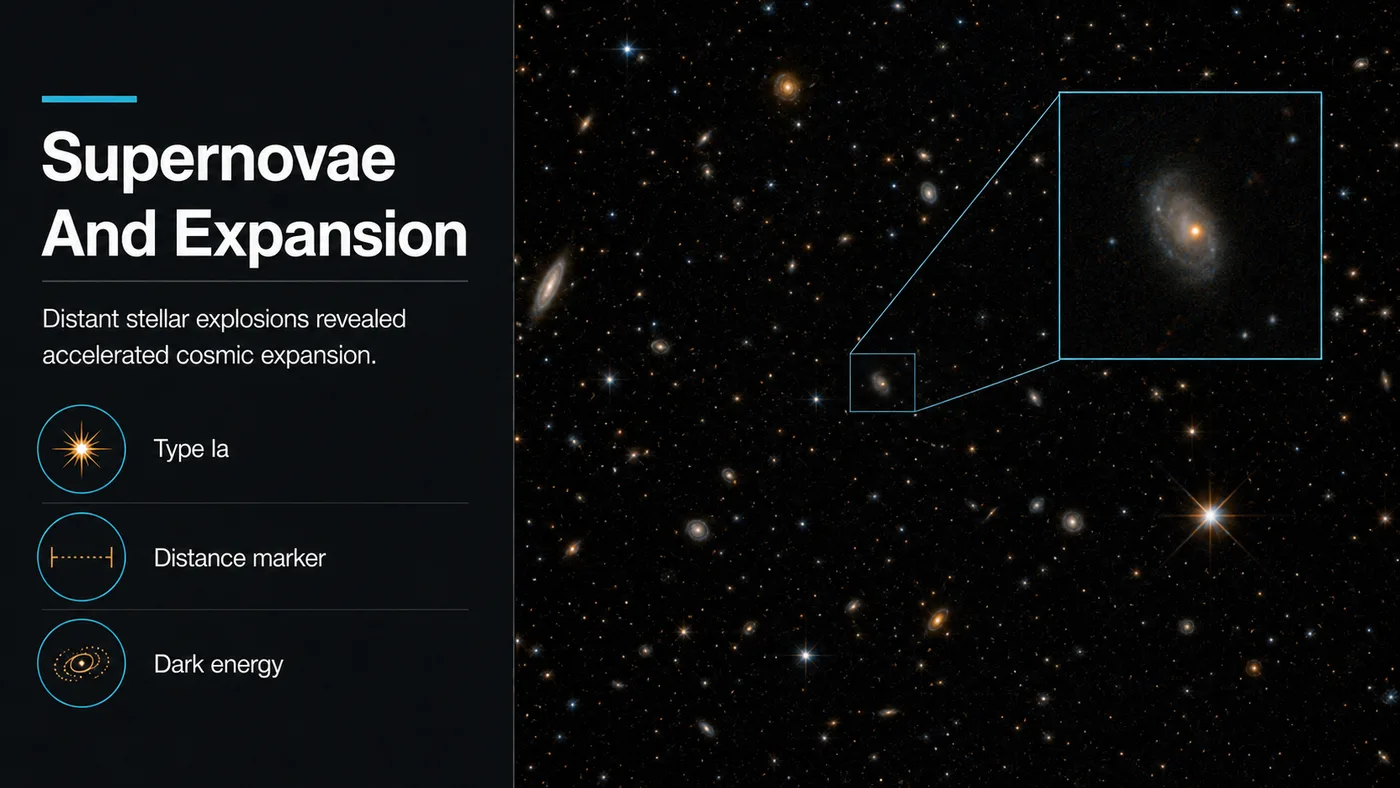
Standard Candles
The Hubble Space Telescope Type Ia supernova survey proved that the expansion of the universe is accelerating.
In 1998, two independent supernova search teams, the High-Z Supernova Search Team (led by Brian Schmidt and Adam Riess) and the Supernova Cosmology Project (led by Saul Perlmutter), announced that observations of Type Ia supernovae at redshifts z=0.3–0.8 showed they were fainter than expected in a decelerating universe, implying the expansion was actually accelerating. Type Ia supernovae serve a
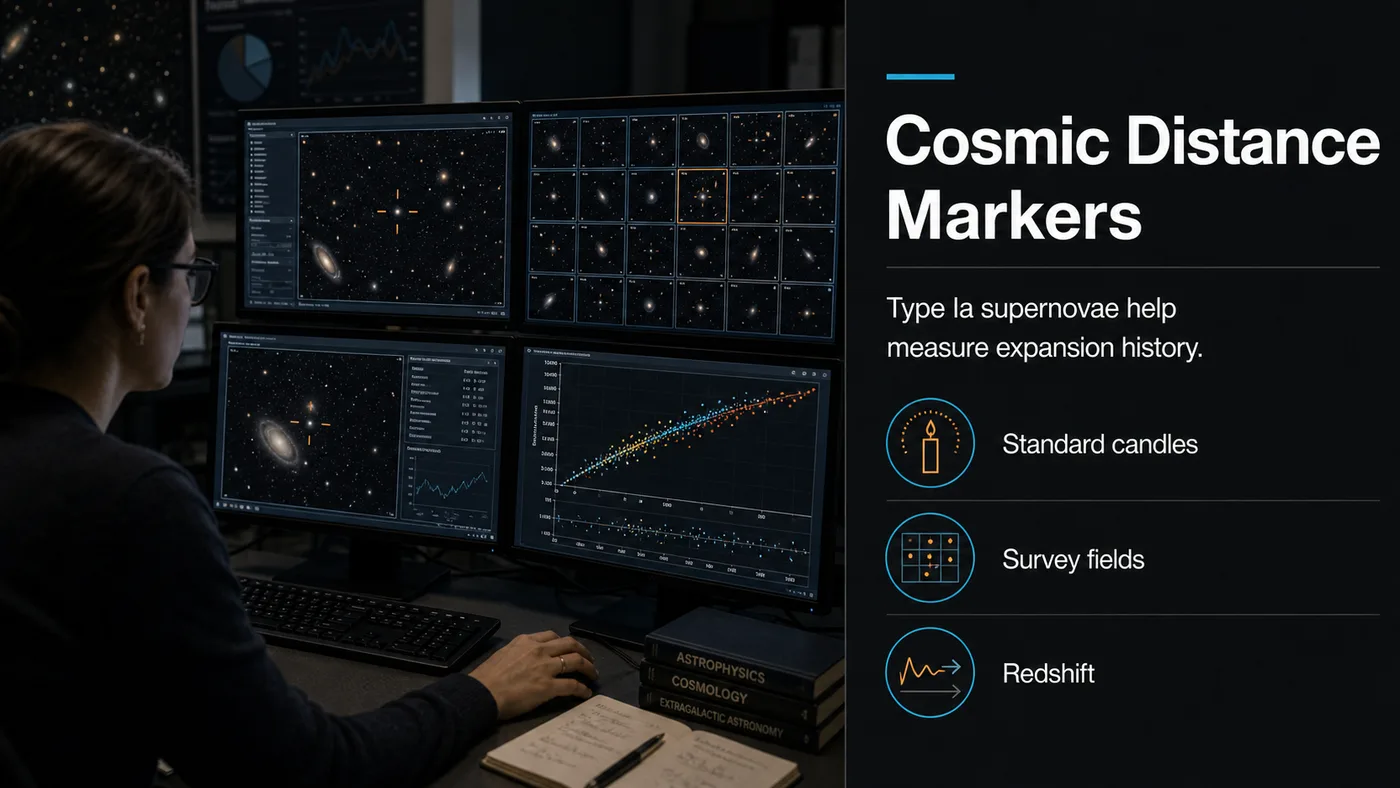
The Brightest Deaths
Type Ia supernovae, white dwarf thermonuclear explosions used as standard candles across the observable universe.
Type Ia supernovae occur when a white dwarf in a binary system accretes enough mass to approach the Chandrasekhar limit (~1.44 solar masses), triggering a thermonuclear runaway that destroys the star. Because the ignition occurs near a fixed mass threshold, Type Ia supernovae have nearly uniform peak luminosity, approximately 5 billion times the Sun's luminosity. The Phillips relation (1993) link
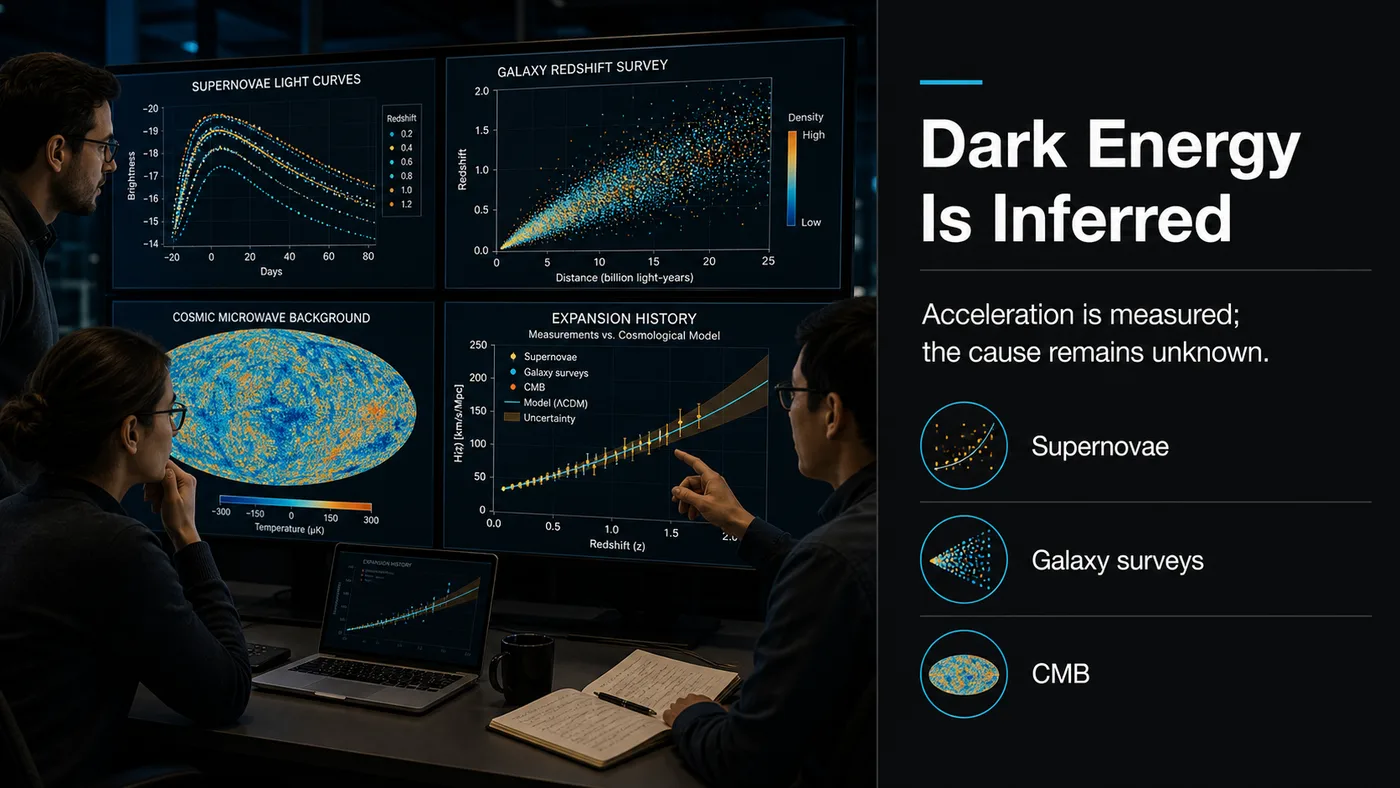
The Universe Pulls Apart
The accelerating expansion of the universe, dark energy comprising ~68% of the cosmos, discovered 1998.
The discovery that the universe's expansion is accelerating, announced in 1998 by two independent supernova teams, implies the existence of an energy component with negative pressure, termed dark energy. In the standard ΛCDM cosmological model, the cosmological constant Λ (equivalent to a dark energy density of approximately 7×10⁻³⁰ g/cm³) accounts for approximately 68% of the total energy budget
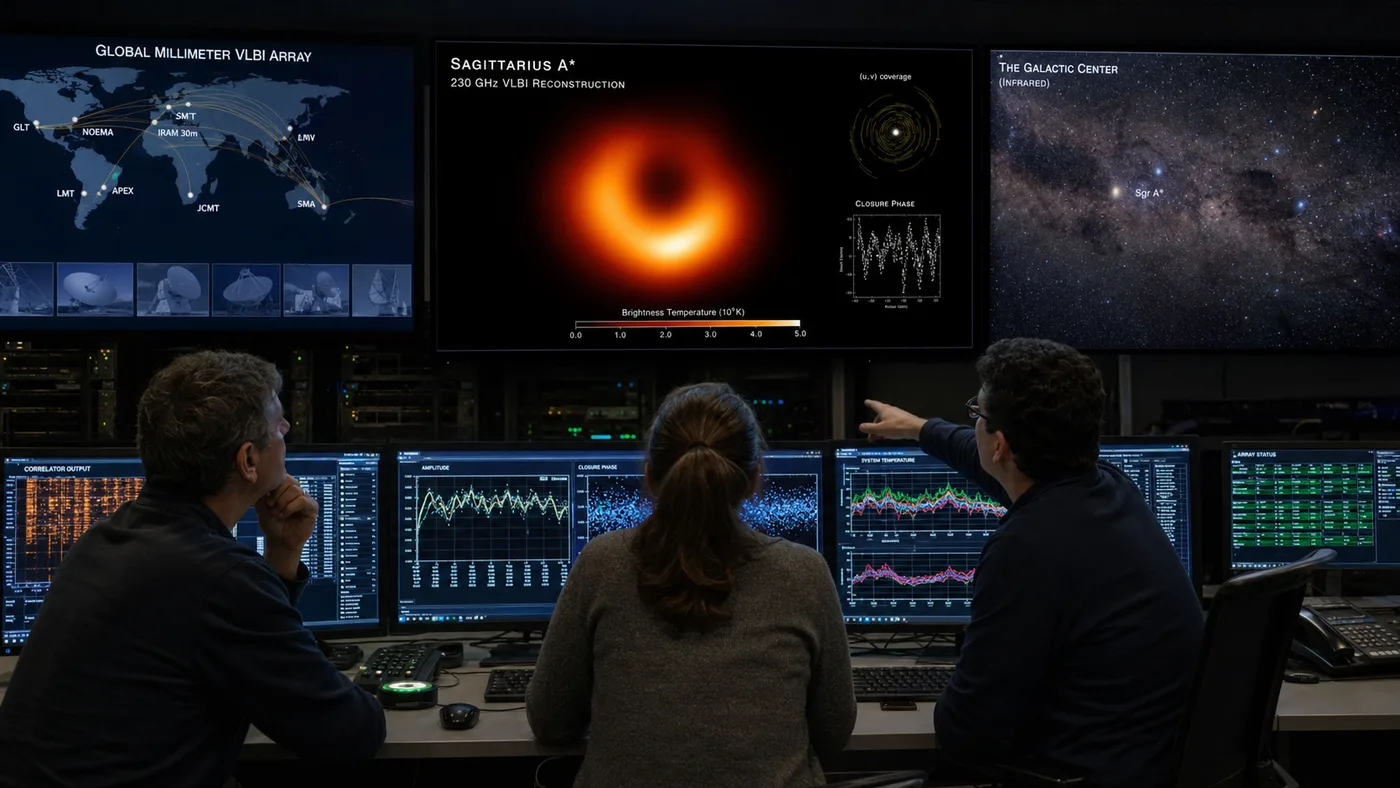
At the Center of Everything
Sagittarius A*, four million solar masses in 12 million kilometers, orbited by stars for 26,000 years.
Sagittarius A* (Sgr A*) was first detected as an anomalously compact radio source in the direction of the galactic center by astronomers at the National Radio Astronomy Observatory in 1974. Subsequent near-infrared observations of stellar orbits around the compact radio source, particularly star S2/S0-2 with an orbital period of approximately 16 years, provided definitive evidence for a 4-milli
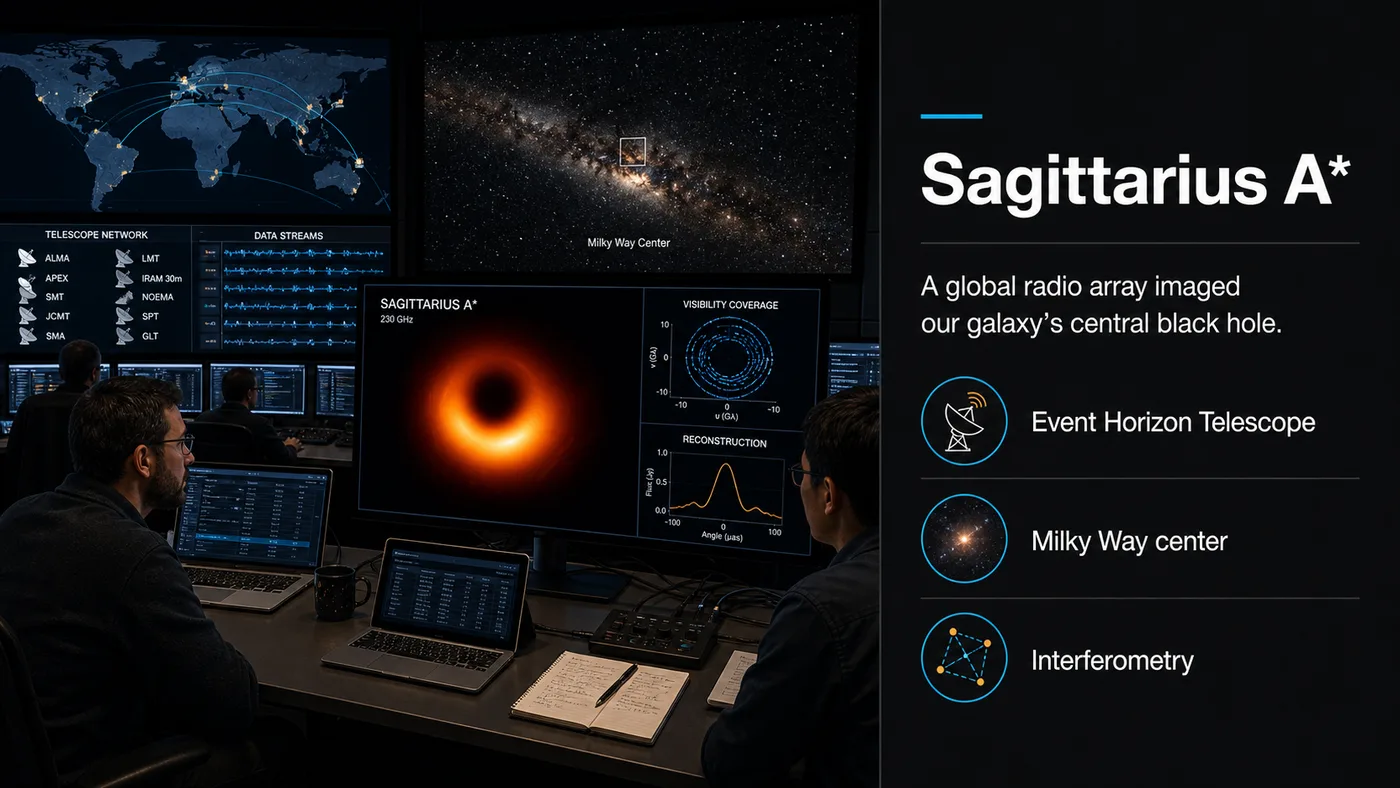
Our Black Hole
EHT image of Sagittarius A*, May 12, 2022. The 4-million-solar-mass black hole at the Milky Way's center.
On May 12, 2022, the Event Horizon Telescope collaboration published the first image of Sagittarius A* (Sgr A*), the supermassive black hole at the center of the Milky Way, 26,000 light-years from Earth. Sgr A* has a mass of approximately 4 million solar masses and a Schwarzschild radius of approximately 12 million km. The EHT observed Sgr A* during its 2017 observing campaign using the same 1.3 m
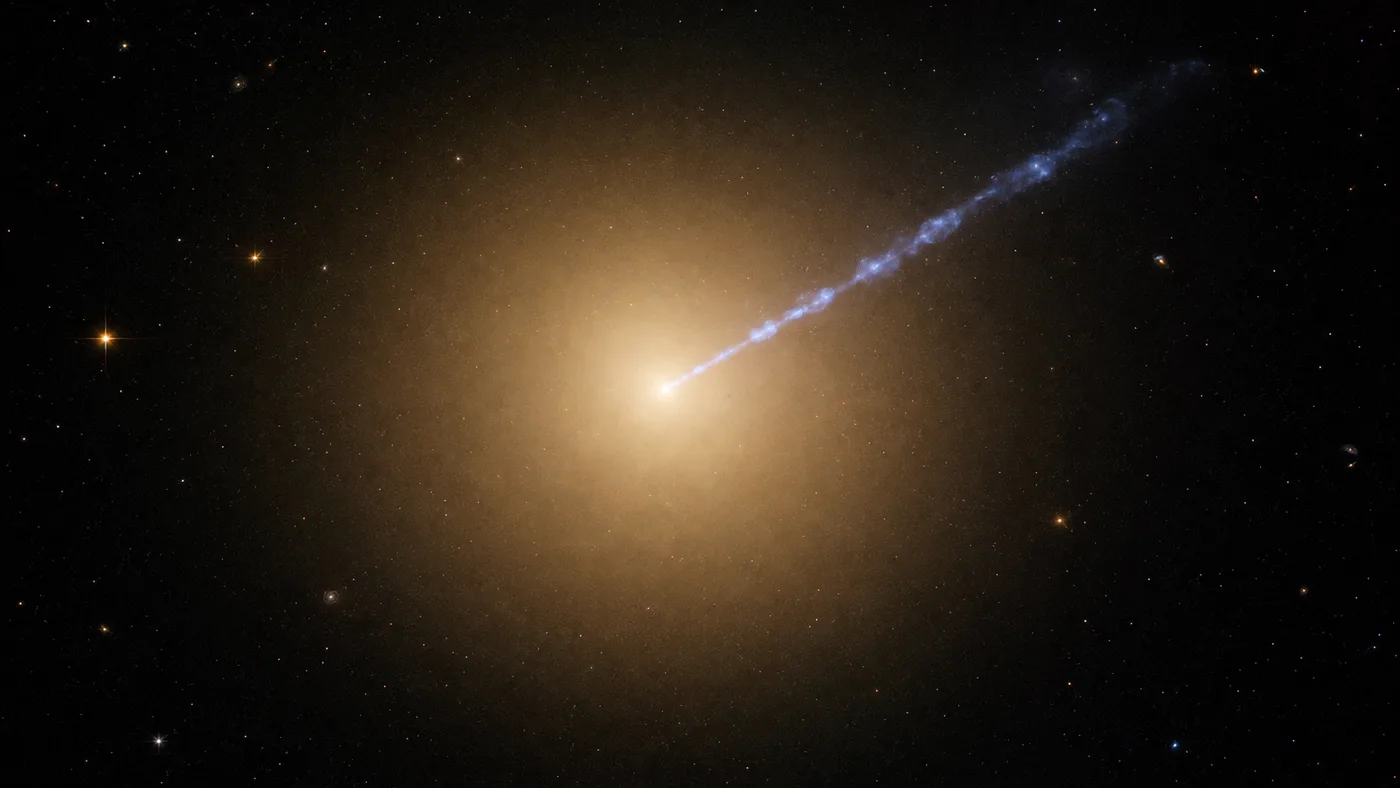
The Blandford-Znajek Engine
In M87* jet formation, magnetic fields threading a spinning black hole's ergosphere accelerate plasma to 99% light speed.
The relativistic jet of M87 is believed to be powered by the Blandford-Znajek mechanism (1977). Magnetic field lines threading the ergosphere of a rapidly spinning Kerr black hole extract rotational energy from the black hole via frame-dragging, accelerating electrons and positrons outward along the rotation axis. The M87 jet contains bright emission knots, the brightest of which, knot A, is 60
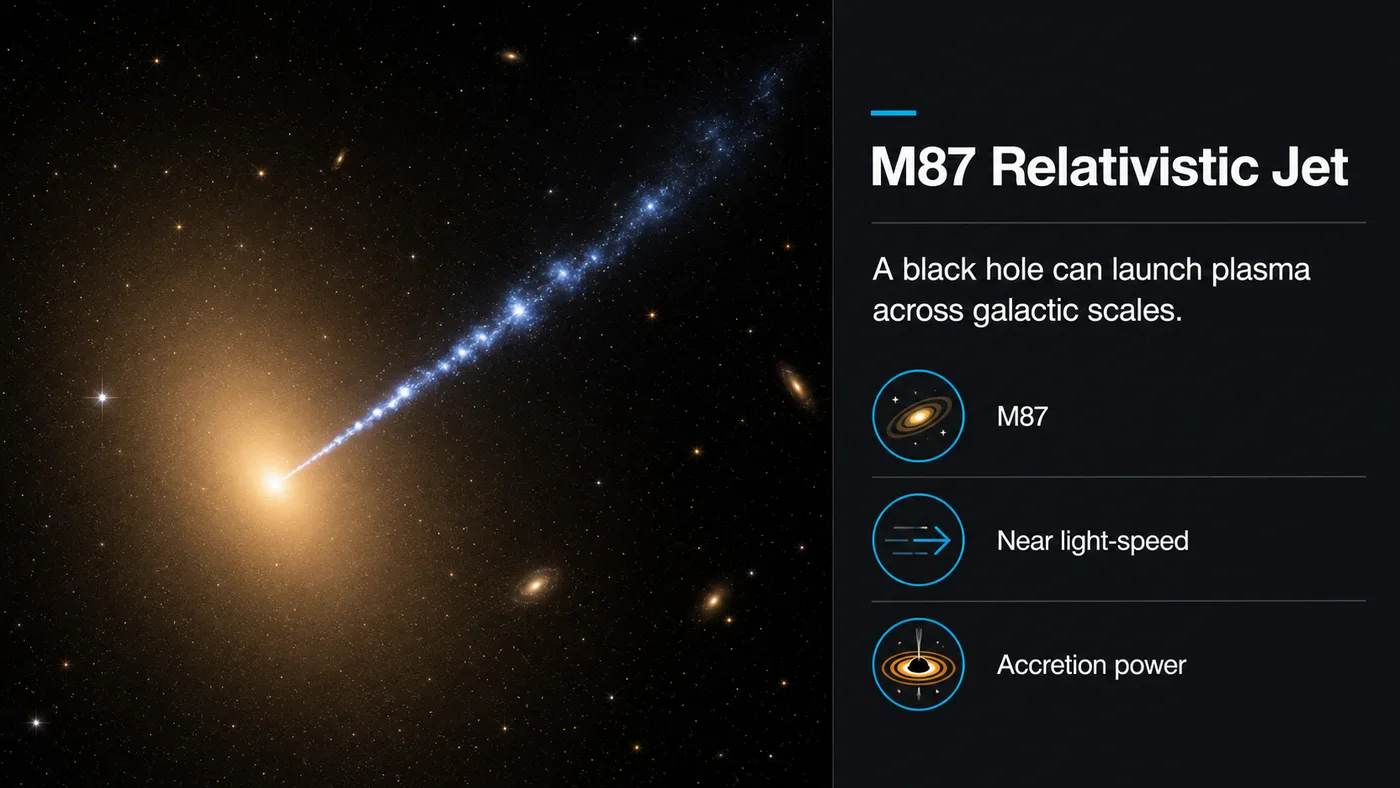
The Jet from Nothing
M87*, a 6.5-billion-solar-mass black hole launching a plasma jet at near-light speed across 5,000 light-years.
Galaxy M87 (Messier 87) is an elliptical galaxy 55 million light-years away in the Virgo Cluster. Its nucleus hosts M87*, a black hole of approximately 6.5 billion solar masses. From this black hole, a relativistic jet of plasma extends at least 5,000 light-years, observed across radio, optical, and X-ray wavelengths. The jet was first observed by Heber Curtis in 1918. Superluminal motion in the j
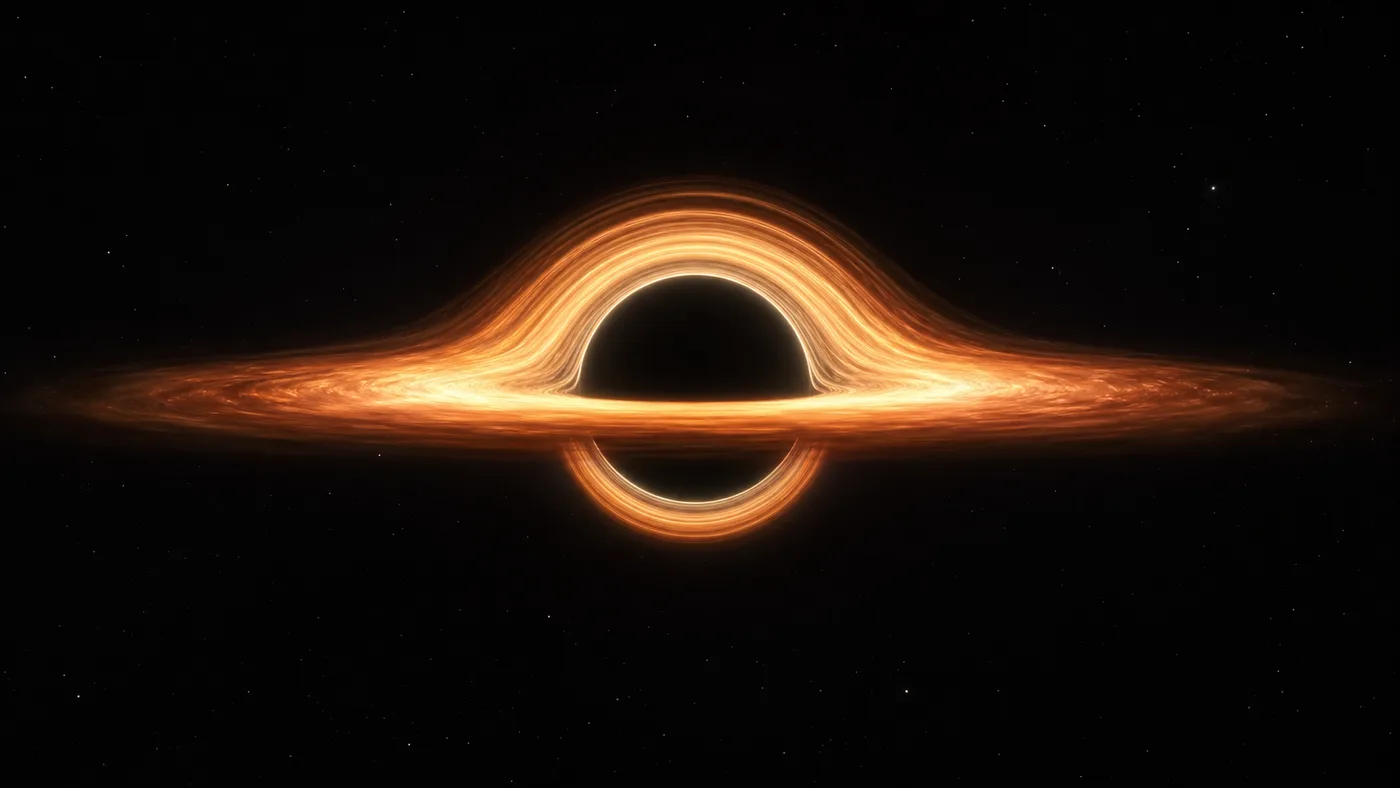
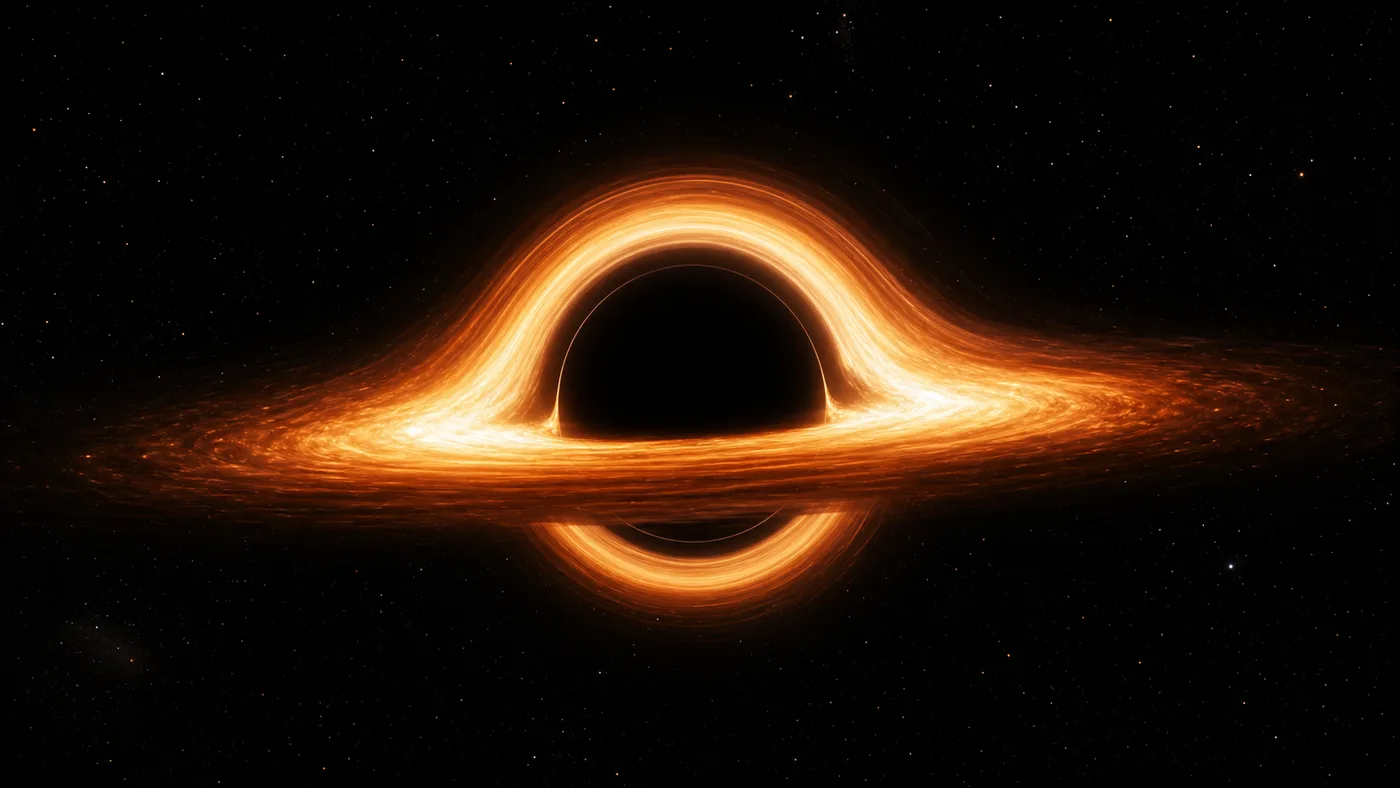
Gravity's Lens: Light Bent by a Black Hole
Accretion disk simulation · general-relativistic ray tracing · photon ring visualization
General relativity predicts that spacetime curvature near a black hole bends photon paths dramatically. When an accretion disk of superheated plasma surrounds a black hole, light from behind and below the disk is gravitationally lensed upward and forward, creating a bright photon ring and a characteristic asymmetric brightness profile. Simulations based on the Kerr metric reproduce the lensing geo
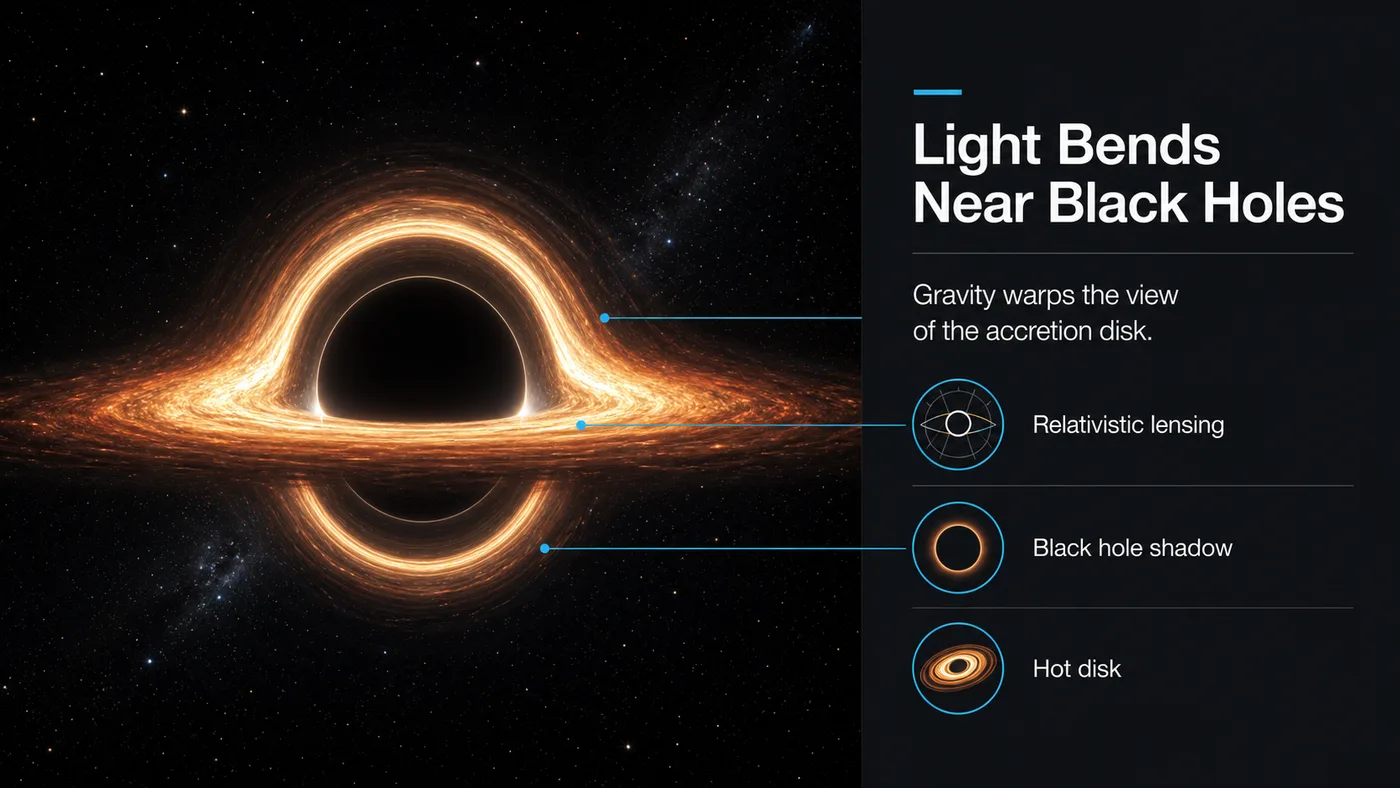
Warped Light: The Anatomy of an Accretion Disk
Black hole accretion disk · general-relativistic lensing · photon ring anatomy
When plasma spirals into a stellar-mass or supermassive black hole it forms a superheated accretion disk radiating across the electromagnetic spectrum. General relativity's spacetime curvature bends photons emitted by the far side of the disk upward and around the black hole, making the underside of the disk appear overhead in the observer's frame, a distinctive feature of Kerr geometry lensing.
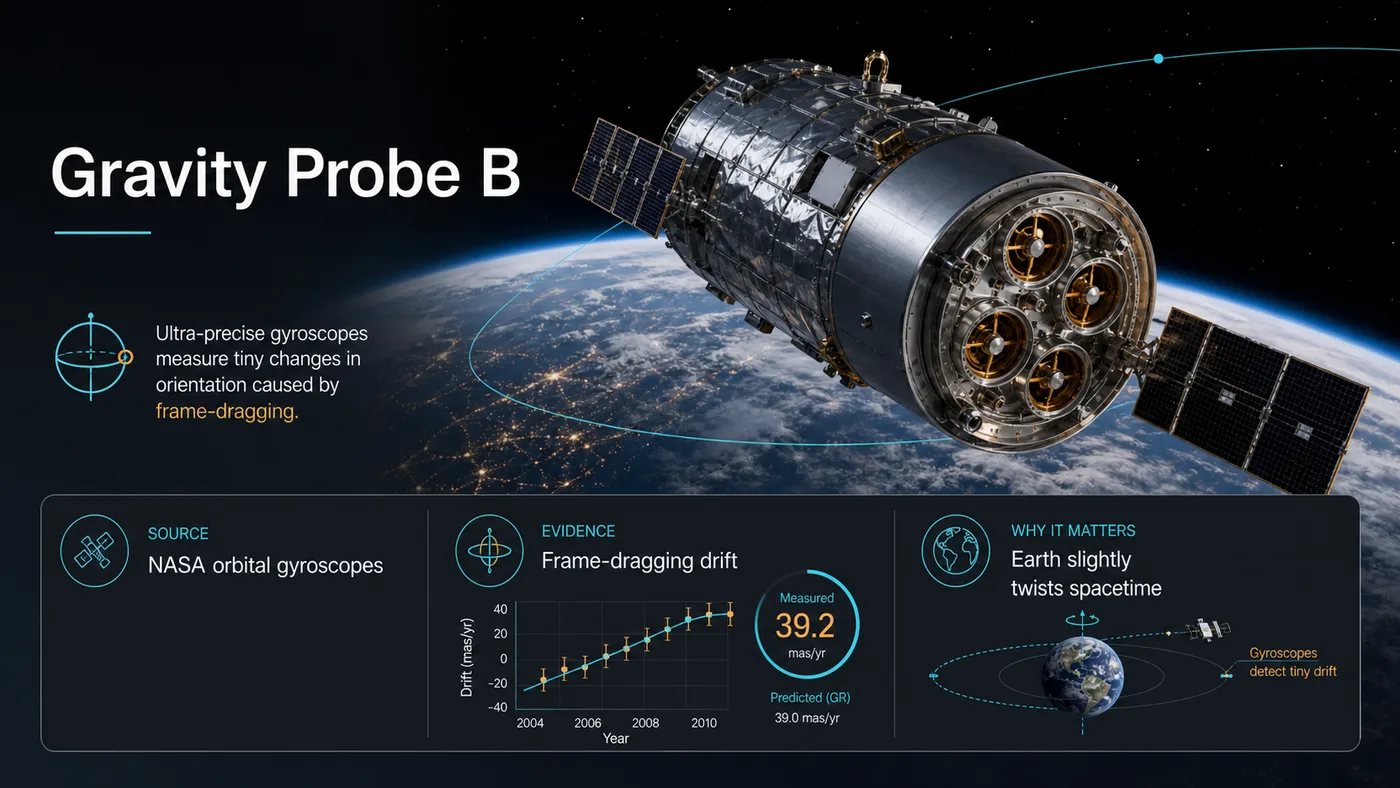
Frame Dragging Measured: Gravity Probe B
Gravity Probe B spacecraft · gyroscope precession · geodetic and Lense-Thirring effects · Earth orbit
Gravity Probe B (GP-B) was a NASA spacecraft launched in April 2004 into a 642-km polar orbit to measure two predictions of general relativity: the geodetic effect (Earth's mass curving spacetime causes orbiting gyroscopes to precess at 6,606.1 ± 18.3 milliarcseconds per year) and the Lense-Thirring frame-dragging effect (Earth's rotation drags spacetime, precessing gyroscopes at 39.2 ± 7.2 millia
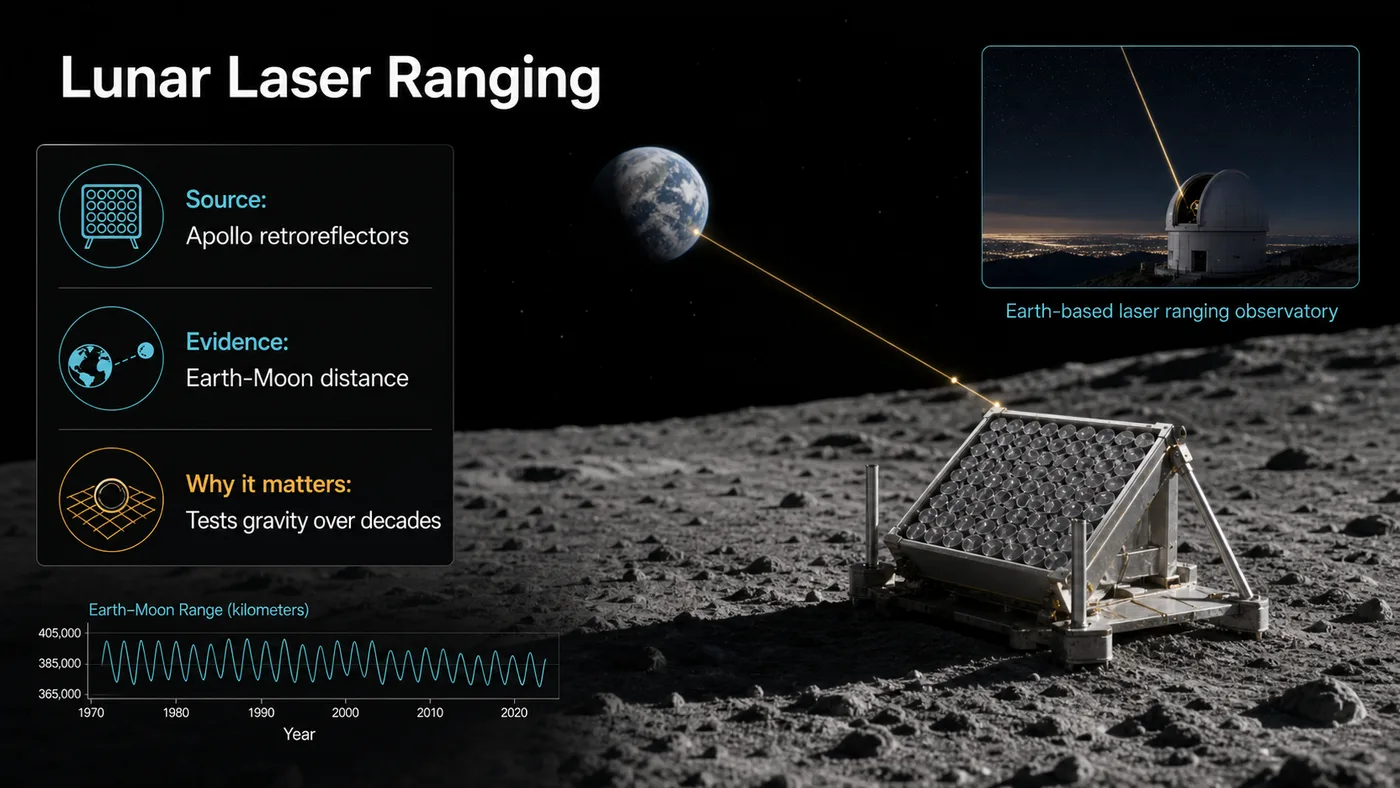
Millimeter Moonshots: Lunar Laser Ranging
Lunar Laser Ranging · Apollo retroreflector arrays · Earth-Moon distance · equivalence principle
Lunar Laser Ranging (LLR) has continuously measured the Earth-Moon distance since the Apollo 11 astronauts deployed the first corner-cube retroreflector array (ALSEP) at Tranquility Base in July 1969. Subsequent Apollo 14 and 15 missions deployed additional arrays. Soviet Lunokhod rovers carried two more. Ground stations, notably Apache Point Observatory Lunar Laser-ranging Operation (APOLLO) in
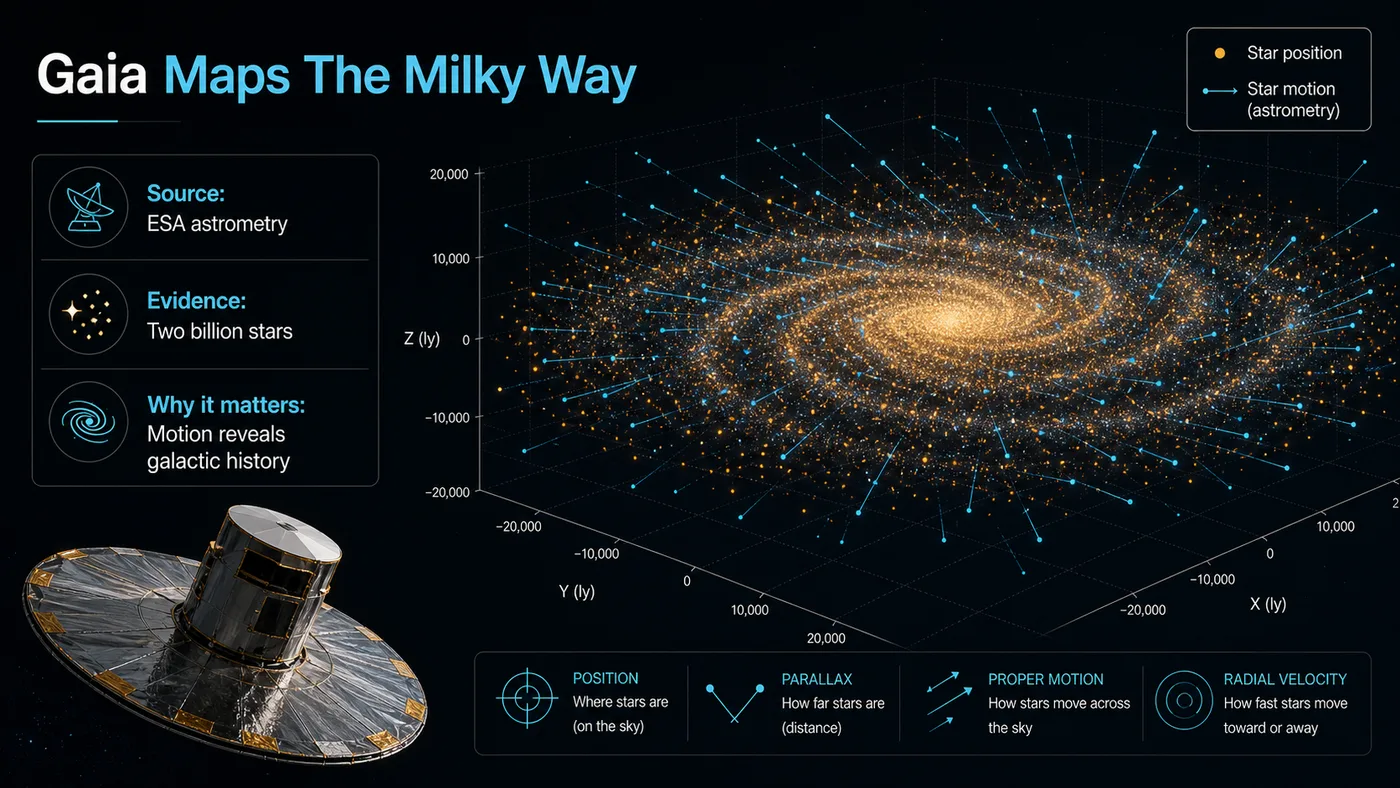
One Billion Stars Mapped: ESA's Gaia
ESA Gaia spacecraft · astrometry · 3D Milky Way structure · proper motions and parallaxes
ESA's Gaia mission, launched in December 2013 and operating at the Sun-Earth L2 point, has produced the most precise three-dimensional map of the Milky Way ever assembled. By the Data Release 3 (2022), Gaia had measured positions, parallaxes, and proper motions for roughly 1.5 billion sources, with parallax uncertainties below 20 microarcseconds for bright stars. The data have revealed the Milky W
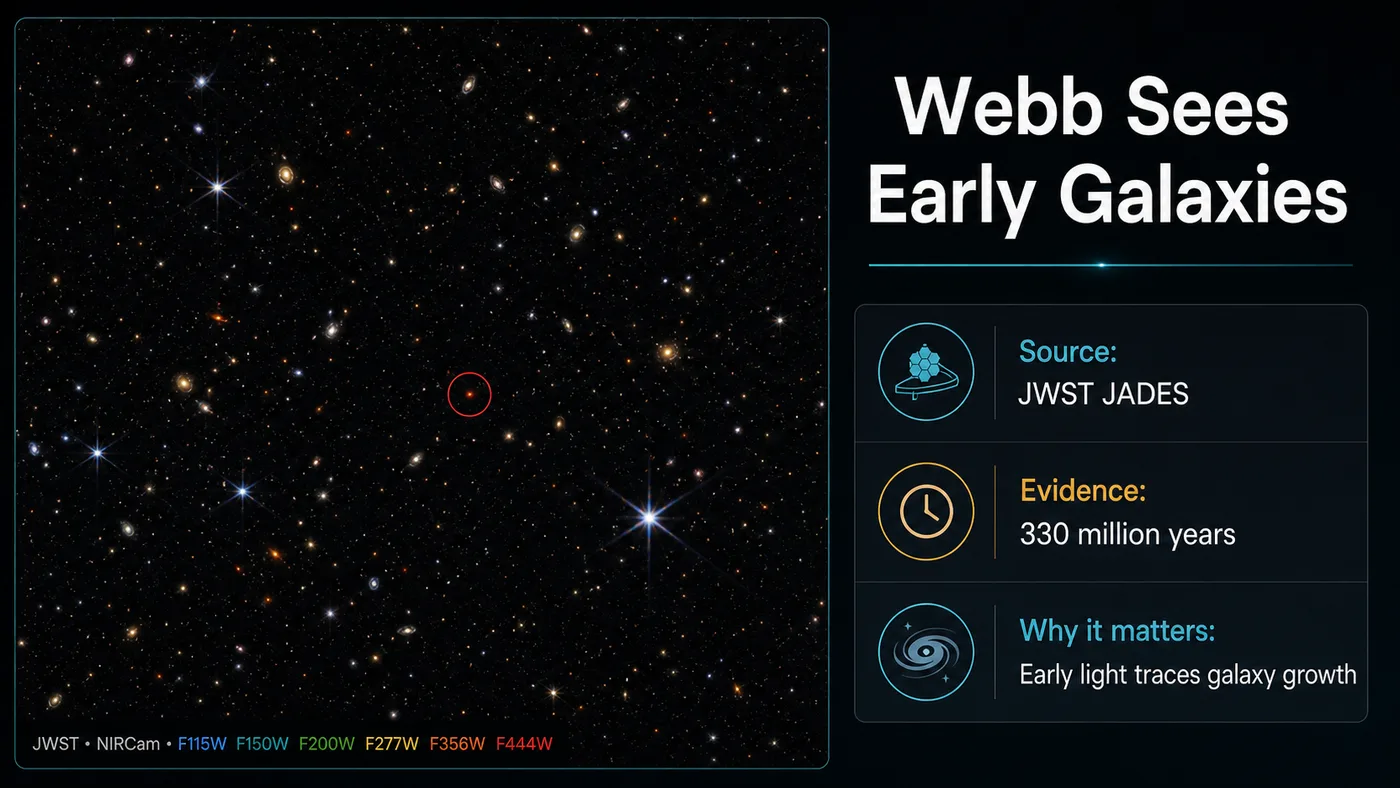
First Light Factories: JWST JADES Survey
James Webb Space Telescope · JADES survey · early galaxy formation · redshift z>10 candidates
The JWST Advanced Deep Extragalactic Survey (JADES) is one of the most ambitious deep-field programs conducted with the James Webb Space Telescope, using over 770 hours of observing time with both NIRCam and NIRSpec. Published results beginning in 2022–2023 identified galaxy candidates at redshifts above 10, corresponding to light emitted when the Universe was less than 500 million years old. Sev
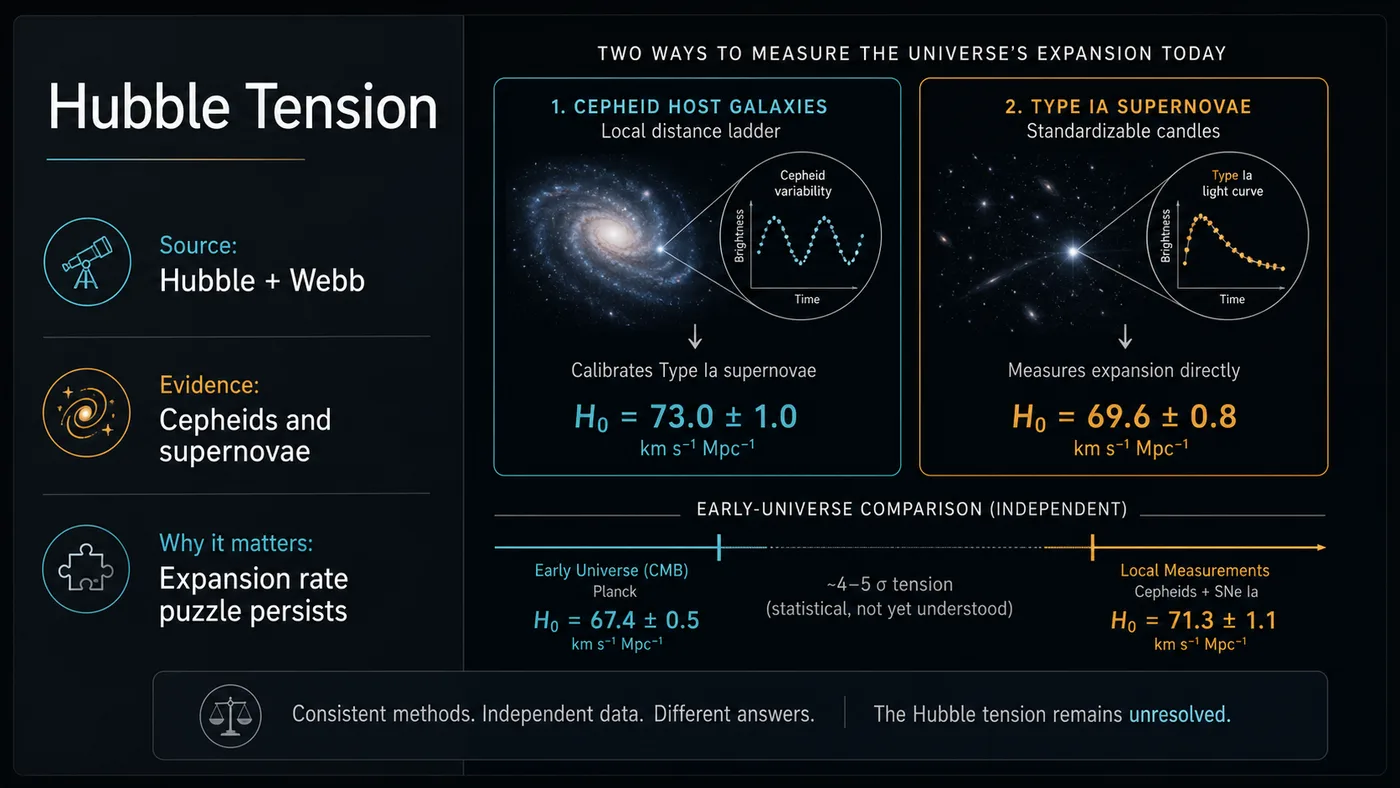
The Tension at the Heart of Cosmology: H₀
Hubble constant tension · distance ladder vs. CMB · SH0ES and Planck measurements
The Hubble constant H₀ describes the current rate of cosmic expansion. Two independent measurement paths yield persistently discrepant values. The distance ladder (Cepheid variables calibrated with HST and JWST, then Type Ia supernovae at larger distances) gives H₀ ≈ 73 km/s/Mpc (SH0ES collaboration), while extrapolating Planck CMB data under ΛCDM gives H₀ ≈ 67.4 km/s/Mpc. The statistical signific
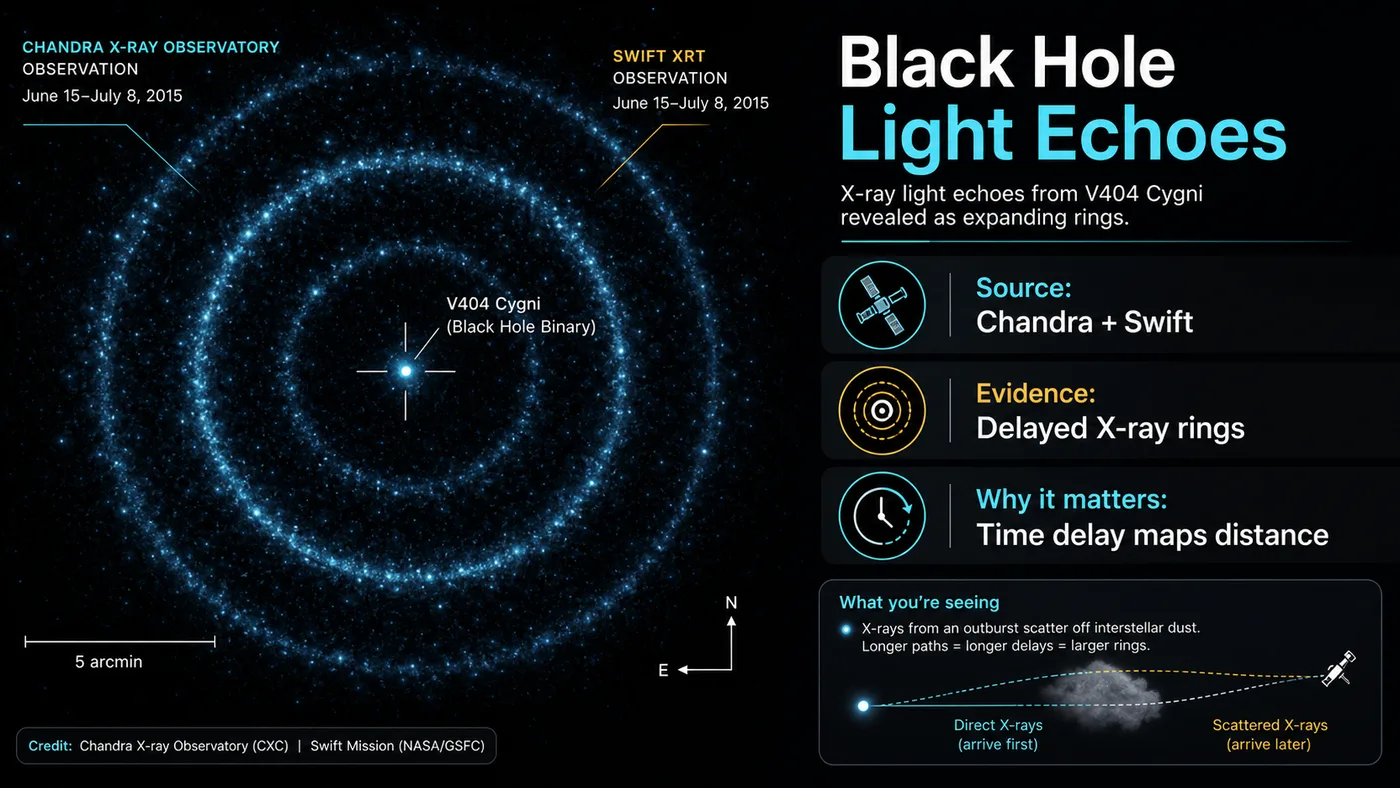
X-ray Echoes: Chandra Hears a Black Hole Flare
Chandra X-ray Observatory · X-ray light echoes · iron K-alpha reverberation · black hole corona
Chandra X-ray Observatory, launched in July 1999, has been used to detect X-ray light echoes (or "X-ray reverberations") from the coronae of accreting black holes. When a flare erupts in the hot corona above a black hole's accretion disk, the direct X-ray pulse arrives at the observer first. A slightly delayed echo arrives after reflecting off the inner accretion disk, imprinting an iron K-alpha
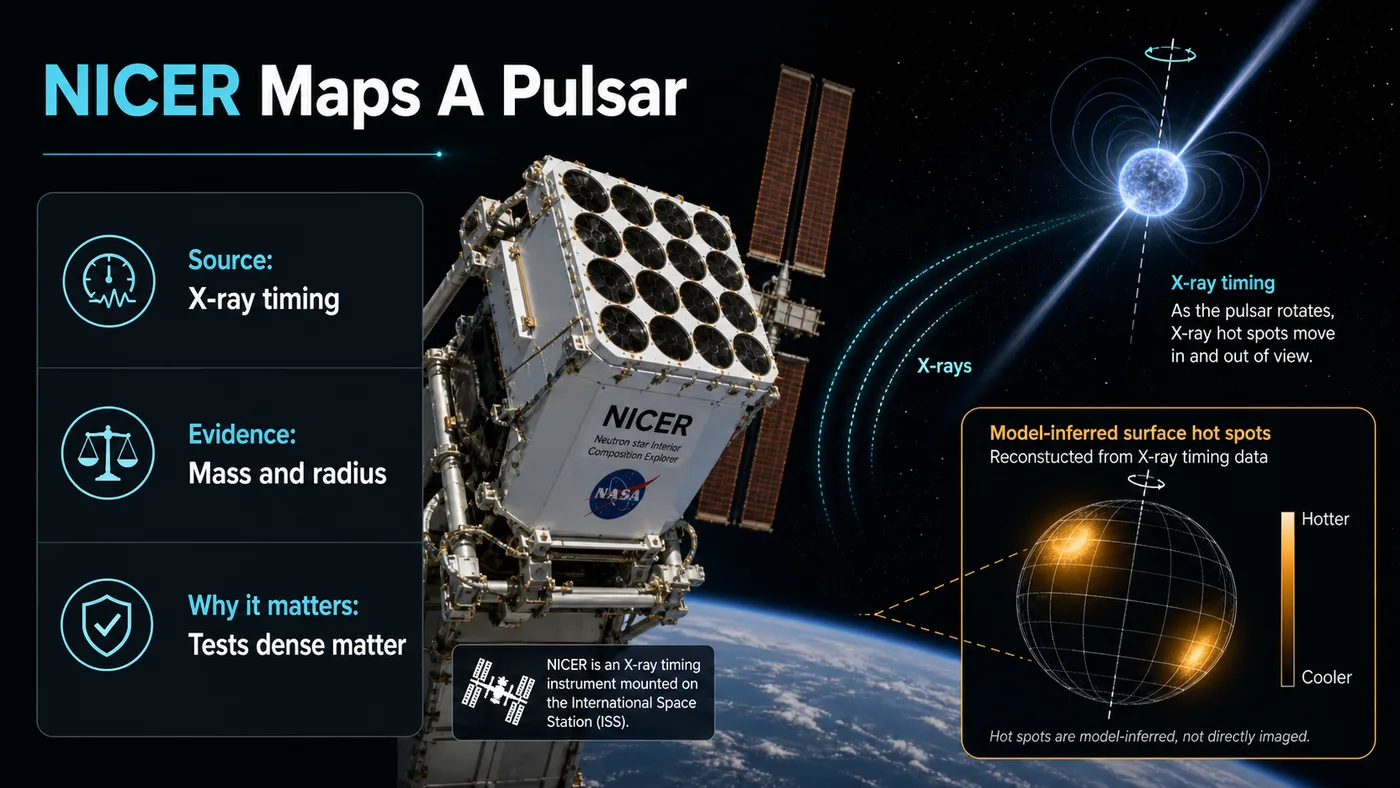
Neutron Star Portrait: NICER Maps a Pulsar Surface
NICER instrument · ISS · X-ray pulse profile · neutron star radius and equation of state
The Neutron Star Interior Composition Explorer (NICER) is an X-ray timing instrument mounted on the International Space Station, deployed in June 2017. NICER collects soft X-rays (0.2–12 keV) from millisecond pulsars with microsecond timing precision, enabling pulse-profile modeling that constrains neutron star radii and masses, critical inputs for the nuclear equation of state at supranuclear de
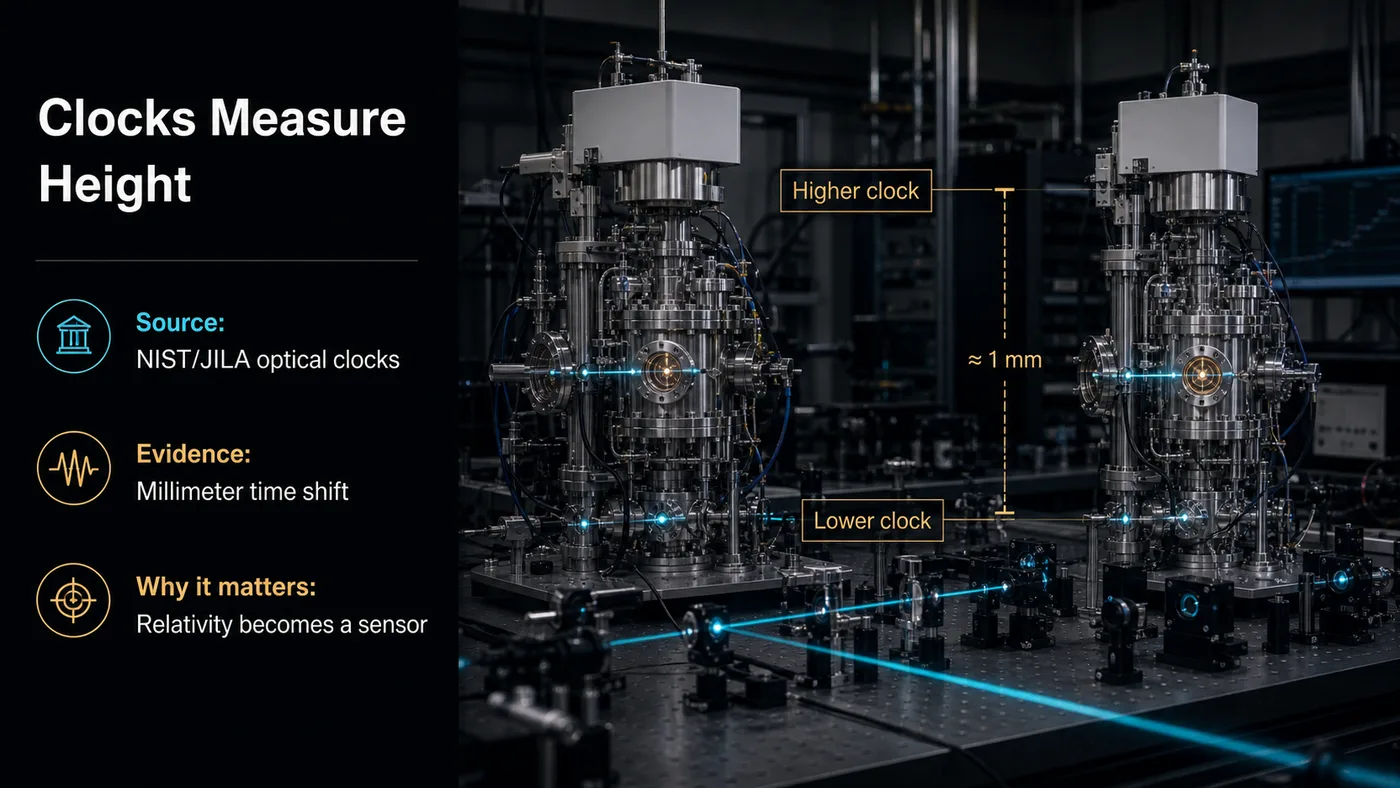
Clocks That Weigh Mountains: Relativistic Geodesy
Optical lattice clocks · relativistic geodesy · gravitational redshift · height measurement
General relativity predicts that clocks run faster at higher gravitational potential. Clocks higher up tick faster by approximately 1.09 × 10⁻¹⁶ per meter of altitude (the gravitational redshift). Modern optical lattice clocks based on strontium-87 or ytterbium-171 have achieved fractional frequency uncertainties below 10⁻¹⁸, making them sensitive to height differences of centimeters. This enable
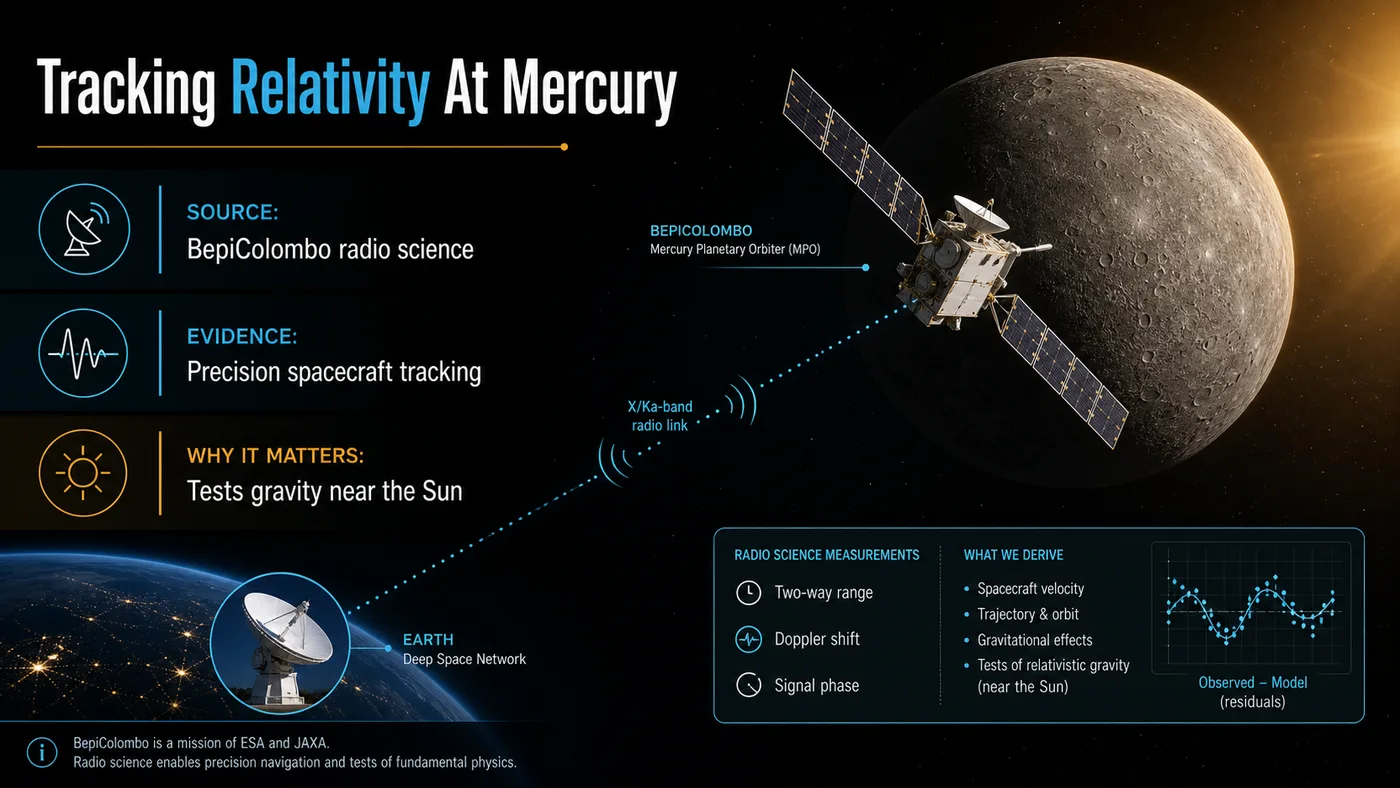
Closest to the Sun: BepiColombo Tests Relativity at Mercury
BepiColombo spacecraft · Mercury orbit · perihelion precession · MORE radio science
BepiColombo is an ESA/JAXA joint mission to Mercury launched in October 2018, consisting of two orbiters, ESA's Mercury Planetary Orbiter (MPO) and JAXA's Mercury Magnetospheric Orbiter (Mio). Its MORE (Mercury Orbiter Radio-science Experiment) instrument suite uses precise radio tracking at X and Ka bands to measure Mercury's orbit to sub-meter precision, enabling tests of general relativity inc
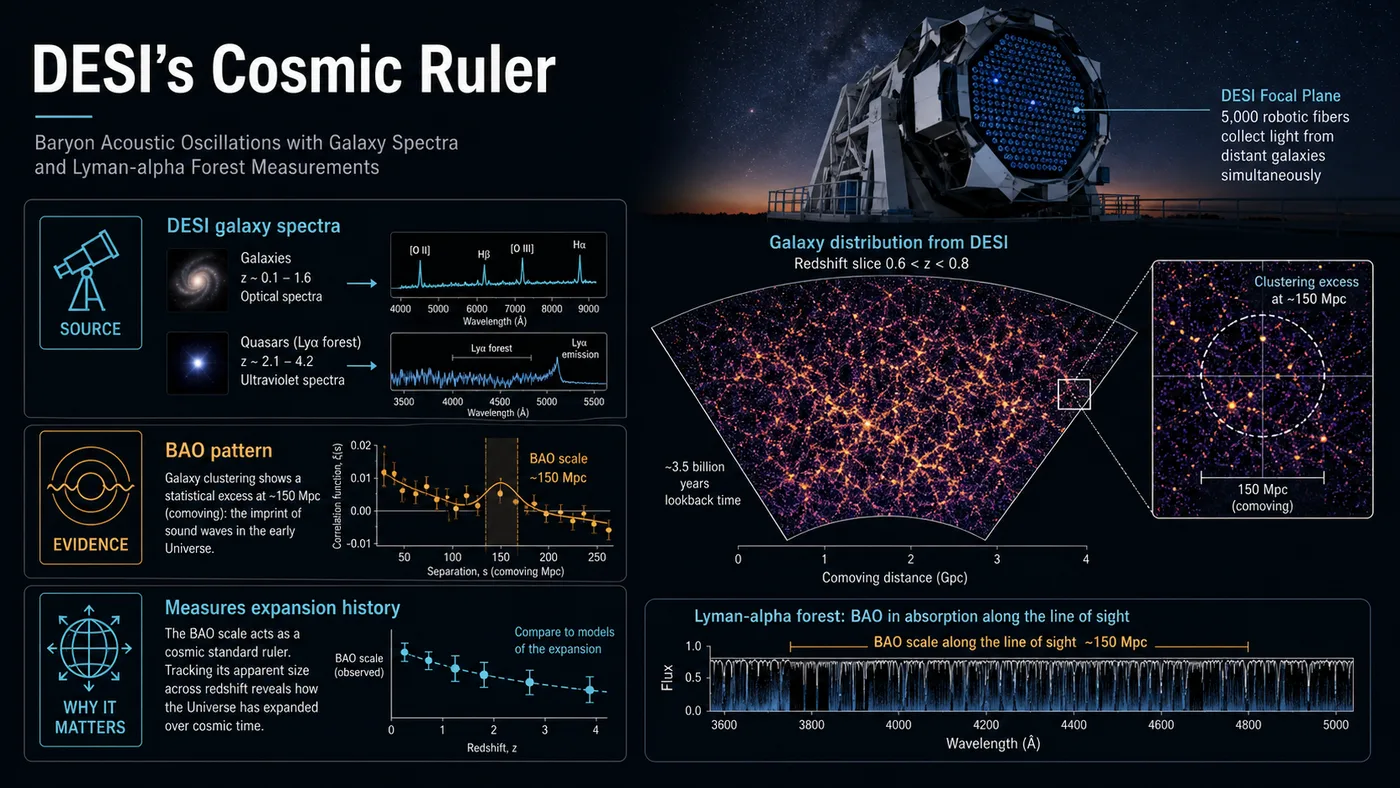
The Universe's Yardstick: DESI Baryon Acoustic Oscillations
DESI spectrograph · Baryon Acoustic Oscillations · 4-meter Mayall Telescope · large-scale structure
Baryon Acoustic Oscillations (BAOs) are a characteristic scale of approximately 500 million light-years, imprinted in the distribution of galaxies by pressure waves in the early Universe that froze at the epoch of recombination. This scale acts as a "standard ruler" for measuring cosmic distances and the expansion history. The Dark Energy Spectroscopic Instrument (DESI), mounted on the 4-meter May
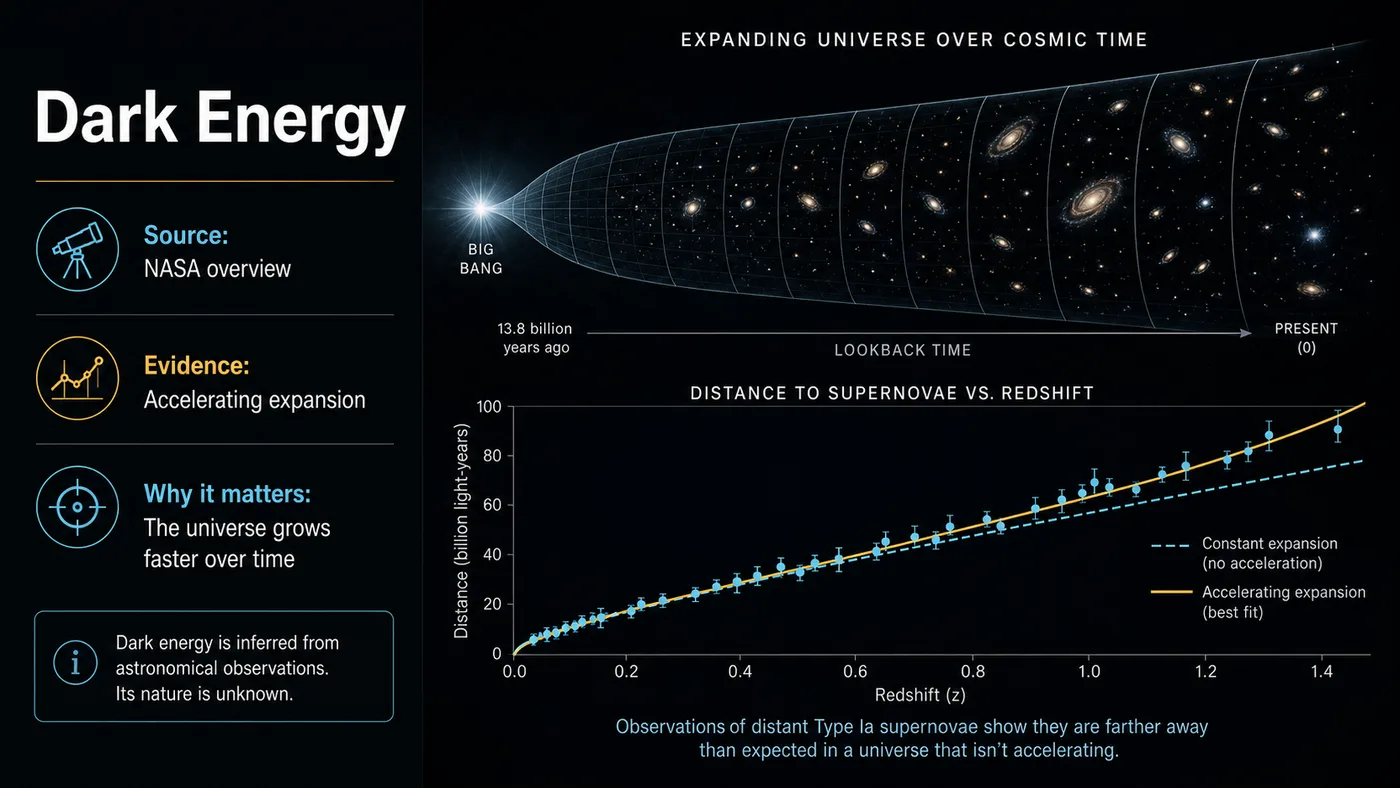
The Accelerating Universe: Dark Energy Discovered
Type Ia supernovae · Supernova Cosmology Project / High-Z Supernova Team · accelerating expansion · 1998
In 1998, two independent teams, the Supernova Cosmology Project (SCP) led by Saul Perlmutter and the High-Z Supernova Search Team, published measurements of distant Type Ia supernovae showing that the universe's expansion is accelerating rather than decelerating. By comparing the brightness of high-redshift supernovae (z ~ 0.5–1) with nearby counterparts, they found the distant ones fainter than
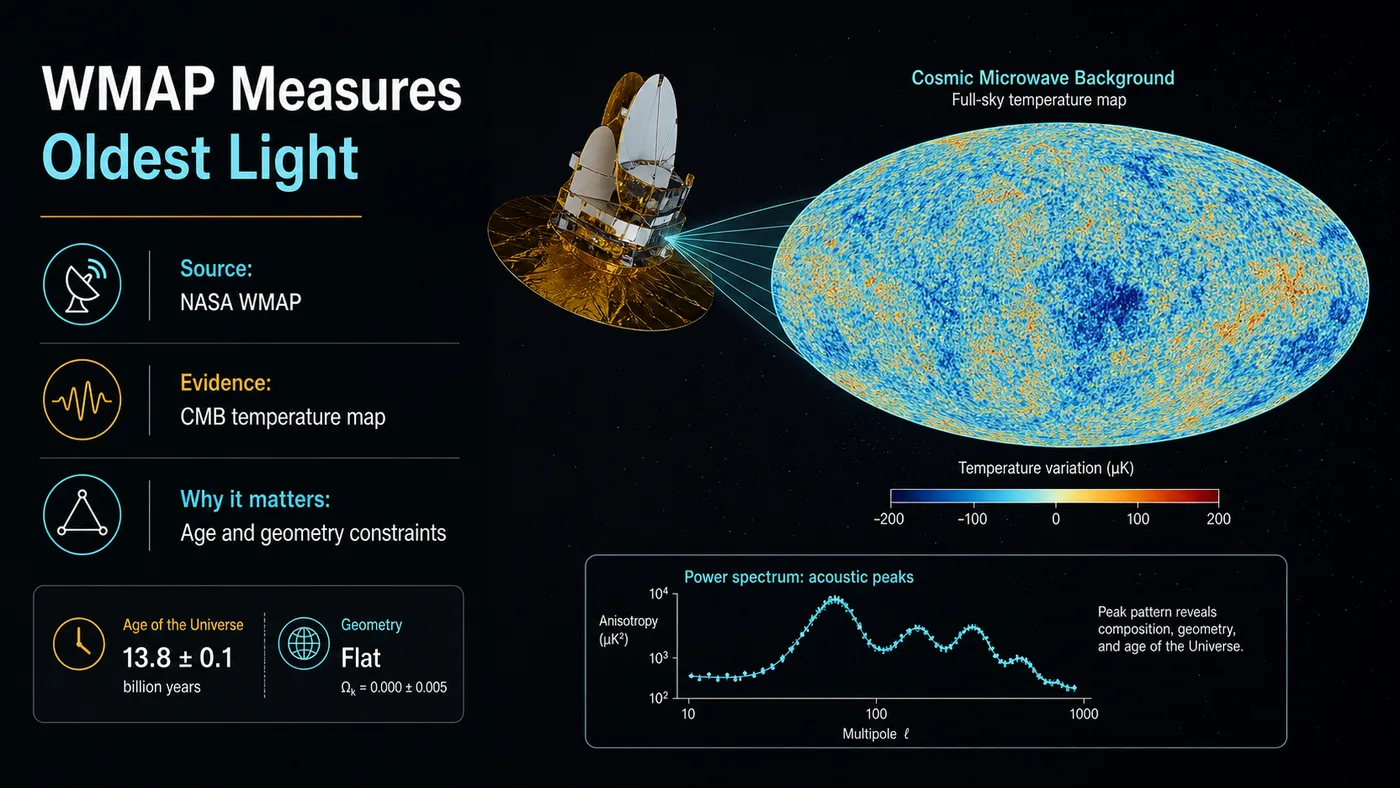
The Oldest Light: WMAP Maps the Cosmic Microwave Background
WMAP satellite · Cosmic Microwave Background · temperature anisotropies · age of universe
NASA's Wilkinson Microwave Anisotropy Probe (WMAP) operated from 2001 to 2010, measuring the Cosmic Microwave Background (CMB), the thermal afterglow of the Big Bang from 380,000 years after the initial singularity, when the Universe became transparent. WMAP's nine-year data release produced a full-sky temperature map with 13-arcminute resolution, revealing temperature fluctuations of order ±200
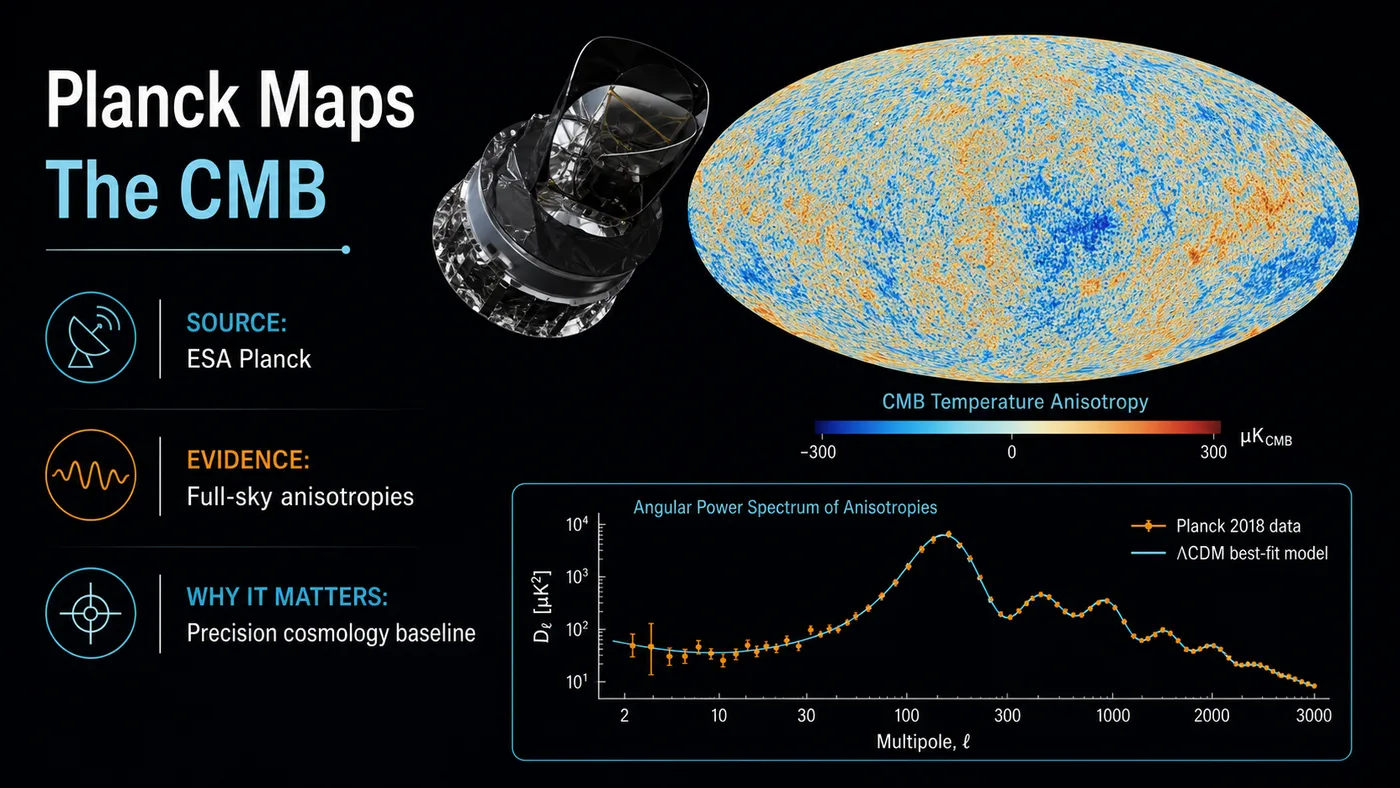
The Finest Map of Everything: ESA Planck Satellite
ESA Planck satellite · CMB precision cosmology · HFI bolometers · 0.1 K operating temperature
ESA's Planck satellite operated from 2009 to 2013, mapping the Cosmic Microwave Background with unprecedented sensitivity across nine frequency bands (30–857 GHz). Its High Frequency Instrument (HFI) used bolometric detectors cooled to 0.1 K by a dilution refrigerator, among the coldest objects in space during operations. Planck's 2018 legacy data release provided CMB temperature and polarization
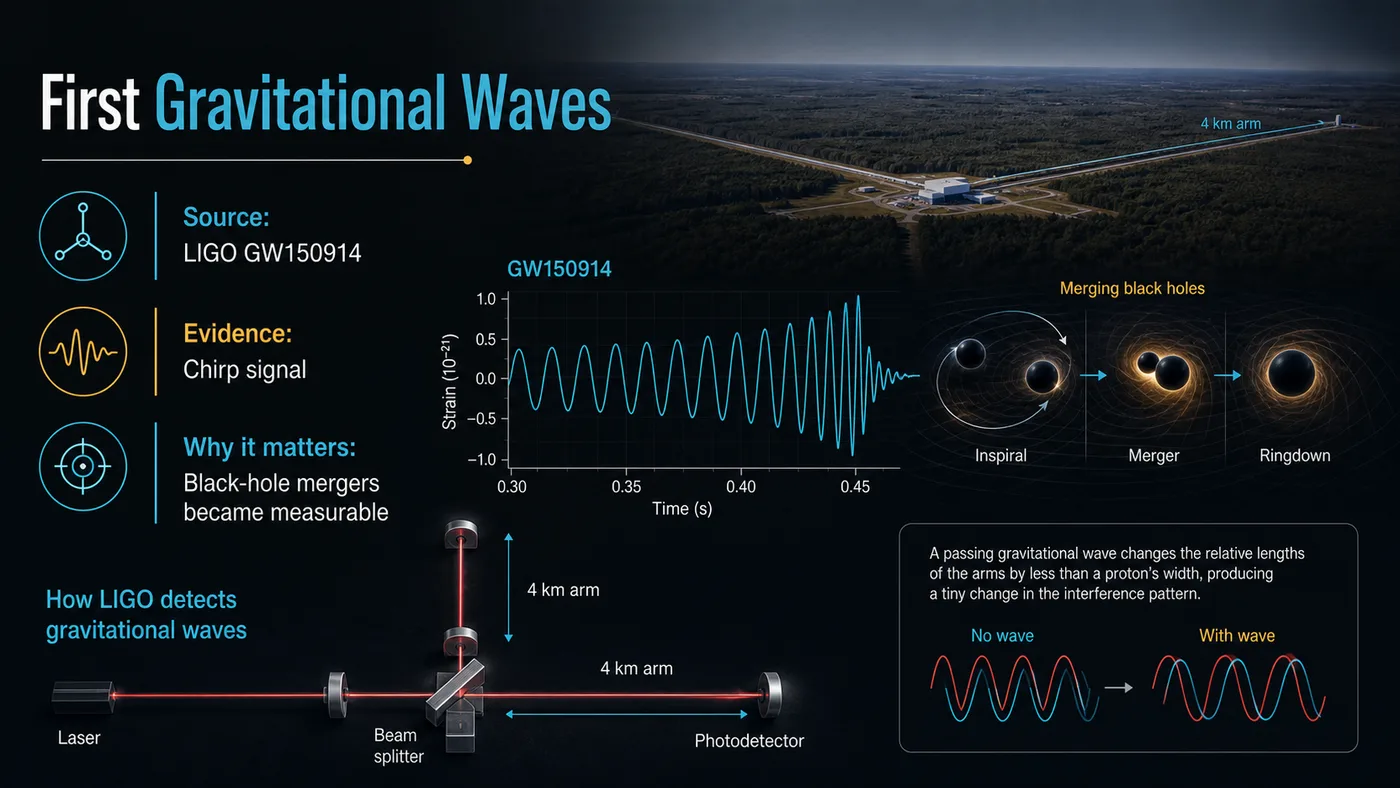
The Chirp Heard Round the Universe: GW150914
LIGO · GW150914 · binary black hole merger · gravitational wave first detection · September 14, 2015
On September 14, 2015 at 09:50:45 UTC, the two LIGO detectors in Hanford, Washington and Livingston, Louisiana simultaneously recorded a gravitational wave signal designated GW150914. The signal matched the numerical relativity template for the inspiral, merger, and ringdown of two black holes with inferred masses of approximately 29 and 36 solar masses merging at ~1.3 billion light-years, pro
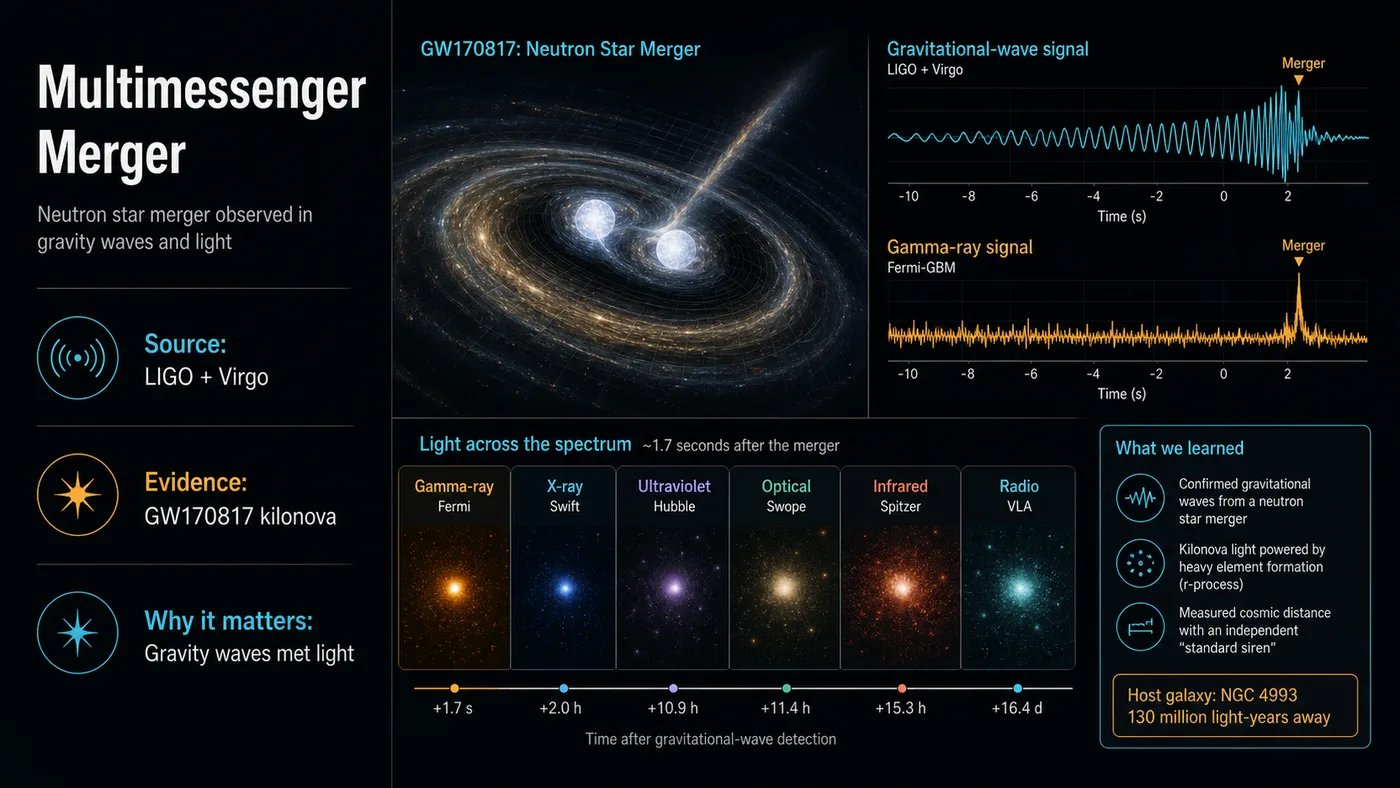
Gold Forged in Starquake: GW170817 Multi-Messenger Astronomy
GW170817 · neutron star merger · kilonova · multi-messenger astronomy · August 17, 2017
On August 17, 2017, LIGO and Virgo detected gravitational waves from the inspiral and merger of two neutron stars, event GW170817, at approximately 130 million light-years in galaxy NGC 4993. 1.74 seconds after the gravitational wave merger, Fermi GBM detected a short gamma-ray burst (GRB 170817A). Over the following days, ground and space telescopes across the electromagnetic spectrum observed
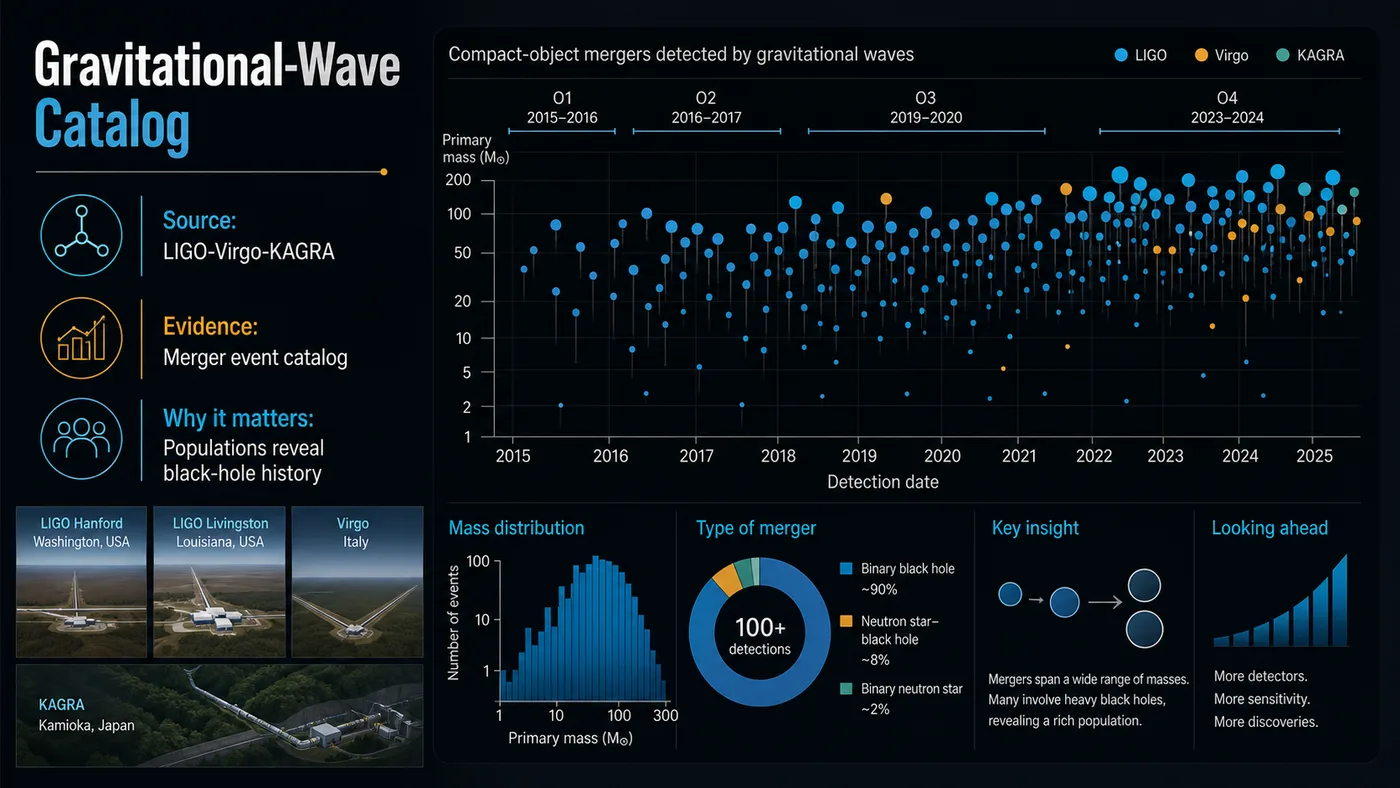
A Population of Mergers: The GWTC Catalog
LIGO-Virgo-KAGRA · GWTC-3 · gravitational wave transient catalog · merger mass distribution
The Gravitational Wave Transient Catalog (GWTC-3), released in 2021, compiles 90 confident gravitational wave events detected through LIGO-Virgo-KAGRA Observing Run 3. The catalog includes binary black hole mergers, binary neutron star mergers, and neutron star-black hole mergers detected across cosmological distances. KAGRA (Kamioka Gravitational Wave Detector) in Japan, using cryogenically cool
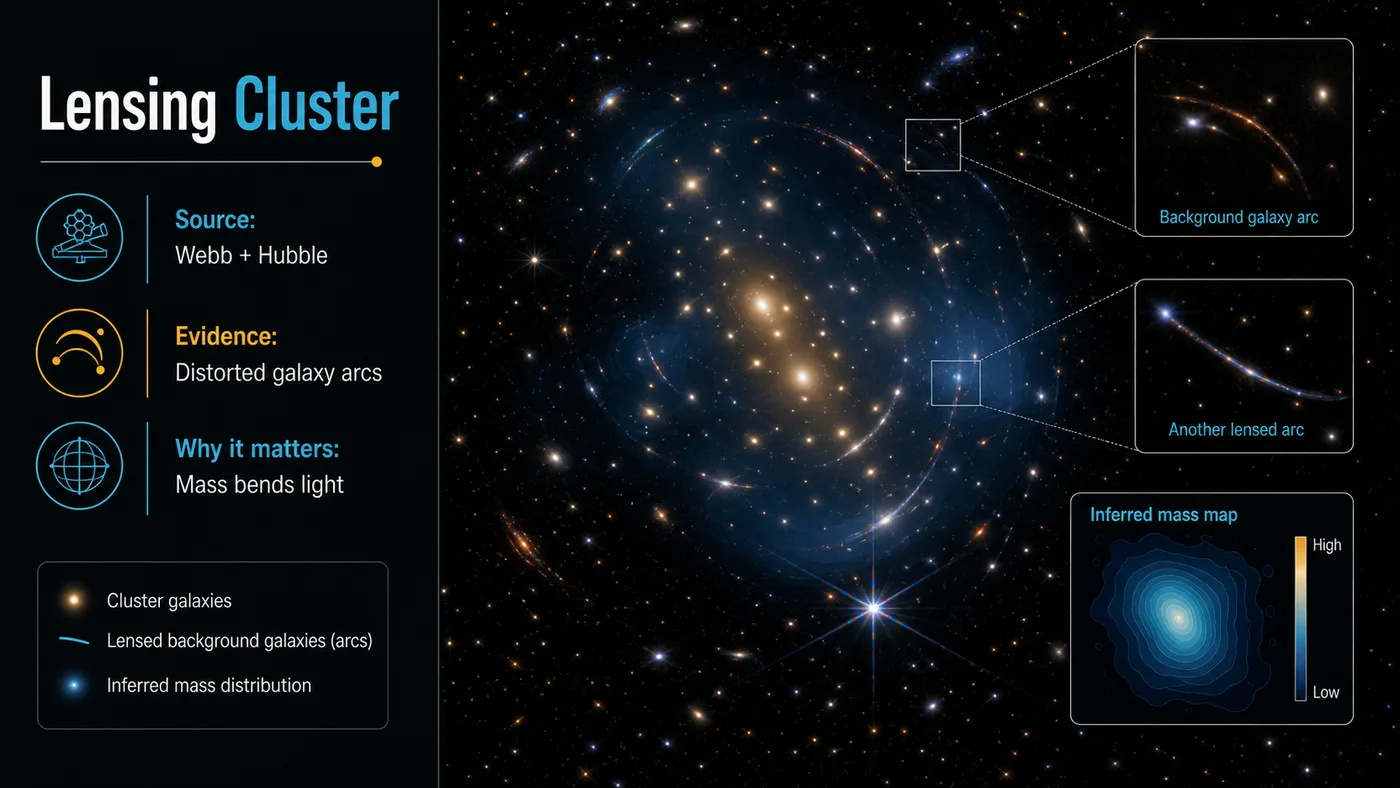
Cosmic Magnifying Glass: JWST and Hubble Joint Lensing
JWST + Hubble Space Telescope · gravitational lensing · galaxy cluster · background galaxy arcs
Massive galaxy clusters act as natural gravitational telescopes, bending and magnifying the light of more distant background galaxies. The combination of JWST's infrared sensitivity and angular resolution with Hubble's optical and UV coverage has enabled the deepest joint lensing studies in history. Clusters such as Abell 2744 (Pandora's Cluster), SMACS 0723, and El Gordo have been observed in joi
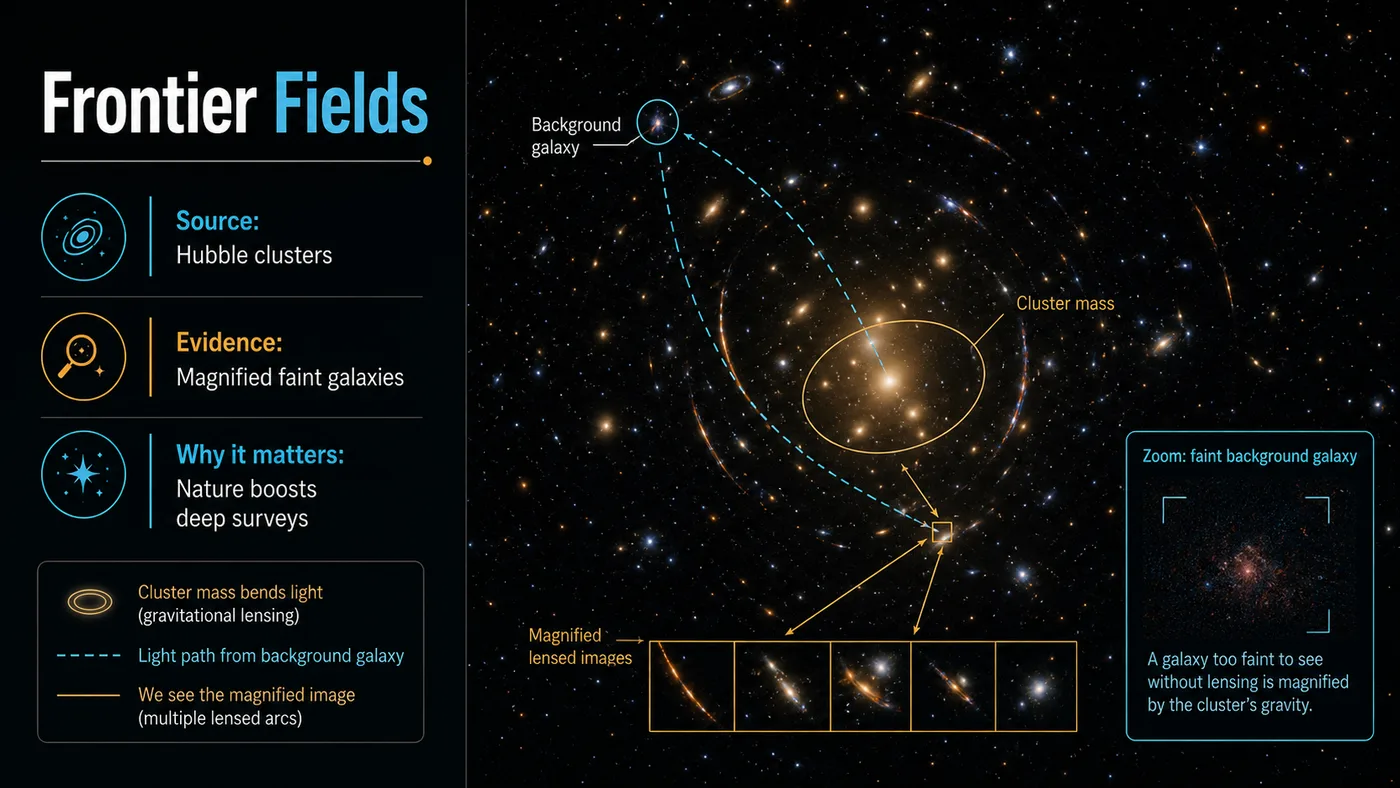
Hubble's Deepest Lenses: The Frontier Fields
Hubble Space Telescope · Frontier Fields program · gravitational lensing · six galaxy clusters
The Hubble Frontier Fields program (2013–2016) was a large-scale Director's Discretionary observing campaign using HST to image six massive galaxy clusters (Abell 2744, MACS J0416, MACS J0717, MACS J1149, Abell S1063, and Abell 370) plus six parallel blank fields, accumulating approximately 560 orbits total. By exploiting gravitational lensing amplification from each cluster, the program reached
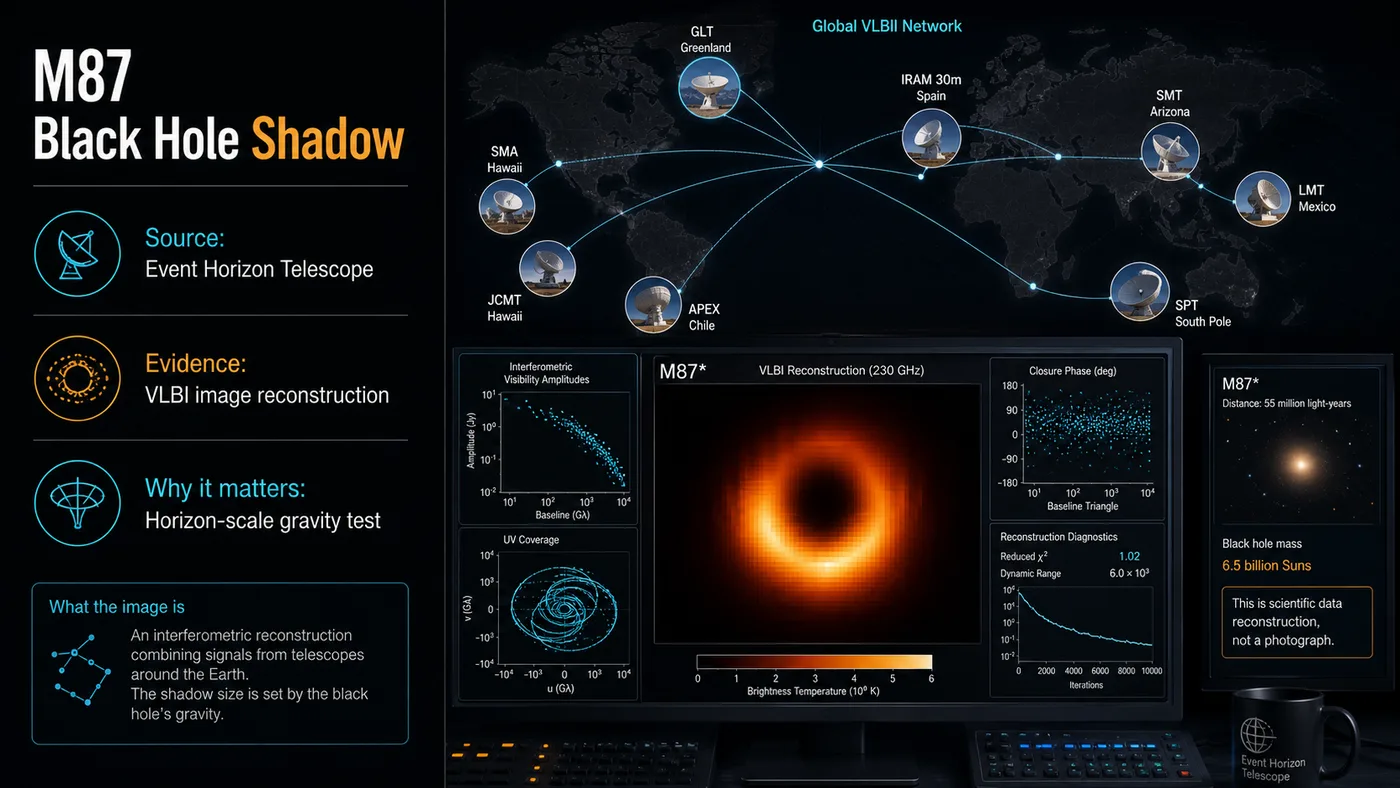
The Shadow of a Giant: M87* Imaged by the EHT
Event Horizon Telescope · M87* · black hole shadow · VLBI · April 10, 2019 announcement
On April 10, 2019, the Event Horizon Telescope (EHT) collaboration released the first-ever image of a black hole's shadow, the supermassive black hole M87* at the center of galaxy M87, approximately 6.5 billion solar masses and 55 million light-years distant. The EHT is a global Very Long Baseline Interferometry (VLBI) array operating at 1.3-mm wavelength, combining radio telescopes across Earth
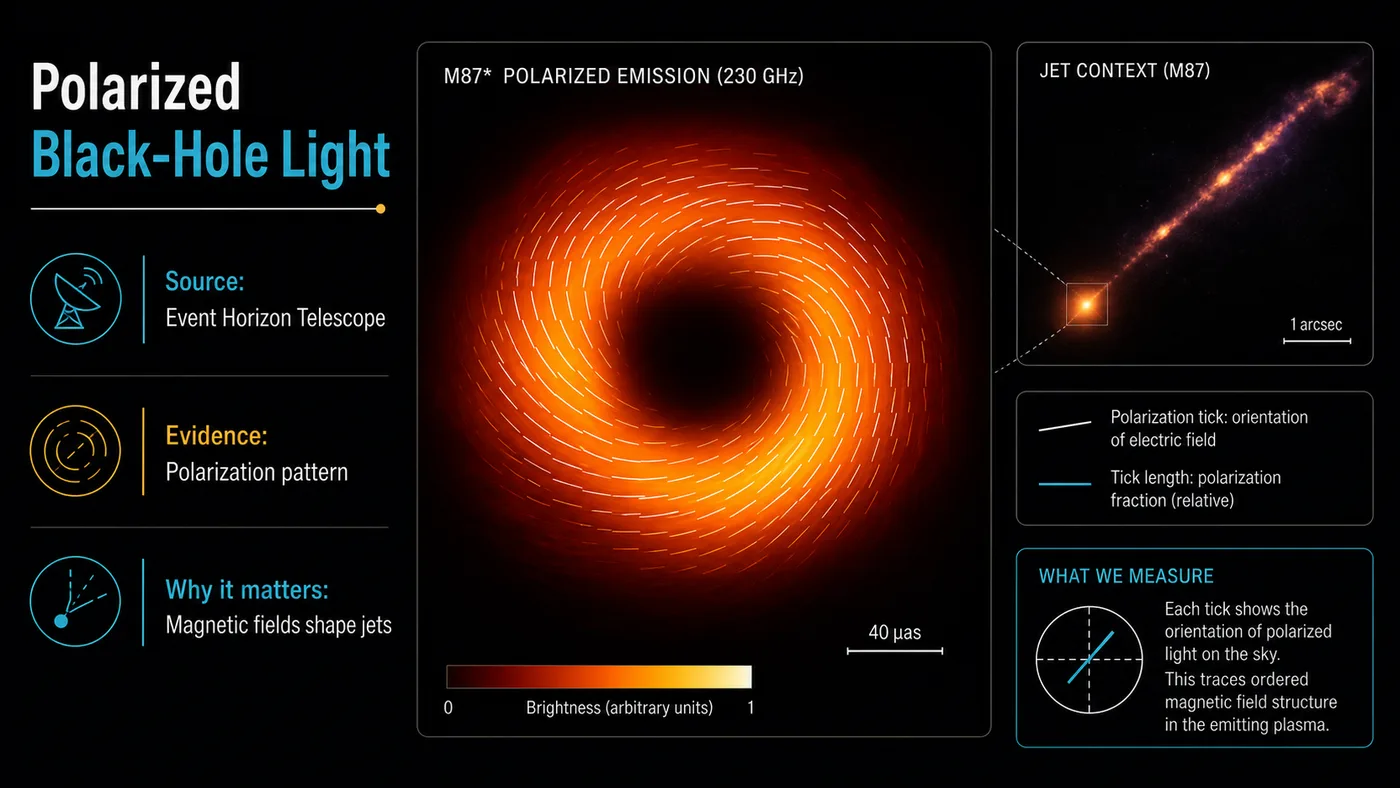
Twisted Light: Polarization Maps the Black Hole's Magnetic Field
Event Horizon Telescope · M87* polarized emission · magnetic field structure · jet launching
In March 2021, the EHT collaboration published polarimetric images of M87*, showing the linear polarization of the photon ring emission. The polarization vector pattern, forming a nearly azimuthal (spiral) structure around the ring, reveals the organized magnetic field geometry threading the accretion disk and base of the relativistic jet. The degree of linear polarization (a few percent) and po
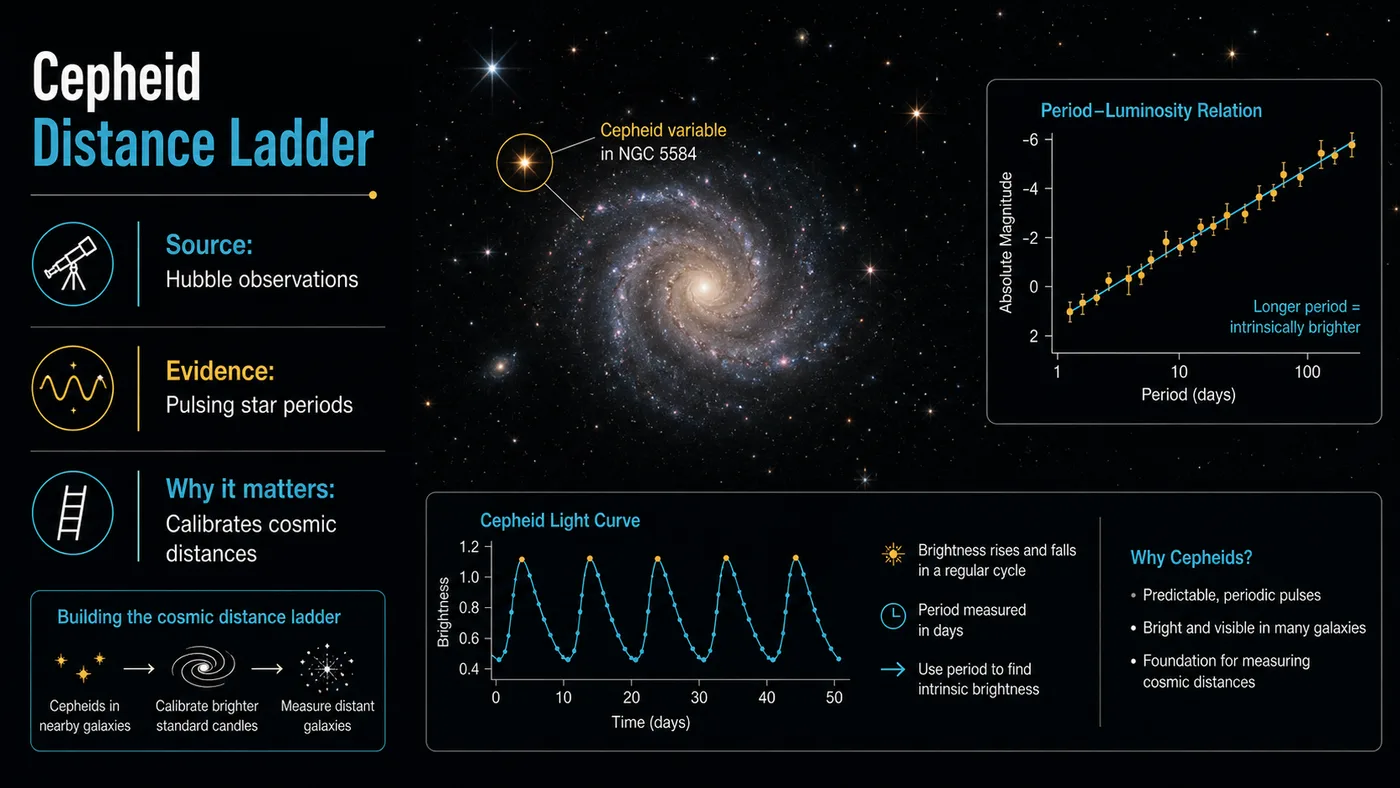
The Cosmic Ladder: Cepheid Variables as Standard Candles
Cepheid variable stars · period-luminosity relation · HST and JWST · distance ladder calibration
Cepheid variable stars pulsate with periods of days to weeks and obey a tight period-luminosity relation (the Leavitt law) first identified by Henrietta Swan Leavitt in 1908. Because a Cepheid's intrinsic luminosity is determined by its pulsation period, measuring the period gives the intrinsic brightness, and comparing this to the observed brightness yields the distance. Cepheids are the primary
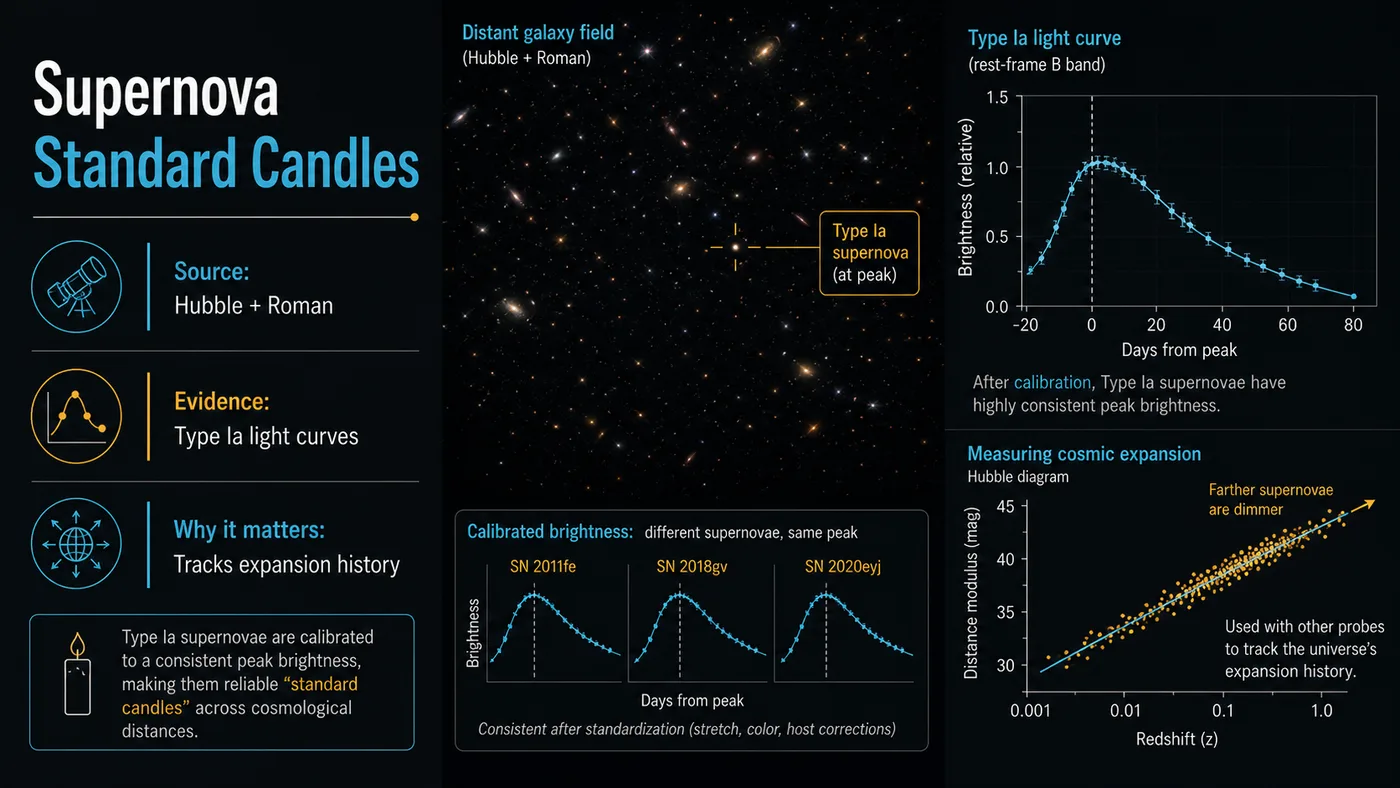
Stellar Explosions as Yardsticks: Type Ia Supernovae
Type Ia supernovae · Phillips relation · standardizable candles · cosmological distance measurement
Type Ia supernovae are thermonuclear explosions of carbon-oxygen white dwarf stars that exceed the Chandrasekhar mass limit (~1.4 solar masses) through mass transfer or merger. Their intrinsic peak luminosities are standardizable via the Phillips relation (1993). Brighter events decline more slowly from peak, enabling correction of observed peak magnitude to a standard value. After calibration, a
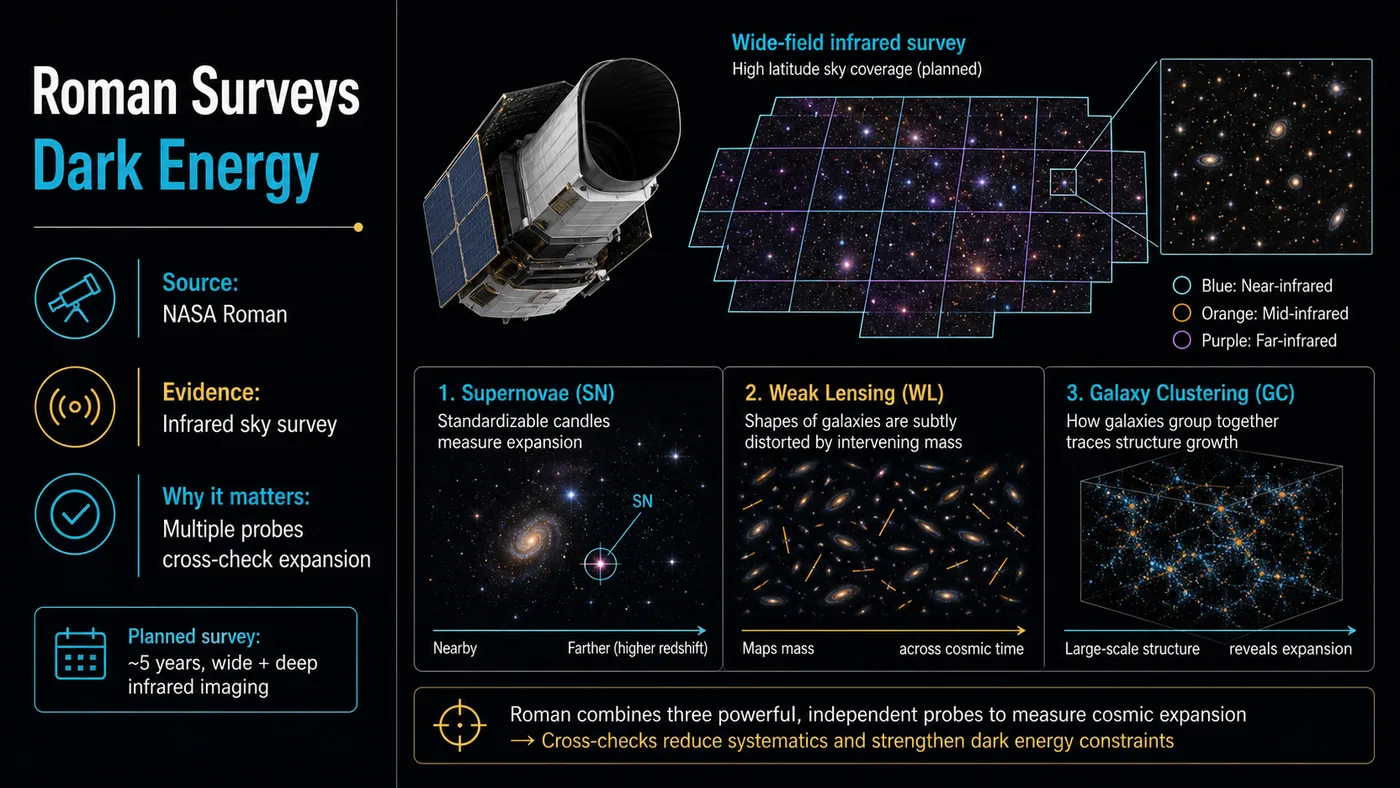
Wide-Eye in Space: NASA Roman's Dark Energy Survey
Nancy Grace Roman Space Telescope · wide-field infrared survey · dark energy · gravitational lensing
The Nancy Grace Roman Space Telescope (formerly WFIRST) is a NASA wide-field infrared space observatory with a 2.4-meter primary mirror identical in diameter to Hubble but with a 100× larger field of view, achieved through a 300-megapixel focal plane assembly. Roman's High Latitude Wide Area Survey will image ~2,000 square degrees in the near-infrared, measuring weak gravitational lensing (cosmic
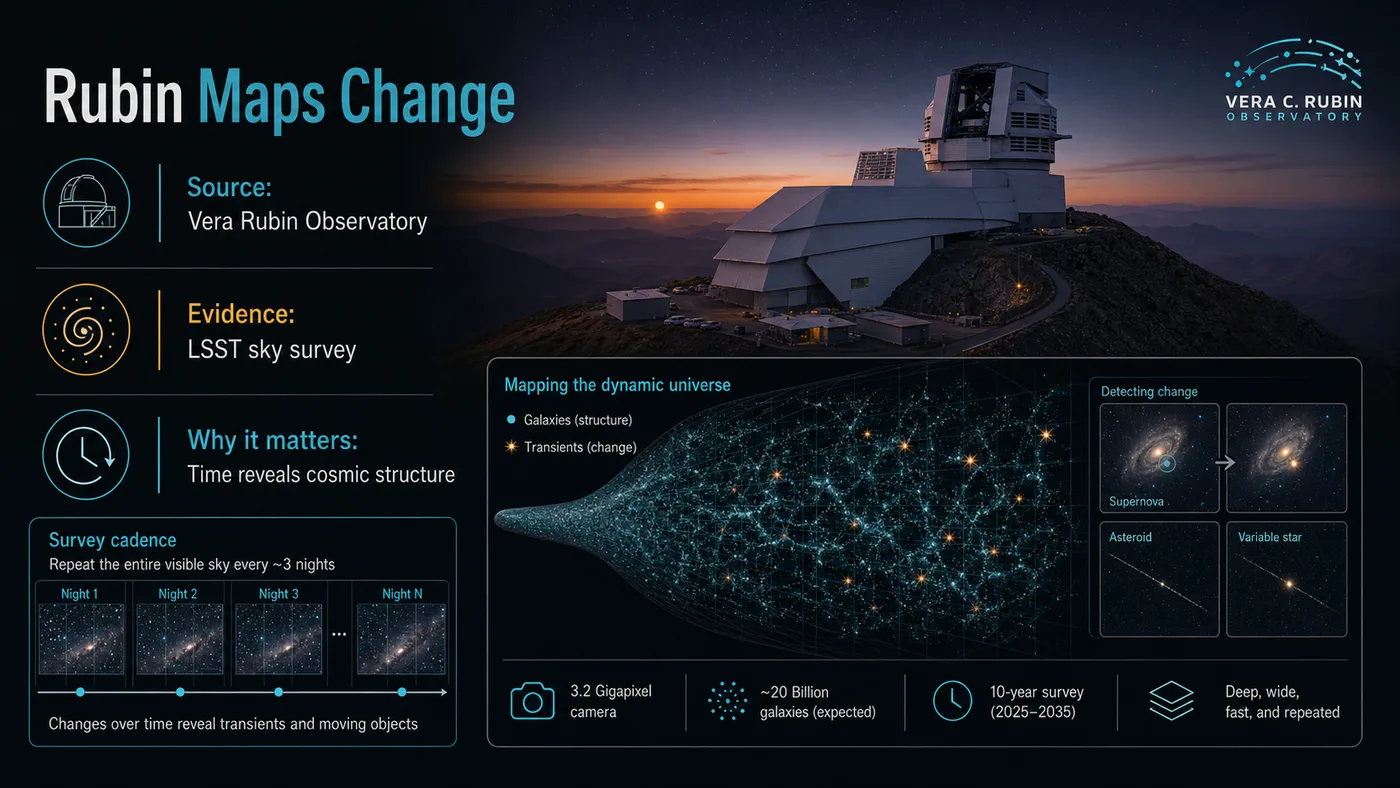
Ten Years, Ten Billion Pixels: Vera Rubin Observatory
Vera C. Rubin Observatory · LSST · 8.4-meter Simonyi Survey Telescope · 3.2 gigapixel camera
The Vera C. Rubin Observatory on Cerro Pachón in Chile hosts the Simonyi Survey Telescope with an 8.4-meter primary mirror and the Legacy Survey of Space and Time (LSST) camera, a 3.2-gigapixel focal plane consisting of 189 individual CCDs, the largest digital camera ever built for astronomy. The telescope's wide 9.6-square-degree field of view enables it to image the entire visible southern sky
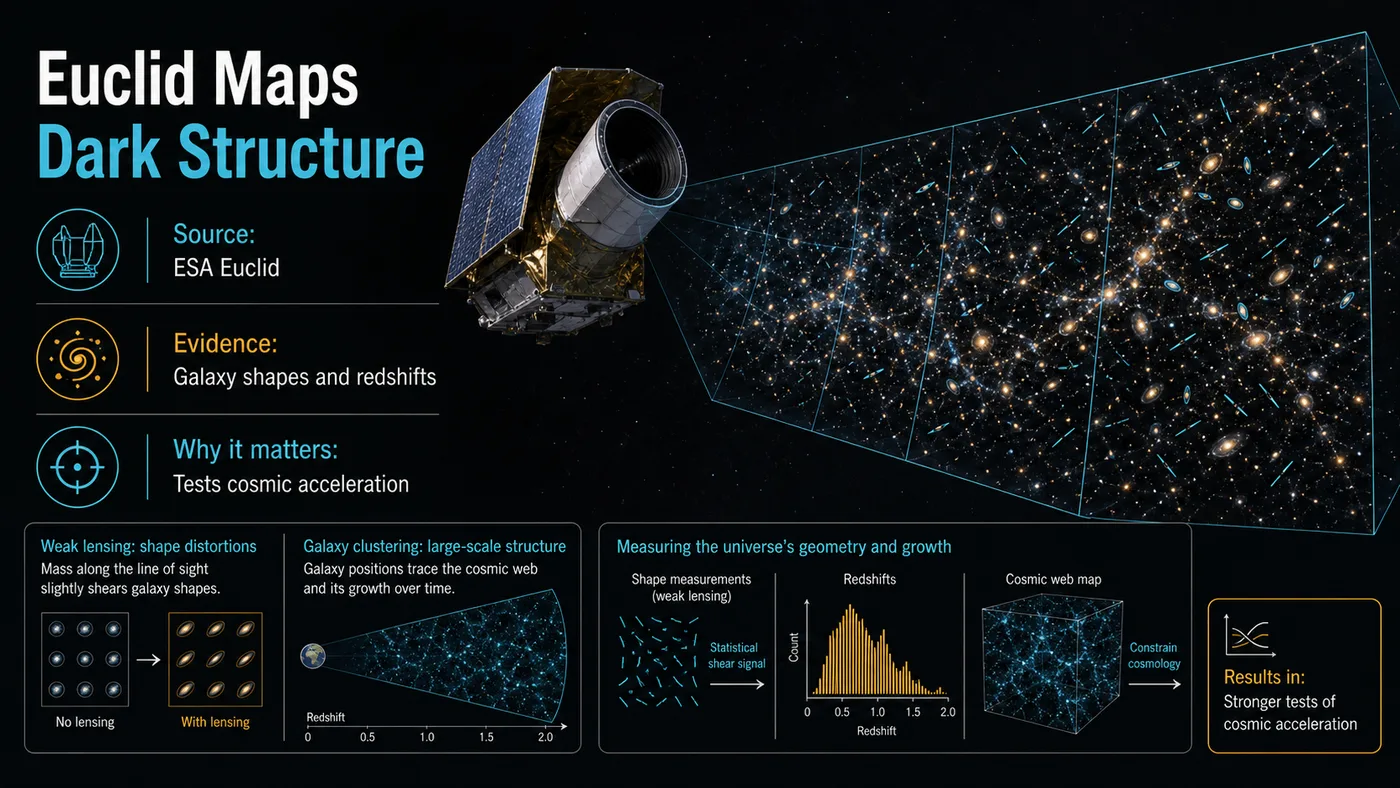
The Cosmic Web Mapped: ESA Euclid
ESA Euclid satellite · weak gravitational lensing · galaxy clustering · dark matter and dark energy
ESA's Euclid satellite, launched in July 2023 to the Sun-Earth L2 point, is a wide-field optical and near-infrared space telescope designed to map the large-scale structure of the Universe across 15,000 square degrees (approximately one third of the entire sky) over six years. Its VIS instrument (visible imager) and NISP (near-infrared spectrometer and photometer) work together to measure galaxy
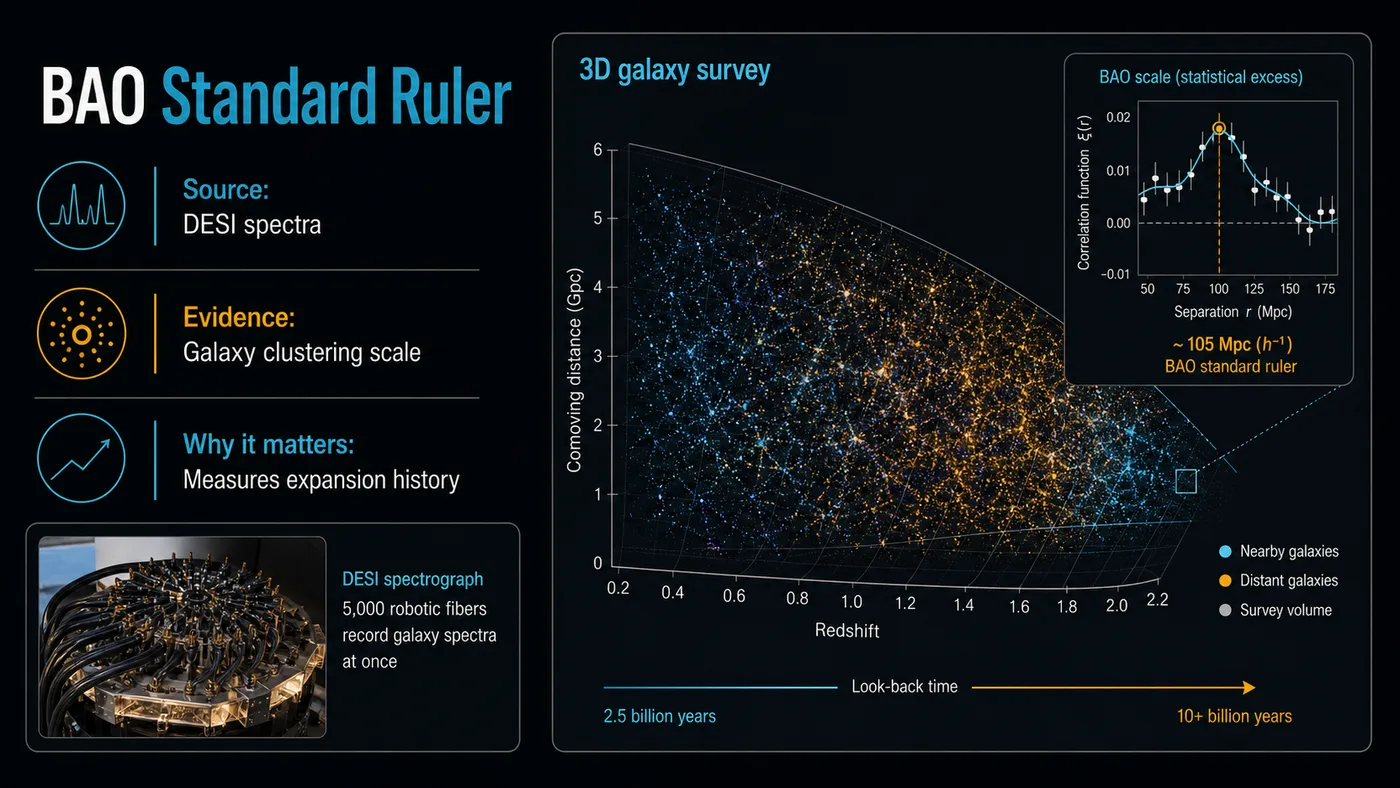
Mapping Cosmic Expansion: DESI Year-1 BAO Results
DESI spectrograph · BAO peak in galaxy power spectrum · dark energy equation of state · Year-1 data release 2024
DESI's Year-1 results released in April 2024 represent the most precise BAO measurements achieved to date, based on approximately 6 million galaxies and quasars observed in the first year of the five-year survey. By measuring the BAO peak position in the galaxy power spectrum and correlation function across multiple redshift bins, luminous red galaxies (LRG), emission line galaxies (ELG), quasars
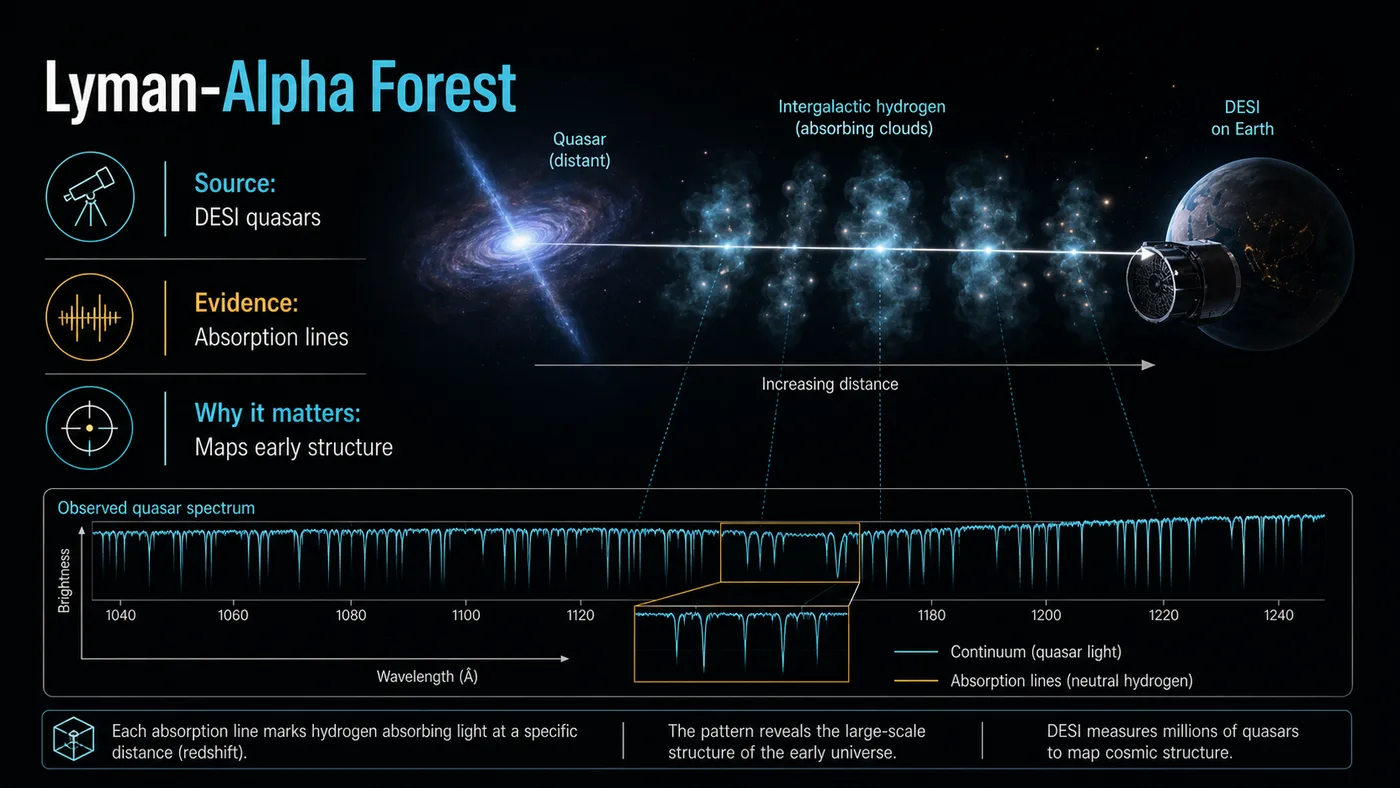
Whispers in Quasar Light: The Lyman-Alpha Forest
DESI · Lyman-alpha forest · quasar spectra · intergalactic medium · BAO at high redshift
The Lyman-alpha forest is the pattern of absorption lines in quasar spectra produced by neutral hydrogen in the intergalactic medium (IGM) between the quasar and the observer. Each absorption dip corresponds to a hydrogen cloud at a specific redshift, and the statistical distribution of these absorbers traces the large-scale structure of matter at high redshift (z = 2–4), a cosmic epoch inaccessi
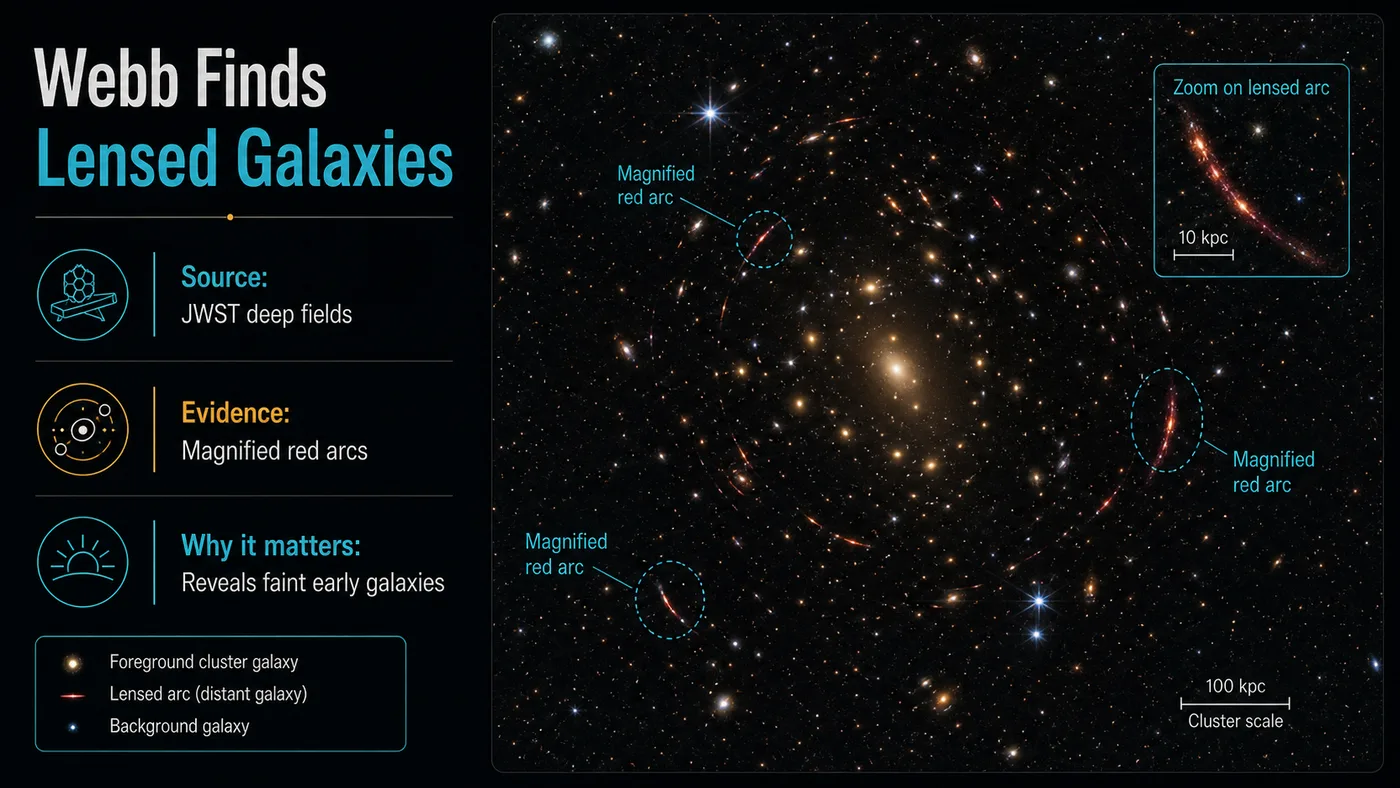
Light from the Beginning: JWST Finds the Universe's First Galaxies
James Webb Space Telescope · gravitational lensing · early galaxy formation · redshift z>12
James Webb Space Telescope, since its first science observations in mid-2022, has dramatically advanced the study of early galaxy formation by combining its infrared sensitivity with the gravitational lensing magnification from foreground clusters. JWST's NIRCam and NIRISS instruments have detected and spectroscopically confirmed galaxies at redshifts above 12, when the Universe was less than 400
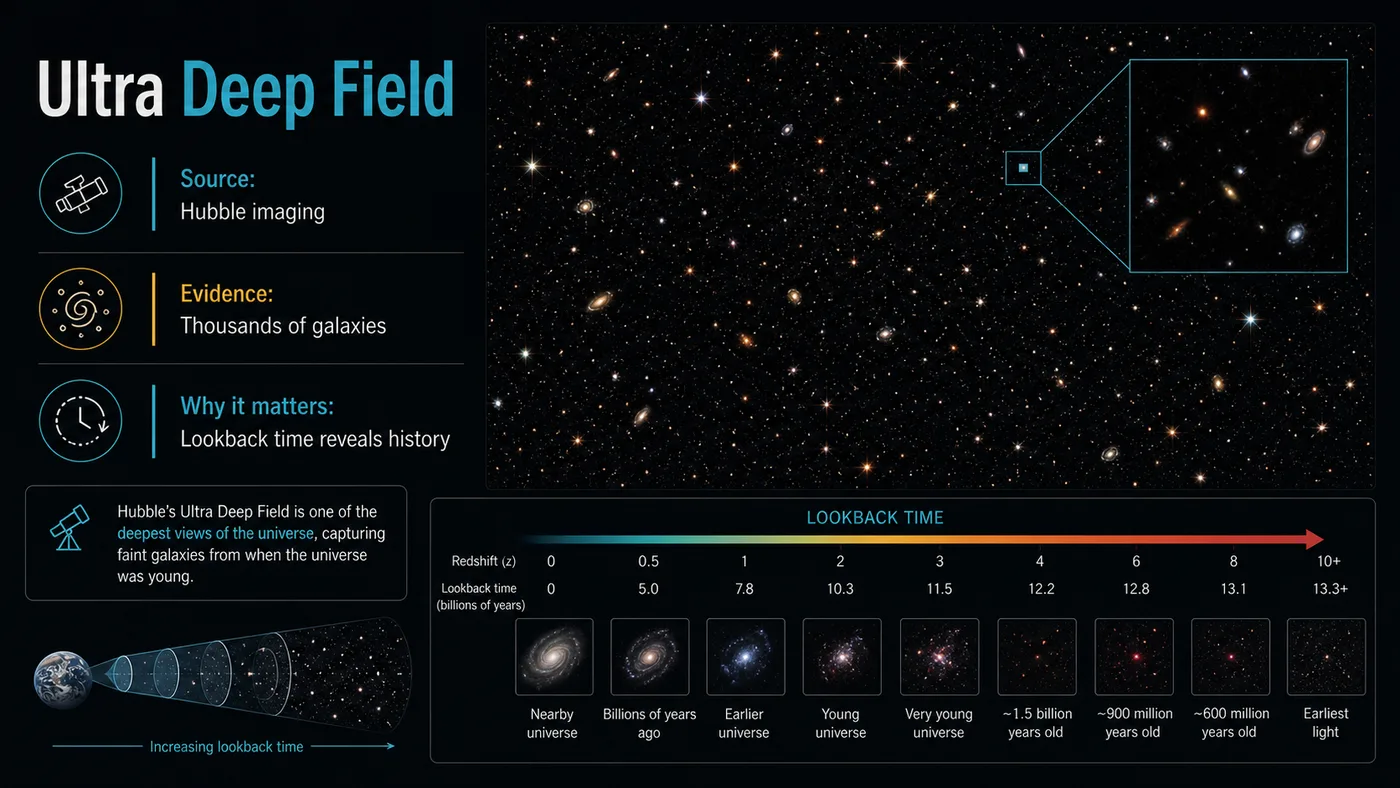
A Window to 13 Billion Years Ago: The Hubble Ultra Deep Field
Hubble Space Telescope · Ultra Deep Field · 11.3-day exposure · galaxy evolution lookback
The Hubble Ultra Deep Field (HUDF) was assembled from 800 exposures totaling approximately 11.3 days of observation time collected between September 2003 and January 2004 with the Advanced Camera for Surveys (ACS) aboard HST. The resulting composite image covers approximately 11 square arcminutes in the Fornax constellation and contains approximately 10,000 galaxies spanning nearly the full observ
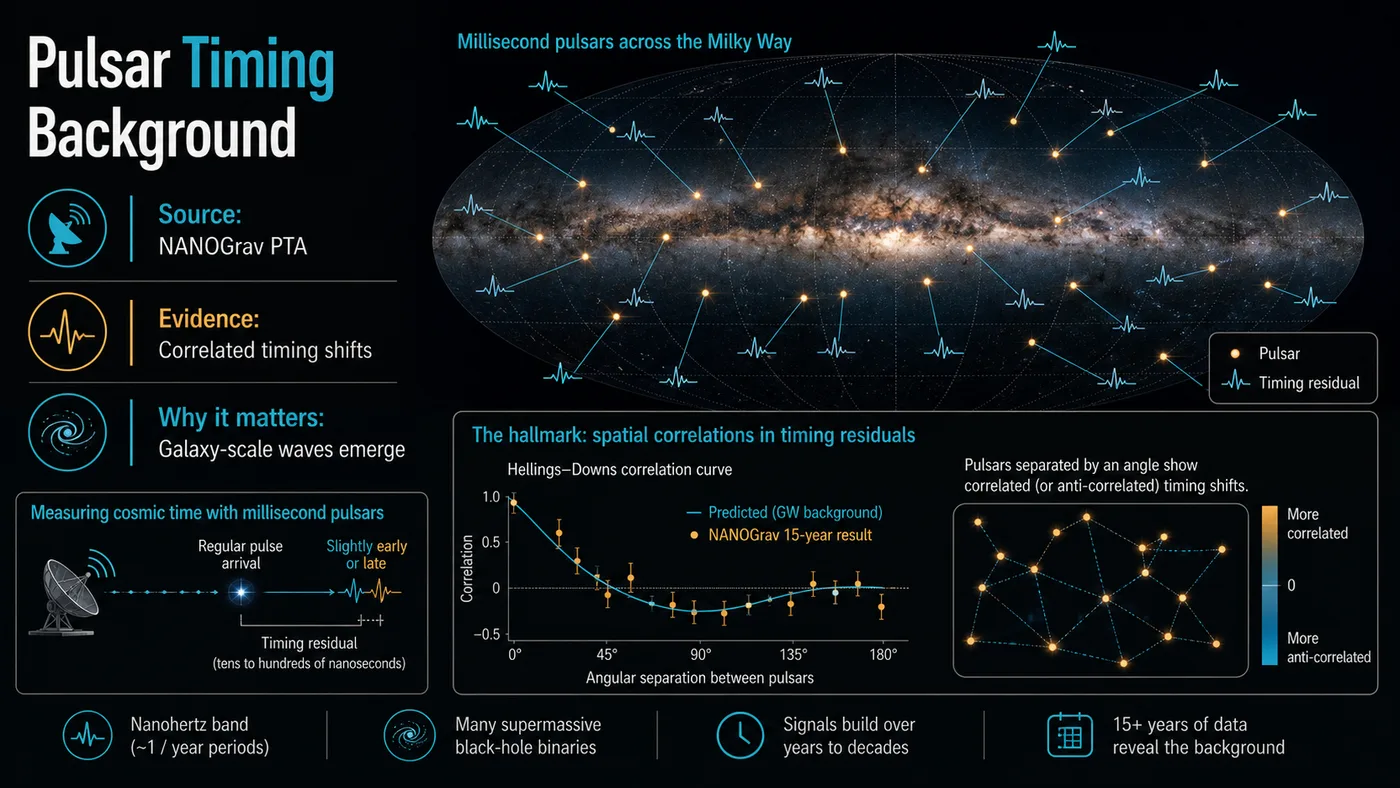
Pulsar Timing Array: The Nanohertz Background
NANOGrav 15-year dataset · nanohertz gravitational-wave background · 2023 announcement
The North American Nanohertz Observatory for Gravitational Waves (NANOGrav) uses an array of millisecond pulsars as a galaxy-scale detector for gravitational waves. In June 2023 the NANOGrav collaboration published strong evidence of a nanohertz gravitational-wave background in their 15-year dataset, consistent with a cosmic chorus of merging supermassive black hole binaries. The detection rests o
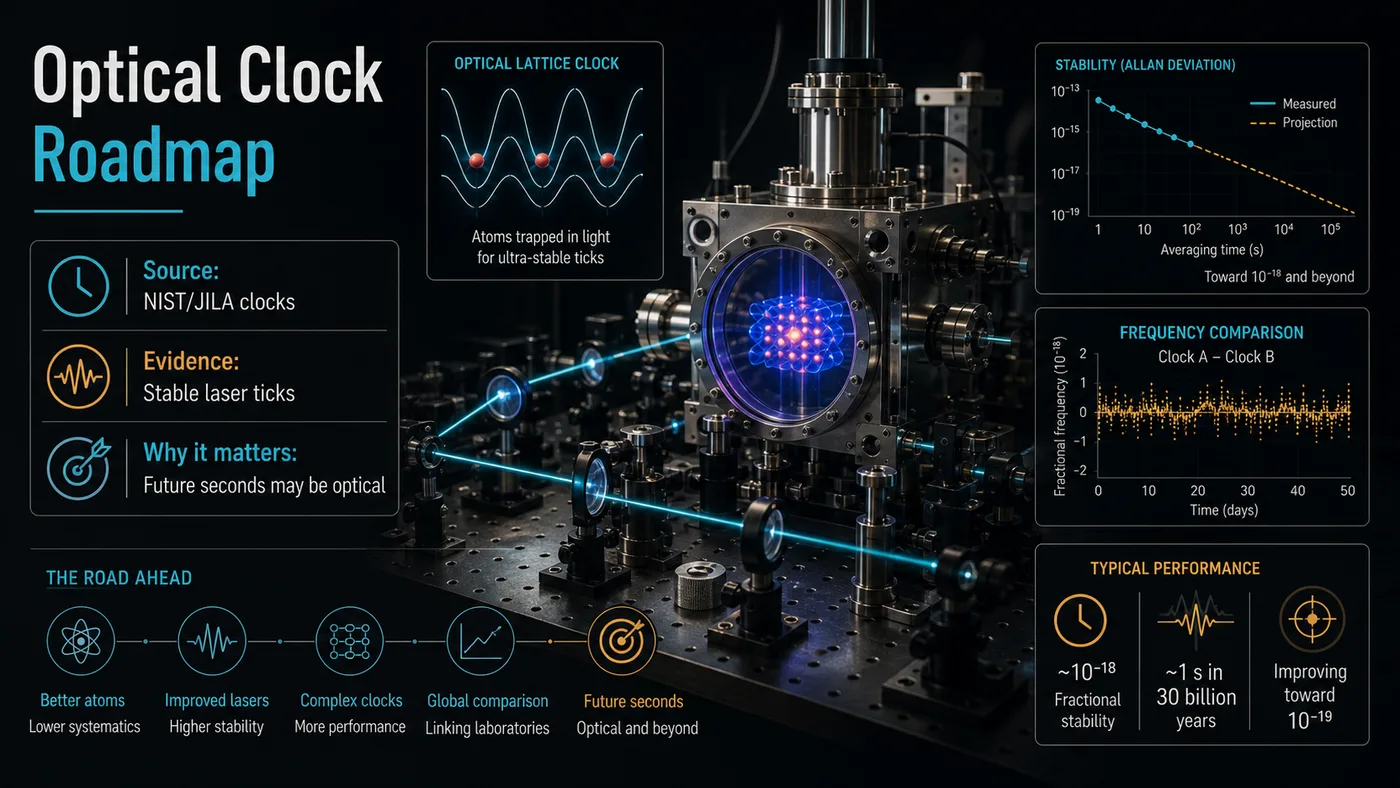
Optical Clocks: Redefining the Second
Sr and Yb optical lattice clocks · 10⁻¹⁸ precision · proposed SI second redefinition
Optical atomic clocks based on strontium (Sr) and ytterbium (Yb) lattice transitions now operate at fractional frequency uncertainties below 10⁻¹⁸, roughly 100 times more stable than the cesium microwave primary standard that defines the SI second. The current SI second is defined by the cesium-133 hyperfine transition at 9.192631770 GHz, established in 1967. International metrology bodies includi
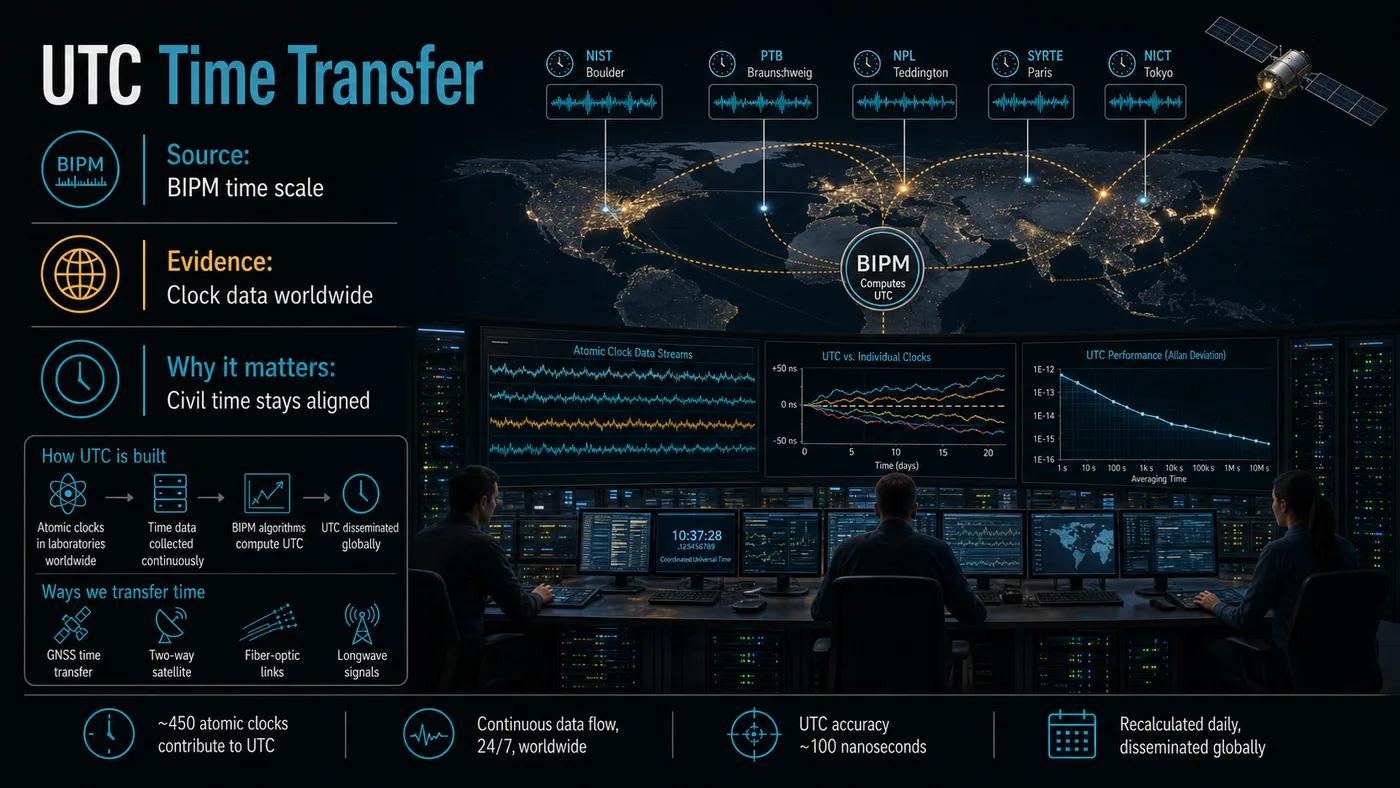
UTC: The Global Heartbeat
BIPM International Atomic Time · GPS carrier-phase time transfer · sub-nanosecond synchronization
Coordinated Universal Time (UTC) is maintained by the Bureau International des Poids et Mesures (BIPM) in Sèvres, France, by combining data from approximately 450 atomic clocks in over 80 national metrology laboratories worldwide. International Atomic Time (TAI) is a continuous time scale computed monthly by the BIPM. UTC differs from TAI by an integer number of leap seconds, currently 37 seconds.
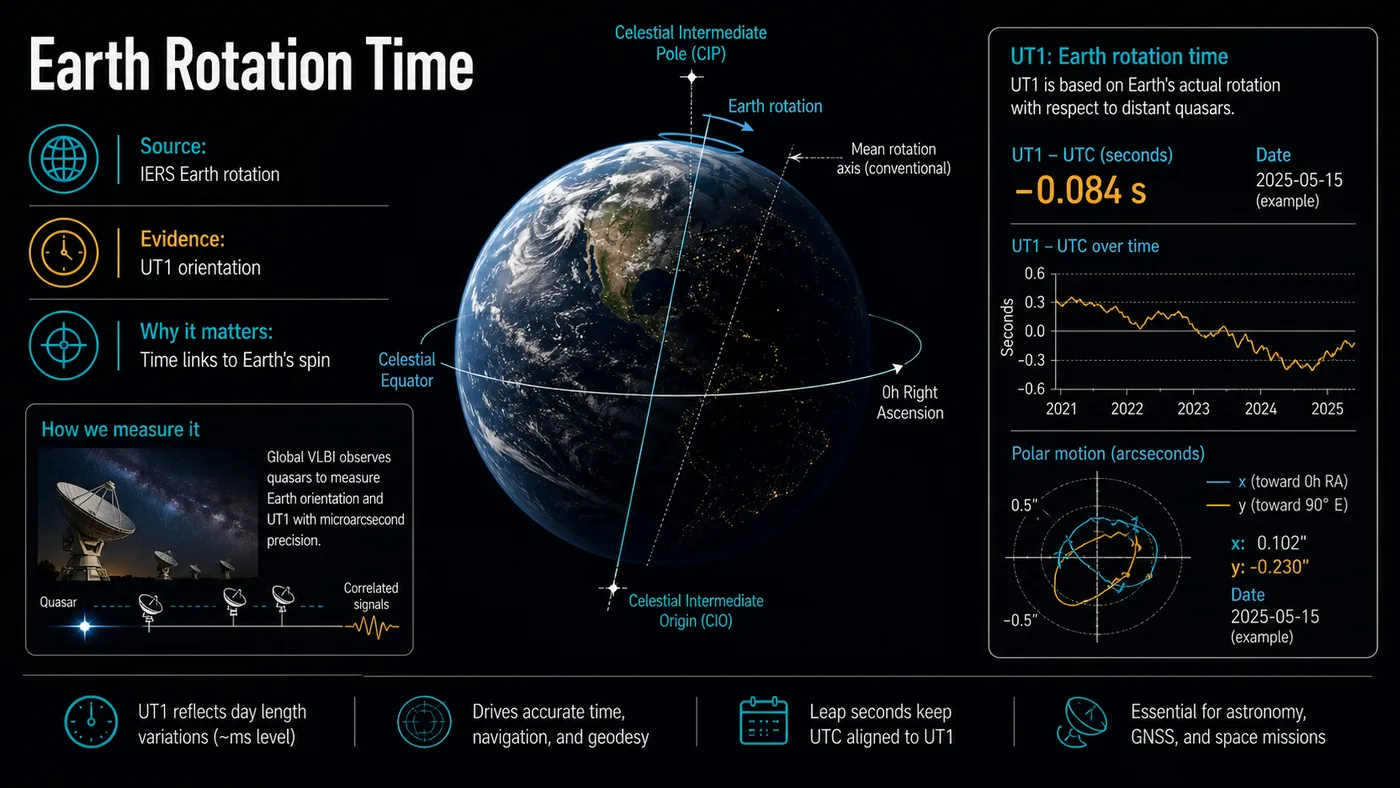
UT1: Measuring Earth's Wobble
VLBI Earth orientation parameters · UT1–UTC difference · polar motion monitoring
Universal Time 1 (UT1) is a time scale based on Earth's actual rotation angle, measured by Very Long Baseline Interferometry (VLBI) observations of distant quasars. Because Earth's rotation rate is irregular (slowing due to tidal friction, fluctuating from ocean currents, atmospheric loading, and inner-core coupling), UT1 drifts from the uniform atomic UTC. The International Earth Rotation and Re
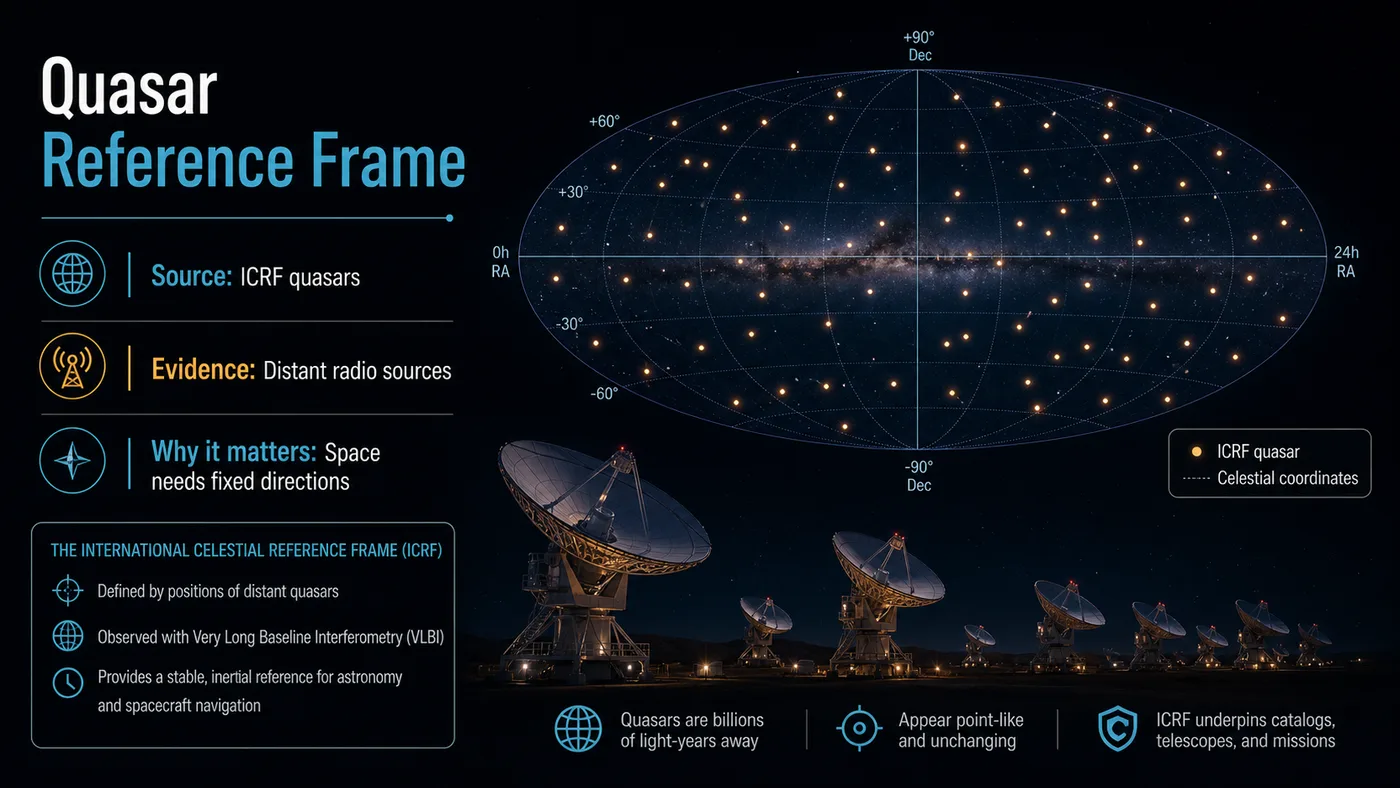
ICRF: Quasars as Fixed Stars
International Celestial Reference Frame · VLBI quasar astrometry · ICRF3 2018
The International Celestial Reference Frame (ICRF) is the IAU-adopted fundamental celestial reference frame, realized through VLBI positions of extragalactic radio sources, primarily quasars, whose distances are so vast that their proper motions are immeasurably small on human timescales. ICRF3, adopted by the IAU in 2018, is based on positions of 4,588 compact radio sources, with 303 defining s
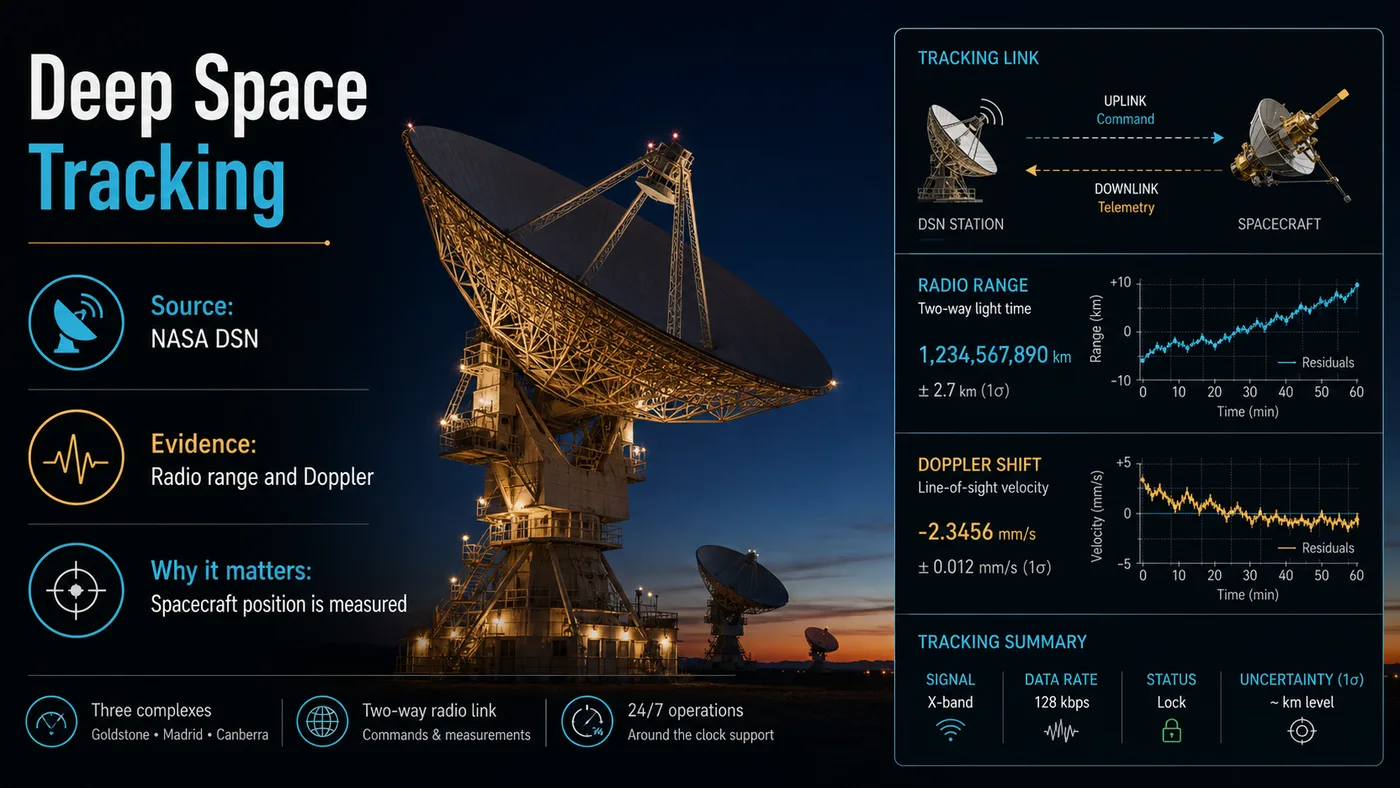
Deep Space Network: Listening Across the Solar System
NASA DSN · 70-meter dishes · Goldstone, Madrid, Canberra · Voyager contact
NASA's Deep Space Network (DSN) is the world's largest and most sensitive scientific telecommunications system, comprising clusters of large parabolic dish antennas at Goldstone (California), Madrid (Spain), and Canberra (Australia). The three sites are spaced roughly 120 degrees apart in longitude to provide continuous 24-hour coverage of spacecraft anywhere in the sky. The flagship 70-meter dish
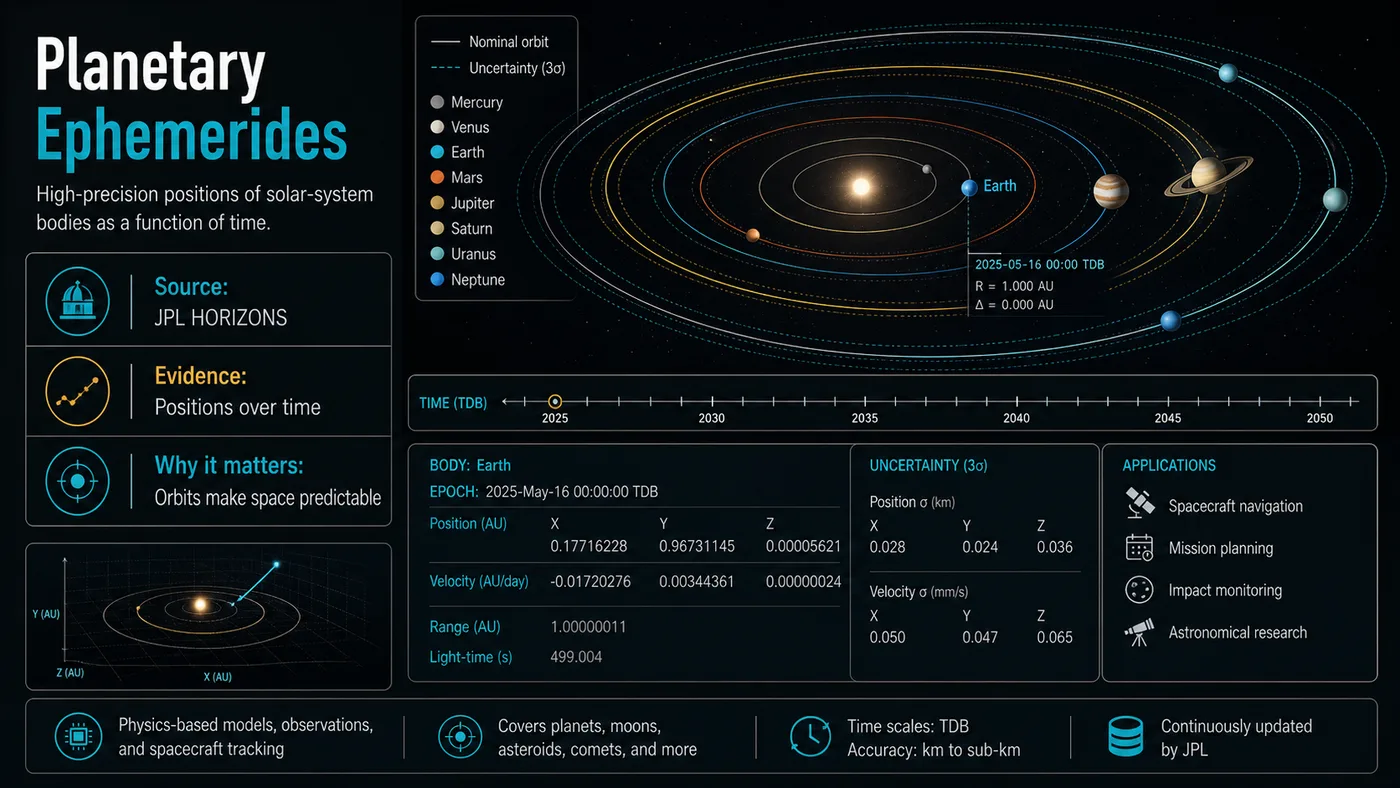
Planetary Ephemerides: Mapping the Solar System
JPL DE440 ephemeris · radar ranging · Doppler tracking · solar system dynamics
Planetary ephemerides are numerical models that specify the positions and velocities of all solar system bodies as a function of time. The Jet Propulsion Laboratory's Development Ephemeris series, currently DE440/DE441 published in 2021, integrates the equations of motion for all planets, the Moon, and selected asteroids, fitted to over a century of ground-based astrometry and modern radar rangi
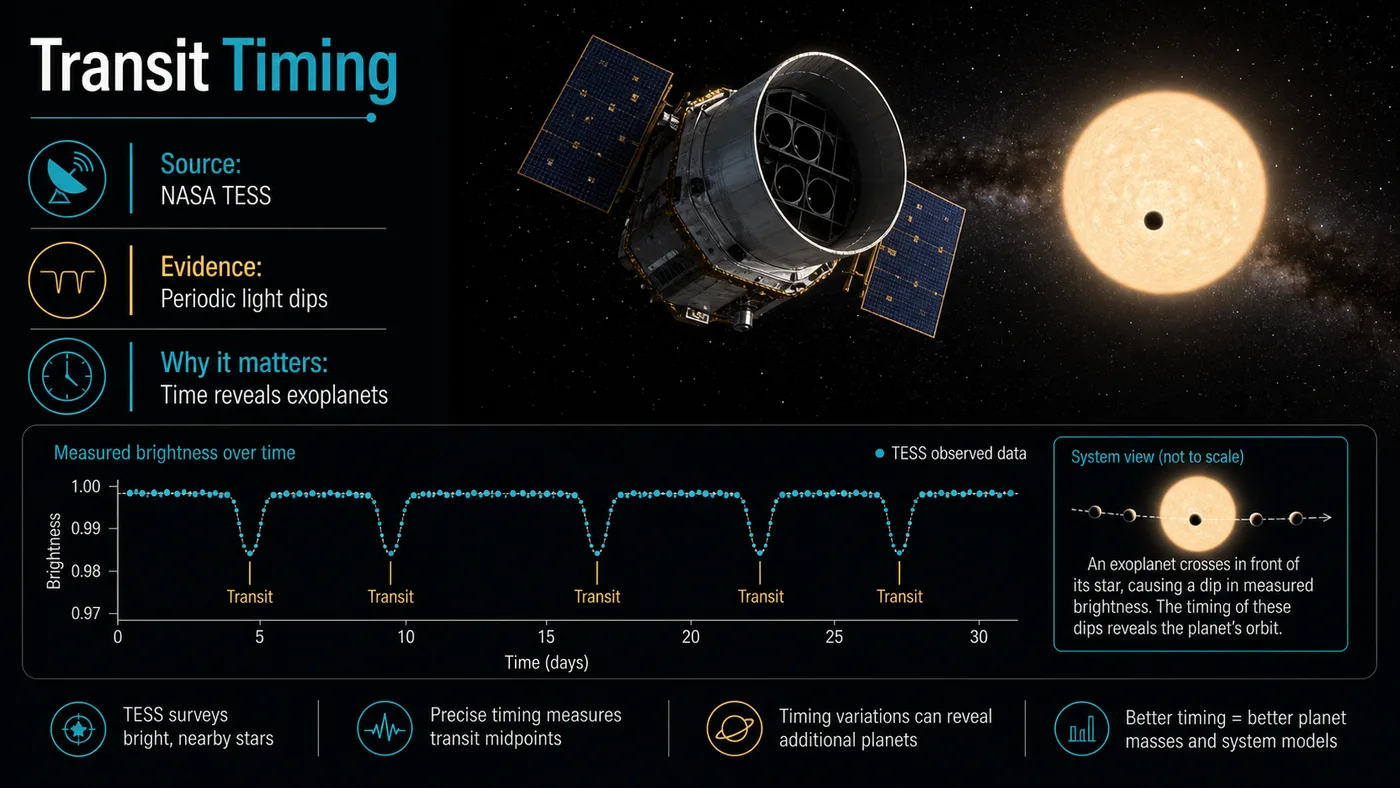
TESS: Timing the Transit
Transiting Exoplanet Survey Satellite · 27-day sectors · transit timing variations · exoplanet discovery
The Transiting Exoplanet Survey Satellite (TESS), launched by NASA in April 2018, surveys the entire sky in 26 sectors, each observed for approximately 27 days, using four wide-field cameras to detect the periodic dimming of stars as exoplanets transit across their stellar disks. Transit timing variation (TTV) analysis, measuring deviations from strict periodicity in successive transits, can rev
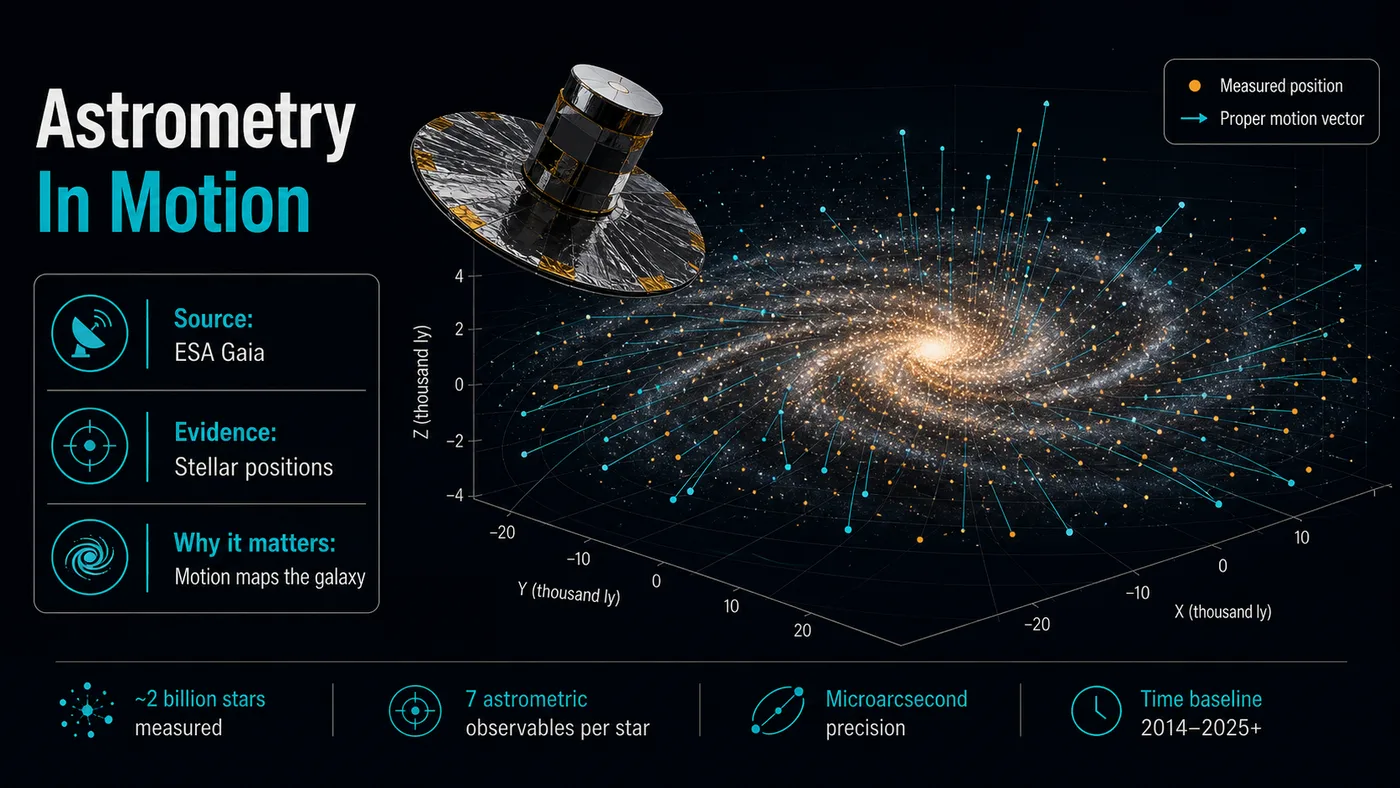
Gaia: Mapping a Billion Stars in Motion
ESA Gaia satellite · Gaia Data Release 3 (2022) · microarcsecond proper motions · parallax
ESA's Gaia spacecraft, operating at the Sun-Earth L2 Lagrange point since 2014, is conducting an all-sky astrometric survey of unprecedented precision. Gaia Data Release 3 (DR3, June 2022) provided positions, parallaxes, and proper motions for approximately 1.5 billion sources, with parallax uncertainties as small as 7 microarcseconds for the brightest stars. The mission measures each star's posit
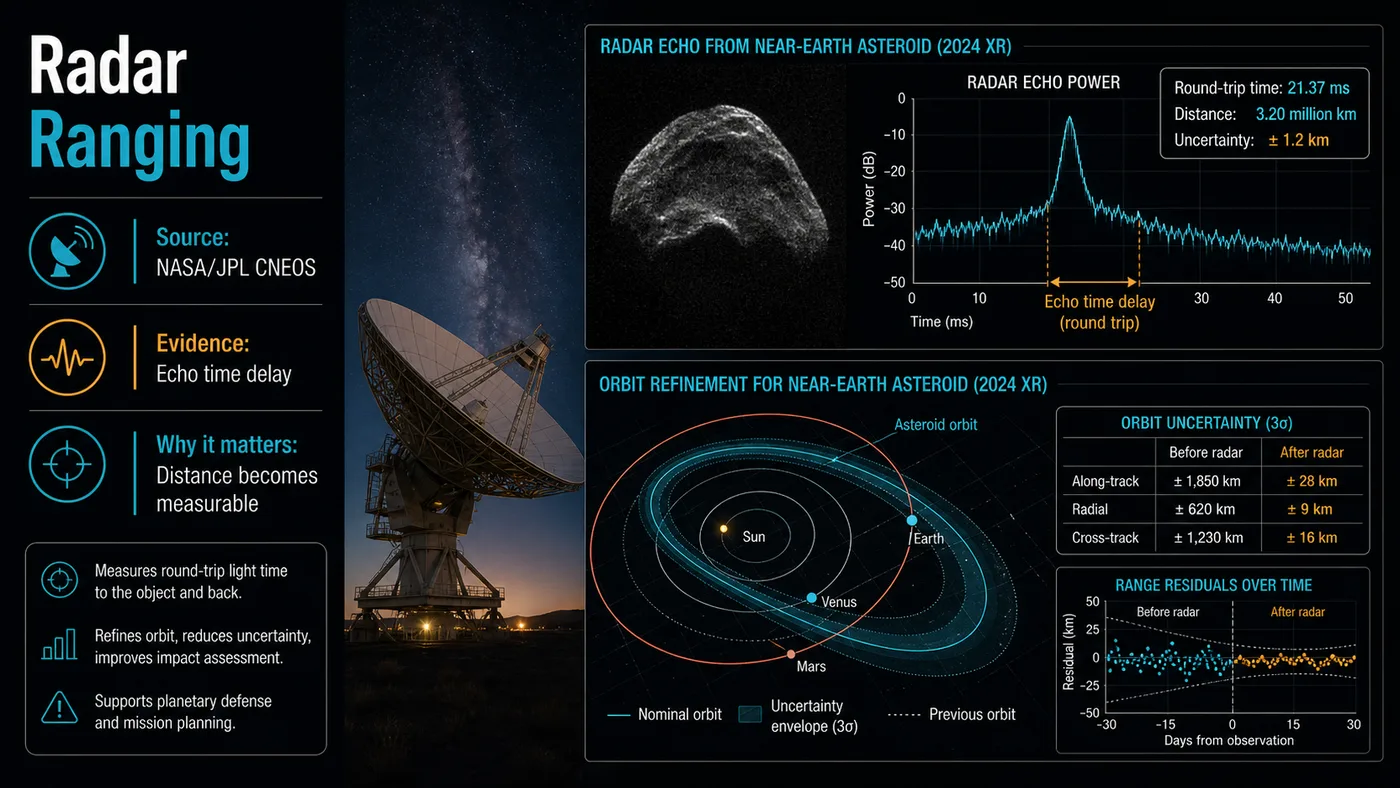
Radar Ranging: The Solar System's Tape Measure
Arecibo + Goldstone · Venus and Mars radar ranging · AU calibration · planetary distances
Ground-based radar ranging to solar system bodies, particularly Venus and Mars, has provided the most precise measurements of interplanetary distances and the value of the Astronomical Unit. The technique involves transmitting a high-power radar pulse from a large dish (historically Arecibo 305 m, Goldstone 70 m), waiting for the echo to return from the planet's surface, and measuring the round-
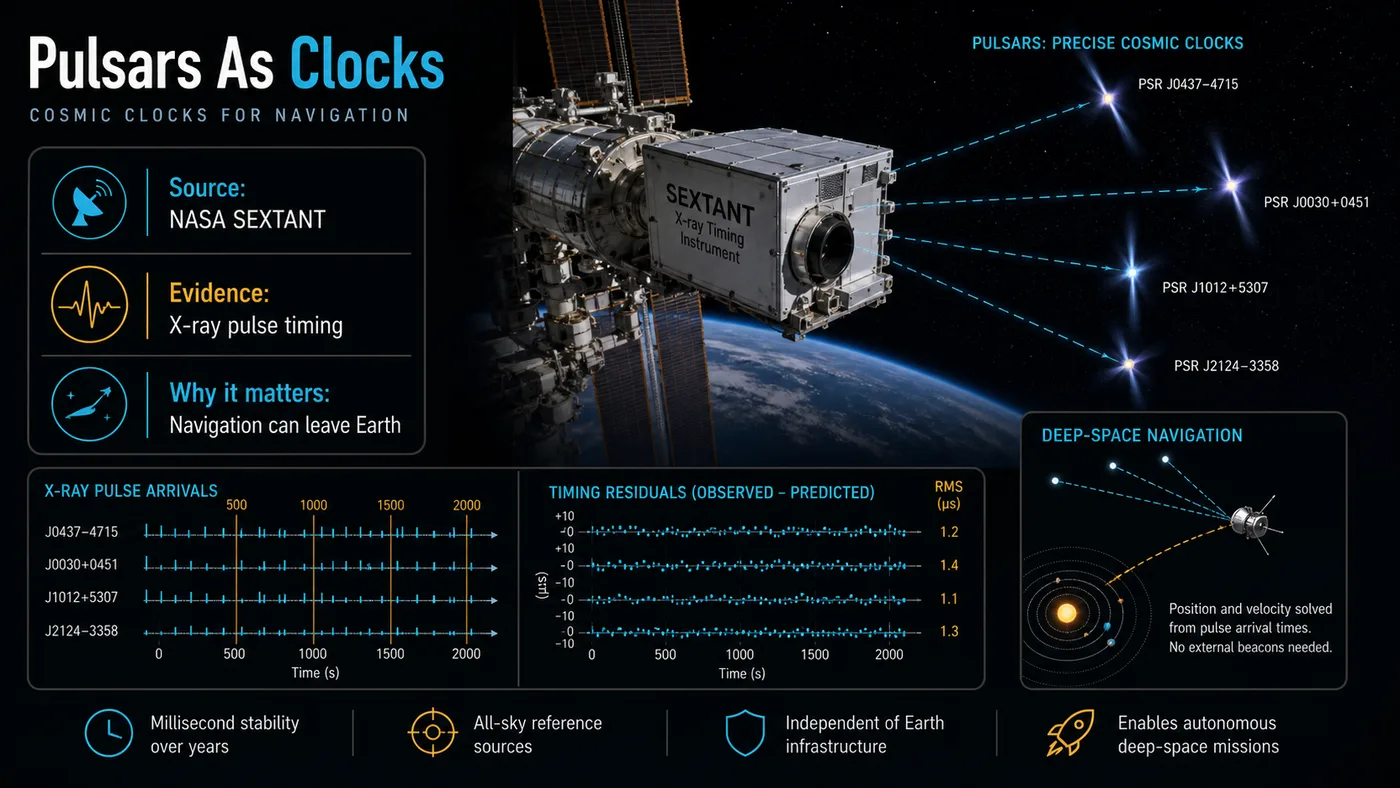
Millisecond Pulsars: Nature's Perfect Clocks
Millisecond pulsars · pulse timing precision · relativistic tests · binary pulsar Nobel 1993
Millisecond pulsars (MSPs) are neutron stars spun up to rotation rates of hundreds of times per second through accretion of matter from a binary companion, producing pulse arrival times stable to better than a microsecond over years. The first binary pulsar (PSR B1913+16) was discovered by Hulse and Taylor in 1974. Its orbital decay matched general relativistic predictions for gravitational-wave e
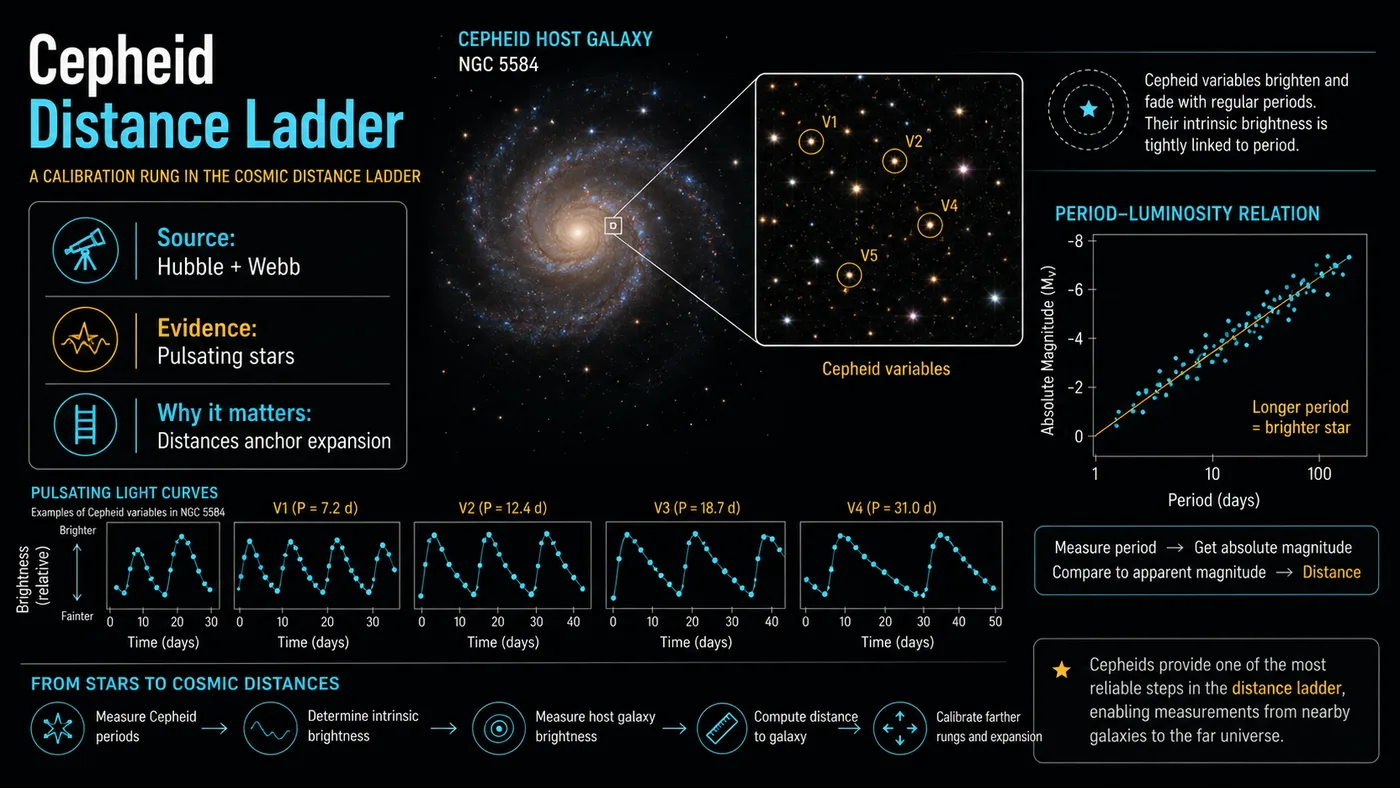
Cepheids: The Cosmic Ruler
Henrietta Leavitt 1908 · period-luminosity relation · SH0ES program · Hubble tension
Henrietta Swan Leavitt discovered in 1908 that Cepheid variable stars in the Small Magellanic Cloud exhibit a tight relationship between their pulsation period and intrinsic luminosity, the period-luminosity (P-L) relation. This discovery made Cepheids standard candles for extragalactic distance measurement. The SH0ES (Supernovae H0 for the Equation of State) team, using Hubble Space Telescope an
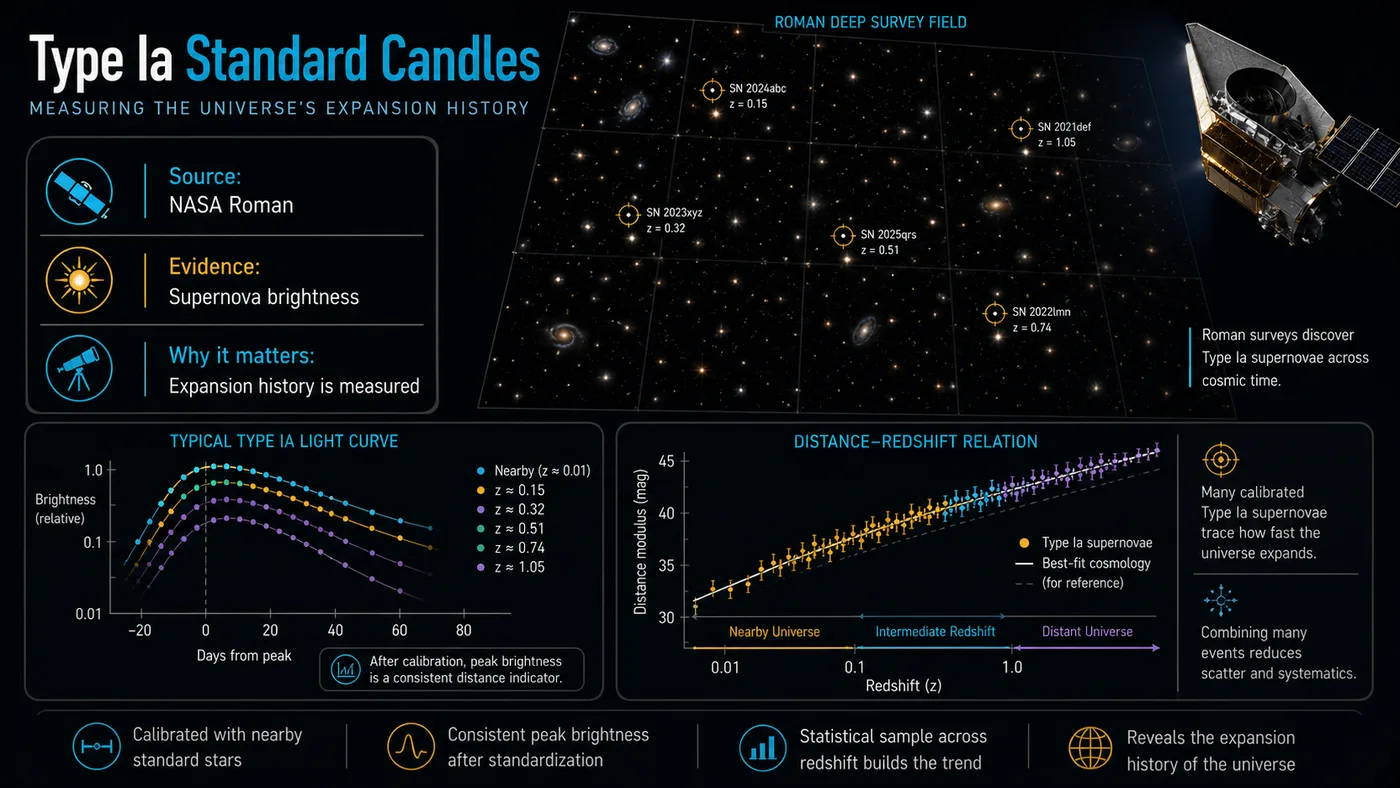
Type Ia Supernovae: Measuring Cosmic Acceleration
Chandrasekhar limit · Phillips relation · accelerating expansion 1998 · Nobel Prize 2011
Type Ia supernovae arise when a white dwarf accreting mass from a companion reaches near the Chandrasekhar limit of approximately 1.4 solar masses, triggering a thermonuclear explosion of remarkable consistency. The Phillips relation (1993) showed that the peak absolute magnitude correlates tightly with the light-curve decline rate, making Type Ia SNe standardizable candles accurate to ~7% in dist
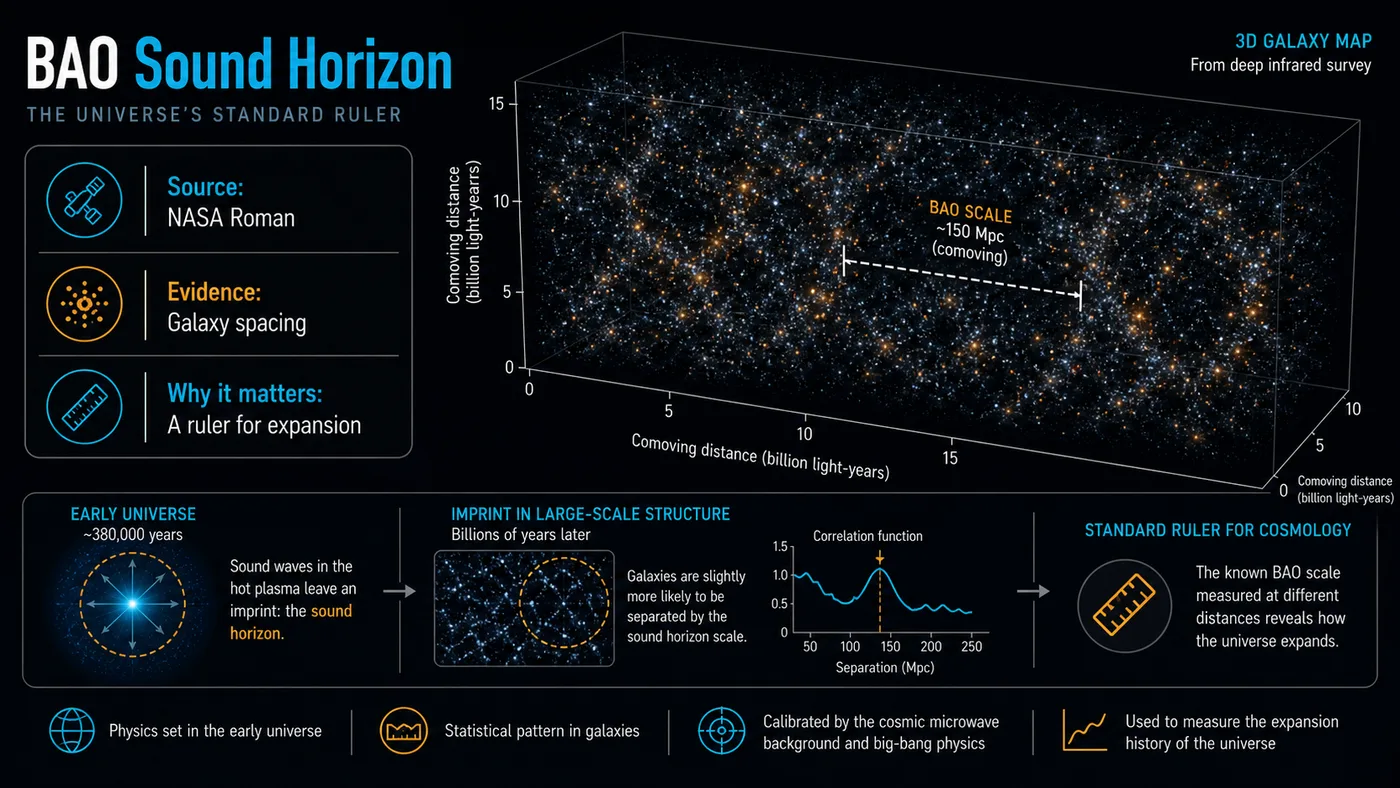
Baryon Acoustic Oscillations: The Universe's Standard Ruler
Sound horizon ~150 Mpc · SDSS detection 2005 · BAO standard ruler · H₀ and dark energy
Baryon Acoustic Oscillations (BAO) are a signature imprinted in the large-scale distribution of galaxies, arising from acoustic pressure waves that propagated through the hot plasma of the early universe until recombination at redshift z ≈ 1100. These waves left a preferred clustering scale, the sound horizon of approximately 150 Mpc, visible as a gentle excess in the two-point correlation funct
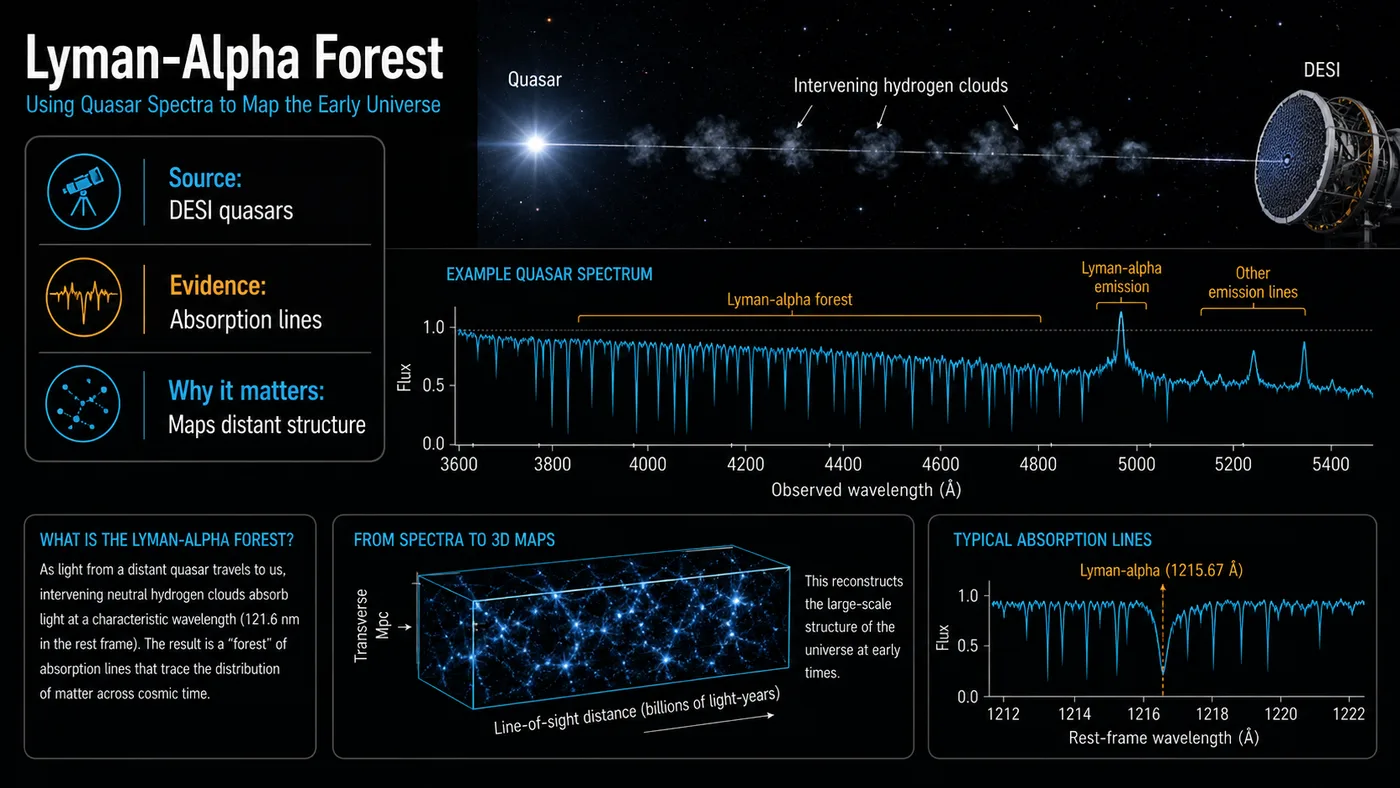
Lyman-Alpha Forest: Mapping the Cosmic Web in Absorption
High-z quasar spectra · intergalactic medium hydrogen · IGM tomography · BOSS/DESI BAO
The Lyman-alpha forest is the pattern of absorption lines seen in the spectra of high-redshift quasars, caused by clouds of neutral hydrogen in the intergalactic medium (IGM) absorbing quasar light at the Lyman-alpha wavelength (121.6 nm, redshifted into the optical for distant sources). Each absorption trough marks a gas cloud along the line of sight, building a one-dimensional map of the IGM den
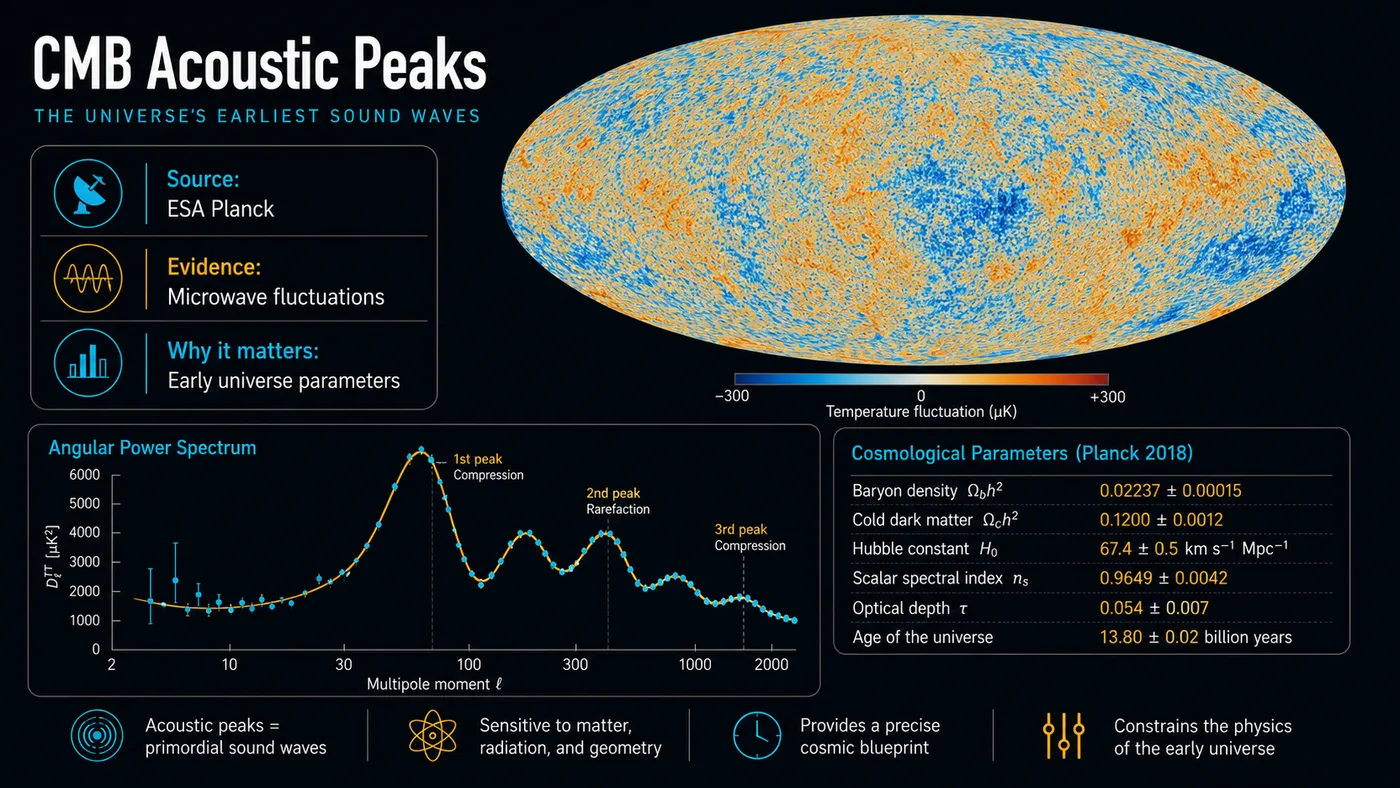
CMB Acoustic Peaks: The Fingerprint of the Early Universe
Planck satellite · CMB temperature power spectrum · Λ-CDM 6-parameter fit · H₀ = 67.4 km/s/Mpc
The cosmic microwave background (CMB) temperature anisotropies carry a distinctive pattern of acoustic peaks in the angular power spectrum, the Cl vs multipole-moment (l) plot, arising from photon-baryon plasma oscillations at recombination (z ≈ 1100, approximately 380,000 years after the Big Bang). ESA's Planck satellite (2009–2018) measured these peaks with exquisite precision across thousands
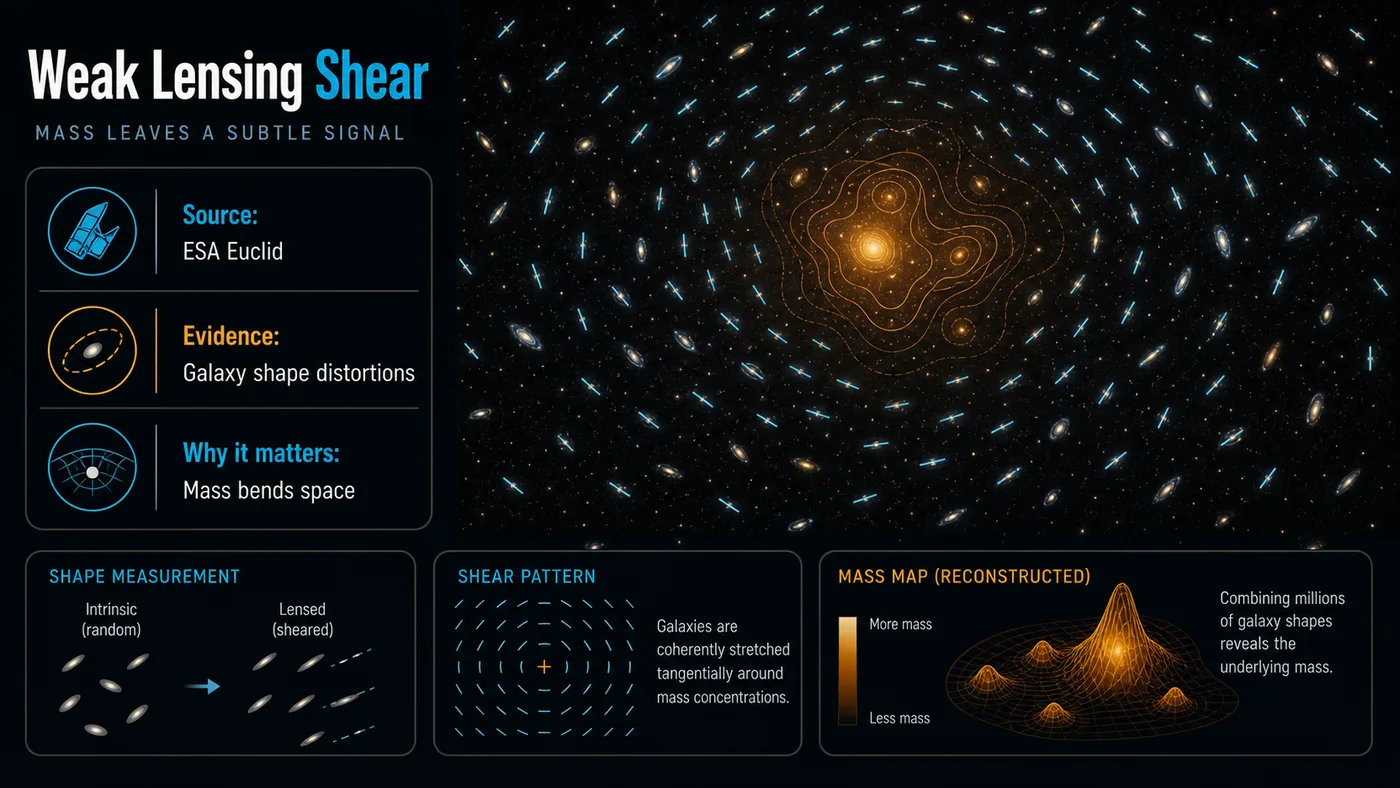
Weak Gravitational Lensing: Dark Matter's Shadow
Cosmic shear · DES, KiDS, Euclid, Roman, LSST/Rubin · S8 tension · dark matter mapping
Weak gravitational lensing (cosmic shear) measures the coherent distortion of background galaxy shapes by foreground matter, primarily dark matter, bending light according to general relativity. By statistically analyzing the shapes of millions of galaxies, surveys measure the shear two-point correlation function, which constrains the matter power spectrum amplitude parameter S₈ = σ₈(Ω_m/0.3)^0.
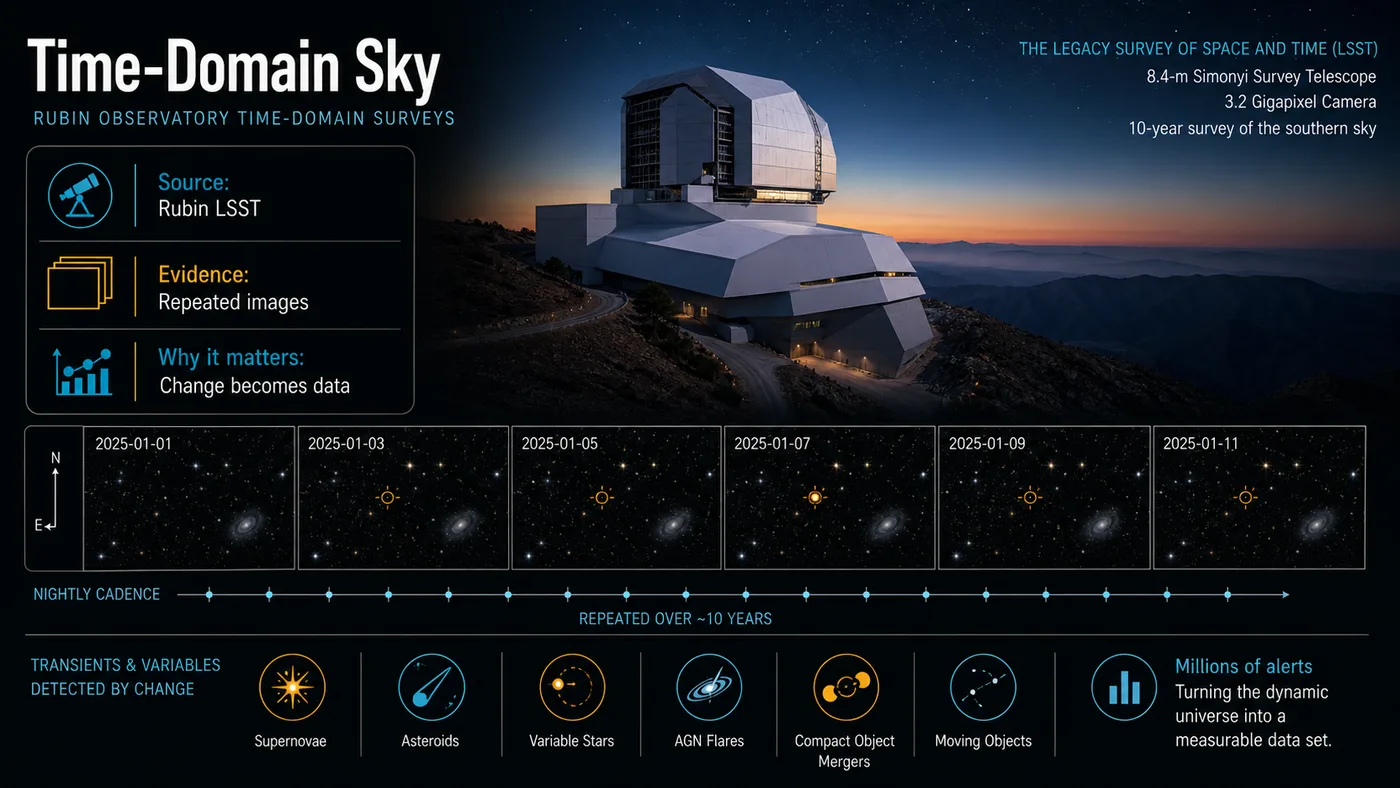
Rubin Observatory: The Moving Sky
Vera C. Rubin Observatory · LSST · 8.4-meter · 3.2-gigapixel camera · 10-year cadence survey
The Vera C. Rubin Observatory on Cerro Pachón, Chile, is conducting the Legacy Survey of Space and Time (LSST), a 10-year cadence survey of the entire southern sky with the world's largest digital camera, a 3.2-gigapixel focal plane array. The 8.4-meter primary mirror and fast f/1.23 focal ratio allow the telescope to image a 9.6 square-degree field every 30 seconds, revisiting the entire visible
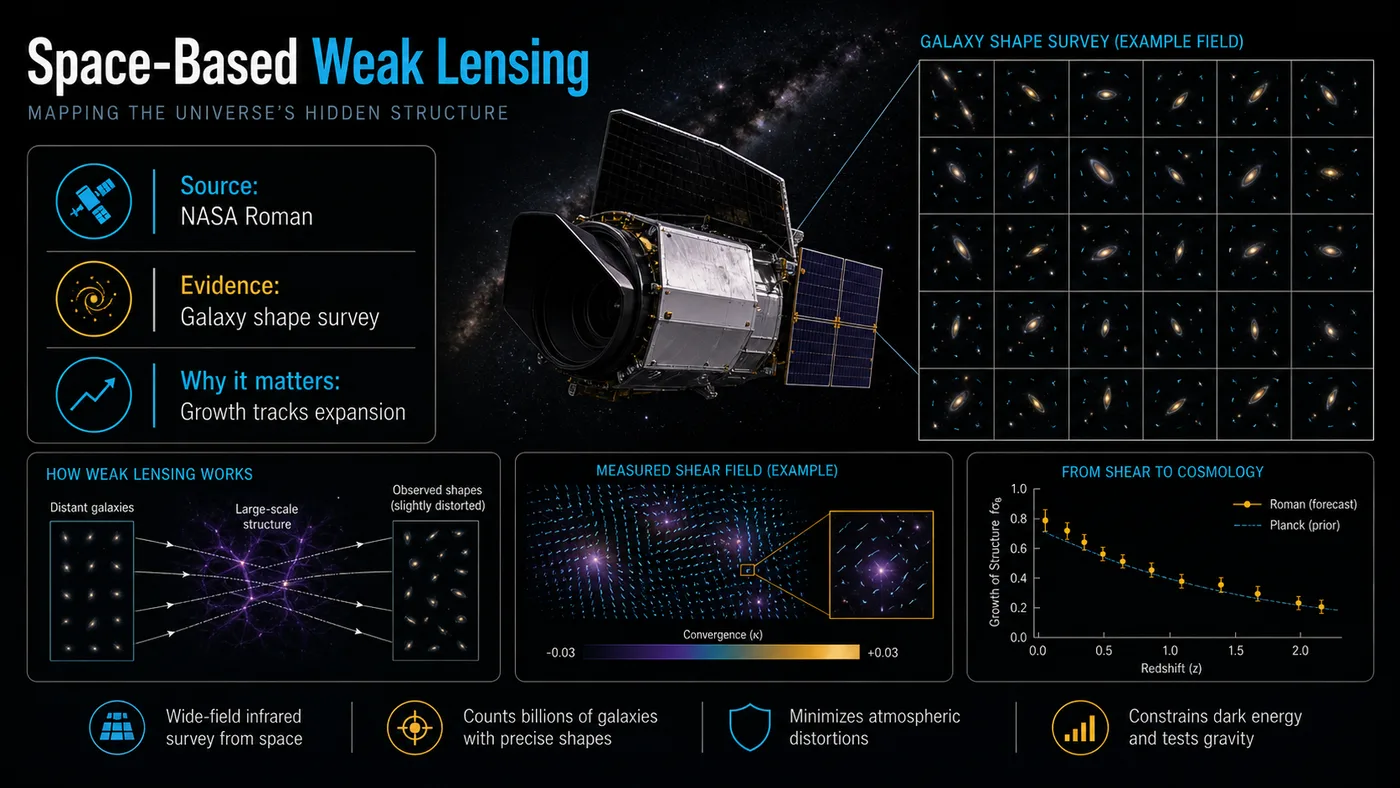
Roman Space Telescope: Wide-Field Cosmic Shear
Nancy Grace Roman Space Telescope · 2.4-meter · WFI · weak lensing · high-latitude wide area survey
The Nancy Grace Roman Space Telescope (Roman), a NASA flagship mission scheduled for launch in the mid-2020s, carries a 2.4-meter primary mirror donated by the National Reconnaissance Office and a Wide Field Instrument (WFI) covering 0.28 square degrees per pointing, roughly 100 times the field area of Hubble Space Telescope in the optical. Roman's High Latitude Wide Area Survey will image billio
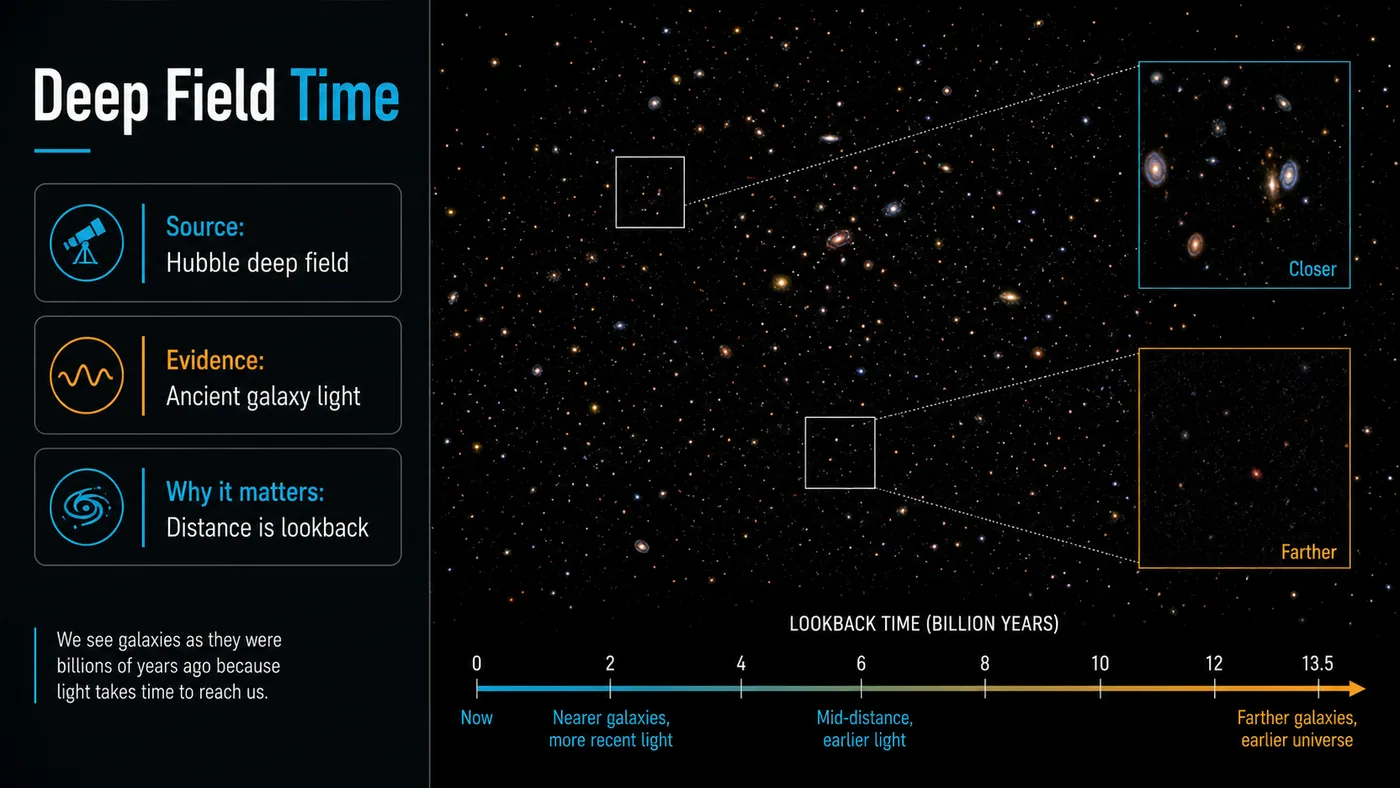
Hubble Deep Field: Looking Back in Time
Hubble Deep Field 1995 · HDF-N · 10-day exposure · galaxies at redshift z > 5 · deep time
In December 1995, the Hubble Space Telescope stared at a tiny patch of apparently empty sky near the Big Dipper (about the angular size of a tennis ball at 100 meters) for ten consecutive days, collecting photons in multiple filter bands. The resulting Hubble Deep Field North (HDF-N) revealed approximately 3,000 galaxies in various stages of evolution, many at redshifts z > 3 (seen as they appea
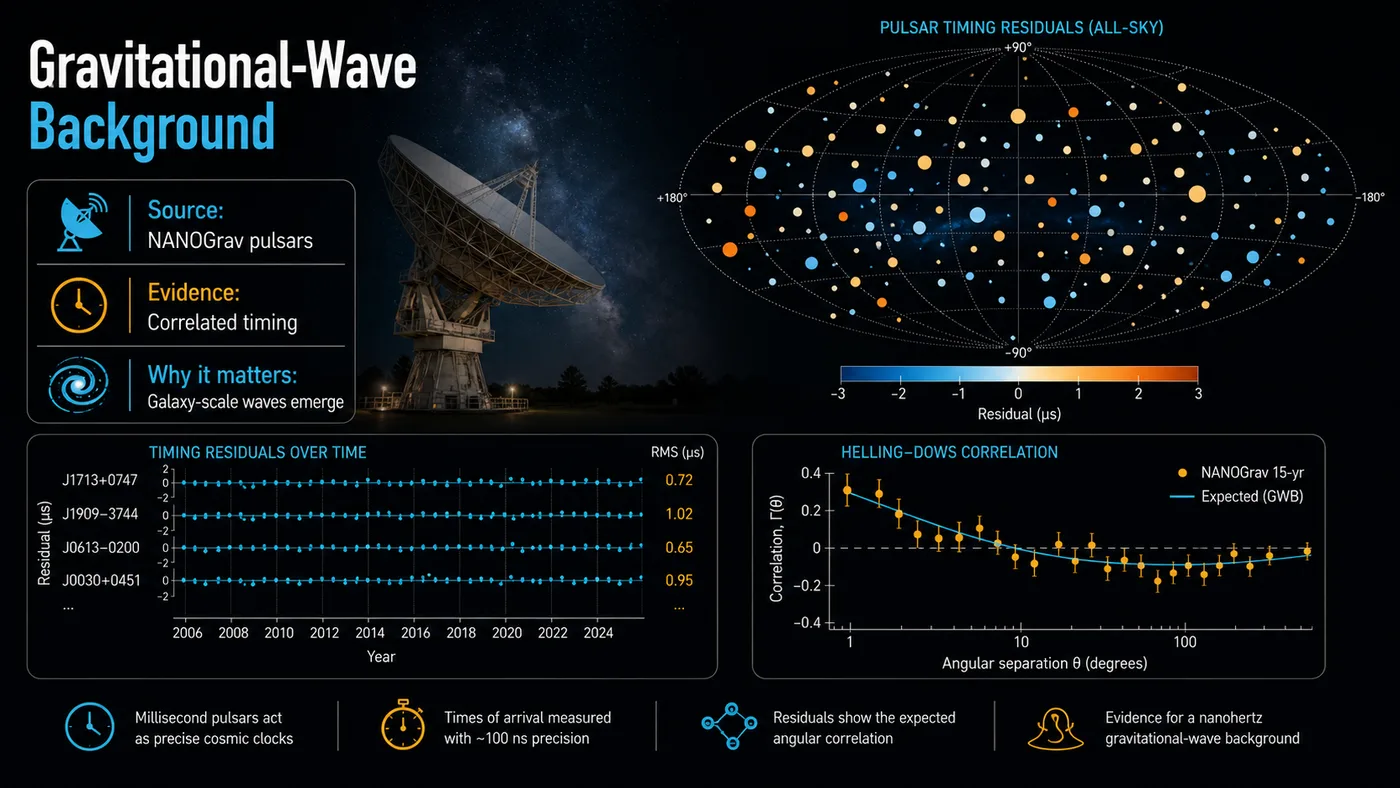
NANOGrav: Opening the Nanohertz Window
NANOGrav 15-year dataset · gravitational-wave background evidence · June 2023 · Hellings-Downs
The North American Nanohertz Observatory for Gravitational Waves (NANOGrav) collaboration published in June 2023 compelling evidence for a stochastic gravitational-wave background in their 15-year dataset of millisecond pulsar timing observations. The key signature is the Hellings-Downs angular correlation, a characteristic quadrupolar pattern in the timing residual cross-correlations between pul
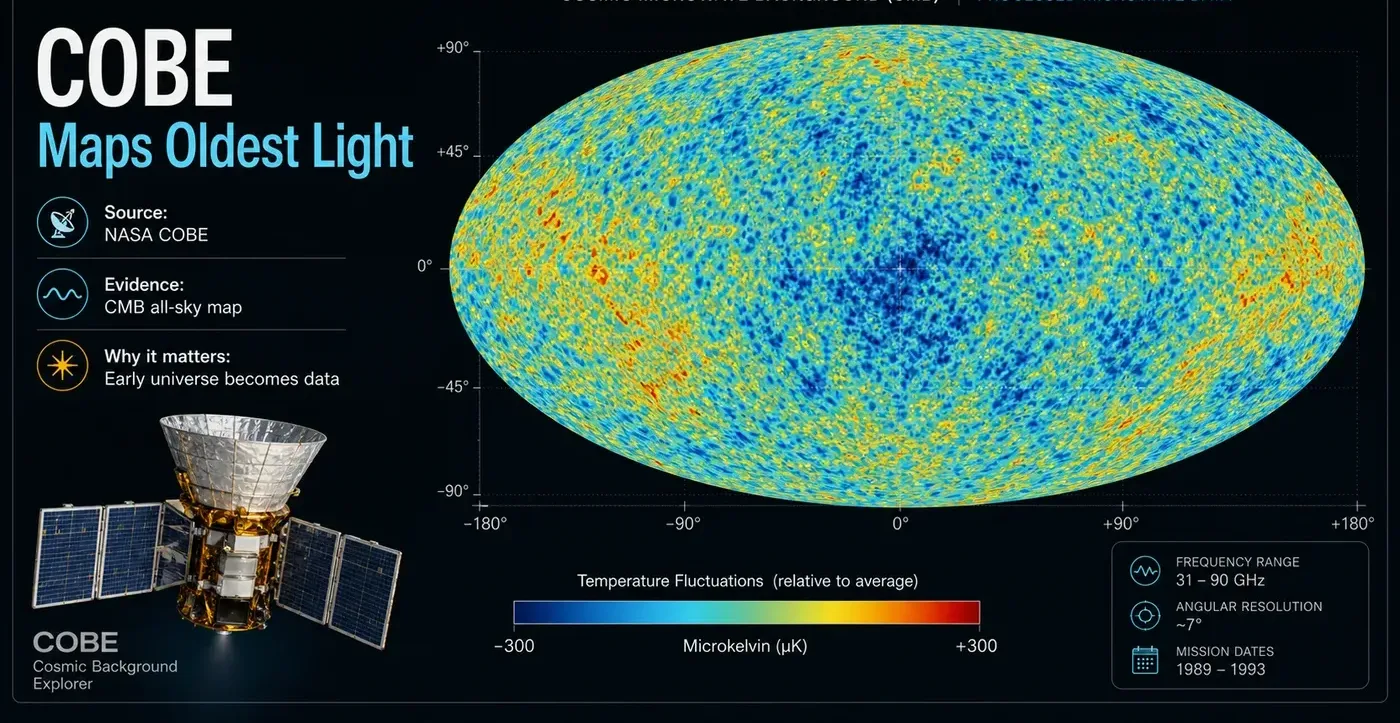
COBE: The First Map of the Beginning
COBE satellite · CMB anisotropy discovery 1992 · Nobel Prize 2006 · Smoot & Mather
The Cosmic Background Explorer (COBE) satellite, launched by NASA in 1989, made two landmark measurements of the cosmic microwave background. The FIRAS instrument confirmed the CMB spectrum as a near-perfect blackbody at 2.725 K with deviations smaller than 50 parts per million, the most perfect blackbody ever measured. In April 1992, the DMR instrument announced the first detection of CMB temper
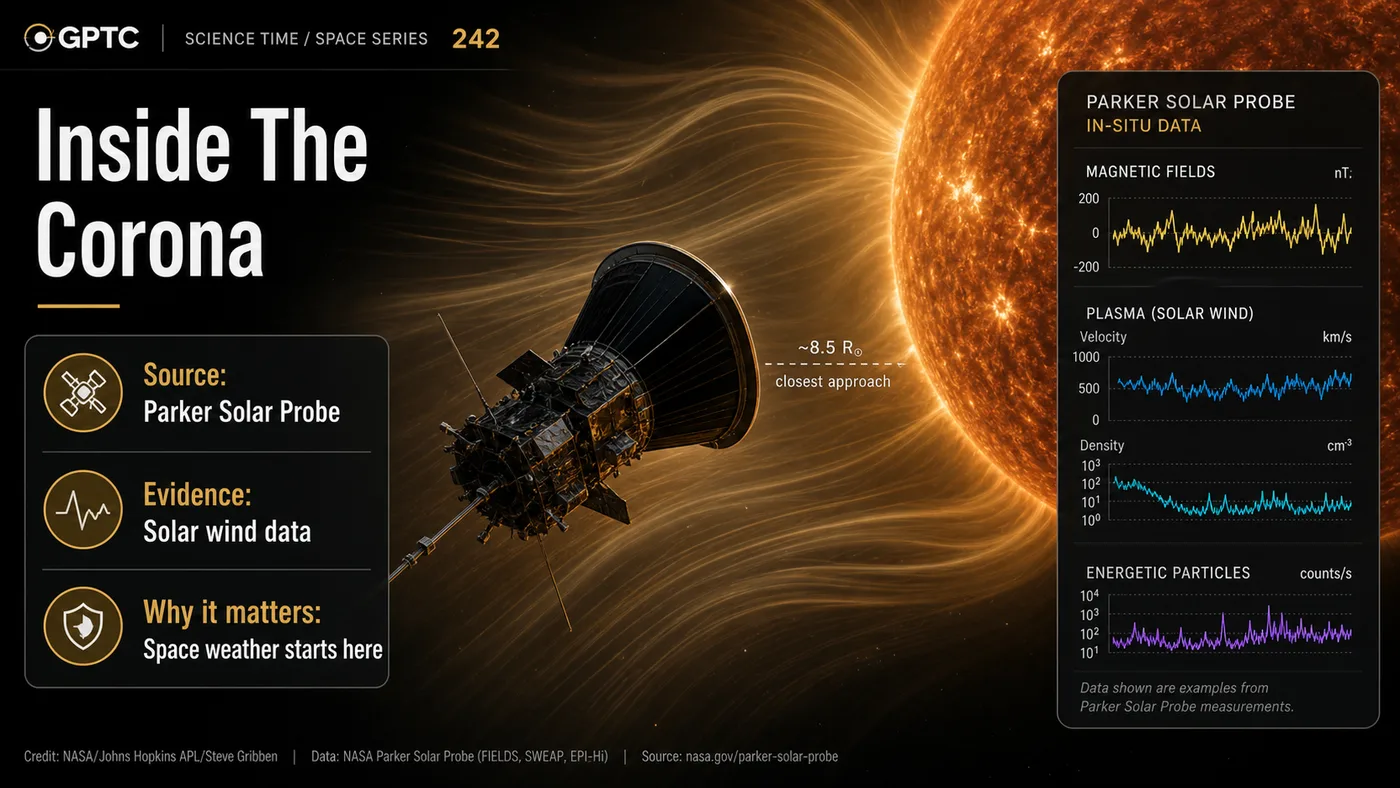
Parker Solar Probe: Touching the Sun
Parker Solar Probe · launched 2018 · perihelion 6.1 million km · solar corona entry 2021
NASA's Parker Solar Probe (PSP), launched in August 2018, is the fastest human-made object and the spacecraft that has traveled closer to the Sun than any other. By using multiple Venus gravity assists to progressively tighten its orbit, PSP reached a perihelion distance of approximately 6.1 million kilometers (8.8 solar radii) in December 2024. In 2021, PSP became the first spacecraft to fly thro
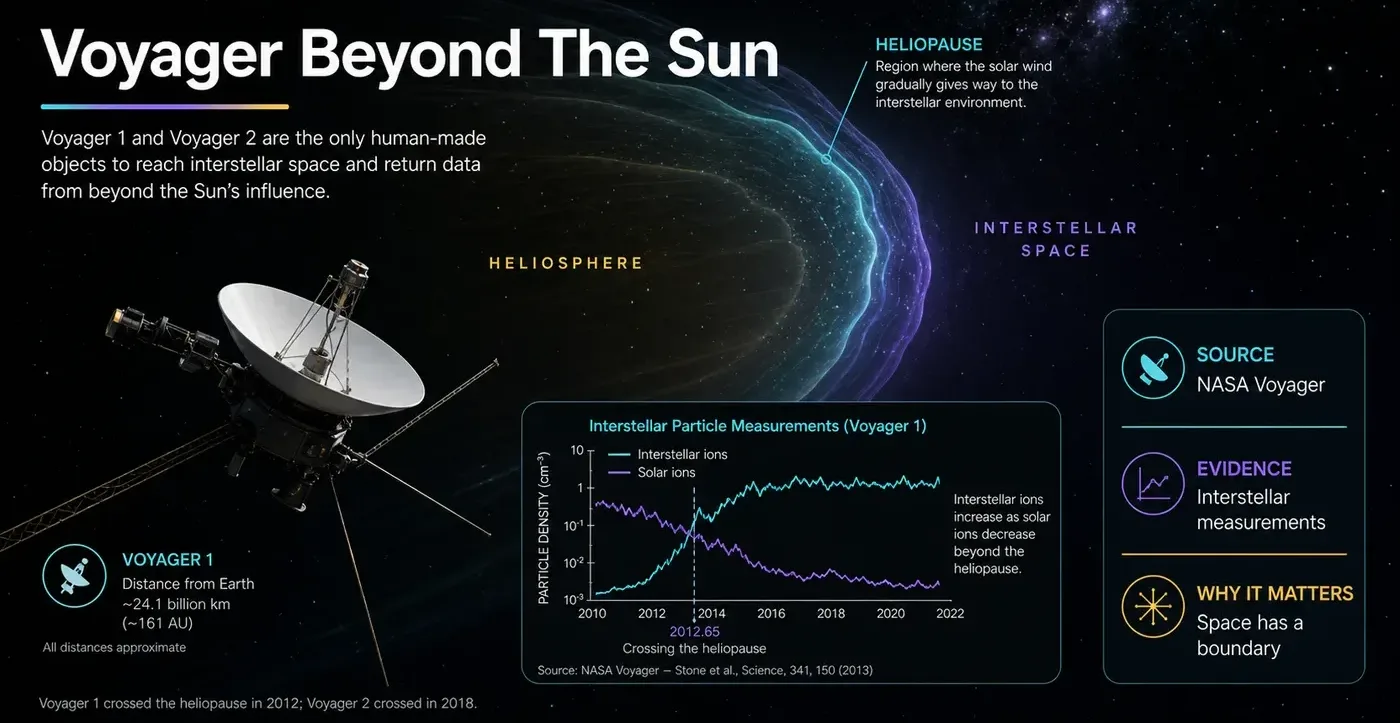
Voyager: Into Interstellar Space
Voyager 1 heliopause crossing 2012 · Voyager 2 crossing 2018 · local interstellar medium
NASA's Voyager 1 spacecraft, launched in September 1977, crossed the heliopause, the boundary between the solar wind and the local interstellar medium (LISM), in August 2012, becoming the first human-made object to enter interstellar space. Voyager 2 followed in November 2018. Confirmation came from the plasma wave science instrument, which detected a sharp increase in plasma density consistent
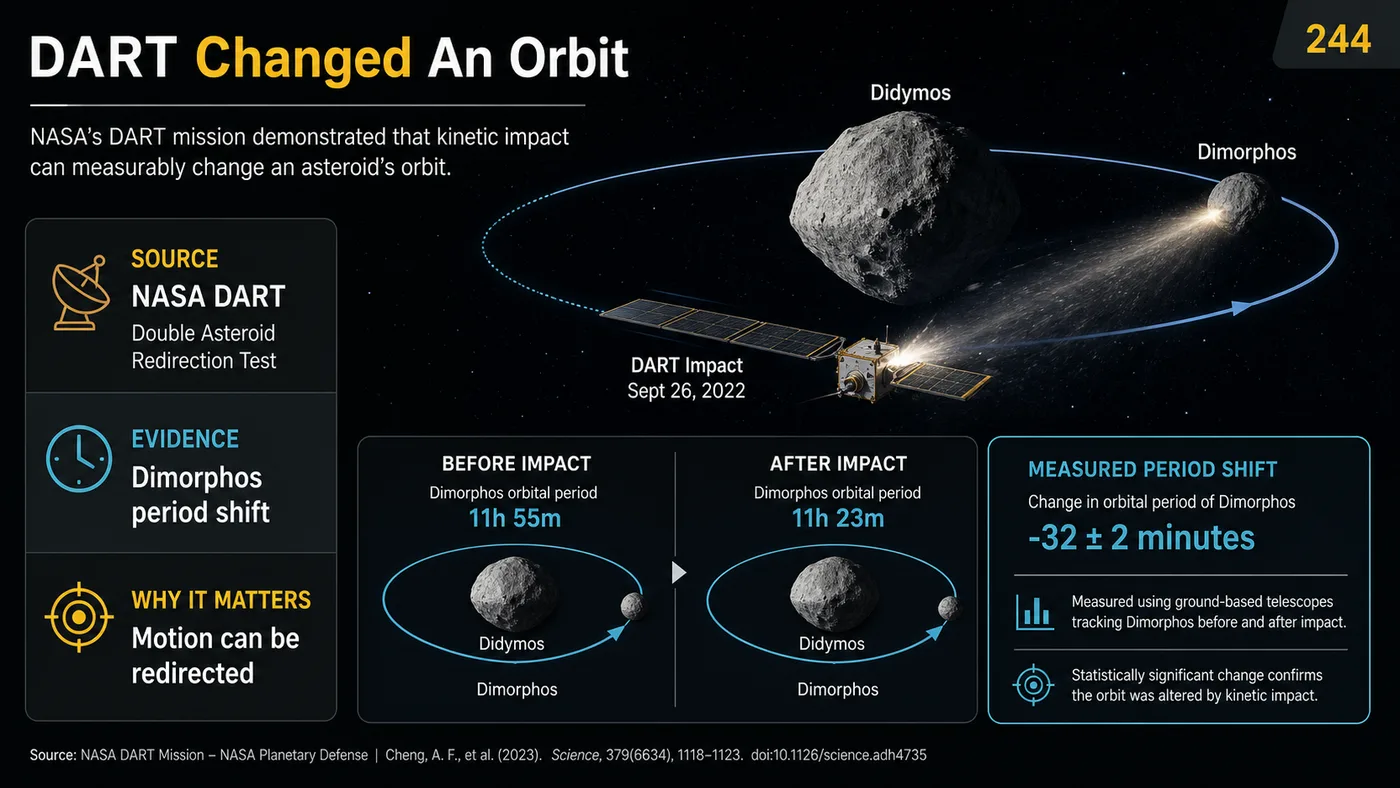
DART: Humanity's First Planetary Defense Test
DART impact Dimorphos September 26 2022 · Δv ≈ 2.7 mm/s · orbital period shortened 33 minutes
NASA's Double Asteroid Redirection Test (DART) spacecraft, launched in November 2021, intentionally impacted the moonlet Dimorphos (diameter ~160 meters) of the binary asteroid system Didymos on September 26, 2022. The impact delivered a Δv of approximately 2.7 mm/s to Dimorphos, shortening its orbital period around Didymos by 33 minutes, from 11 hours 55 minutes to 11 hours 22 minutes, far exce
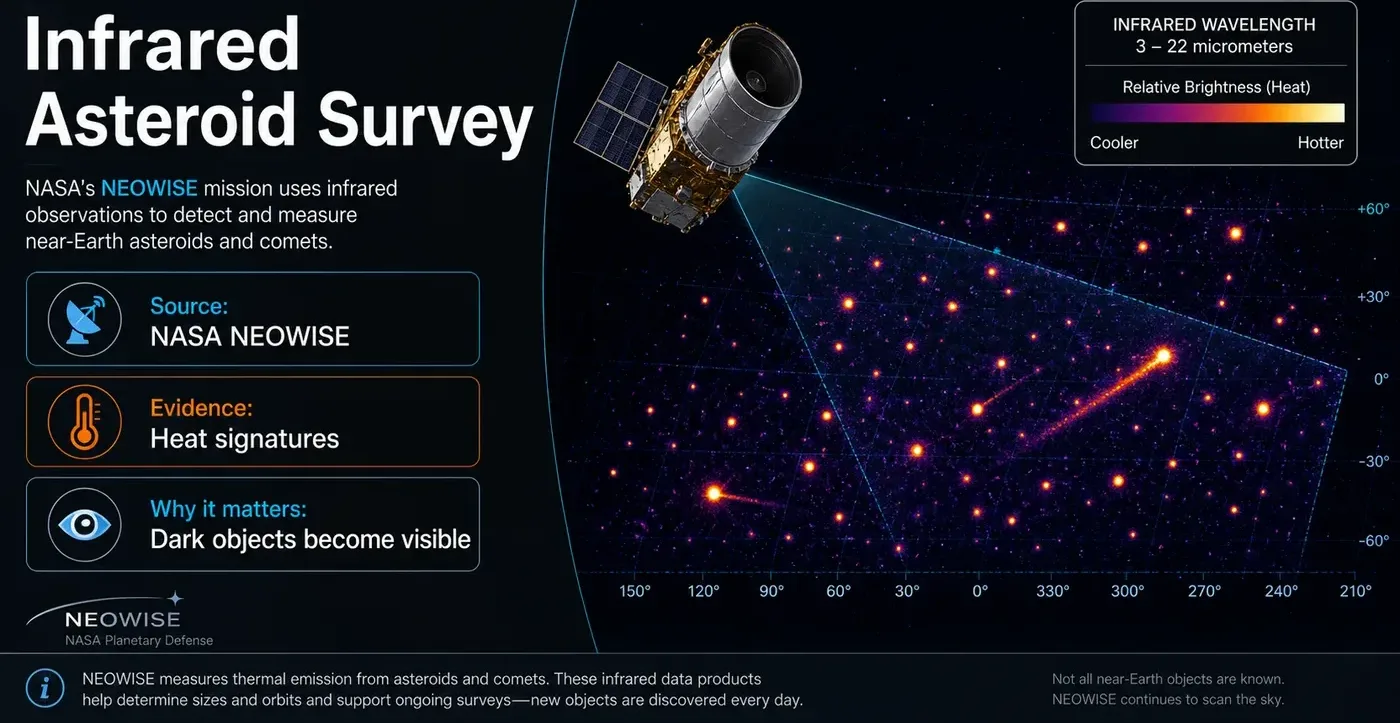
NEOWISE: Counting Asteroids in the Infrared
WISE/NEOWISE · infrared asteroid survey · thermal emission · size estimation · NEO catalog
The Wide-field Infrared Survey Explorer (WISE), launched in December 2009, surveyed the entire sky at four infrared wavelengths (3.4, 4.6, 12, and 22 μm). In its NEOWISE phase (beginning 2013, after the mission was extended and the outer detector bands exhausted), the spacecraft focused on near-Earth object detection and characterization using thermal infrared emission. Because asteroids absorb su
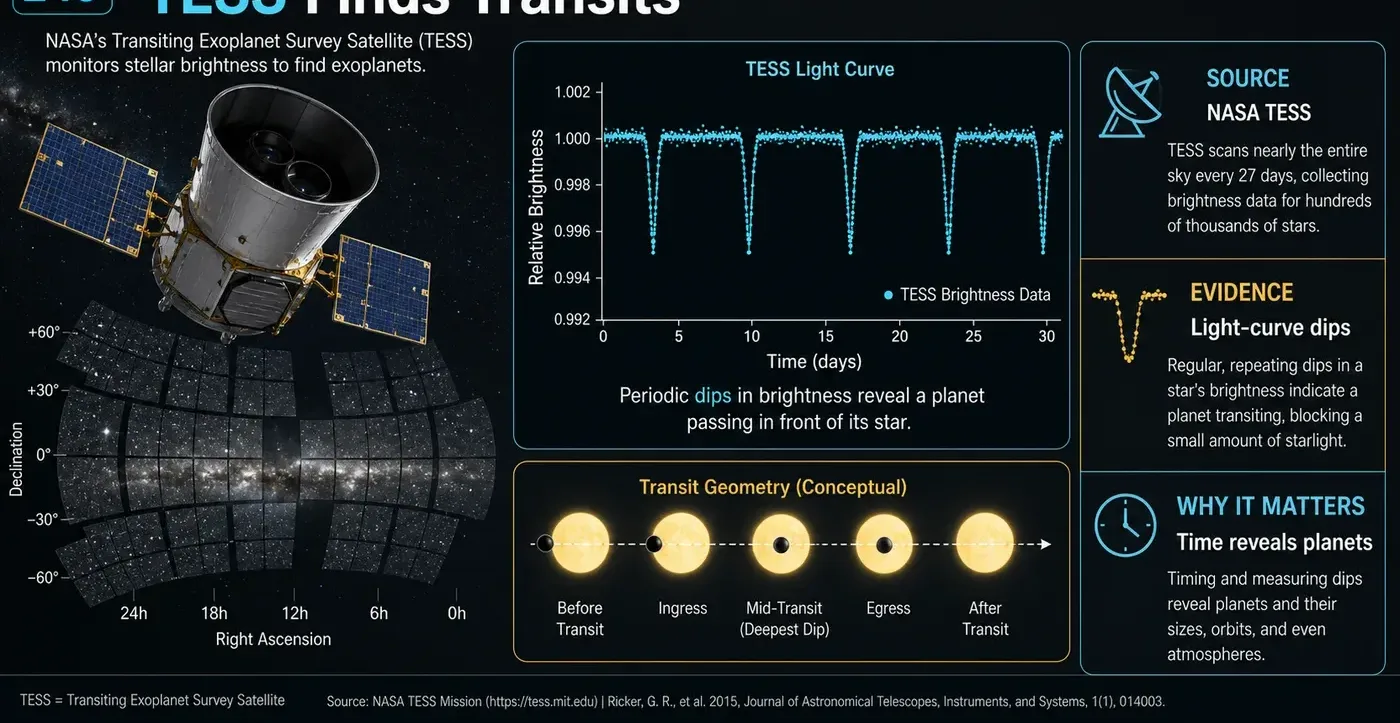
TESS Light Curves: Reading a Planet's Shadow
TESS photometric precision · two-minute cadence · planet radius from transit depth · limb darkening
TESS measures stellar brightness as a function of time, the light curve, with two-minute cadence for pre-selected targets and 10-minute cadence for full-frame images. When a planet transits, it blocks a fraction of the stellar disk equal to (R_planet/R_star)², causing a characteristic flat-bottomed dimming of typically 0.01–1% in amplitude. The shape of the transit ingress and egress is sensitiv
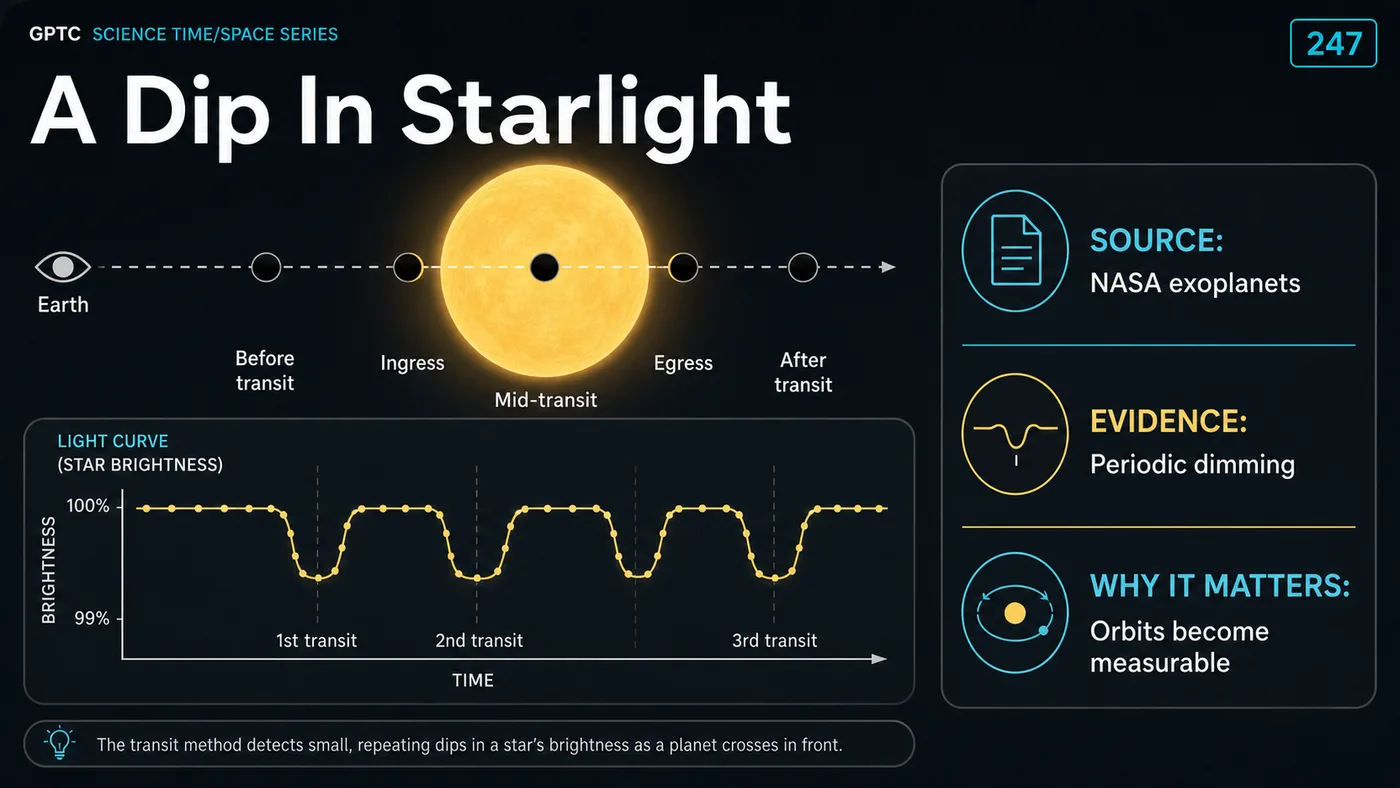
The Transit Method: Shadows on a Star
Transit photometry · exoplanet detection · Kepler legacy · TESS all-sky survey · planet demographics
The transit method detects exoplanets by measuring the periodic dimming of a star's light as a planet passes across its disk as seen from Earth. The transit depth is proportional to (R_planet/R_star)², allowing planetary radii to be measured. Combined with radial velocity measurements of the stellar Doppler wobble (which yield the planet mass), transit measurements provide bulk density and hence c
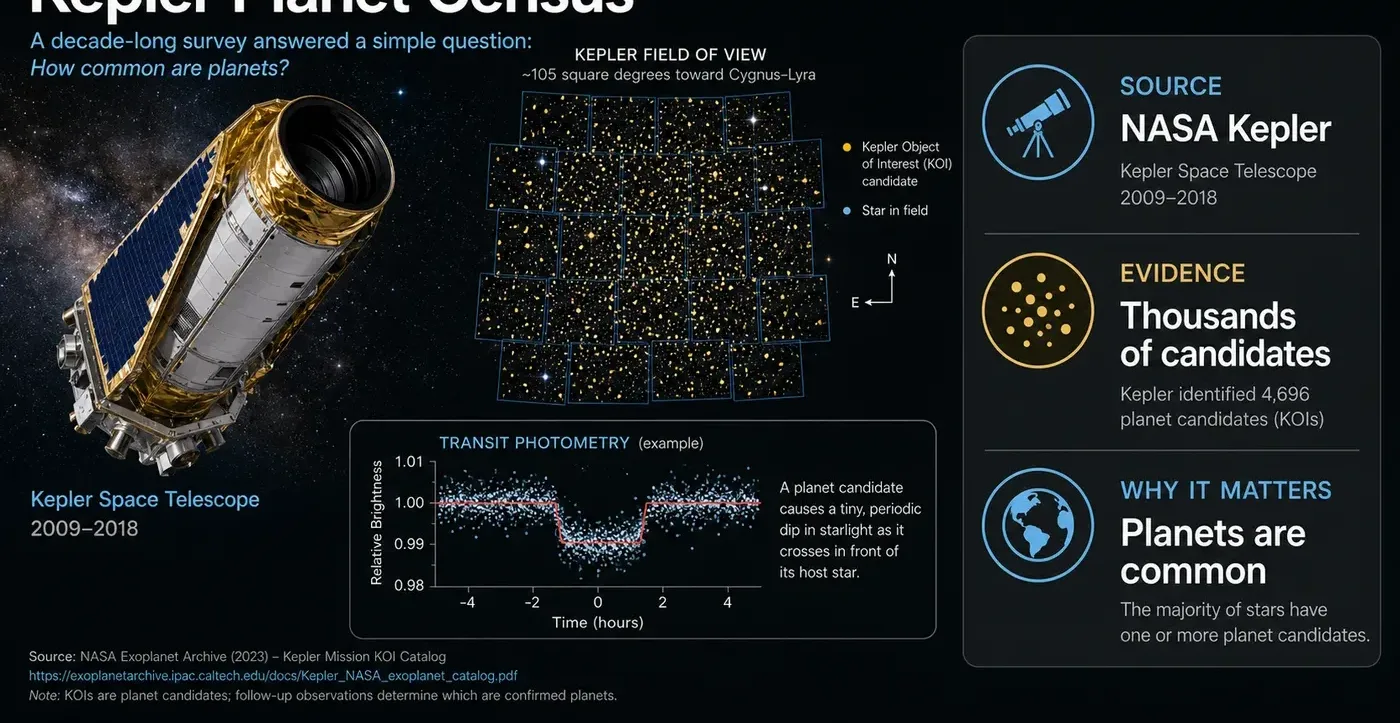
Kepler: The Great Planet Census
Kepler space telescope · 2009–2018 · 2,662 confirmed exoplanets · planet occurrence rates · eta-Earth
NASA's Kepler space telescope, launched in March 2009, monitored the brightness of approximately 150,000 stars in a fixed patch of sky in the Cygnus constellation for four years of prime mission, delivering the first statistically rigorous census of exoplanet sizes and orbital periods. The mission confirmed 2,662 exoplanets (with over 5,000 additional unconfirmed candidates) and established that s
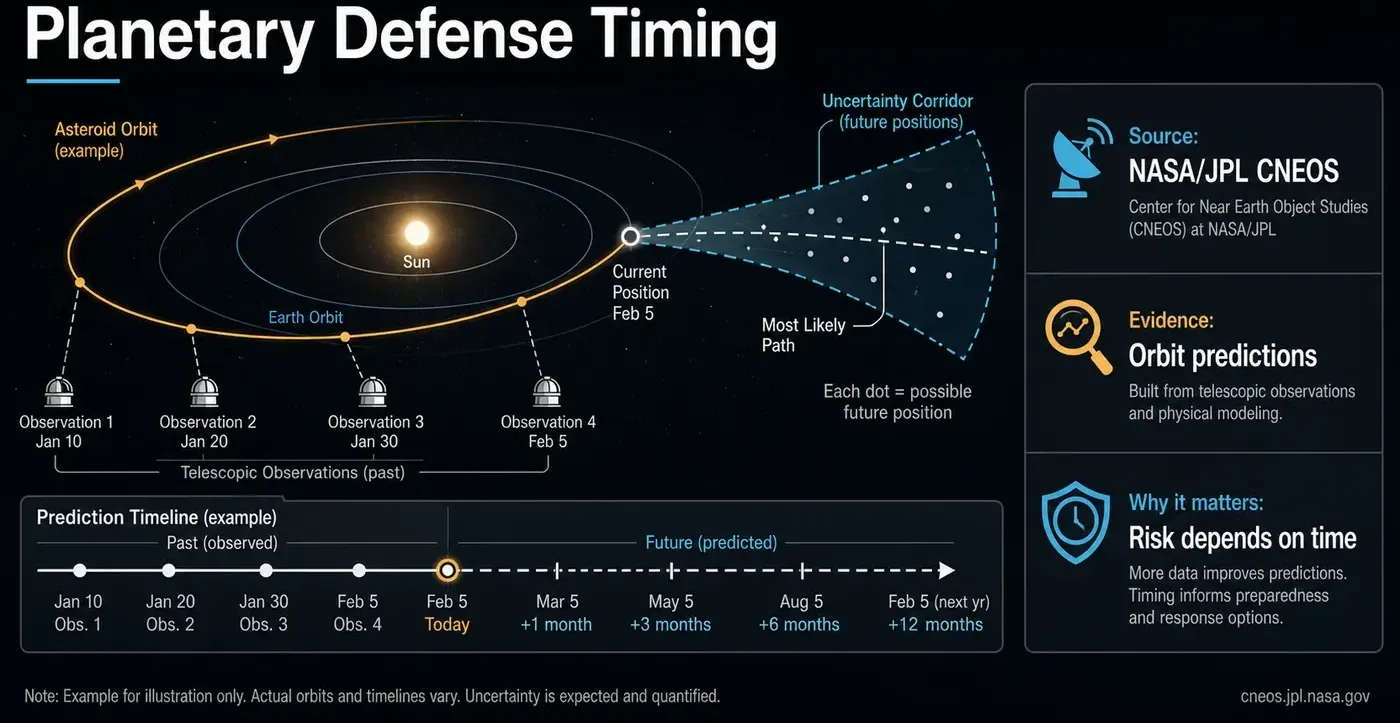
Planetary Defense: The Race Against the Clock
NASA Planetary Defense Coordination Office · NEO tracking · impact probability · warning time
Planetary defense against near-Earth object (NEO) impacts is a time-critical problem. The earlier a potential impactor is detected, the more mission options are available, from kinetic impactor (like DART) to gravity tractor to nuclear deflection. NASA's Planetary Defense Coordination Office (PDCO) coordinates detection by telescopes including the Catalina Sky Survey, Pan-STARRS, and the planned
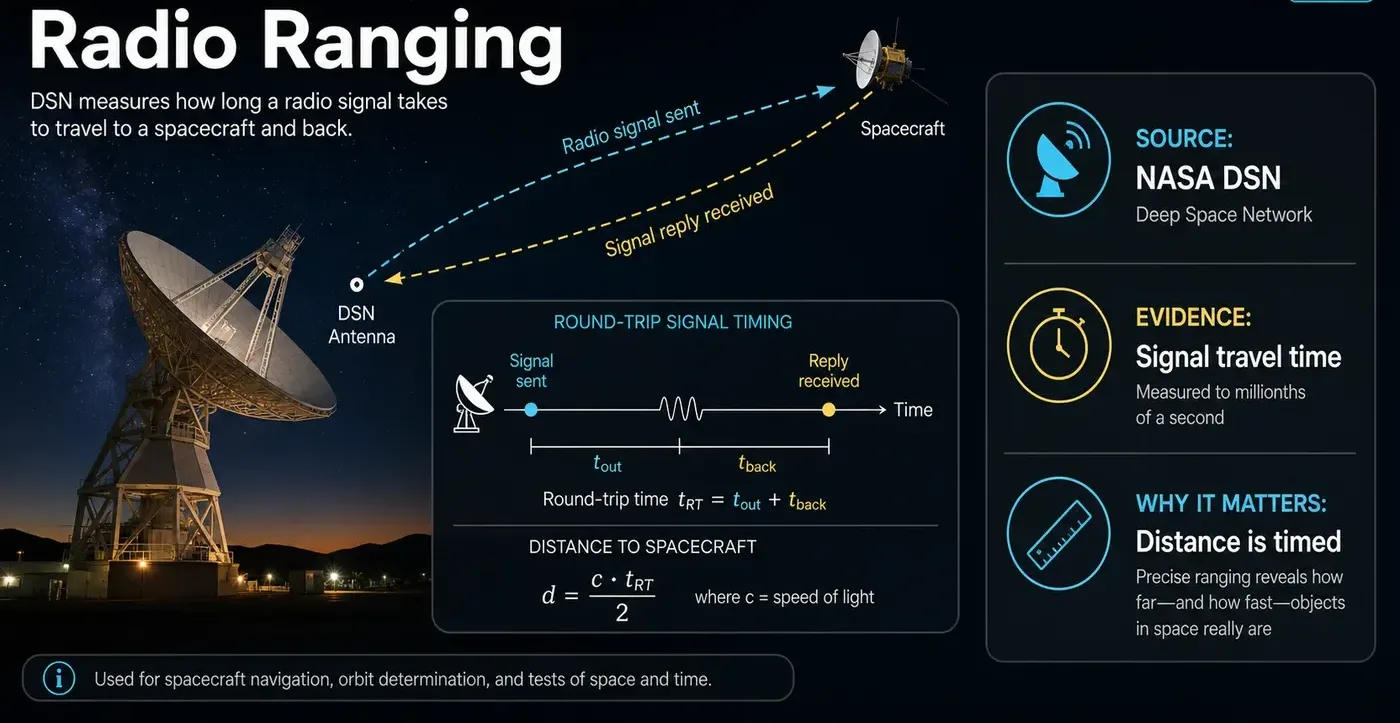
DSN Ranging: Navigation at Solar System Scale
Deep Space Network two-way ranging · Doppler velocity · spacecraft navigation · post-Newtonian tests
The Deep Space Network's ranging technique determines spacecraft position and velocity through two-way radio measurements. A ranging code is uplinked to the spacecraft, which retransmits it. The round-trip delay gives the distance (range), and the Doppler shift of the carrier frequency gives the line-of-sight velocity (range-rate). Combined with very-long-baseline interferometry (VLBI) measurement
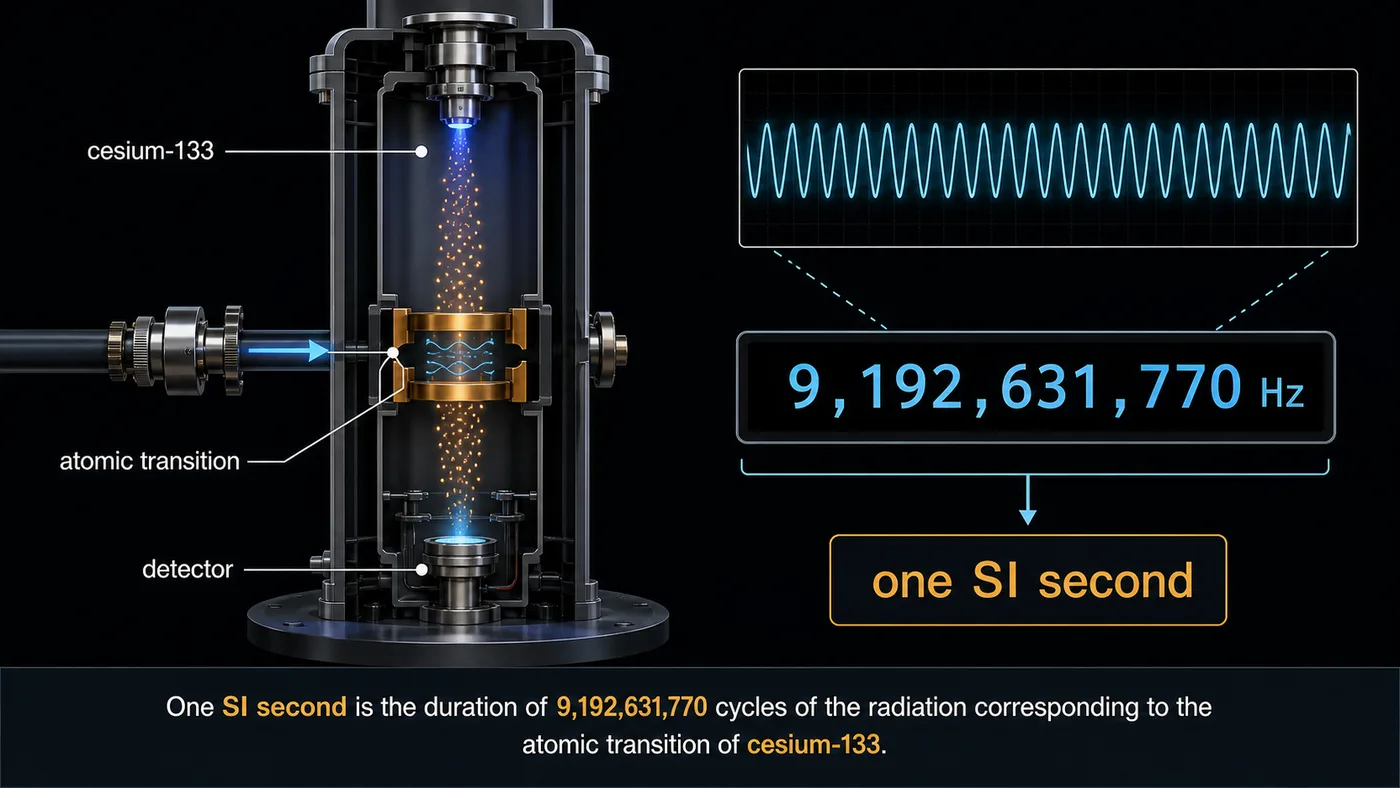
The Atomic Second
How 9,192,631,770 oscillations redefined time itself
The SI second has been defined since 1967 as exactly 9,192,631,770 periods of the radiation corresponding to the hyperfine transition of the ground state of the caesium-133 atom. This replaced the astronomical second (based on Earth's rotation) and made the unit of time far more stable and reproducible. Modern caesium fountain clocks at NIST and PTB achieve uncertainties below 1 part in 10¹⁶, los
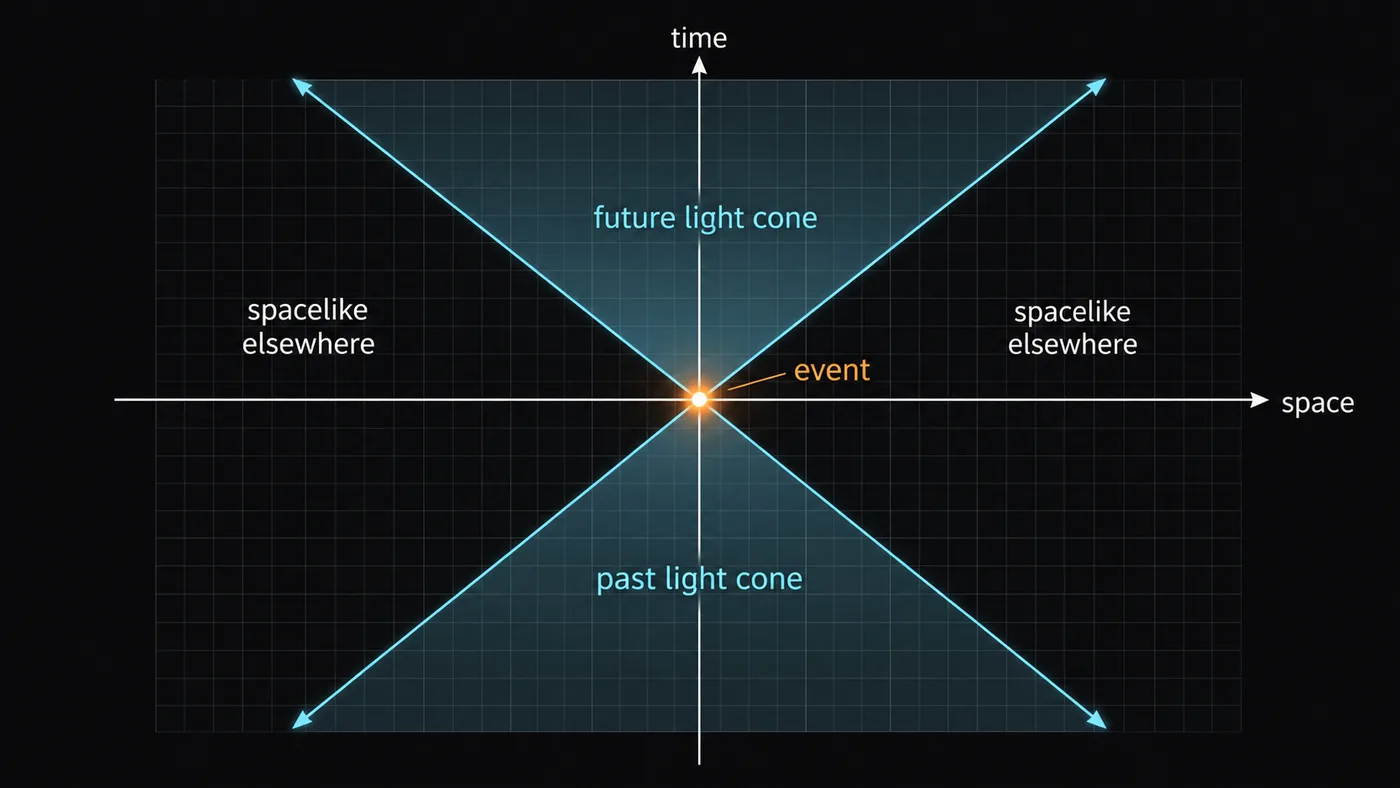
The Light Cone
Every event in spacetime has a boundary, and nothing crosses it
In special relativity, a light cone is the four-dimensional surface traced by light pulses emitted from (or converging on) a single event in spacetime. Events inside the future light cone can be causally reached from the apex, and events inside the past light cone could have influenced it. Events outside the cone (in the "elsewhere") are causally disconnected. No signal traveling at or below the spe
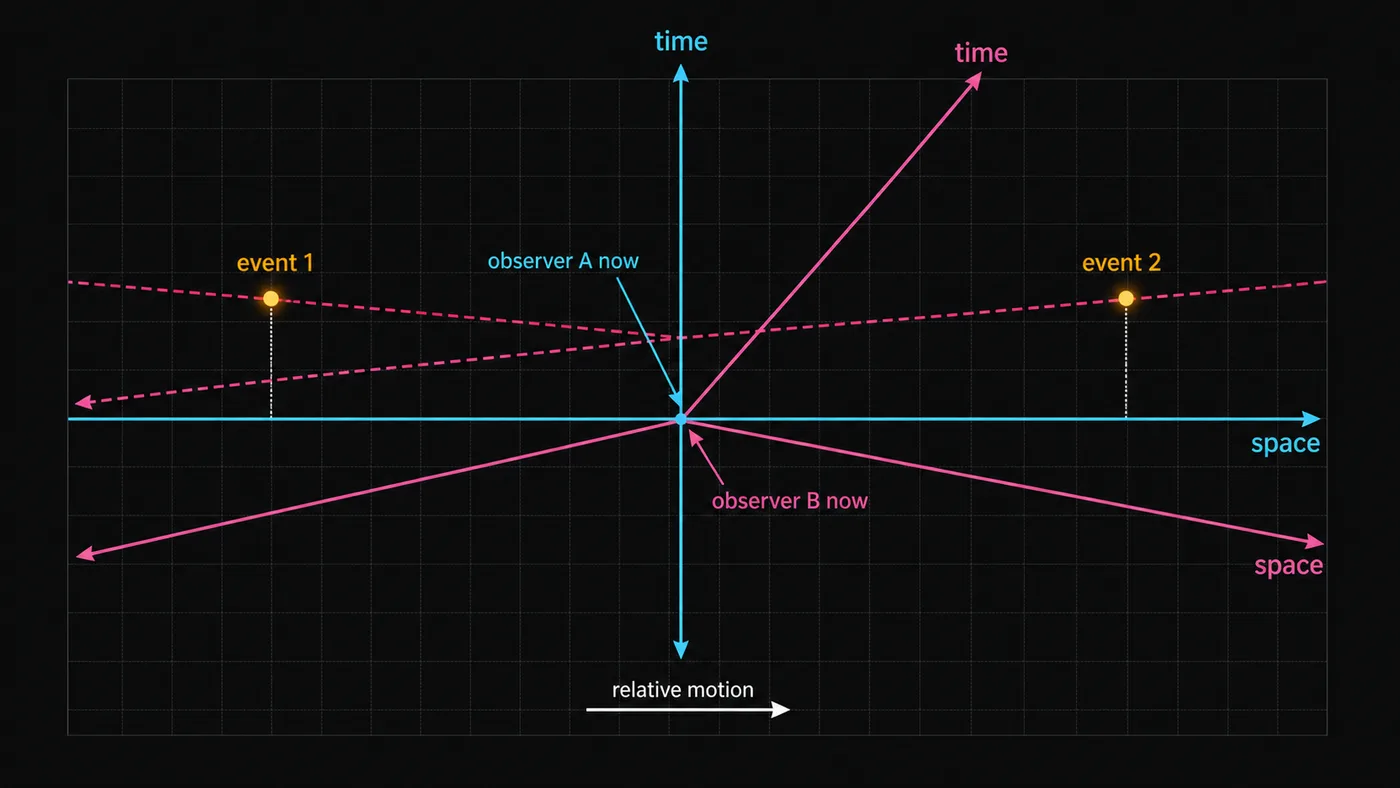
No Universal Now
Two observers, two different "nows". Both correct
Einstein's special relativity (1905) showed that simultaneity is not absolute. Two events that are simultaneous in one inertial reference frame are not simultaneous in another moving frame. In a Minkowski spacetime diagram, a moving observer's surface of simultaneity ("now") is a tilted hyperplane rather than a horizontal one. The tilt angle increases with velocity, becoming 45 degrees at c. This
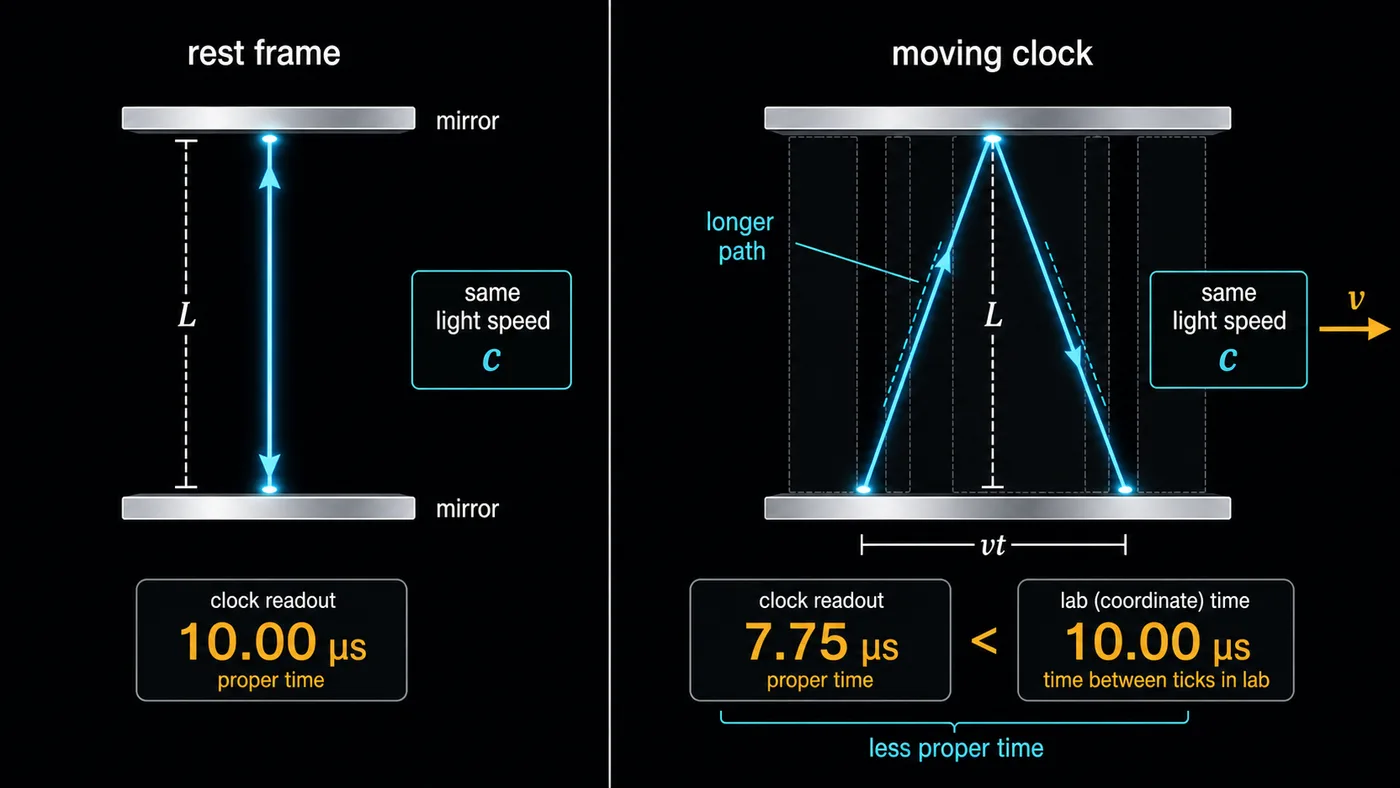
The Light Clock
A photon bouncing between mirrors reveals that moving clocks tick slow
A light clock is a thought experiment used to derive special relativistic time dilation. A photon bounces vertically between two mirrors separated by a fixed distance. For a stationary observer, the photon travels a short vertical path each tick. For an observer watching the clock move horizontally, the photon traces a longer diagonal path, yet the speed of light is invariant (c in all frames). S
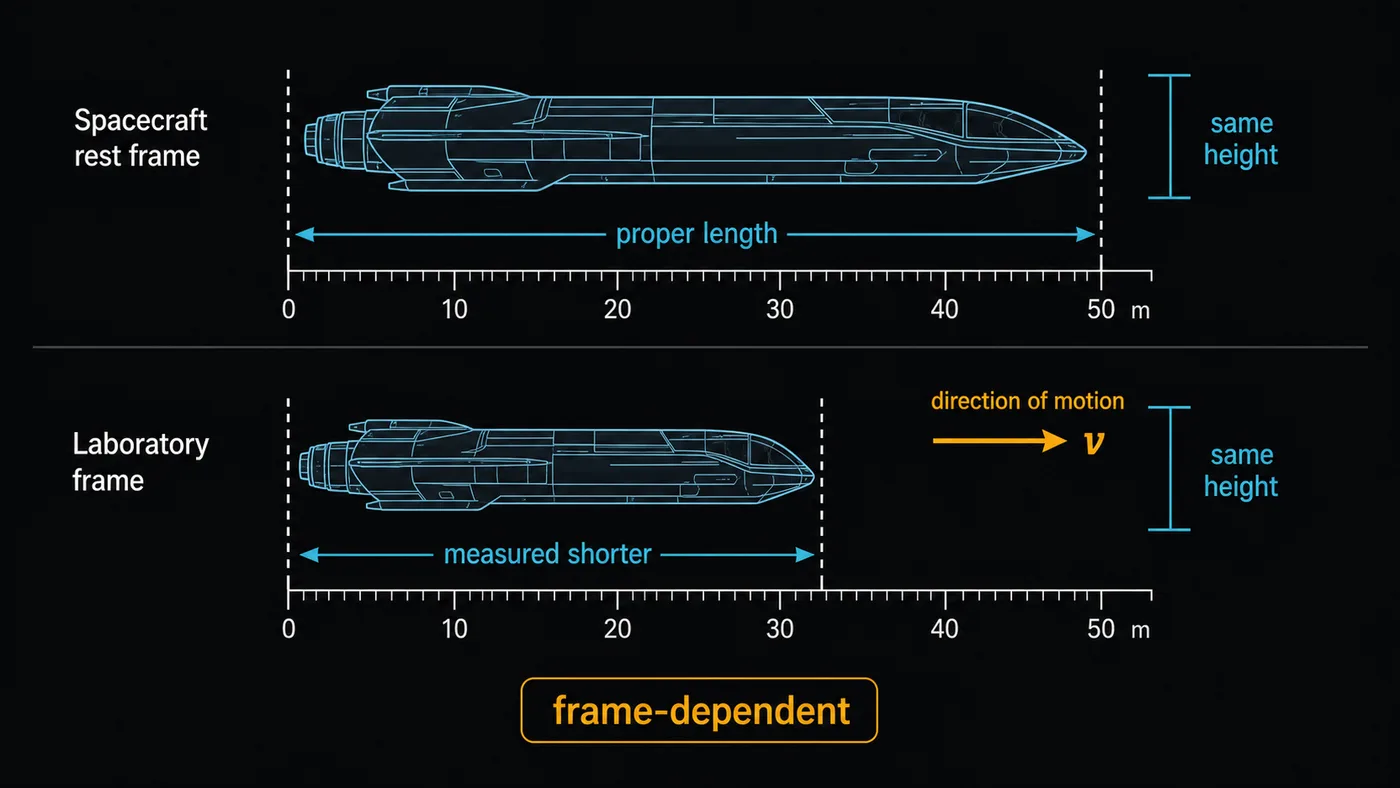
Length Contraction
Moving rulers shrink, but only along the direction of travel
Special relativity predicts that an object moving at velocity v relative to an observer is measured to be shorter along the direction of motion by a factor of 1/γ = √(1 − v²/c²). A one-meter rod moving at 0.866c (γ = 2) would be measured as only 0.5 meters long by the stationary observer. The object is not physically compressed. The measurement reflects the genuine geometric structure of spacetim
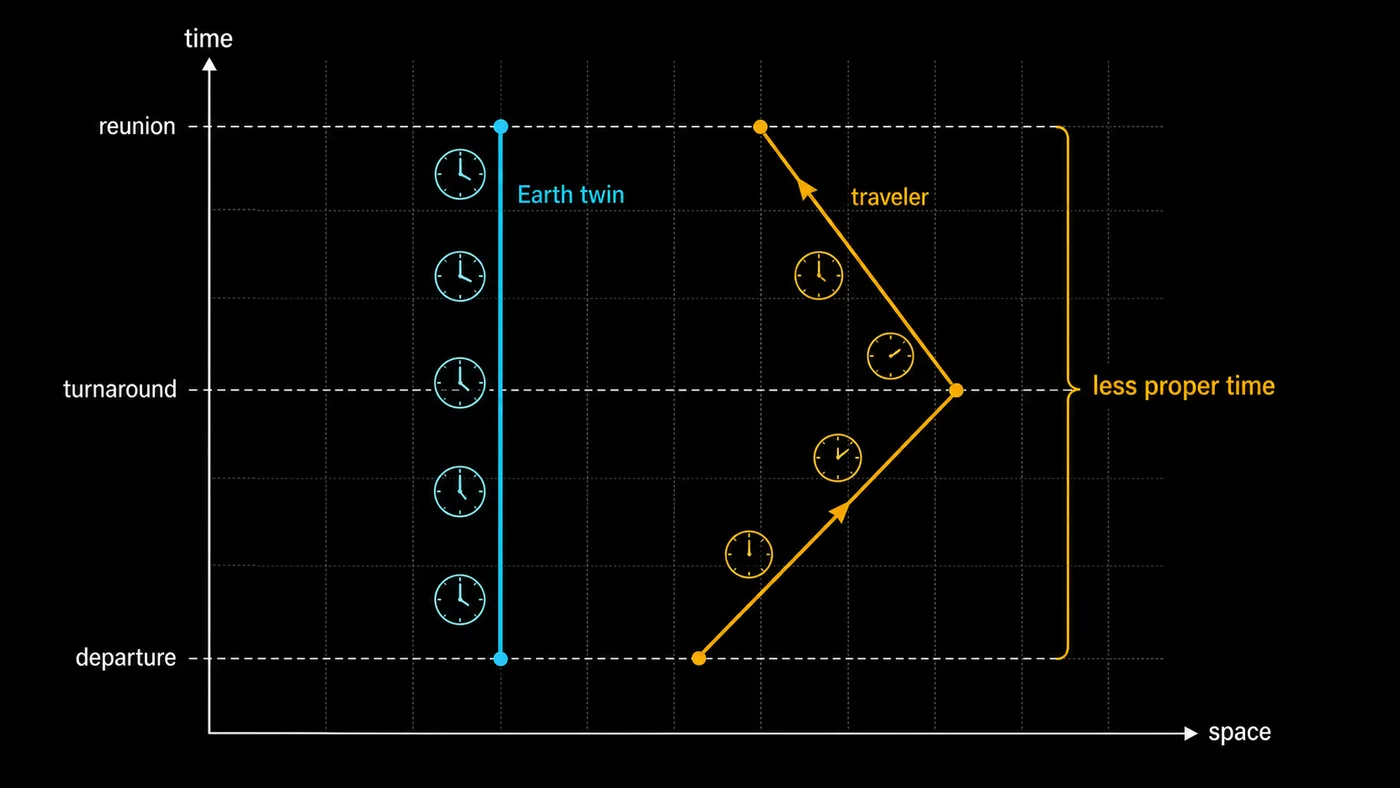
The Twin Paradox
One twin travels at 0.8c. The other stays home. They age differently, for real
The twin paradox illustrates special relativistic time dilation through asymmetric aging. One twin (the traveler) departs at high velocity, reaches a distant point, decelerates, and returns. The stay-at-home twin ages more. At v = 0.8c, γ = 5/3 ≈ 1.667. For every 5 years the traveler experiences, the stay-at-home twin ages approximately 8.3 years. The paradox is resolved by the asymmetry. The trav
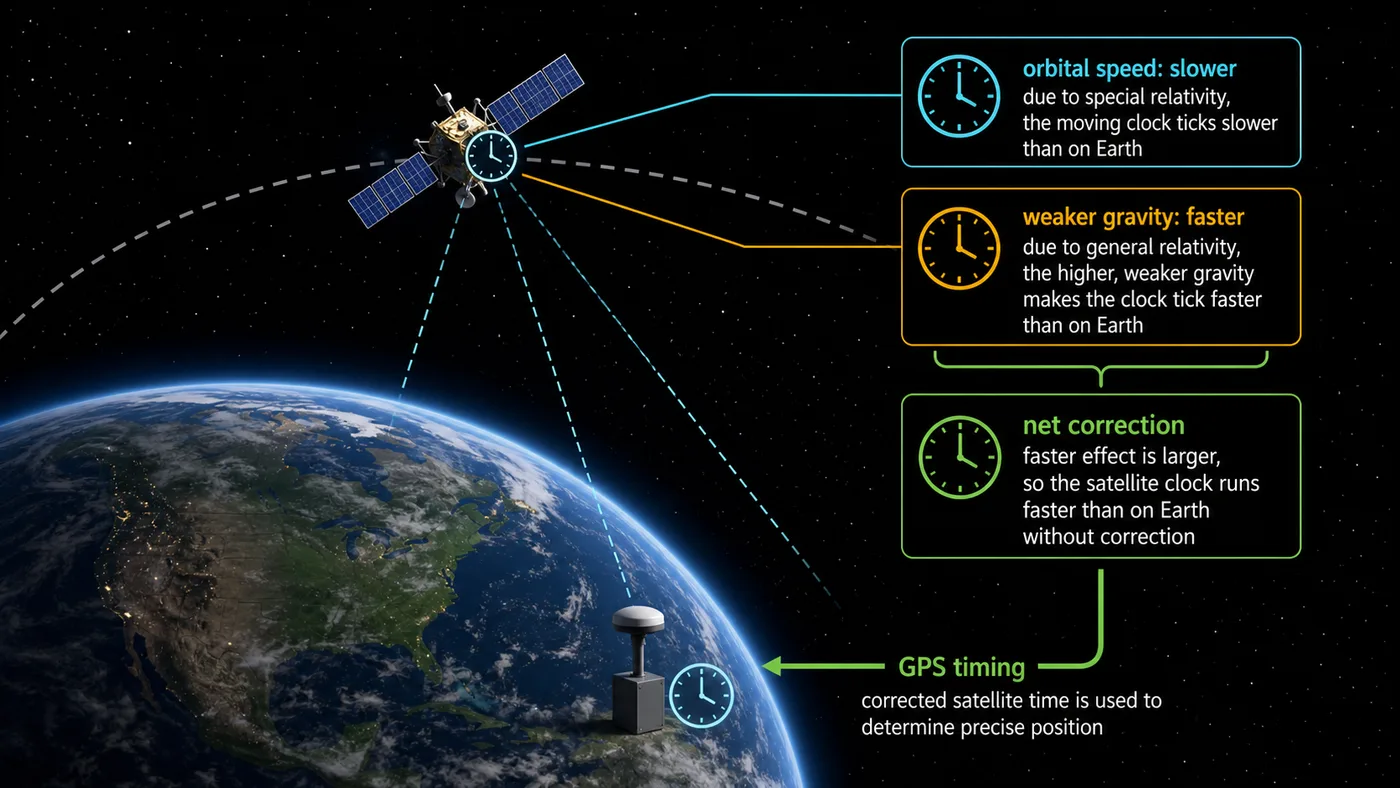
GPS and Relativity
Without Einstein's corrections, your navigation would drift 11 km per day
GPS satellites orbit at approximately 20,200 km altitude and move at roughly 3.87 km/s relative to Earth's surface. Two relativistic effects operate simultaneously: (1) Gravitational time dilation (general relativity) causes satellite clocks to tick approximately 45.9 microseconds per day faster than ground clocks because they are higher in Earth's gravitational potential. (2) Velocity time dilati
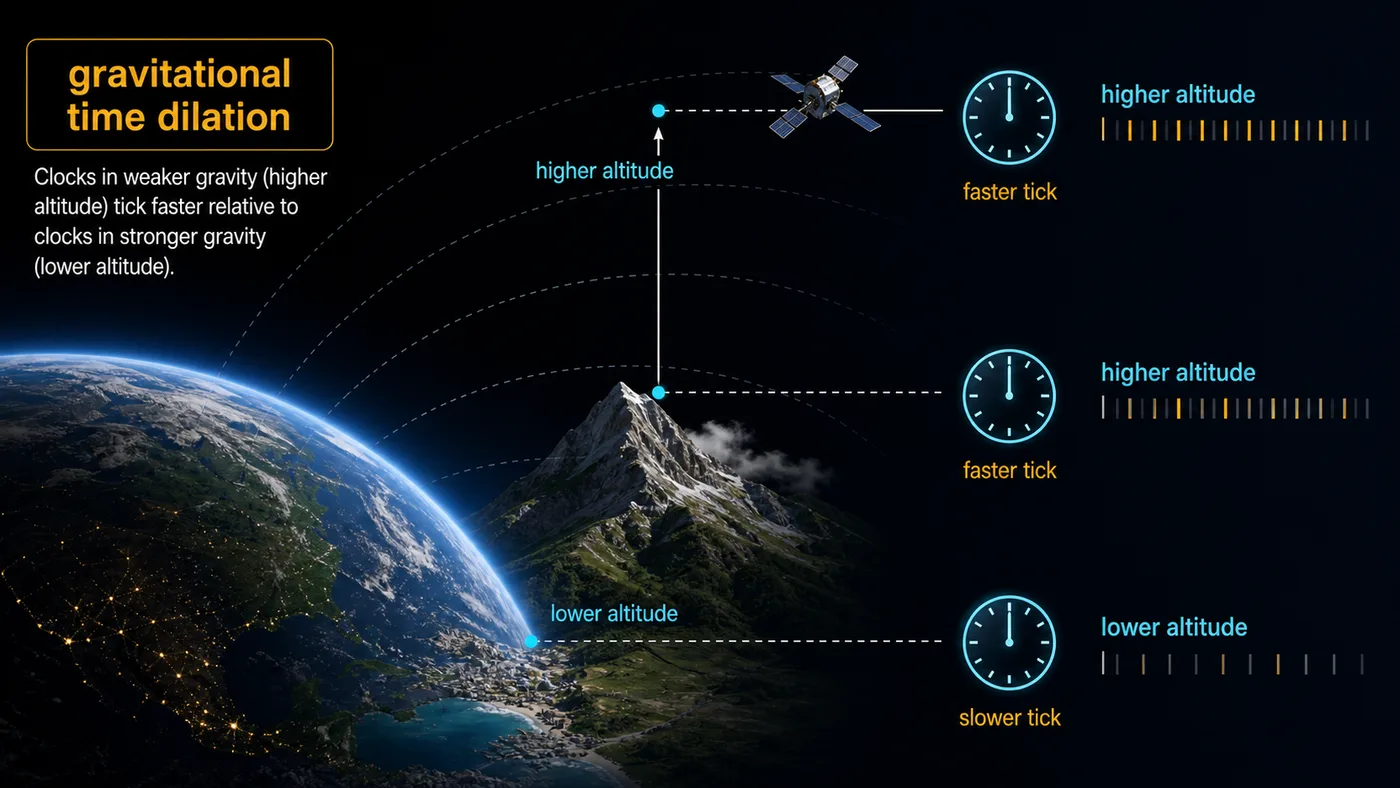
Gravity Slows Time
A clock at altitude ticks faster, confirmed in 1976 by a rocket and an atomic clock
General relativity predicts that clocks run faster at higher gravitational potential (farther from a mass). For a height difference h near Earth's surface, the fractional rate difference is approximately gh/c², where g ≈ 9.8 m/s² and c is the speed of light. The Gravity Probe A experiment (NASA, June 1976) launched a hydrogen maser clock on a rocket to approximately 10,000 km altitude and confirme
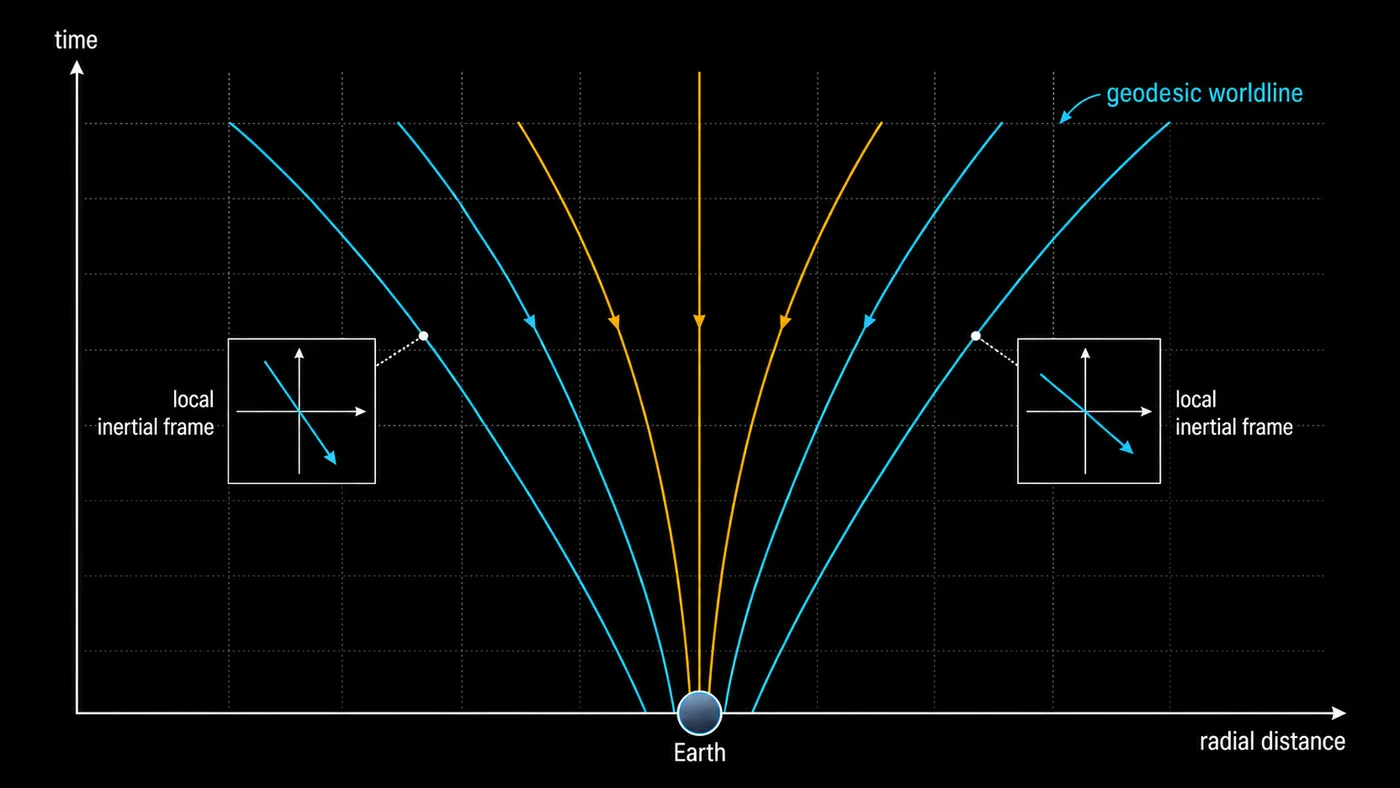
Curved Spacetime
Gravity is not a force. It is the curvature of spacetime itself
Einstein's general theory of relativity (1915) replaces Newton's gravitational force with the concept of curved spacetime. Mass and energy curve the four-dimensional fabric of spacetime, and objects, including light, follow the straightest possible paths (geodesics) through that curved geometry. What appears as a gravitational force is the natural motion along a geodesic in curved spacetime. The
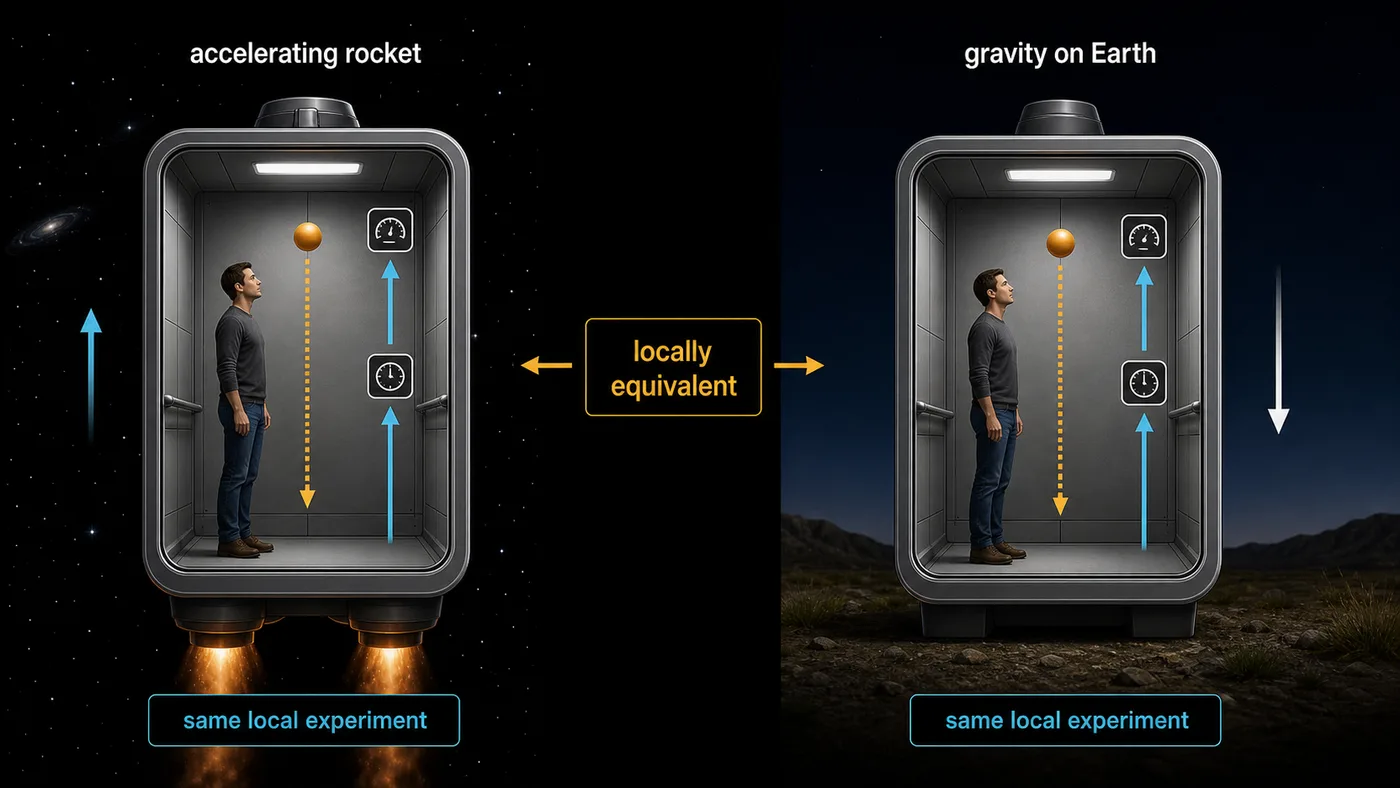
The Equivalence Principle
In free fall, gravity vanishes. In an accelerating rocket, it reappears. Einstein called this the happiest thought of his life.
Einstein's equivalence principle (1907) states that the effects of gravity are locally indistinguishable from those of uniform acceleration. An observer in a closed box cannot determine, through any local experiment, whether the box is at rest in a gravitational field or accelerating through empty space at g = 9.8 m/s². Conversely, an observer in free fall locally experiences weightlessness equi
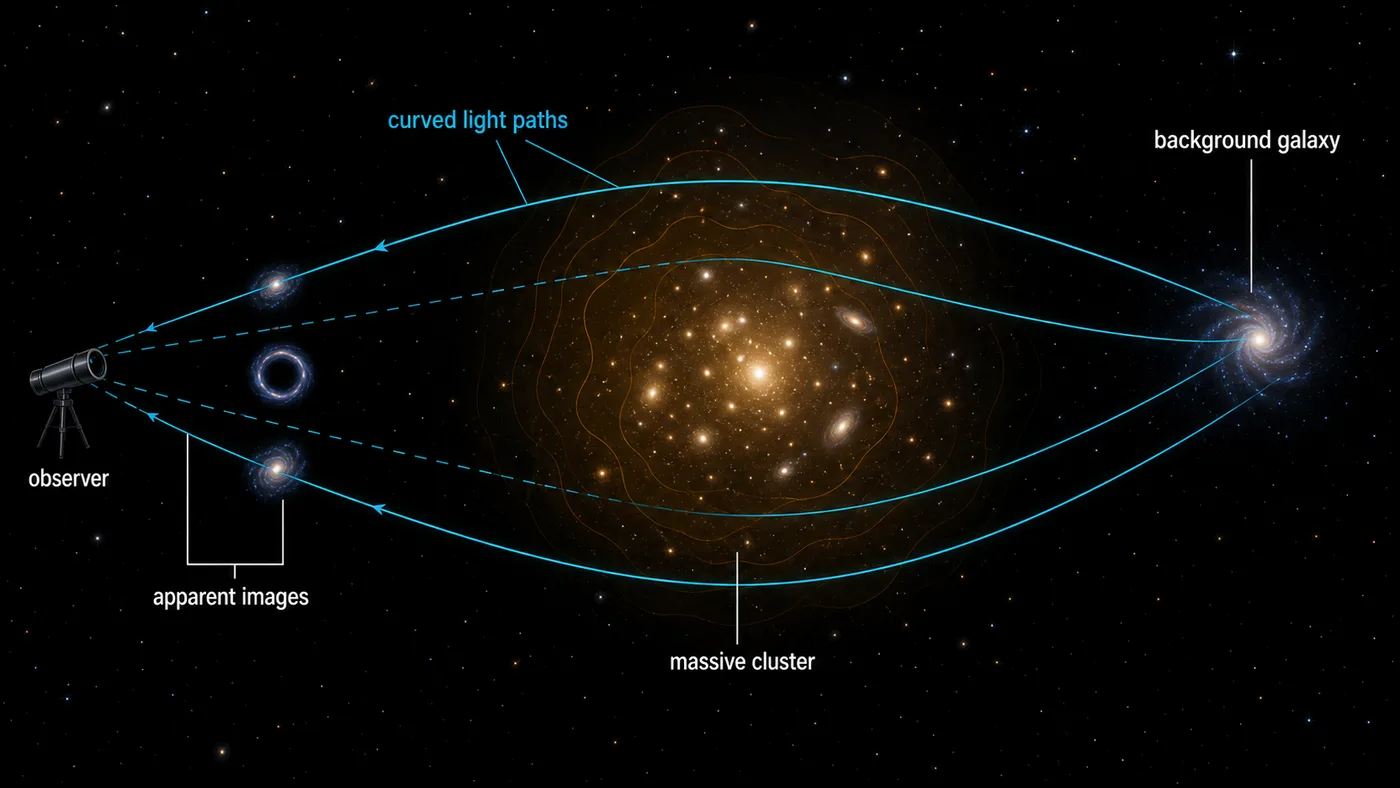
Light Bends Around Mass
In 1919, Arthur Eddington measured starlight bending around the Sun and confirmed Einstein
General relativity predicts that light follows geodesics in curved spacetime, meaning it is deflected by gravitational fields. The deflection angle for light grazing the Sun's limb is 1.75 arcseconds, exactly twice the Newtonian prediction. Arthur Eddington's solar eclipse expeditions of May 29, 1919 (to Príncipe and Sobral) measured this deflection and confirmed Einstein's value. Gravitational l
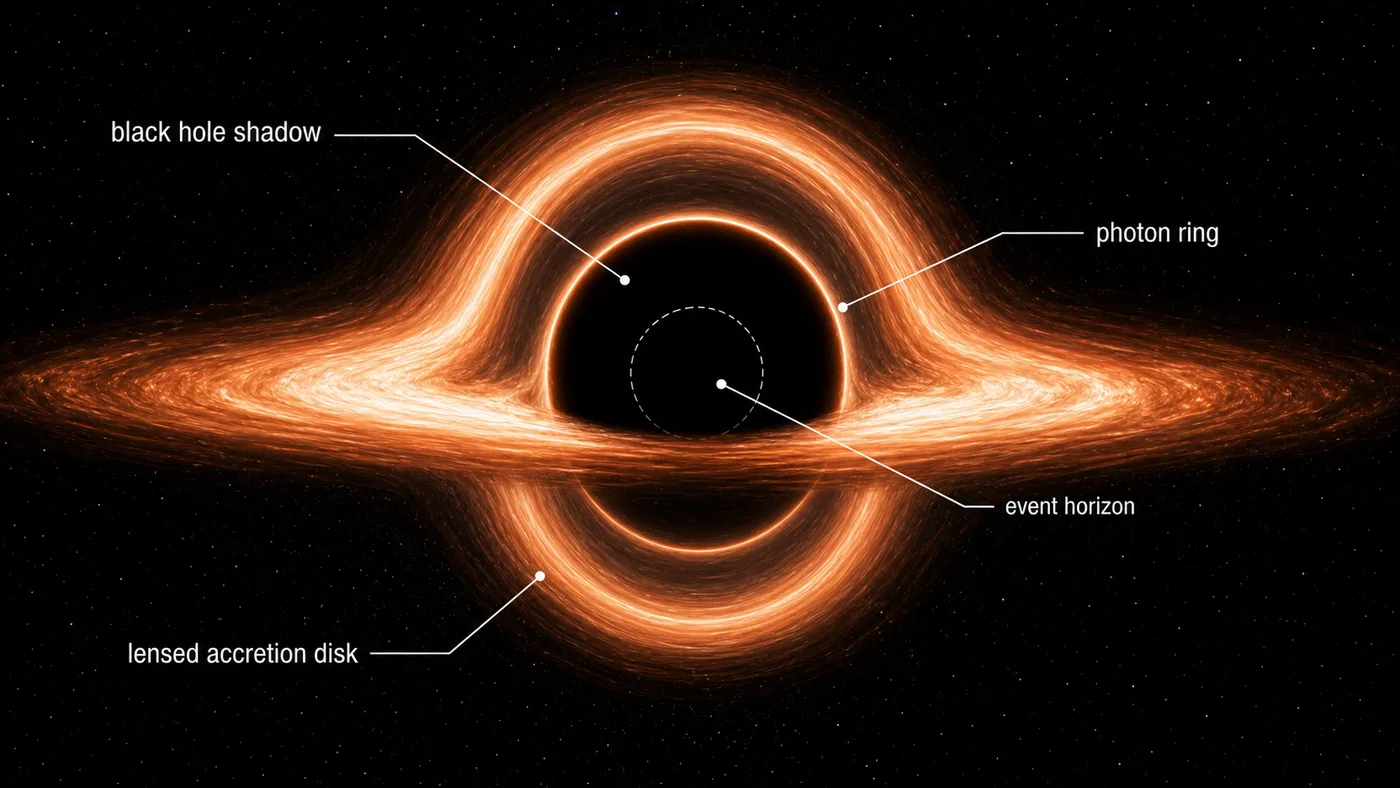
The Black Hole Shadow
In 2019 the Event Horizon Telescope photographed what no one had ever seen: the shadow of M87's black hole
On April 10, 2019, the Event Horizon Telescope (EHT) collaboration published the first direct image of a black hole's shadow, the supermassive black hole M87*, approximately 6.5 billion solar masses at the center of galaxy M87, approximately 55 million light-years away. The bright ring in the image is produced by photons orbiting close to the photon sphere (at 1.5 times the Schwarzschild radius),
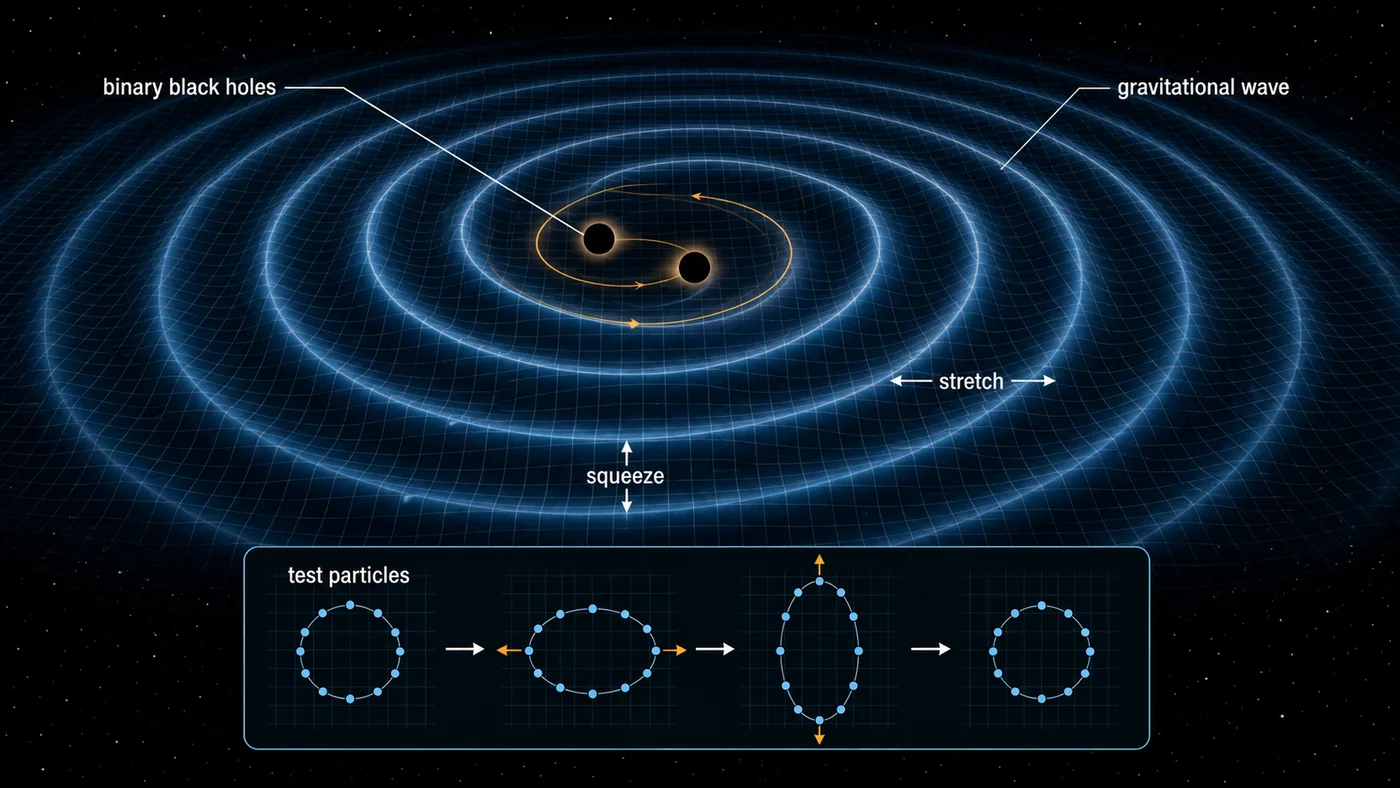
Gravitational Waves
Spacetime itself ripples, stretching and squeezing everything it passes through
Gravitational waves are ripples in spacetime curvature, propagating outward from accelerating massive objects at the speed of light. They were predicted by Einstein in 1916 from his general field equations. The waves manifest as a strain h, a fractional change in distance, expressed as h = ΔL/L. For the first detected event (GW150914, detected September 14, 2015) LIGO measured a peak strain of a
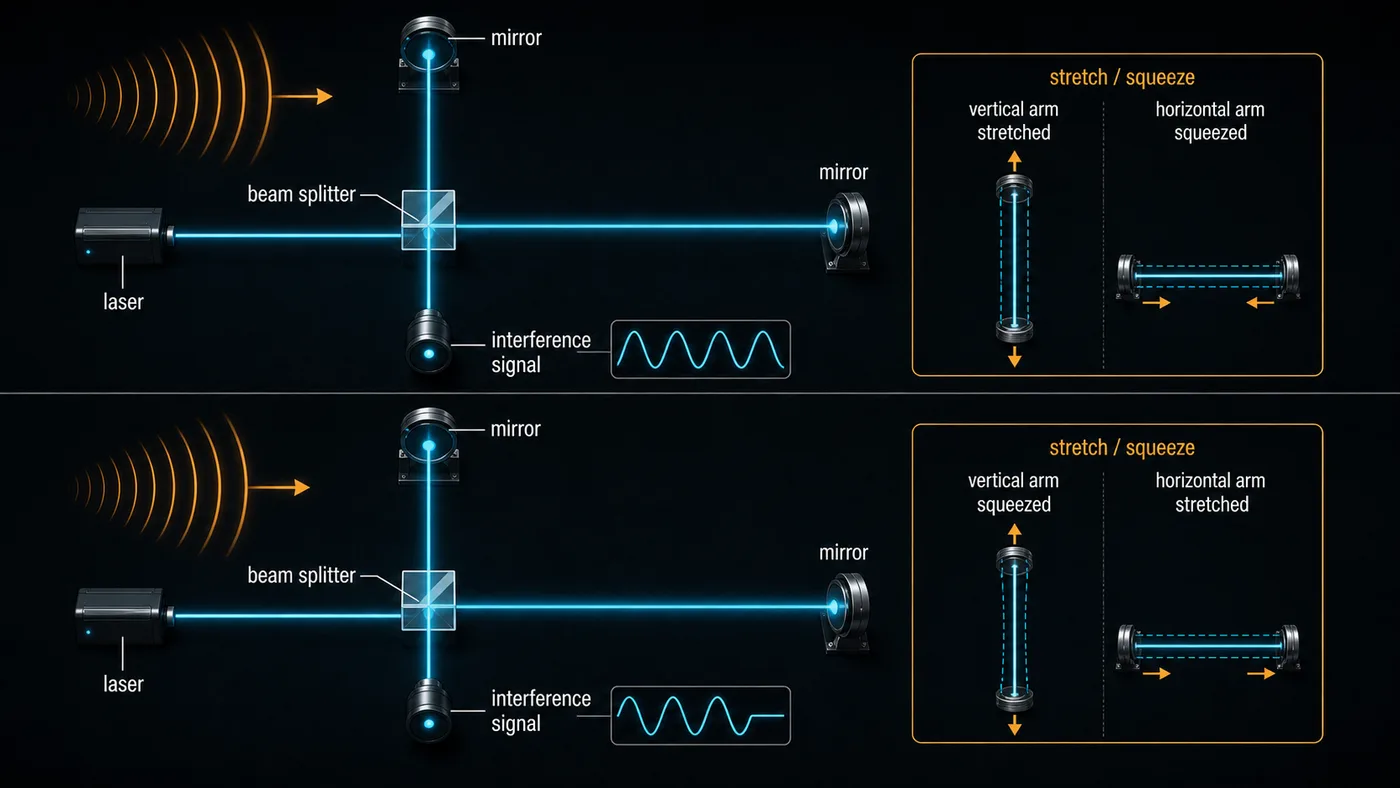
LIGO
Two 4-kilometer arms. A laser beam split in two. And a measurement one-thousandth the diameter of a proton
The Laser Interferometer Gravitational-Wave Observatory (LIGO) operates two detectors: one in Hanford, Washington and one in Livingston, Louisiana, each with two perpendicular arms 4 kilometers long. A laser beam is split and sent down each arm, bounces off mirrors, and recombines. When a gravitational wave passes, one arm stretches while the other squeezes (the quadrupolar pattern), causing a tin
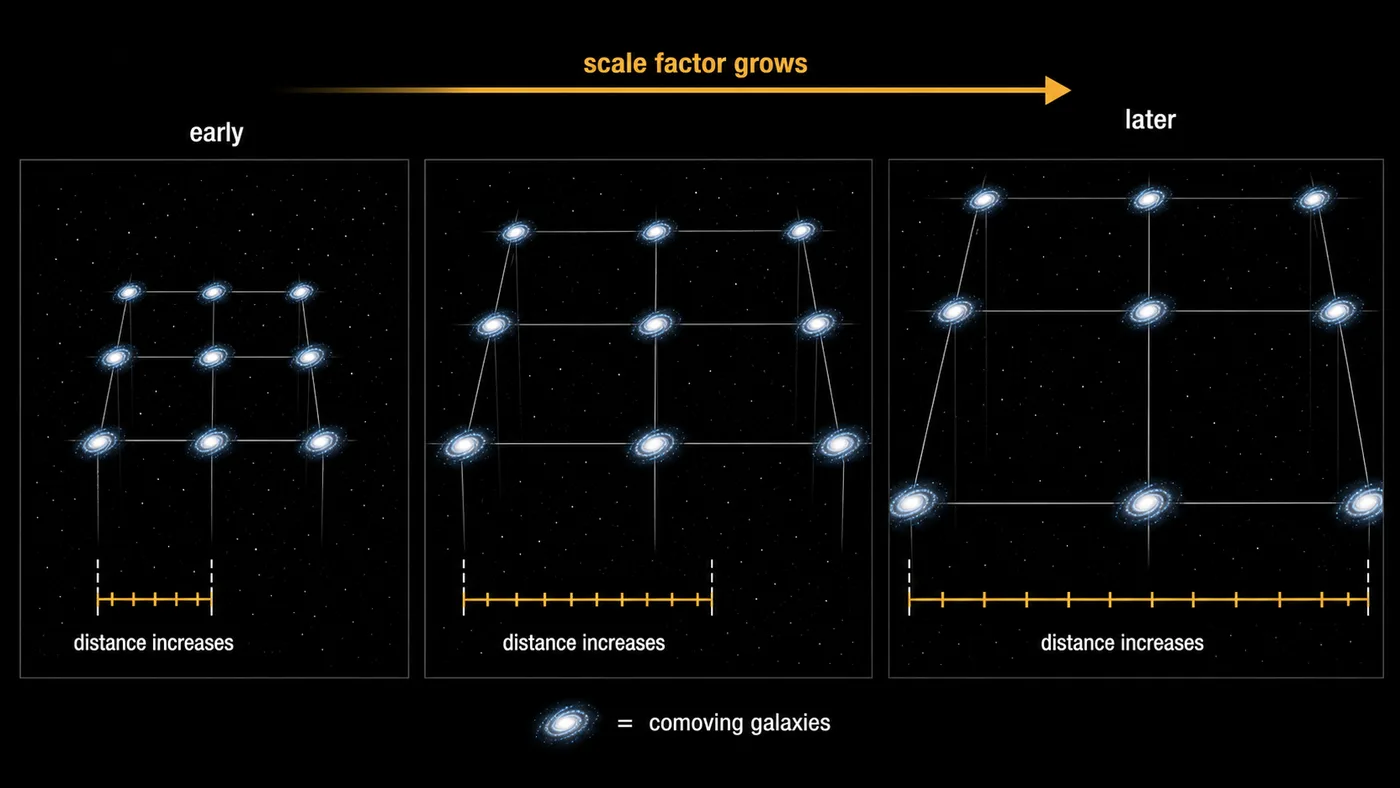
The Expanding Universe
Galaxies are not flying apart. The space between them is growing
The expansion of the universe is described by the scale factor a(t), which gives the relative size of the universe at time t. The Hubble parameter H(t) = ȧ/a describes the rate of expansion. Edwin Hubble's 1929 observations showed that galaxy recession velocities increase proportionally with distance (v = H₀d), implying expansion. Today's Hubble constant H₀ is measured at approximately 67–73 km/s/
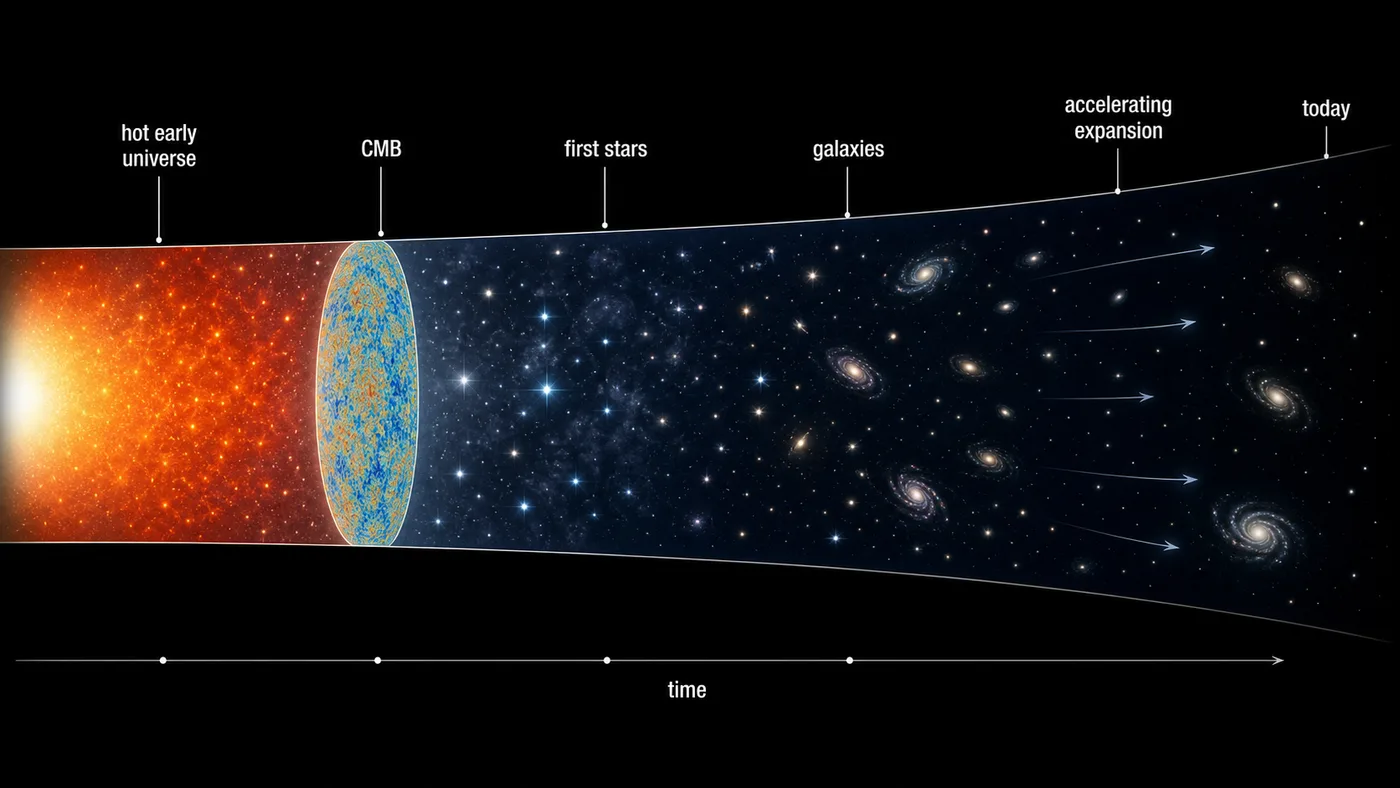
13.8 Billion Years in 15 Seconds
Big Bang nucleosynthesis, the CMB, first stars, galaxies, and now. The whole story
The universe's history spans approximately 13.8 billion years (Planck 2018). Key milestones: Big Bang nucleosynthesis occurred in the first ~3 minutes, producing hydrogen, helium, and trace lithium. Recombination occurred at approximately 380,000 years after the Big Bang (redshift z ≈ 1100), when the universe cooled enough for protons and electrons to combine into neutral hydrogen, releasing the
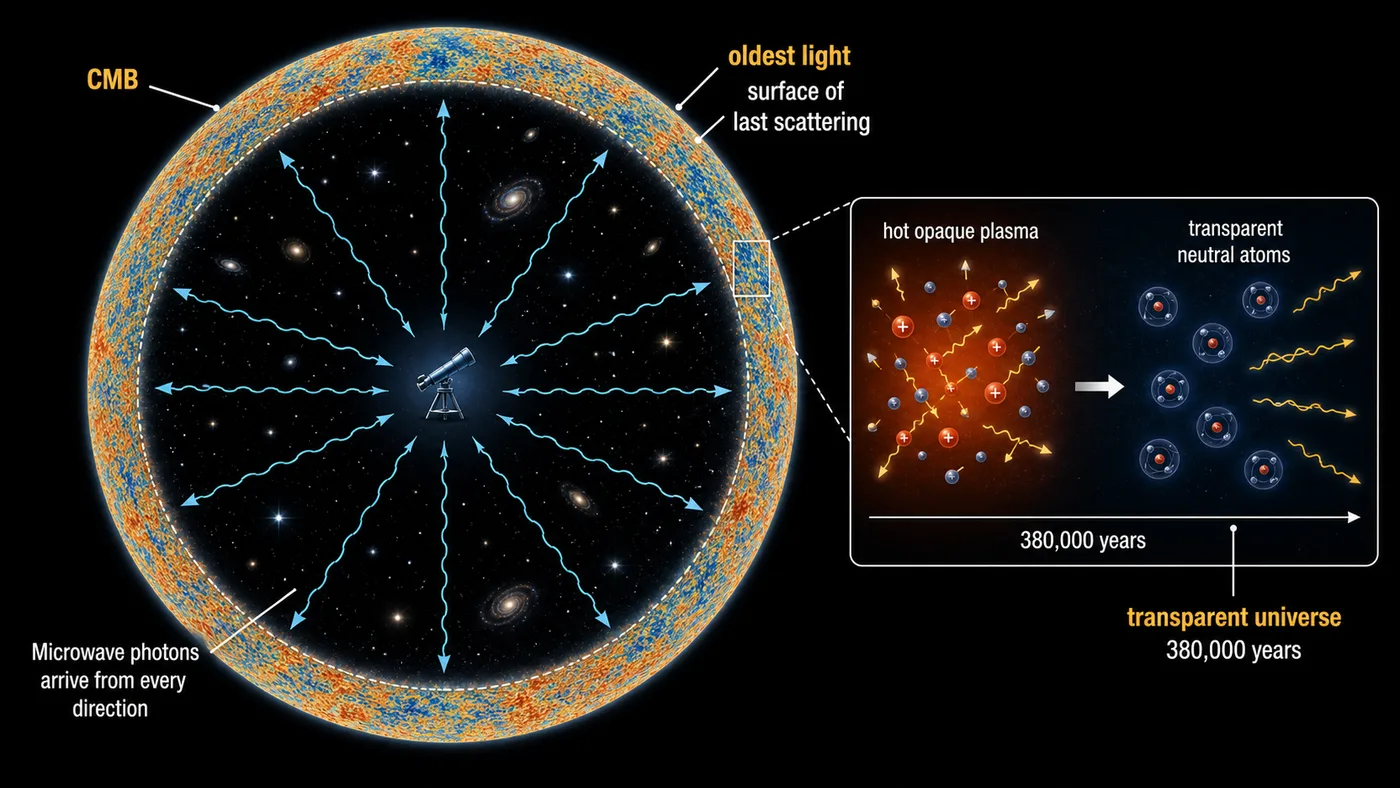
The Oldest Light
The CMB is a snapshot of the universe at 380,000 years, redshifted from 3,000 K to just 2.725 K today
The Cosmic Microwave Background (CMB) is the oldest light we can observe, released approximately 380,000 years after the Big Bang when the universe cooled enough for neutral hydrogen to form, the epoch of recombination (redshift z ≈ 1100). Before this moment the universe was opaque. Photons could not travel freely. After recombination, photons streamed freely for the first time. Today those photo
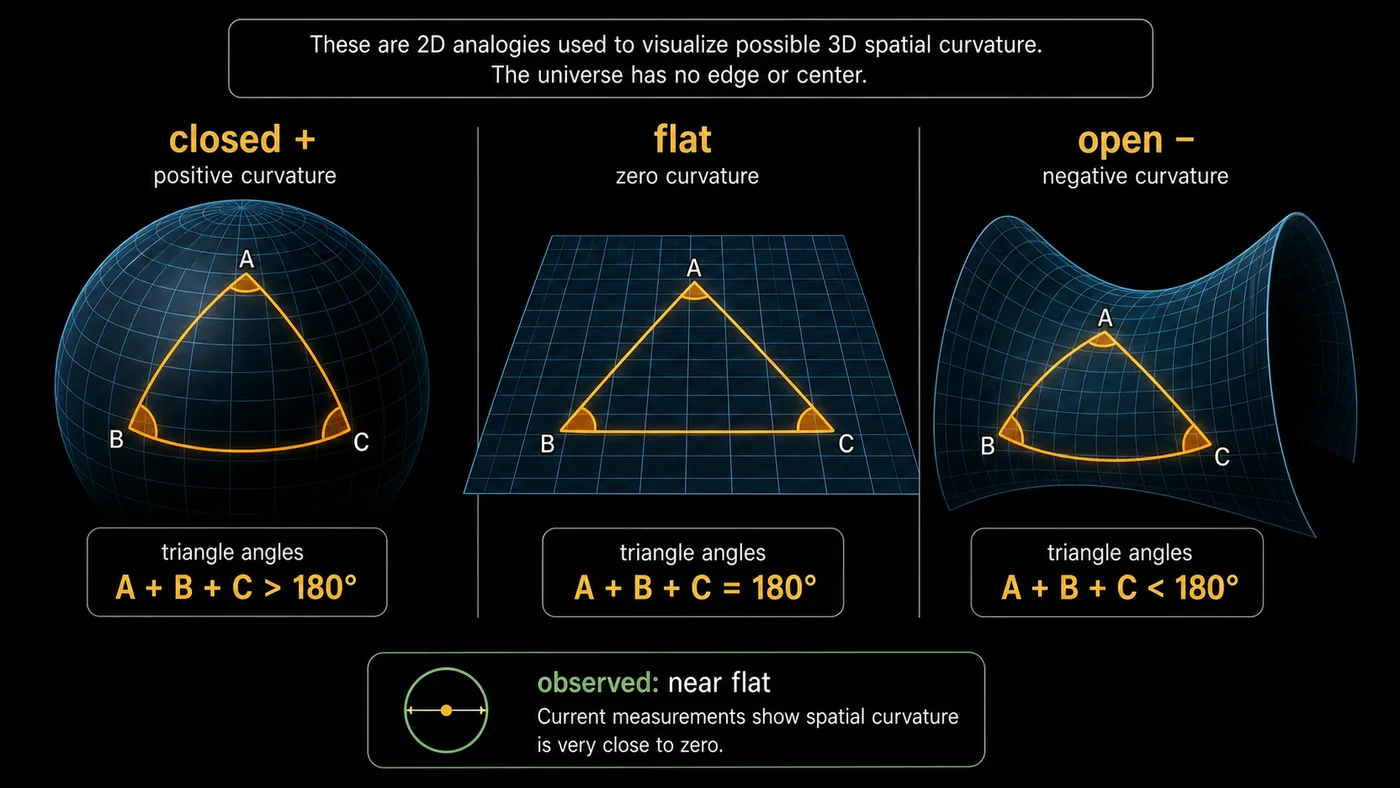
The Shape of Space
Does a triangle's angles add up to 180 degrees? The answer tells you the universe's geometry
The spatial curvature of the universe is described by the density parameter Ω_K. In a positively curved universe (spherical, Ω_K < 0), the angles of a triangle sum to more than 180 degrees. In a negatively curved universe (hyperbolic, Ω_K > 0), they sum to less. In a flat universe (Ω_K = 0), they sum to exactly 180 degrees as in Euclidean geometry. CMB measurements by the Planck satellite (2018) c
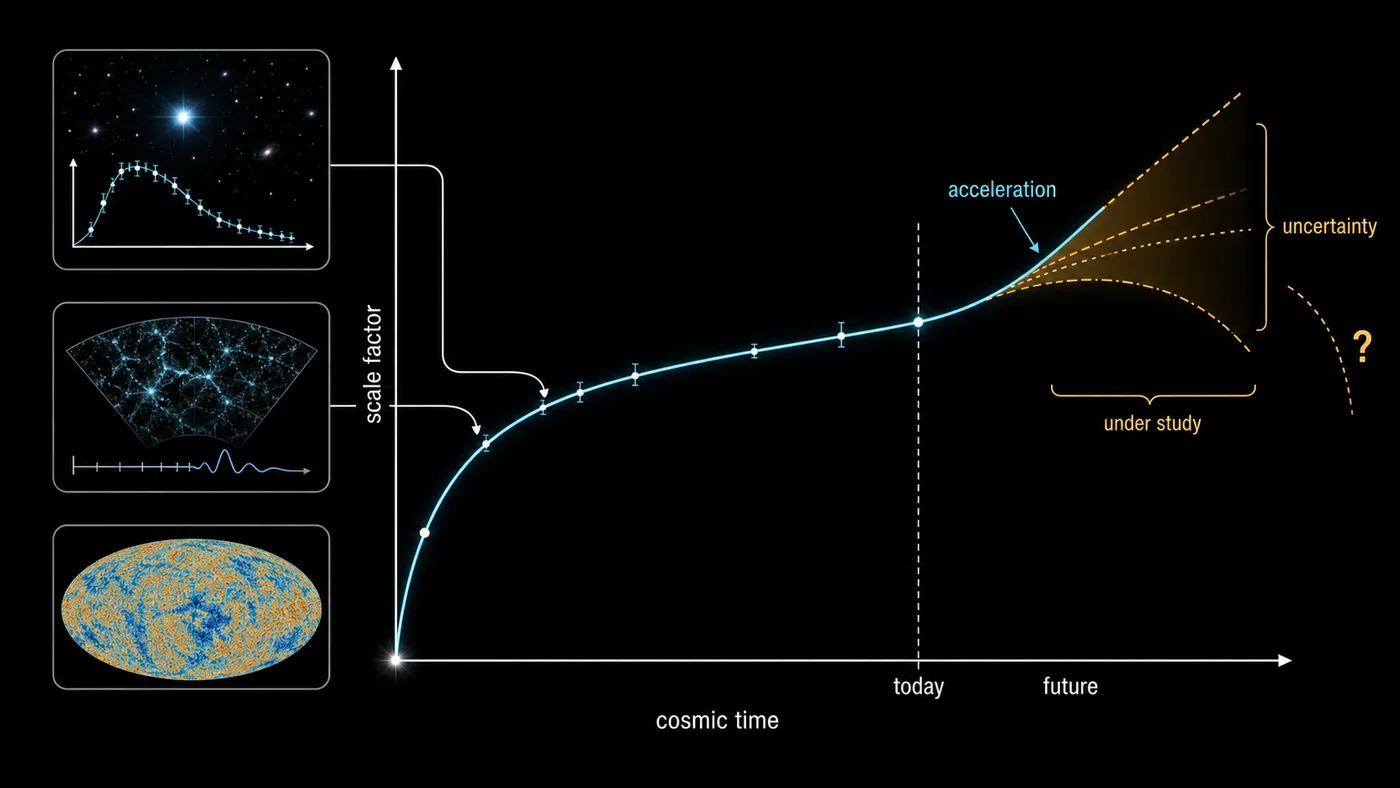
Dark Energy
In 1998, Type Ia supernovae showed the universe is not just expanding but accelerating. Something is pushing.
In 1998, two independent teams (the Supernova Cosmology Project led by Perlmutter, and the High-Z Supernova Search Team led by Schmidt and Riess) used Type Ia supernovae as standard candles to measure cosmic distances and found that distant supernovae were dimmer than expected, meaning the universe's expansion is accelerating. This discovery earned the 2011 Nobel Prize in Physics. The cause is du
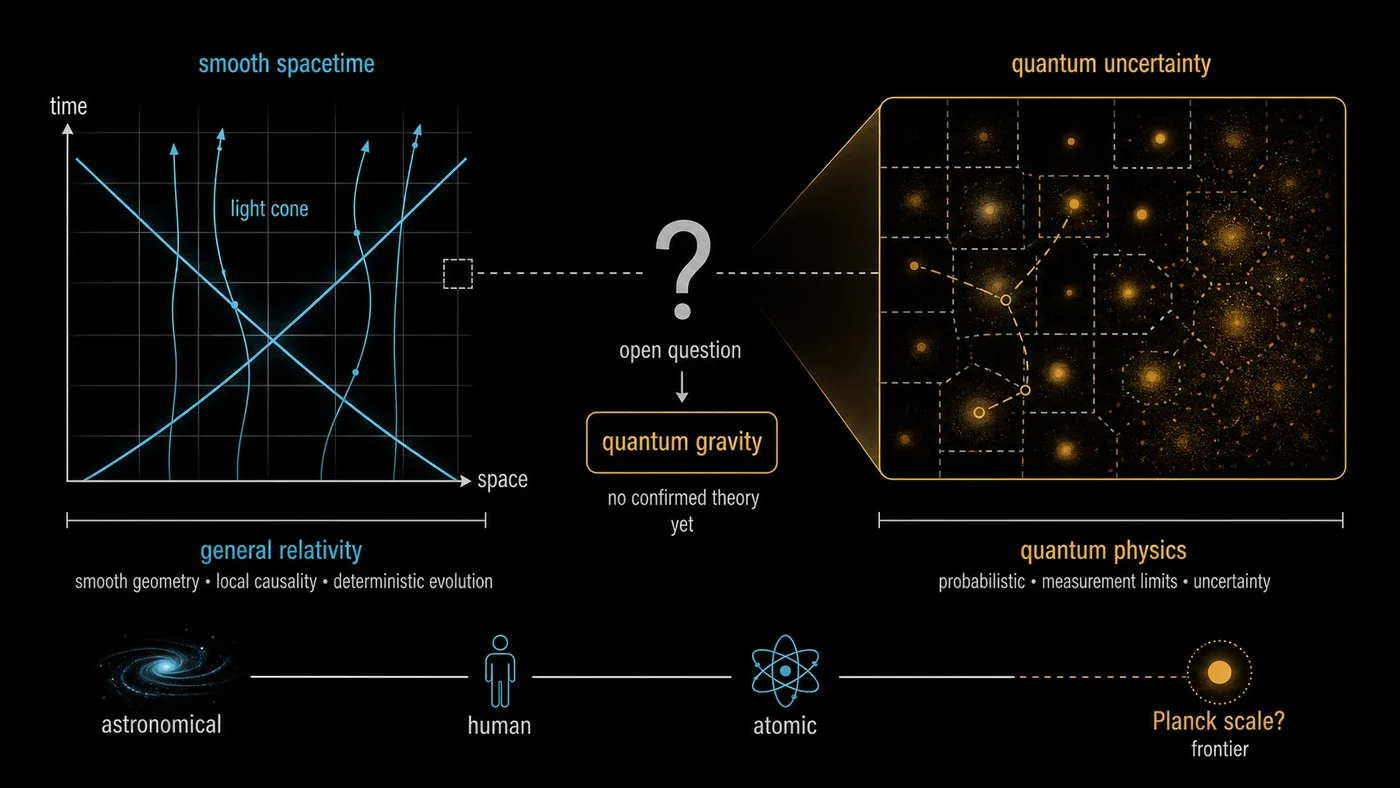
Quantum Gravity
At 10⁻³⁵ meters and 10⁻⁴³ seconds, the two great theories of physics collide, and neither survives intact
General relativity describes gravity as the curvature of spacetime at large scales (a continuous, classical field). Quantum mechanics governs the behavior of matter at small scales (probabilistic, quantized, discrete). The two theories are extraordinarily successful in their respective domains, but they are fundamentally incompatible. Applying quantum field theory to spacetime curvature leads to n
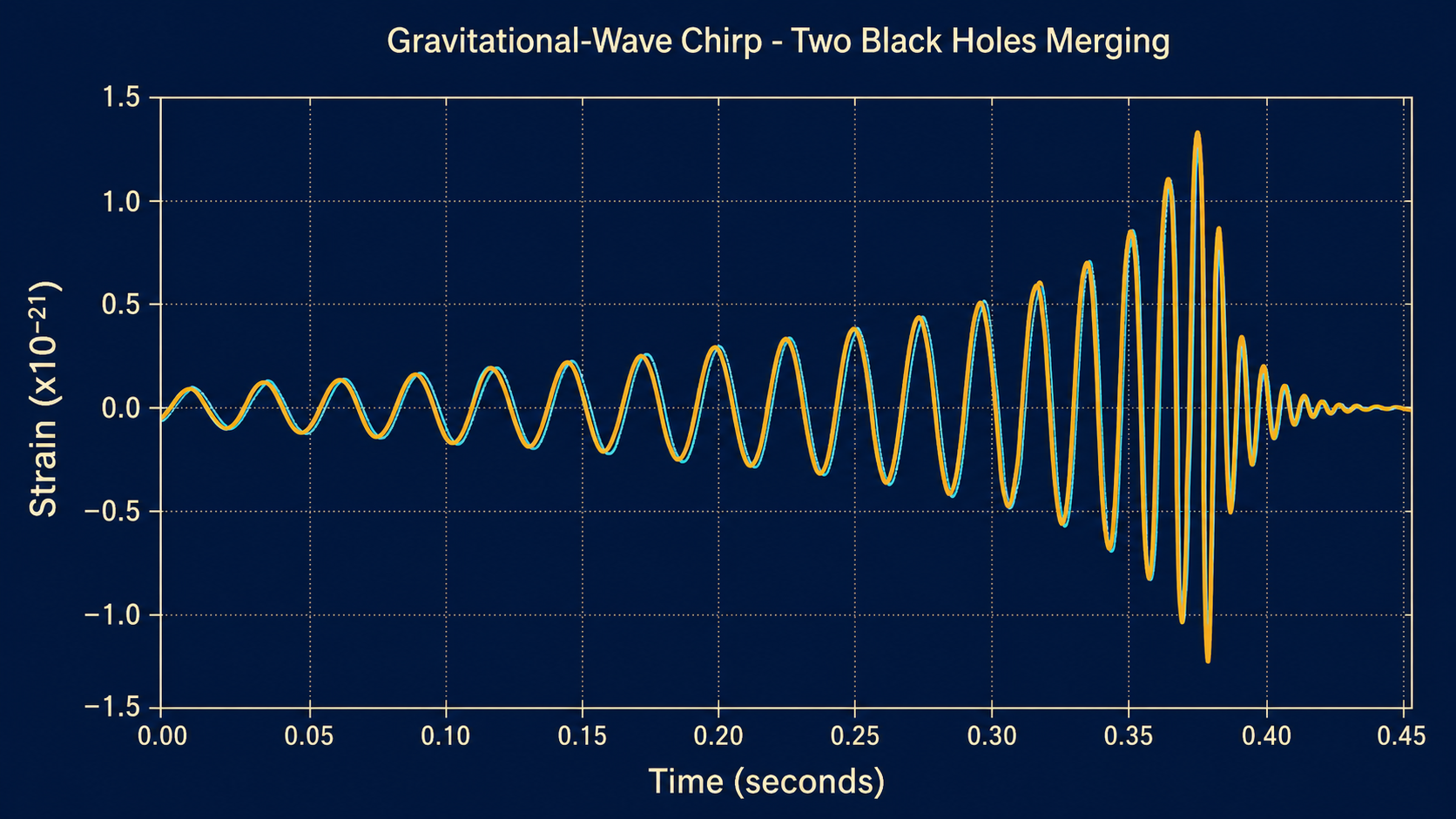
Gravitational-wave chirp (illustration)
Illustration of a LIGO-style strain-vs-time chirp, the signal of two black holes spiralling in and merging.
Educational illustration of a gravitational-wave chirp waveform in the style of the 2015 LIGO GW150914 detection: strain oscillations that start small and slow, then sweep up in amplitude and frequency to the merger before ringing down. Rendered as a clean diagram, not a reproduction of the published LIGO data.
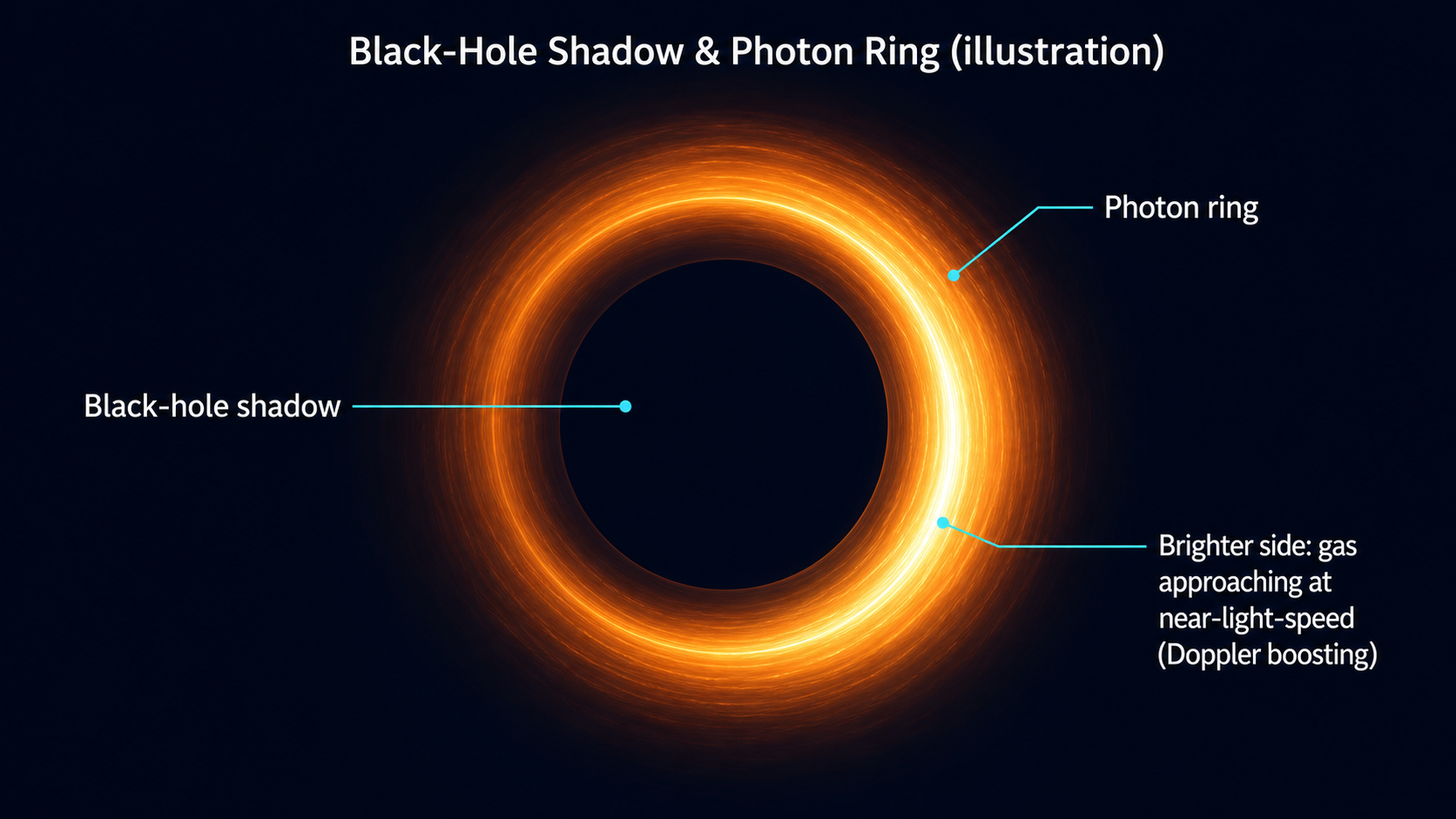
Black-hole shadow & photon ring (illustration)
Illustration of a black-hole shadow ringed by a bright photon ring, styled after Event Horizon Telescope images, not a real photograph.
Educational illustration of a black hole: a bright glowing photon ring of orbiting plasma around a dark central shadow, with one side brighter to show Doppler boosting from gas approaching at near-light-speed. Styled after the Event Horizon Telescope M87*/Sagittarius A* images but rendered as an explanatory diagram, not a captured photograph.
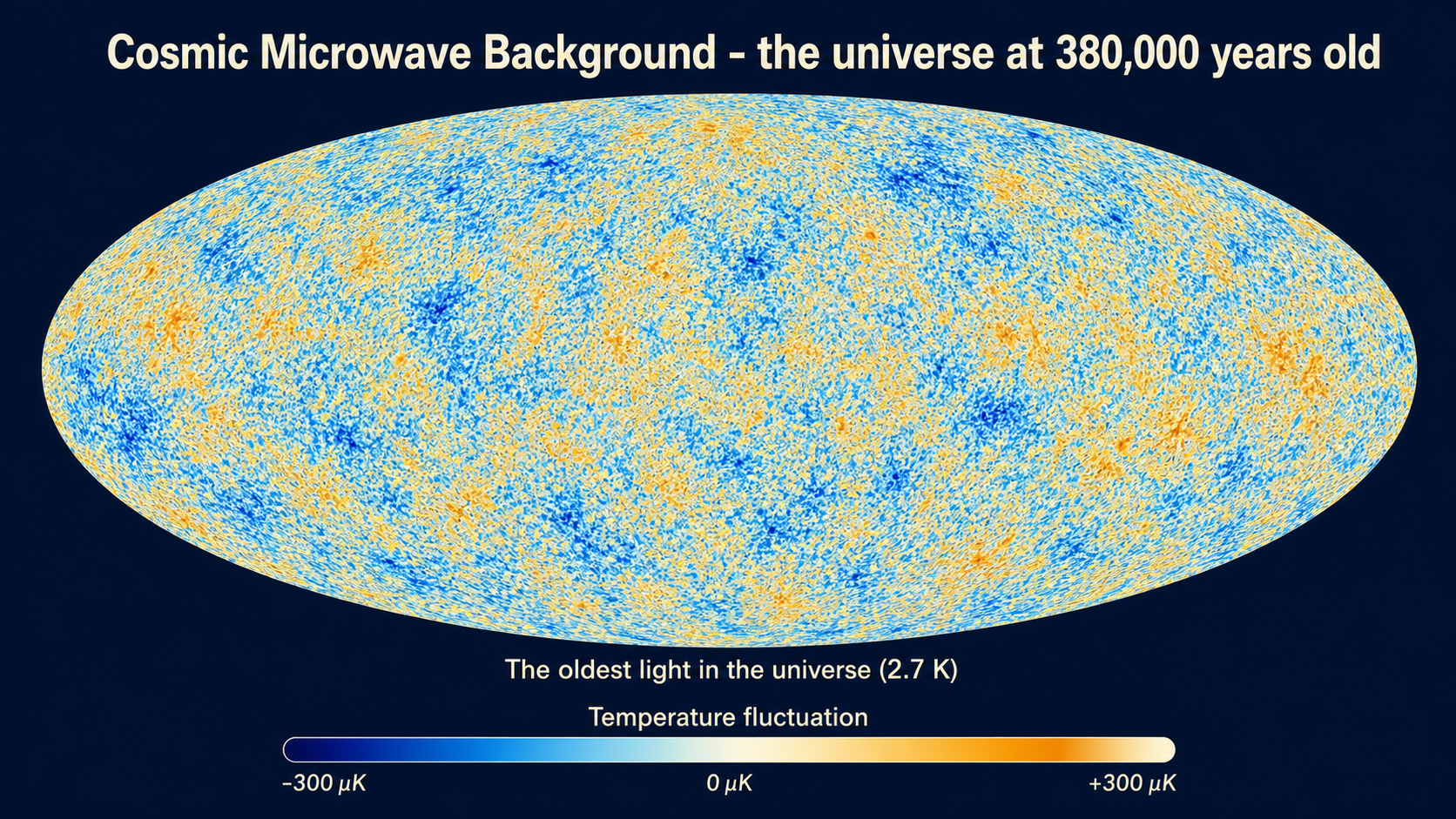
Cosmic microwave background all-sky map (illustration)
Planck-style all-sky map of the oldest light, tiny temperature ripples in the 2.7 K afterglow of the Big Bang.
Educational illustration of the cosmic microwave background in the Planck-satellite Mollweide all-sky style: a fine speckled pattern of temperature fluctuations (about 1 part in 100,000) across the whole sky, cooler regions in blue and warmer regions in orange and cream, labelled as the universe at 380,000 years old at 2.7 Kelvin. Rendered as a diagram, not the published Planck data map.